Understanding Consumer Behavior: A Marketer's 2026 Guide


TL;DR:
- Most consumer decisions occur below conscious awareness, driven primarily by emotion, memory, and psychological shortcuts.
- Marketers must tailor messages to each stage of the decision process, acknowledging the nonlinear and subconscious nature of buying behaviors.
Most marketers assume they know why people buy. They're wrong. 95% of purchase decisions happen below conscious awareness, driven by emotion, memory, and psychological shortcuts that no demographic spreadsheet can capture. Understanding consumer behavior means getting underneath the surface logic customers tell themselves and identifying what actually moves them. This guide breaks down the psychology, the decision process, the trends reshaping buying habits in 2026, and the practical strategies that translate all of it into campaigns that convert.
Table of Contents
- Key takeaways
- Understanding consumer behavior: the psychology behind every purchase
- The consumer decision-making process
- Trends reshaping consumer behavior in 2026
- Applying consumer behavior analysis to your campaigns
- My honest take on where most marketers still get this wrong
- Put these insights to work with Babylovegrowth
- FAQ
Key takeaways
| Point | Details |
|---|---|
| Decisions are mostly subconscious | About 95% of consumer choices happen below awareness, making emotional triggers more powerful than rational arguments. |
| Five stages, five mindsets | Each stage of the decision journey requires distinct messaging, not a single campaign pushed across all touchpoints. |
| AI is changing product discovery | One in four U.S. consumers now uses AI tools to research and discover products, reshaping where and how marketers must show up. |
| Loss framing outperforms gain framing | Promotions built around what consumers might lose convert better than equivalent messages about what they might gain. |
| Behavioral data beats surveys | Self-reported preferences regularly diverge from actual behavior, making real-time behavioral data far more reliable for targeting. |
Understanding consumer behavior: the psychology behind every purchase
The starting point for any serious consumer behavior analysis is psychology. Not personality types or broad generational labels. The actual cognitive and emotional mechanisms that shape perception, preference, and choice.
Perception shapes reality before facts do
Consumers do not experience your brand objectively. They filter every message through prior associations, current mood, and contextual cues. A product positioned next to premium competitors feels more valuable. A sale price framed as "limited stock" triggers urgency that a simple discount does not. Perception is the first lever, and marketers who ignore it spend budget overcoming resistance they created themselves.

Motivation, memory, and emotional triggers
Emotional connectivity produces more than twice the business value of rational satisfaction alone. That is not a soft finding. It means your messaging about features and specifications is doing roughly half the work of messaging that makes someone feel understood, safe, or aspirational.Memory plays an equally underestimated role. Consumers recall brands associated with strong emotional moments far longer than those associated with clever copy. This is why experiential campaigns and visual storytelling outlast feature announcements in brand recall.
Psychological levers that reduce decision friction
Six well-documented principles shape how consumers respond to choice. Social proof, scarcity, and reciprocity are among the most potent, not because they manipulate, but because they resolve uncertainty. When a consumer is unsure, they look for signals. Reviews, low-stock notices, and free samples each provide a signal that makes the next step feel obvious rather than risky.
- Social proof: 91% of consumers read online reviews, and 82% trust them as much as a recommendation from a friend.
- Scarcity: Limited availability shifts the mental framing from "should I buy this?" to "can I still get this?"
- Reciprocity: A free resource or sample creates a psychological obligation that meaningfully increases purchase likelihood.
- Loss aversion: People respond more strongly to avoiding a loss than gaining an equivalent benefit of the same size.
Pro Tip: When writing promotional copy, test two versions: one that highlights what the customer gains and one that frames what they risk missing. Loss-framed messaging often yields higher conversions across most product categories.
The consumer decision-making process
Knowing that decisions are emotional is useful. Knowing where in the decision journey to deploy which type of message is what separates average campaigns from exceptional ones. The five-stage decision process is the framework that makes this precision possible.
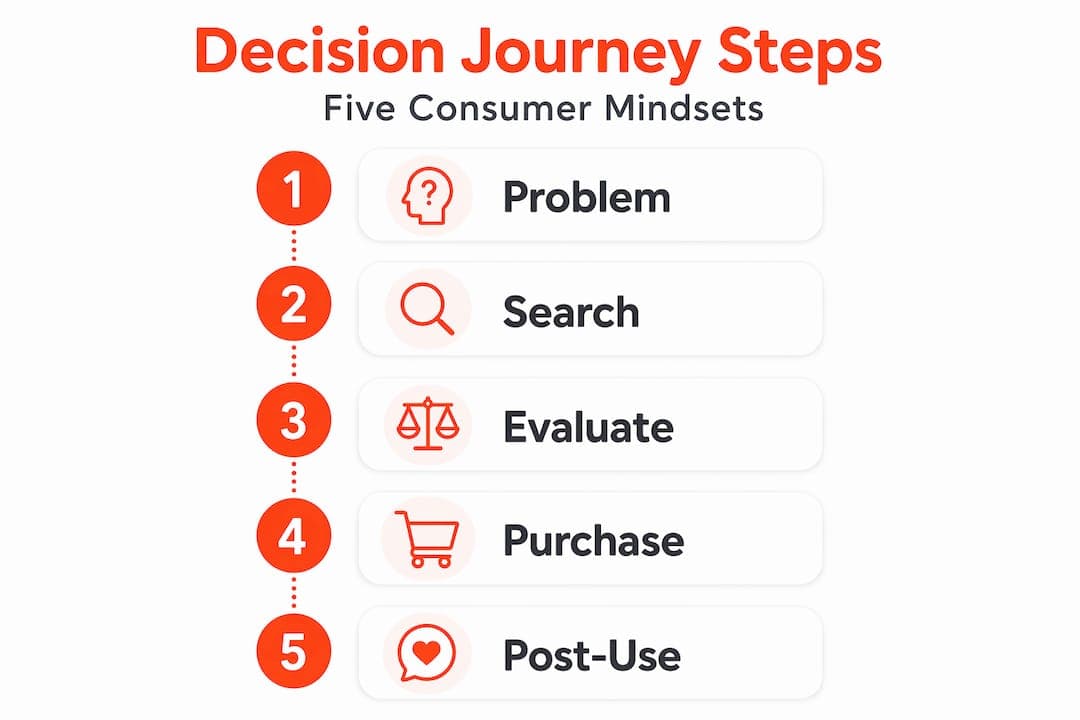
| Stage | Consumer mindset | What marketers should do |
|---|---|---|
| Problem recognition | "Something isn't working" or "I want something better" | Surface the pain or aspiration through content and ads before the consumer even starts searching |
| Information search | "What are my options?" | Dominate search, review sites, and AI discovery platforms with credible, detailed content |
| Evaluation of alternatives | "Which option fits me best?" | Provide comparison content, testimonials, and specific differentiation that matches buyer criteria |
| Purchase decision | "I'm ready, but am I making the right call?" | Reduce friction with clear guarantees, return policies, and scarcity signals |
| Post-purchase evaluation | "Did I make the right choice?" | Confirm the decision with onboarding content, loyalty programs, and proactive support |
Each stage represents a distinct mindset, and blasting the same message across all five wastes spend and creates mismatched expectations. A consumer in the evaluation stage does not need brand awareness content. They need specifics that help them justify the choice they are already leaning toward.
One important caveat: real consumer journeys are rarely linear. Shoppers loop back to information search after encountering a negative review mid-funnel. Habitual buyers skip stages entirely, jumping from recognition straight to purchase. Understanding these shortcuts and detours lets you deploy retention and re-engagement tactics at the right moment rather than assuming a tidy progression.
Trends reshaping consumer behavior in 2026
Consumer behavior analysis cannot be static. The external conditions shaping how and why people buy shift constantly, and 2026 has brought several changes that marketers need to account for now.
Financial pressure is rewriting spending priorities. 27% of beauty consumers plan to keep their preferred brands but switch to cheaper retailers. 43% have simplified their routines. In markets like India, 73% of consumers expect prices to keep rising, and frugality indexes are at record levels. The implication for marketers is direct: value messaging and flexible pricing structures are no longer optional in most categories.
Subscription fatigue is real and measurable. Subscription counts have declined 15 to 20% since late 2023. Consumers are auditing their recurring commitments and cutting anything that does not deliver clear, regular value. If your product or service runs on a subscription model, the burden of proof for continued relevance has increased significantly.
AI is now a discovery channel. 25% of U.S. consumers already use AI tools to research products and make purchase decisions in 2026. This is not a future consideration. It is current consumer behavior that requires your content to be structured for AI comprehension, not just Google indexing. Marketers who understand how AI transforms product discovery are already building content architectures optimized for this shift.
Behavioral signals predict shifts early. Research shows that language and sentiment analysis can surface macro consumer behavior changes 12 to 18 months before they show up in sales data. Brands that track the words consumers use in reviews, social posts, and search queries can position their messaging ahead of competitors who wait for the trend reports.
Applying consumer behavior analysis to your campaigns
Knowing the theory matters. Translating it into campaigns that reach real people and produce measurable results is the actual goal. Here is how to apply consumer psychology insights systematically.
-
Segment by psychology, not just demographics. Two 35-year-old women with identical income and zip codes can have radically different purchasing drivers. Cognitive and emotional segmentation based on motivations, values, and decision styles produces more precise targeting than age brackets alone. Survey data is useful for starting hypotheses, but behavioral data from actual clicks, watches, and purchases should validate or override it.
-
Match message to decision stage. Map your current content assets to each of the five stages. Most brands discover they are heavily weighted toward awareness and purchase content with almost nothing designed for the evaluation stage, where many decisions are actually made or abandoned.
-
Use loss framing strategically. "Don't miss your renewal discount" outperforms "Get 20% off renewal" in most tested email subject lines. Reframe your strongest offers around what the customer risks losing by waiting.
-
Treat post-purchase as a marketing phase, not a support problem. Buyers in the post-purchase evaluation stage are highly receptive to reassurance content that confirms they made the smart choice. Brand loyalty built through AI-driven content during this window produces repeat purchases and referrals at a fraction of acquisition costs.
-
Close the gap between stated and actual behavior. Traditional surveys carry significant bias. Consumers say they prioritize sustainability, then buy based on price. They claim brand loyalty, then switch for a 10% discount. Behavioral simulation tools and biometric research methods yield a more accurate picture of how consumers make decisions under real conditions.
Pro Tip: Build a simple decision-stage content audit quarterly. List every piece of content you publish and assign it a stage. If you have fewer than 20% of assets targeting the evaluation stage, that is where your funnel is leaking.
My honest take on where most marketers still get this wrong
I have reviewed hundreds of marketing strategies over the years, and the single most common failure is not the absence of data. It is the interpretation of data through the wrong lens. Marketers will pull demographic reports, build personas with names and coffee preferences, and still miss the actual psychological driver behind purchase behavior in their category.
The discomfort I see most often is with subconscious influence. Acknowledging that your customers are not making purely rational choices feels, to some marketers, like manipulation. It is not. Applying psychological principles of influence ethically means reducing the stress of decision-making for people who genuinely want what you offer. That framing matters, both for the campaigns you build and the internal conversations you have when justifying creative decisions.
What actually changed my thinking was watching live behavioral research. Consumers said one thing and clicked another. Every time. The gap between what people report and what they do is not a research methodology problem. It is human nature. The marketers who accept this and build strategies on behavioral signals rather than self-reported preferences are the ones consistently outperforming their categories. I have stopped treating surveys as ground truth and started treating them as hypotheses that behavioral data either confirms or contradicts.
— Tilen
Put these insights to work with Babylovegrowth
Understanding your consumers is only half the equation. The other half is publishing content that reaches them at the right stage of their journey, at scale, without burning your team's bandwidth.
Babylovegrowth is built precisely for this. The platform's organic traffic tool uses data-driven insights to identify where your audience is searching and what content will capture them at each stage of their decision process. Its automated publishing system deploys content consistently across channels, aligned to the behavioral patterns your audience actually follows. Add the SEO link building platform to strengthen your presence in the research spaces where consumers form preferences, and you have a full-funnel system grounded in consumer behavior analysis. Try Babylovegrowth free and see how behavioral insights translate directly into organic growth.
FAQ
What does understanding consumer behavior actually mean?
Understanding consumer behavior means analyzing how and why people make purchasing decisions, including the psychological, social, and emotional forces that shape their choices. Most of these forces operate below conscious awareness.
What are the biggest factors influencing consumer choices?
Emotion, memory, social proof, perceived value, and situational context are among the most consistent drivers. Demographics matter far less than the psychological state a consumer is in at the moment of decision.
How do consumers make decisions across five stages?
Consumers move through problem recognition, information search, evaluation of alternatives, purchase decision, and post-purchase evaluation. The path is rarely linear, and each stage requires different messaging and content types from marketers.
How is AI changing consumer behavior in 2026?
25% of U.S. consumers now use AI tools for product research and discovery. This makes AI-optimized content a frontline marketing requirement, not a future consideration, for brands that want to be found during the research phase.
How can marketers use behavioral data more effectively?
Replace reliance on self-reported survey data with behavioral signals such as click patterns, content engagement, and purchase sequences. These reveal actual decision-making patterns rather than what consumers think or say they prefer.