Technical SEO: Boosting Search Visibility With Precision


Struggling with slow crawl rates or unexplained ranking drops can leave even seasoned SEO professionals searching for answers. Mastering technical SEO is more than ticking boxes on a checklist—it means fine tuning the very backbone of your website so search engines can efficiently crawl, index, and rank your pages. By clarifying the core principles and clearing up common misconceptions, you can transform your e-commerce site into a strong, high-performing contender in organic search results.
Table of Contents
- Technical SEO Defined And Common Misconceptions
- Core Elements Of Technical SEO Success
- Site Speed, Crawlability, And Indexing Essentials
- Automation, AI Tools, And Real-World Applications
- Common Technical SEO Pitfalls To Avoid
Key Takeaways
| Point | Details |
|---|---|
| Understanding Technical SEO | It focuses on enhancing a website's backend performance, influencing how search engines crawl and rank content. |
| Importance of Regular Audits | Conducting quarterly technical SEO audits is vital to identify and fix performance issues that could harm search visibility. |
| Common Misconceptions | Many believe technical SEO is a one-time task or secondary to content quality, but it is crucial for optimal user experience and rankings. |
| Utilizing AI Tools | Implement AI-powered tools for automated site analysis and error detection to improve efficiency and accuracy in technical SEO efforts. |
Technical SEO Defined And Common Misconceptions
Technical Search Engine Optimization represents a specialized approach focused on improving a website's backend infrastructure to enhance search engine performance. Unlike content or link-building strategies, technical SEO concentrates on optimizing the foundational elements that determine how search engines crawl, understand, and rank web pages.
At its core, technical SEO involves several critical components that directly impact search visibility:
- Website speed and performance optimization
- Mobile responsiveness and device compatibility
- Structured data markup implementation
- Secure server configurations
- Efficient crawling and indexing mechanisms
- Minimizing server response times
Many digital marketing professionals misunderstand technical SEO, often conflating it with content creation or link acquisition. search engine optimization techniques require a nuanced understanding that goes beyond surface-level tactics. Technical SEO operates as the fundamental framework that supports all other optimization efforts, ensuring search engines can effectively discover, interpret, and prioritize website content.
The misconception that technical SEO is purely a backend concern overlooks its profound impact on user experience and search rankings. Modern search algorithms increasingly prioritize websites with robust technical foundations, meaning elements like page load speed, mobile compatibility, and server health directly influence organic visibility.
Common Technical SEO Misunderstandings:
- Believing technical optimization is a one-time task
- Assuming content quality matters more than technical infrastructure
- Overlooking mobile performance requirements
- Neglecting website security protocols
- Ignoring crawl efficiency and indexing challenges
Pro tip: Conduct a comprehensive technical SEO audit quarterly to identify and address potential performance bottlenecks before they impact your search rankings.
Here's a comparison of technical SEO audits and manual checks for maintaining site health:
| Method | Frequency | Strengths | Limitations |
|---|---|---|---|
| Technical SEO Audit | Quarterly | Comprehensive issue detection | May miss urgent, emerging problems |
| Manual Checkups | Ongoing/As needed | Real-time observation of specific site sections | Time-consuming for large websites |
| Automated Tool Alerts | Continuous | Immediate notification of critical errors | Can produce false positives |
| Scheduled Reviews | Monthly | Uncovers trends and recurring issues | Relies on consistent execution |
Core Elements Of Technical SEO Success
Technical Search Engine Optimization encompasses a comprehensive set of strategies designed to enhance a website's backend infrastructure and search engine performance. Technical SEO core elements are critical for ensuring search engines can effectively discover, understand, and rank web content with precision and efficiency.
The fundamental components of technical SEO success include multiple interconnected technical aspects that directly influence search visibility:
- Website crawlability and indexing efficiency
- Page loading speed and performance optimization
- Mobile responsiveness and device compatibility
- Secure HTTPS connections
- Clean and logical website architecture
- Structured data markup implementation
- XML sitemap and robots.txt configuration
Search engines rely on sophisticated algorithms that evaluate websites based on their technical foundation. Websites with robust technical infrastructure receive preferential treatment, as they demonstrate reliability, security, and user-friendly design. This means that even exceptional content can be overlooked if the underlying technical framework is poorly constructed.
Website Performance Ranking Factors:
- Page load speed under 3 seconds
- Mobile-first indexing compatibility
- Secure SSL/HTTPS protocols
- Minimal server response times
- Efficient content delivery networks
Pro tip: Implement a quarterly technical SEO audit to systematically identify and resolve potential performance bottlenecks that could negatively impact search rankings.
Site Speed, Crawlability, And Indexing Essentials
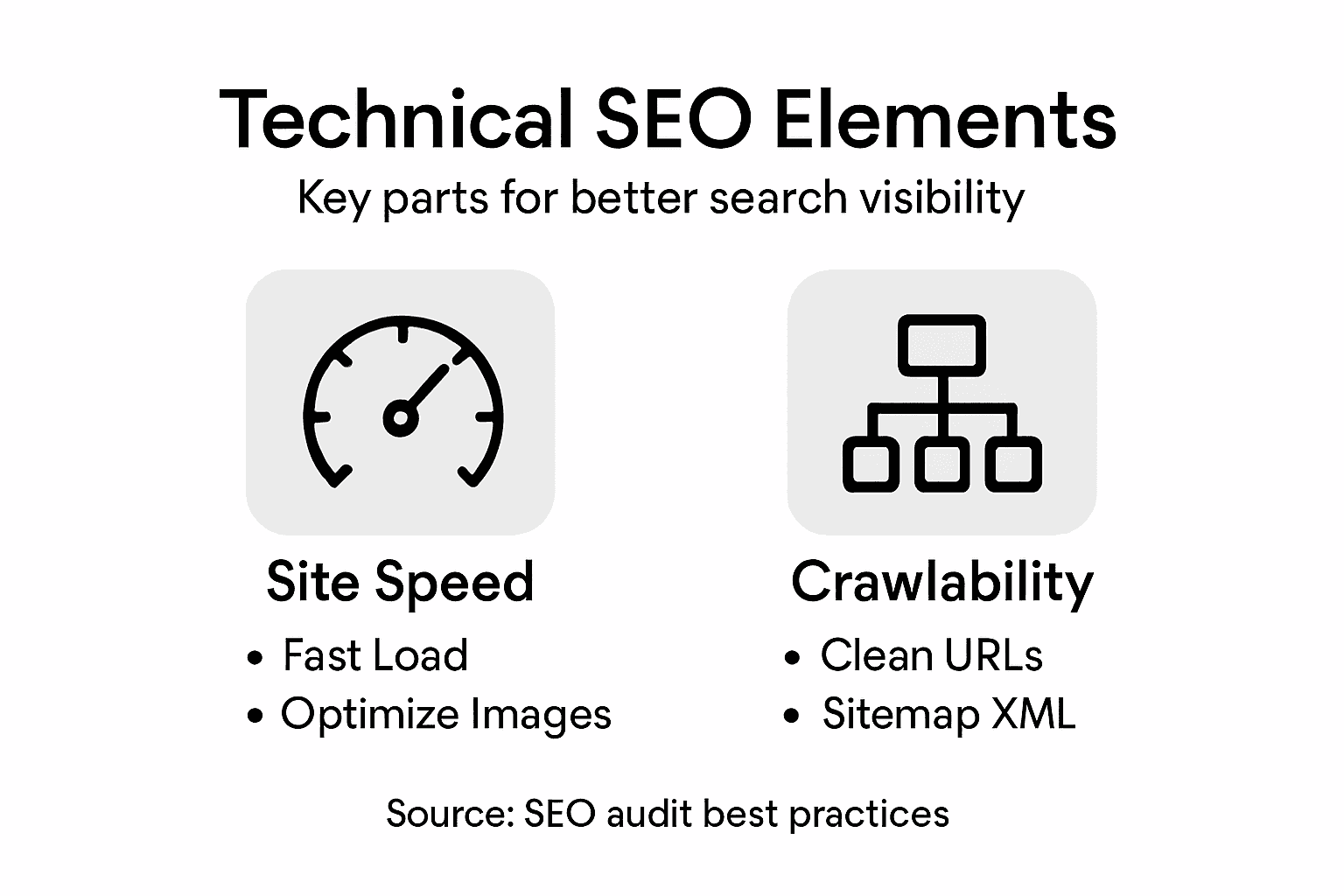
Technical SEO requires a deep understanding of three critical interconnected elements: site speed, crawlability, and indexing. Technical SEO optimization strategies are fundamental for ensuring search engines can effectively discover, understand, and rank website content.
The core components of this technical optimization process include:
- Reducing page load times
- Creating clean, logical site architecture
- Implementing efficient crawl pathways
- Minimizing server response times
- Ensuring mobile responsiveness
- Developing comprehensive XML sitemaps
- Configuring robots.txt for precise bot access
Website crawlability determines how search engine bots navigate and understand your site's structure. Think of it like a roadmap that guides search engine algorithms through your digital content landscape. When your website has clear, logical pathways, search engines can more efficiently index your pages, ultimately improving your organic search visibility.
Key Crawlability and Indexing Factors:
- Minimal broken internal links
- Clear hierarchical site structure
- Fast server response times
- Comprehensive XML sitemap
- Strategic robots.txt configuration
Pro tip: Conduct monthly technical audits to identify and resolve crawlability issues that might prevent search engines from fully understanding your website's content.

Automation, AI Tools, And Real-World Applications
Artificial Intelligence is revolutionizing technical SEO by transforming complex optimization processes into streamlined, intelligent workflows. AI tools for research enable digital marketers to automate tedious tasks, analyze massive datasets, and generate strategic insights with unprecedented speed and accuracy.
Key AI-powered automation capabilities for technical SEO include:
- Automated site crawling and performance analysis
- Intelligent content gap identification
- Real-time keyword and ranking tracking
- Automated technical error detection
- Predictive optimization recommendations
- Competitor technical infrastructure analysis
- Scalable content generation and optimization
These advanced technologies go beyond traditional manual SEO approaches by providing dynamic, data-driven solutions that adapt in real time. Machine learning algorithms can now predict potential optimization opportunities, identify technical barriers, and recommend precise interventions that would be impossible through manual review.
Strategic AI Automation Advantages:
- Faster performance diagnostics
- More comprehensive analysis
- Reduced human error
- Continuous optimization
- Scalable insights generation
Pro tip: Implement AI-powered technical SEO tools that offer comprehensive auditing and automated recommendations to systematically improve your website's search engine performance.
Below is a reference table summarizing how automation and AI enhance technical SEO tasks:
| SEO Task | Manual Approach | AI/Automation Approach |
|---|---|---|
| Site Crawling | Step-by-step, tool-assisted | Automated, rapid full-site scans |
| Error Detection | Manual review of reports | Instant detection and notification |
| Content Optimization | Manual edits and benchmarking | Automated suggestions and fixes |
| Performance Analysis | Spreadsheet-based tracking | Live dashboards and predictive insights |
Common Technical SEO Pitfalls To Avoid
Technical SEO strategies require meticulous attention to detail to prevent performance-limiting mistakes. Common technical SEO pitfalls can dramatically undermine a website's search engine visibility and user experience if not carefully managed.
The most critical technical SEO errors that digital marketers and website owners must proactively address include:
- Improper robots.txt configuration
- Slow page loading speeds
- Ineffective mobile responsiveness
- Duplicate content issues
- Broken internal linking structures
- Incorrect meta tag implementations
- Neglecting website security protocols
- Poor URL structure and canonicalization
Many website owners unknowingly sabotage their search rankings by overlooking seemingly minor technical details. Search engine algorithms have become increasingly sophisticated, penalizing websites with suboptimal technical infrastructures. Understanding these potential pitfalls allows businesses to develop more robust and search-friendly digital platforms.
Top Technical SEO Mistakes to Prevent:
- Blocking essential crawl resources
- Ignoring mobile page performance
- Failing to implement secure connections
- Creating complex, non-intuitive site architectures
- Neglecting regular technical audits
Pro tip: Conduct comprehensive technical SEO audits quarterly and immediately address any identified issues to maintain optimal search engine performance.
Supercharge Your Technical SEO with AI-Powered Automation
Navigating the complexities of technical SEO can be overwhelming when you face challenges like slow site speed, crawlability issues, or inefficient indexing. This article highlights the critical pain points every website owner must address to improve search engine visibility and user experience. With growing demands for mobile responsiveness, secure HTTPS connections, and quarterly technical audits, it is clear that manual methods alone may not be enough to keep your site optimized and competitive.

Don't let technical pitfalls hold your brand back. Babylovegrowth.ai offers an all-in-one SaaS platform designed to tackle exactly these issues by combining AI automation with proven SEO strategies. From automated technical website auditing to seamless structured data markup and internal link building, this platform makes it easy to maintain a solid foundation for superior search rankings. Take control of your crawlability, speed, and indexing performance today by exploring how technical SEO automation can power your growth. Visit Babylovegrowth.ai now and transform your website into a search engine favorite.
Frequently Asked Questions
What is technical SEO?
Technical SEO is the process of optimizing the backend infrastructure of a website to enhance its performance in search engine rankings. This includes improving site speed, mobile responsiveness, structured data markup, and server configurations, among other factors.
How often should I conduct a technical SEO audit?
It is advisable to conduct a comprehensive technical SEO audit quarterly. This helps identify and resolve potential performance bottlenecks before they impact your search rankings.
Why is crawlability important for my website?
Crawlability refers to how easily search engine bots can navigate and index your website. A well-structured site allows search engines to efficiently discover and rank your content, significantly influencing your organic visibility.
What are common technical SEO mistakes to avoid?
Common mistakes include improper robots.txt configuration, slow page loading speeds, ineffective mobile responsiveness, duplicate content issues, and neglecting website security protocols. Addressing these issues is crucial for maintaining optimal search engine performance.