Strategic marketing planning: boost organic growth with AI


TL;DR:
- AI enhances marketing strategy by amplifying content output and ROI when integrated thoughtfully.
- Developing a clear strategic plan ensures AI tools support targeted growth and avoid wasted resources.
- Ongoing human oversight and regular updates are essential for effective hybrid marketing workflows.
AI-powered automation doesn't replace strategic thinking. It amplifies it. AI-driven automation boosts content output 3 to 4 times, SEO traffic by 40 to 300%, and engagement by 34% for businesses that use it intentionally. The mistake most small and medium business owners make is reaching for automation tools before they have a clear marketing strategy. This guide walks you through the complete planning process, shows you where AI fits in, gives you real benchmarks to measure progress, and helps you avoid the most common pitfalls that waste budget and time.
Table of Contents
- Understanding the strategic marketing planning process
- Integrating AI-driven automation with your marketing strategy
- Benchmarks and KPIs for measuring success
- Overcoming challenges and optimizing hybrid workflows
- What most businesses miss about strategic marketing and AI
- Accelerate your strategic marketing success with AI-driven tools
- Frequently asked questions
Key Takeaways
| Point | Details |
|---|---|
| Strategy first, tools second | Having a structured marketing plan amplifies the impact of AI and automation. |
| AI accelerates growth | Content, SEO, and engagement see 3-4x improvements when automation supports strategy. |
| Track the right KPIs | Leads, ROI, and CAC are critical measures of a successful AI-powered marketing plan. |
| Hybrid workflow wins | Combining AI with human oversight delivers quality, consistency, and brand authenticity. |
Understanding the strategic marketing planning process
Before you add any technology to your marketing stack, you need a foundation. Think of your marketing plan as a blueprint. Without it, even the best AI tools are just producing content for nobody in particular.
Strategic marketing planning for SMBs follows a structured sequence: define your mission, run a SWOT analysis (strengths, weaknesses, opportunities, threats), build customer personas, map the buyer journey, craft your value proposition, choose your marketing mix, create an action plan, and set up measurement systems. Each step informs the next, and skipping any of them creates gaps that show up later as wasted spend or stalled growth.Here's a numbered breakdown of the core planning steps and which AI tools accelerate each phase:
- Define your mission and goals — Clarify what you're growing toward and why. AI tools: ChatGPT for goal articulation, Google Looker for data context.
- Run a SWOT analysis — Map internal and external factors honestly. AI tools: AI-powered competitive research platforms.
- Build customer personas — Define who you're talking to, their pain points, and their habits. AI tools: audience segmentation tools, CRM analytics.
- Map the buyer journey — Identify touchpoints from awareness to purchase. AI tools: behavior analytics platforms.
- Set your marketing mix — Decide channels, messaging, and frequency. AI tools: content planning platforms like Babylovegrowth.ai.
- Build an action plan and content calendar — Schedule specific tasks, campaigns, and content. AI tools: automated scheduling and content cluster strategy tools.
- Define KPIs and measurement systems — Set clear metrics before you launch. AI tools: dashboards with automated reporting.
| Planning step | Key KPI to track | AI acceleration |
|---|---|---|
| Mission and goals | ROI, organic reach | Goal modeling tools |
| SWOT analysis | Market share data | Competitive AI research |
| Persona building | Lead quality score | CRM and segmentation AI |
| Content planning | Content output volume | Automated editorial calendars |
| Measurement setup | CAC, LTV, engagement rate | AI-powered analytics dashboards |
The SBA marketing guide recommends tracking leads per month, customer acquisition cost (CAC), lifetime value (LTV), and overall ROI as your baseline measurement set. These four numbers tell you whether your marketing engine is actually working.
Pro Tip: Don't try to build your entire marketing plan in one sitting. Draft the mission and SWOT first, then schedule separate sessions for personas and content planning. You'll make better decisions with fresh thinking.
Integrating AI-driven automation with your marketing strategy
Once your strategy is in place, automation becomes a powerful accelerator rather than a distraction. The key is knowing exactly where AI fits and where human judgment still matters most.

Here's a side-by-side comparison of traditional versus hybrid workflows:
| Factor | Traditional workflow | Hybrid (AI + human) workflow |
|---|---|---|
| Content output per month | 4 to 8 pieces | 16 to 30 pieces |
| Cost per piece | High (agency or in-house) | Significantly lower |
| Brand consistency | Depends on team | AI learns tone; human reviews |
| SEO optimization | Manual keyword research | Automated with human review |
| Turnaround time | Days to weeks | Hours to days |
The numbers back this up. AI boosts content output by up to 340% and delivers 3.2 to 3.7 times marketing ROI for SMBs, with 96% cost savings compared to fully human workflows. That's not a marginal improvement. That's a structural shift in how competitive small businesses can be.
Here's where automation adds the most value in a typical SMB workflow:
- Content drafts: AI generates first drafts for blog posts, email sequences, and social captions.
- SEO optimization: Keyword research, meta descriptions, and internal linking get handled automatically through an AI content marketing platform.
- Social scheduling: Posts are queued, timed, and distributed based on audience activity data.
- Performance reporting: Weekly summaries flag what's working and what needs adjustment.
- Content repurposing: A single article gets turned into LinkedIn posts, email snippets, and short video scripts.
Expanding into content automation for SEO is especially valuable for SMBs competing against larger brands with bigger content teams. Explore AI tools for SMBs to find the right stack for your specific business size and industry.
Pro Tip: Use AI for volume and speed, but always have a human review every piece for brand tone and E-E-A-T (Expertise, Experience, Authority, Trustworthiness) before publishing. Google rewards content that demonstrates real expertise, not just keyword density.
Benchmarks and KPIs for measuring success
Automating your content is only valuable if you can tell whether it's actually working. Setting the right KPIs before you launch gives you a clear scorecard.
The most relevant metrics for SMBs running hybrid marketing workflows include:
- Leads per month: How many qualified prospects are entering your funnel?
- Customer acquisition cost (CAC): What does it cost to convert one new customer?
- Lifetime value (LTV): How much revenue does a customer generate over the full relationship?
- Marketing ROI: Revenue generated divided by total marketing spend.
- Organic traffic share: What percentage of your site visits come from unpaid search?
- Engagement rate: Are people actually reading, sharing, and responding to your content?
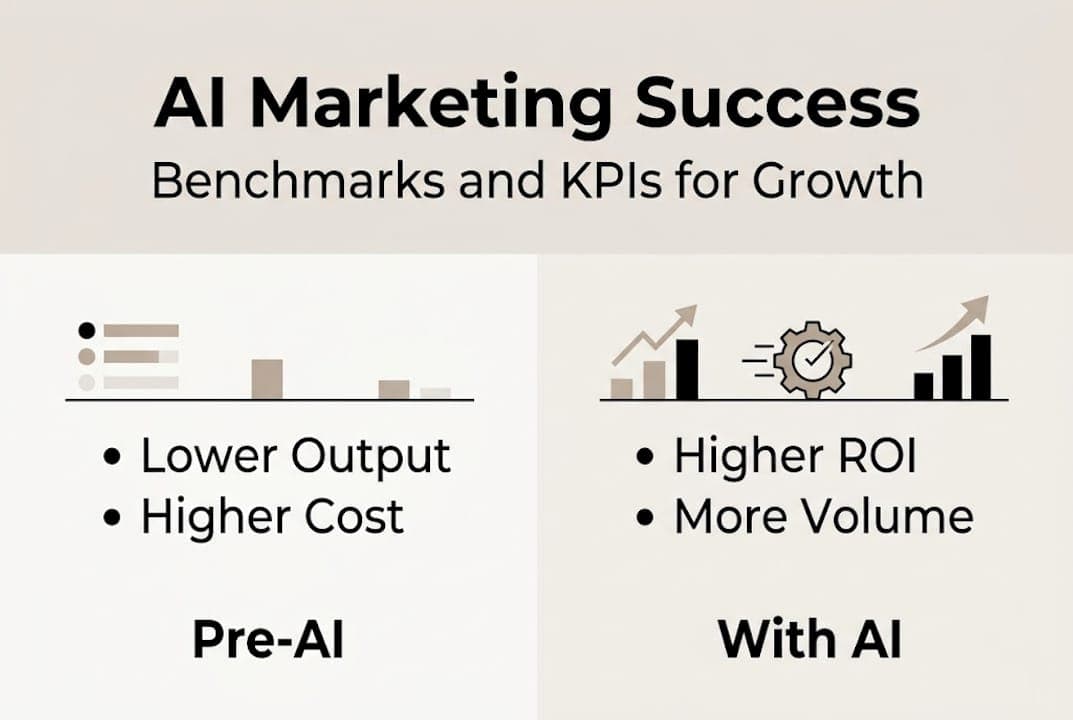
Empirical benchmarks from businesses that have adopted AI content marketing show a 3.2 to 3.7 times average ROI, a 340% increase in content output, a 30% reduction in CAC, and a breakeven point reached in just 2 to 4 months. Those numbers change the conversation about what's realistic for an SMB with a lean team.
Here's what the before-and-after typically looks like:
| KPI | Pre-AI baseline | Post-AI benchmark |
|---|---|---|
| Content pieces per month | 4 to 8 | 20 to 30 |
| Cost per content piece | $300 to $800 | $30 to $150 |
| Marketing ROI | 1x to 1.5x | 3.2x to 3.7x |
| CAC | Baseline | 30% lower |
| Organic traffic growth | 5 to 10% monthly | 40 to 300% over 6 months |
| Time to content breakeven | 6 to 12 months | 2 to 4 months |
A structured content calendar for AI SEO keeps your output consistent and aligned with keyword targets. Pair that with an AI-powered content workflow and you cut research time by up to 60%, which directly improves your cost-per-piece metric.
Look at marketing strategies data to calibrate your benchmarks against industry averages so you're setting targets that are ambitious but grounded in reality.
Key stat: A 340% increase in content output doesn't just mean more articles. It means more entry points for organic search, more social touchpoints, and more chances to build authority with your target audience.
Overcoming challenges and optimizing hybrid workflows
Even the best-designed hybrid marketing system runs into problems. The teams that thrive long-term are the ones that anticipate these issues before they become expensive mistakes.
The most common failure modes in AI-assisted marketing look like this:
- Over-automation: Removing human judgment entirely, leading to off-brand or factually incorrect content.
- Generic output: AI trained on too little brand-specific data produces content that sounds like everyone else in your industry.
- No review process: Publishing AI drafts without editing removes the quality control that protects your brand reputation.
- Compliance gaps: In regulated industries (finance, healthcare, legal), AI-generated content often misses required disclosures or uses language that creates liability.
- Stale strategy inputs: If you feed outdated persona data or old keyword research into AI tools, the output is optimized for a market that no longer exists.
AI in complex scenarios requires human oversight and specific brand training, especially in regulated industries where generic AI content carries real legal and reputational risk. Over-reliance on automation without strategic review is the most common reason SMBs see disappointing results.
The fix isn't doing less with AI. It's building a smarter review process around it. Use AI social media management tools to handle distribution, but keep a human in the loop for anything customer-facing or compliance-sensitive.
When it comes to brand building with AI and maintaining brand loyalty with AI, consistency and quality control matter more than volume alone.
Important benchmark: Revision rates drop from 41% to 18% when human oversight is built into the AI content workflow from the start, not added as an afterthought.
Pro Tip: Set a quarterly review of your marketing plan and AI tool settings. Retrain your tools on updated brand voice guidelines, new customer insights, and current keyword data every three months. Markets shift, and your AI inputs need to keep pace.
What most businesses miss about strategic marketing and AI
Here's the uncomfortable truth: most SMBs adopt AI because they want to produce more content faster, not because they've thought carefully about what they're trying to achieve. The result is a flood of mediocre output that generates traffic but zero conversions.
The businesses that actually win with AI are the ones that do the strategic work first. They define a clear positioning, understand their customers deeply, and then use automation to scale what already works. They use tools from an automated content generation guide to systemize proven approaches, not to shortcut the thinking.
Pure automation outperforms traditional manual workflows on volume and cost. But hybrid models, where AI handles production and humans handle strategy and review, consistently outperform both on quality, brand differentiation, and long-term authority. The technology is a lever. Strategic clarity is the fulcrum. Without both, you're just spinning.
The differentiator in 2026 isn't access to AI tools. Every competitor has access to the same tools. The differentiator is the quality of thinking that goes into how you use them.
Accelerate your strategic marketing success with AI-driven tools
You now have the framework. The next step is putting it to work without spending months on trial and error.
Babylovegrowth.ai gives you an AI-powered system that handles the heavy lifting: automated SEO-optimized articles, a 30-day personalized content plan, backlink exchange, and performance tracking, all built around your specific business goals. Start with an AI SEO audit to see exactly where your organic growth gaps are. Then plug into the organic traffic tool to build consistent, compounding traffic without an agency budget. Strategy plus automation, finally in one place.
Frequently asked questions
What is strategic marketing planning in simple terms?
It's a step-by-step process for setting business marketing goals, analyzing the market, identifying your audience, and creating a clear roadmap to achieve measurable growth.
How can AI improve my marketing plan's results?
AI boosts content output by up to 340%, delivers 3.2 to 3.7 times ROI, and cuts costs by up to 96%, making it especially effective for routine content creation and campaign optimization tasks.
What are the top KPIs for measuring marketing success?
Core metrics include leads, CAC, LTV, ROI, and organic traffic share. These four numbers give you a complete picture of whether your marketing is generating real business value.
Are there risks or downsides to using AI in marketing?
Yes. AI needs human oversight and brand-specific training to avoid generic or off-brand output, particularly in regulated industries where compliance errors carry legal and reputational risk.
How often should a strategic marketing plan be updated?
Review your plan at least quarterly. AI tools and market dynamics evolve quickly, and outdated inputs lead to content optimized for a market that no longer matches your customers.