Marketing Funnels: 42% Better Lead Gen & SEO in 2026


Most businesses think marketing funnels follow a straight line from first click to final sale. This oversimplification leaves massive SEO opportunities untapped. In reality, 68% of marketers mistakenly view marketing funnels as strictly linear, limiting their ability to target search intent effectively. This guide reveals how multi-stage funnels align with SEO strategies, how AI automation accelerates growth, and what metrics prove your funnel works. You'll walk away knowing how to map content to customer intent and scale organic traffic sustainably.
Table of Contents
- Understanding Marketing Funnels: Definition and Stages
- How Marketing Funnels Enhance SEO
- Leveraging AI for Automated Funnel Optimization
- Common Misconceptions About Marketing Funnels
- Comparing Marketing Funnel Frameworks
- Measuring and Analyzing Funnel Performance
- Practical Case Study: AI-Driven Funnel Optimization Success
- Boost Your Marketing Funnels With AI-Powered SEO Solutions
- Frequently Asked Questions
Key Takeaways
| Point | Details |
|---|---|
| Funnels are multi-stage journeys | Customers enter and exit at various points, requiring content tailored to each stage's search intent. |
| Funnel alignment boosts SEO results | Funnel-aligned content produces a 35% increase in relevant organic traffic and improves lead generation by 42%. |
| AI automation cuts production time | AI reduces content creation time by 50% while increasing organic traffic through smart backlink strategies. |
| Common myths block optimization | Misconceptions about linearity and funnel types prevent effective SEO targeting and content strategy. |
| Framework choice drives success | Selecting the right funnel model based on business complexity and SEO goals maximizes growth potential. |
Understanding Marketing Funnels: Definition and Stages
Marketing funnels map the complete customer journey from initial awareness to post-purchase retention. Each stage represents a distinct mindset and requires different content approaches to match search intent.
The classic funnel stages include:
- Awareness: Prospects discover your brand through informational searches and broad keywords.
- Interest: Visitors explore solutions, seeking educational content that addresses their problems.
- Consideration: Potential customers compare options, searching for comparisons and detailed reviews.
- Intent: Buyers show purchase signals through transactional keywords and specific product searches.
- Evaluation: Decision makers scrutinize features, pricing, and testimonials before committing.
- Purchase: Customers convert, completing transactions or signing agreements.
- Retention: Existing clients remain engaged through ongoing support, updates, and loyalty content.
Mapping content to these stages optimizes relevance and engagement. When you align blog posts, landing pages, and resources with specific funnel positions, you address exact needs at the right moment. This precision improves conversion rates and builds trust systematically.

Multi-channel funnels reflect modern buyer behavior. Customers rarely move linearly from top to bottom. They might enter at consideration after a referral, circle back to awareness content, or jump directly to purchase. This complexity requires flexible content strategies that serve visitors wherever they land. Understanding how networking amplifies marketing reach helps you design funnels that capture diverse entry points and guide prospects effectively through non-linear paths.
How Marketing Funnels Enhance SEO
Search intent varies dramatically across funnel stages. Someone searching "what is email marketing" sits at awareness, while "best email automation software pricing" signals evaluation stage intent. Matching your content to these intent types improves rankings and attracts qualified visitors.
Funnel-aligned SEO delivers measurable results. Research shows funnel-focused content increases relevant organic traffic by 35% and improves lead generation efficiency by 42%. These gains happen because search engines reward content that satisfies user intent completely. When you create awareness blog posts targeting informational keywords and consideration pages optimized for comparison terms, you capture prospects at multiple journey points.
Key benefits of funnel-optimized SEO include:
- Higher-quality traffic from visitors searching terms that match your offerings
- Improved engagement metrics as content directly answers stage-specific questions
- Better conversion rates when prospects find exactly what they need at their journey stage
- Stronger keyword coverage across informational, navigational, and transactional queries
Aligning keywords and content themes to buyer journey phases requires strategic planning. Map your keyword research to funnel stages first. Assign top-of-funnel keywords to blog posts and guides. Middle-funnel terms belong on comparison pages and case studies. Bottom-funnel keywords drive product pages and pricing content.
Pro Tip: Audit your existing content quarterly to verify it still matches current search intent patterns. User behavior shifts over time, and keeping content aligned maintains your competitive edge.
Implementing automated content strategies ensures you produce enough high-quality material to cover all funnel stages without overwhelming your team. This systematic approach transforms SEO from guesswork into a predictable growth engine.
Leveraging AI for Automated Funnel Optimization
AI transforms funnel optimization from a manual slog into a scalable system. Modern AI tools analyze search intent, generate stage-specific content, and build backlinks automatically. This automation dramatically accelerates your ability to cover all funnel stages with relevant, optimized material.
AI-powered platforms reduce content production time by 50% while maintaining quality standards. Instead of spending weeks creating blog posts, guides, and landing pages manually, you can generate comprehensive content libraries in days. AI analyzes top-ranking competitors, identifies content gaps, and produces articles optimized for your target keywords at each funnel stage.
Key advantages of AI-driven funnel automation:
- Speed: Generate dozens of stage-specific articles monthly instead of a handful
- Consistency: Maintain quality and formatting standards across all funnel content
- Scalability: Expand into new topics and keywords without proportional resource increases
- Optimization: Continuously refine content based on performance data and ranking signals
AI-powered backlink strategies enhance domain authority systematically. Automated outreach identifies relevant linking opportunities, personalizes pitches, and tracks placement success. This consistent link building reinforces your funnel pages in search results, making it easier for prospects to discover your content at every stage.
Integration of AI with funnel stages enables repeatable growth. You establish templates and workflows that automatically produce awareness content targeting informational queries, consideration content addressing comparison searches, and conversion content optimized for transactional intent. This systematic approach removes bottlenecks and lets you scale predictably.
Pro Tip: Combine AI automation with regular KPI monitoring. Track which funnel stages generate the most qualified leads, then allocate more AI resources to those high-performing areas for compound growth effects.
Exploring automated content generation methods and streamlining your link building workflow positions your business to capitalize on AI's efficiency gains. Understanding how multi-channel funnels integrate with AI content completes your optimization strategy, ensuring you reach prospects across all touchpoints with minimal manual effort.
Common Misconceptions About Marketing Funnels
Several persistent myths sabotage effective funnel implementation. Clearing these misconceptions unlocks better SEO performance and more efficient customer acquisition.
Myth 1: Funnels are linear paths from awareness to purchase. Reality shows customers enter at any stage, skip steps, and circle back repeatedly. Modern buyer journeys involve multiple touchpoints across channels. A prospect might discover you through a podcast, research on Google, revisit via social media, and finally convert after reading an email. Data confirms 68% of marketers incorrectly believe funnels are strictly linear, causing them to miss critical optimization opportunities.
Myth 2: Marketing funnels and sales funnels are identical. Marketing funnels focus on attracting, educating, and nurturing prospects through content and campaigns. Sales funnels concentrate on converting qualified leads through direct interactions and closing techniques. Conflating these functions leads to misaligned strategies where marketing teams over-focus on immediate conversions instead of building awareness and trust.
Myth 3: The traditional AIDA model suffices for modern SEO. While Attention, Interest, Desire, Action provides a useful framework, today's multi-channel environment demands more nuanced approaches. Search intent variations, content format preferences, and device-specific behaviors require adaptive funnel models that account for complexity beyond simple four-stage progressions.
These misconceptions cause misaligned content strategies and lost opportunities. When you assume linearity, you neglect middle and bottom-funnel content for visitors who enter directly at consideration or intent stages. When you confuse marketing and sales funnels, you create content that pushes too hard too soon, damaging trust.
"Most marketers underestimate the complexity of customer journeys, misapplying linear funnel models and leaving significant revenue on the table."
Recognizing these myths allows you to design flexible, multi-entry funnels that serve prospects wherever they start their journey. This adaptive approach maximizes your SEO investment by ensuring relevant content exists for every search intent type.
Comparing Marketing Funnel Frameworks
Different funnel frameworks suit different business models and SEO strategies. Selecting the right approach depends on your customer journey complexity, resource availability, and growth goals.
| Framework | Description | SEO Suitability | Automation Compatibility |
|---|---|---|---|
| Traditional Linear | Simple awareness to purchase progression | Limited for multi-channel targeting | Low flexibility for AI workflows |
| Multi-Channel Non-Linear | Reflects modern journeys with multiple entry and exit points | Excellent for intent-based SEO | High compatibility with AI automation |
| AIDA Model | Classic attention, interest, desire, action stages | Requires adaptation for search intent diversity | Moderate fit with content automation |
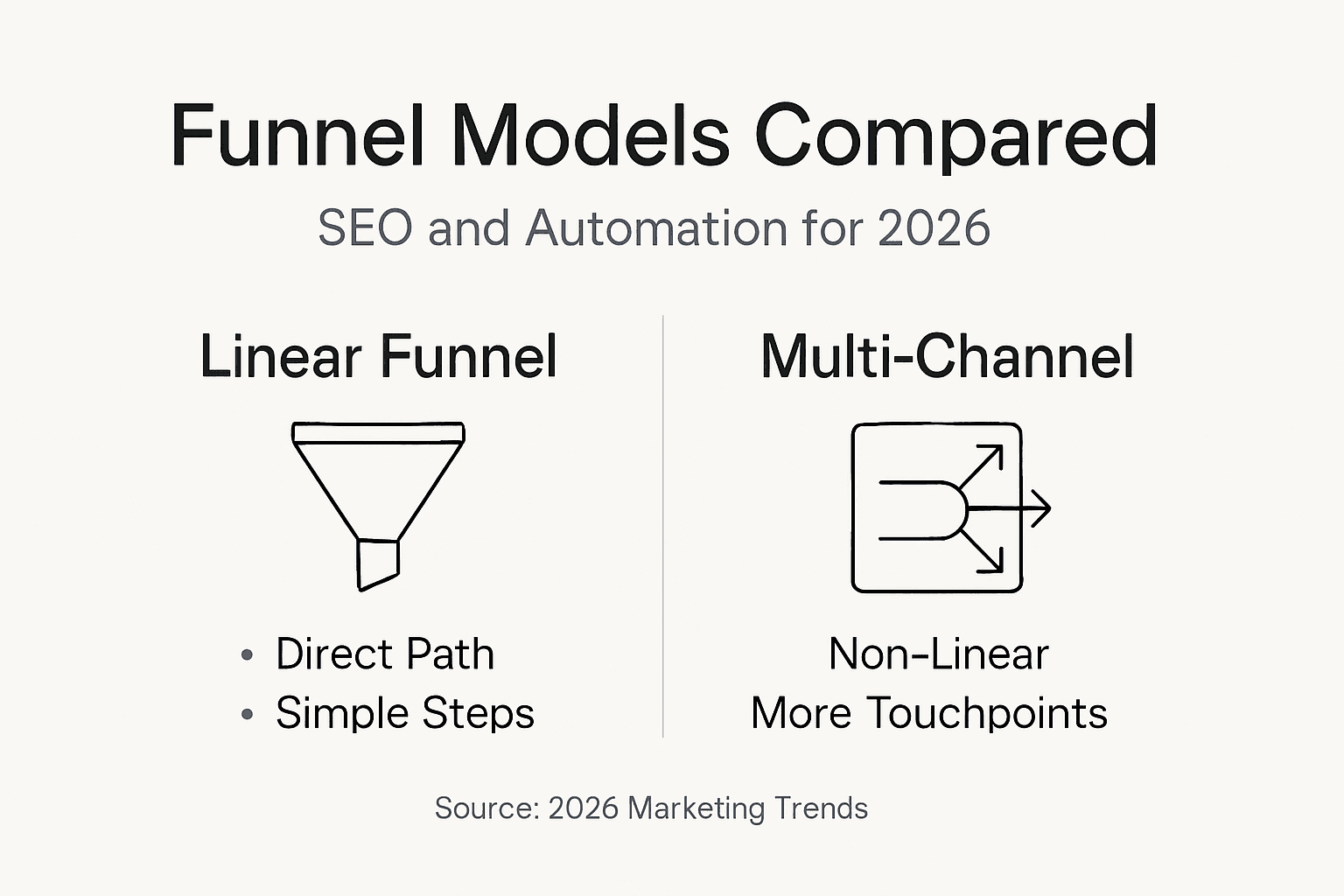
Traditional Linear Funnels work for straightforward products with predictable buyer paths. However, they struggle to accommodate the reality of modern customer research habits. Most prospects explore multiple sources, compare extensively, and make non-sequential decisions.
Multi-Channel Non-Linear Funnels acknowledge complexity. They assume customers enter at various stages, revisit content, and interact across platforms before converting. This model aligns perfectly with SEO strategies that target different intent types. You create content clusters addressing awareness, consideration, and decision keywords, allowing prospects to find relevant information regardless of entry point. AI automation thrives in this framework because you can systematically generate content for every stage and channel combination.
AIDA Model remains useful for understanding basic progression from awareness to action. It provides clear mental markers for content types. However, applying AIDA in 2026 requires recognizing that attention happens across multiple channels, interest develops through diverse content formats, desire builds via social proof and comparisons, and action may occur after numerous touchpoints.
Selection criteria for your business:
- Complexity: Simple products favor traditional models; complex B2B solutions need multi-channel approaches
- Resources: AI automation makes non-linear funnels manageable even for small teams
- Customer behavior: Analyze your actual conversion paths to identify which framework matches reality
- SEO goals: Intent-based targeting demands multi-channel frameworks
Choosing a framework aligned with your customers' actual behavior and your SEO capabilities maximizes funnel effectiveness. Most businesses in 2026 benefit from multi-channel non-linear models supported by AI automation.
Measuring and Analyzing Funnel Performance
Data-driven optimization separates successful funnels from underperforming ones. Tracking the right KPIs reveals exactly where your funnel succeeds and where prospects drop off.
Essential funnel KPIs include:
- Conversion Rate: Percentage of visitors completing desired actions at each stage
- Bounce Rate: Proportion of single-page sessions indicating content mismatch
- Organic Click-Through Rate: CTR from search results showing how well titles and descriptions attract clicks
- Time on Page: Engagement indicator revealing content relevance and quality
- Stage Progression Rate: Movement between funnel stages showing content effectiveness
Regular analysis identifies optimization opportunities. If awareness content has high traffic but poor progression to consideration, you need stronger calls to action or more compelling next-step content. If consideration pages show high bounce rates, your content likely fails to address comparison needs adequately.
KPI-driven optimization can improve funnel efficiency by over 40%. When you systematically test headlines, adjust content depth, refine keyword targeting, and optimize internal linking based on performance data, compound improvements accumulate. Small gains at each stage multiply into substantial overall conversion increases.
Monitoring enables agile responses to behavior shifts. Search trends evolve, competitor strategies change, and customer preferences shift. Monthly KPI reviews let you spot emerging patterns and adjust content strategies before opportunities disappear or problems compound.
Use analytics to refine your entire content ecosystem. Identify which topics generate the most qualified leads, which formats achieve the best engagement, and which channels drive the highest-value traffic. Then allocate more resources to high-performing areas while improving or eliminating weak elements. Discovering how to improve SEO ranking with AI strategies provides additional optimization levers for boosting funnel performance systematically.
Practical Case Study: AI-Driven Funnel Optimization Success
A mid-sized B2B software company implemented comprehensive AI-driven funnel optimization in early 2026, achieving 15-20% sustained monthly organic traffic growth. Their systematic approach demonstrates how combining strategy, automation, and measurement delivers scalable results.
Step 1: Mapped funnel stages to SEO intent keywords. The team analyzed their customer journey and identified distinct keyword clusters for each stage. Awareness keywords focused on problem identification, consideration keywords targeted solution comparisons, and intent keywords emphasized specific product features and pricing terms.
Step 2: Automated content creation with AI tools. Instead of manually writing articles, they deployed AI platforms to generate comprehensive content covering all identified keyword clusters. This acceleration produced 40 high-quality articles monthly compared to their previous 8 manual pieces, providing complete funnel coverage.
Step 3: Integrated backlink automation. Automated outreach systems identified relevant industry sites, personalized pitches, and secured placements systematically. This consistent link building increased domain authority from 32 to 47 within six months, boosting rankings across all funnel content.
Step 4: Continuously monitored KPIs and optimized. Weekly analytics reviews identified top-performing content types and underperforming pages. The team refined weak articles, expanded successful topics, and adjusted keyword targeting based on actual conversion data rather than assumptions.
This case proves that combining clear funnel mapping, AI content automation, systematic link building, and data-driven optimization creates predictable, sustainable growth. The company's success stemmed from treating funnel optimization as an integrated system rather than isolated tactics. Learning effective content planning approaches provides the strategic foundation needed to replicate similar results in your business.
Boost Your Marketing Funnels With AI-Powered SEO Solutions
Transforming your marketing funnel from theoretical concept to growth engine requires the right tools and strategies. AI-powered platforms automate the heavy lifting, letting you focus on strategic decisions rather than repetitive tasks.
Modern AI solutions generate stage-specific content that addresses exact search intents across your funnel. Instead of guessing what prospects need at each phase, you deploy data-driven content that matches proven ranking patterns and user preferences. Automated backlink acquisition accelerates domain authority growth, helping your funnel pages rank higher and attract more qualified traffic. Comprehensive platforms track KPI improvements across all stages, revealing exactly which optimizations drive the best results. This integration of content creation, link building, and analytics creates a complete growth system that scales with your ambitions. Exploring automated content generation techniques and implementing a robust SEO automation platform positions your business to capture more organic traffic systematically. Understanding how AI content strategies foster brand loyalty extends your funnel's impact beyond initial conversions into long-term customer relationships.
Frequently Asked Questions
What is the difference between a marketing funnel and a sales funnel?
Marketing funnels focus on attracting and nurturing prospects through content, education, and brand building activities. Sales funnels concentrate on converting qualified leads through direct interactions, demos, and closing techniques. Marketing generates awareness and interest; sales drives purchase decisions.
How can AI improve my marketing funnel's SEO performance?
AI automates content creation tailored to each funnel stage, ensuring comprehensive keyword coverage without manual bottlenecks. It analyzes search intent patterns to generate optimized articles, builds backlinks systematically to boost domain authority, and identifies content gaps competitors miss. This acceleration produces more traffic faster.
Why is it important to align content with funnel stages?
Alignment ensures your content matches searcher intent at each journey phase. Awareness stage visitors need educational content; consideration stage prospects want comparisons; purchase-ready buyers seek specific product details. Mismatched content frustrates users and tanks conversion rates.
Can marketing funnels be non-linear?
Absolutely. Modern funnels must account for prospects entering at any stage, skipping steps, and revisiting content multiple times before converting. Multi-channel behavior means customers might discover you on social media, research via Google, and convert through email. Non-linear models reflect this reality.
What KPIs should I track to measure funnel success?
Monitor conversion rates at each stage to identify drop-off points. Track organic CTR to gauge search result appeal. Measure bounce rates to assess content relevance. Analyze stage progression rates to understand content effectiveness. Review time on page and engagement metrics to validate quality. These combined indicators reveal funnel health and optimization opportunities.