Lead nurturing explained: Boost conversions with effective strategies


TL;DR:
- Effective lead nurturing builds relationships through personalized content at each stage of the buyer journey.
- Segmentation, automation, lead scoring, and multi-channel outreach are key methodologies for success.
- Properly executed nurturing improves conversion rates, shortens sales cycles, and reduces customer acquisition costs.
Most leads you attract today are not ready to open their wallets. In fact, up to 79% of leads never convert simply because businesses fail to nurture them properly. Lead nurturing is the disciplined practice of building trust with prospects over time, meeting them where they are, and guiding them toward a purchase decision at their own pace. It is not about blasting a drip email sequence and hoping for the best. Done right, it transforms cold interest into genuine intent and turns a disconnected marketing database into a revenue engine. This article breaks down exactly how that works and what you can act on immediately.
Table of Contents
- What is lead nurturing? Definitions, context, and buyer journey
- Core methodologies: Segmentation, automation, scoring, and multi-channel outreach
- Impact and results: Key benchmarks, metrics, and business outcomes
- Nuances, pitfalls, and advanced applications: Edge cases, expert tips, and continuous improvement
- Why traditional lead nurturing falls short: What experts actually do
- Turn lead nurturing insights into automated growth
- Frequently asked questions
Key Takeaways
| Point | Details |
|---|---|
| Relationship building | Lead nurturing centers on building trust and relevance rather than just selling. |
| Segmentation and automation | Successful lead nurturing relies on segmenting your audience and automating outreach across channels. |
| Data-driven improvement | Continuously monitor and optimize performance using metrics, feedback, and testing. |
| Avoid common pitfalls | Prevent fatigue and optimize workflows by adapting to buyer signals and avoiding excessive messaging. |
| Business impact | Well-executed nurturing drives more conversions, higher sales, and stronger customer relationships. |
What is lead nurturing? Definitions, context, and buyer journey
Understanding lead nurturing starts with a clean definition. According to a widely cited framework, lead nurturing is building relationships with prospects through timely, relevant, and personalized content to guide them through the buyer's journey toward sales readiness and conversion. Notice what that definition does not say. It does not say "send weekly newsletters" or "add them to a funnel." It says relationships. That distinction matters enormously for business owners.
The buyer journey follows three broad stages that your nurturing program must serve:
- Awareness: The prospect realizes they have a problem but has not named a solution yet. Your job here is education, not promotion.
- Consideration: They are now evaluating options and comparing approaches. Relevant case studies, comparisons, and insights shine here.
- Decision: They are ready to choose. Social proof, demos, and personalized offers close the gap.
Most businesses make one fatal mistake: they treat all leads the same regardless of which stage those leads occupy. A prospect who just downloaded your introductory guide does not need your pricing page yet. Sending them there anyway signals that you are not paying attention, and attention is the currency of trust.
"Lead nurturing is not about pushing prospects toward a sale. It is about pulling them forward by earning relevance at every step of their journey."
It is also worth recognizing that the buyer journey is rarely linear. A lead might jump from Consideration back to Awareness after a budget freeze, or stall in Decision waiting for internal approval. Effective nurturing stays adaptive, not rigid.
The foundation of all of this rests on the lead generation fundamentals that bring prospects into your orbit in the first place. Without quality top-of-funnel input, even the best nurturing system produces thin results. Get both sides working together, and you have a self-reinforcing growth loop.
Core methodologies: Segmentation, automation, scoring, and multi-channel outreach
Knowing what lead nurturing is brings you halfway. Knowing how to execute it is what separates teams that grow from teams that plateau. The most effective nurturing programs rely on segmentation by buyer persona, stage, and behavior combined with multi-touch automated workflows, lead scoring, and multi-channel outreach.
Here is how each methodology contributes:
- Segmentation: Group your leads by persona (who they are), stage (where they are), and behavior (what they have done). A SaaS buyer who attended your webinar deserves different content than someone who only read one blog post.
- Automation: Use platforms like HubSpot, Marketo, or Salesforce to build workflow-triggered sequences. These content automation tools remove manual bottlenecks and ensure no lead falls through the cracks.
- Lead scoring: Assign point values to behaviors (email opens, page visits, content downloads) and demographic fit. Leads crossing a defined score threshold get routed to sales automatically.
- Multi-channel outreach: Email alone is not enough. Multi-channel outreach combines email, social media touchpoints, paid retargeting, and even SMS to meet leads on the channels they actually use.
| Methodology | Primary Benefit | Best Tool Category |
|---|---|---|
| Segmentation | Higher relevance | CRM platforms |
| Automation | Consistent follow-up | Marketing automation |
| Lead scoring | Sales prioritization | CRM + MAP integration |
| Multi-channel | Broader reach | Ad + email platforms |
Pro Tip: Start with behavioral segmentation before you build any automated workflow. If you segment well first, your automation carries relevant messages to the right people automatically. Segment poorly, and automation just scales your mistakes faster.
A strong foundation in lead segmentation strategies will make every other methodology dramatically more effective. Think of segmentation as the map and automation as the vehicle.

Impact and results: Key benchmarks, metrics, and business outcomes
Let us talk about numbers, because the business case for lead nurturing is remarkable. Companies that excel at it generate 50% more sales-ready leads at 33% lower cost. Nurtured leads also make 47% larger purchases and convert 23% faster than non-nurtured counterparts. Personalized emails specifically boost click-through rates by 14% and conversions by 10%.
Those are not marginal improvements. They are the kind of gains that change quarterly results.
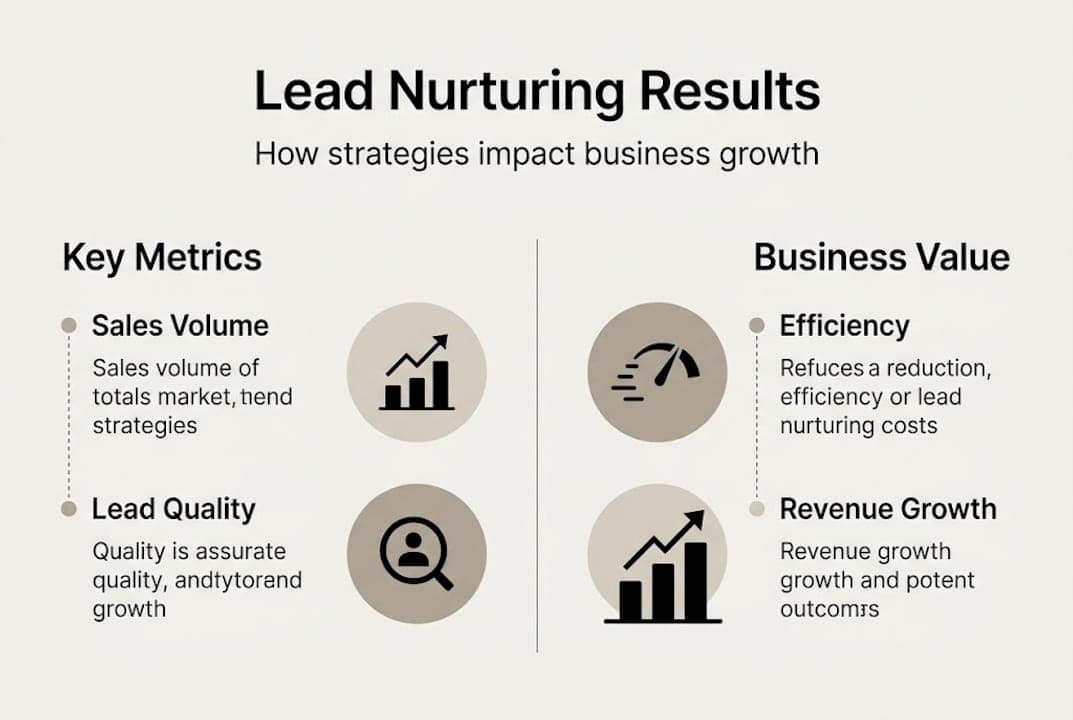
Here is what the benchmark data looks like across key metrics:
| Metric | Nurtured leads | Non-nurtured leads |
|---|---|---|
| Sales-ready lead volume | 50% more | Baseline |
| Cost per sales-ready lead | 33% lower | Baseline |
| Average purchase size | 47% larger | Baseline |
| Conversion speed | 23% faster | Baseline |
| Email CTR (personalized) | +14% | Baseline |
Beyond the numbers, the type of outcomes also differs. Nurtured leads tend to arrive at the sales conversation already educated, already trusting your brand, and already convinced of your category's value. That means less time objection-handling and more time closing.
Key business outcomes you can expect from a well-run program:
- Shorter sales cycles because buyers arrive informed
- Higher average deal values because nurtured leads see full solution value
- Lower customer acquisition cost because nurturing is largely automated
- Better sales and marketing alignment because scoring creates shared language
If you are scaling your inbound strategy, pairing nurturing with lead generation with AI dramatically amplifies these gains. AI-powered content surfaces at the exact moment buyers are searching, and nurturing captures and converts the intent that content generates. Combine that with smart content-driven lead generation to feed the top of your funnel consistently.
Nuances, pitfalls, and advanced applications: Edge cases, expert tips, and continuous improvement
Practical results are impressive, but understanding the nuances and avoiding common pitfalls is what sustains success over time. Several edge cases trip up even experienced marketers.
The most common: handling unresponsive leads. Non-linear buyer journeys require adaptive streams, not rigid sequences. Some buyers go cold, re-engage months later, and convert quickly. Others never move. Your program needs rules for both: re-engagement campaigns for the former and suppression or reclassification for the latter.
Common pitfalls to watch and avoid:
- Over-nurturing: Too many touchpoints too close together creates fatigue and unsubscribes. More contact is not always better contact.
- Data decay: Lead records go stale fast. Email addresses change, job titles shift, and behaviors from 18 months ago may no longer reflect current intent.
- Definition misalignment: Sales and marketing teams often define "sales-ready" differently. Without a shared scoring threshold, handoffs fail and leads get lost.
- Set-and-forget automation: You cannot build a workflow and walk away. Continuously optimize via A/B testing; AI enhances results but requires clean data and consistent human oversight.
For cold lead engagement, consider a "break-up email" strategy: a final, direct message acknowledging the silence and offering an easy opt-out. Counter-intuitively, these often generate strong re-engagement because they feel honest rather than automated.
Pro Tip: Run a quarterly audit of your nurture streams. Pull engagement data, kill anything with less than 10% open rates, and rebuild based on what your best-converting leads actually responded to.
Advanced programs also invest in brand loyalty through nurturing post-purchase, turning customers into advocates. And every touchpoint should be evaluated through conversion optimization principles. Pay special attention to effective CTAs in nurturing emails, since a weak call-to-action wastes even the most relevant content.
Why traditional lead nurturing falls short: What experts actually do
Here is an uncomfortable truth most marketing blogs will not say plainly: the standard drip campaign is largely a relic. It was designed for a world where buyers moved predictably and marketing databases were simple. Neither is true anymore.
Experts who achieve outsized results do not just automate more. They focus relentlessly on relevance. Volume over relevance leads to failure: the practitioners who win emphasize segmentation, continuous feedback loops, and tight system integration over the sheer number of touches.
What that actually looks like in practice: they build nurture streams that respond to signals, not calendars. If a lead revisits your pricing page three times in a week, that behavior triggers a different message than a scheduled Day 14 email. The calendar does not drive the content. The buyer does.
They also close the loop between sales conversations and marketing programs constantly. Every objection a salesperson hears becomes a content opportunity for the nurture stream. This integration is what separates programs that plateau from those that compound. The lead nurturing strategy insights that matter most are the ones built from real buyer feedback, not marketing assumptions.
Turn lead nurturing insights into automated growth
Every strategy in this article becomes exponentially more powerful when backed by smart automation. If you are manually tracking lead behavior and sending individual follow-ups, you are leaving significant revenue on the table.
At BabyloveGrowth.ai, we built our SEO automation platform specifically to help businesses like yours generate consistent, high-quality organic traffic that feeds your nurturing programs with the right prospects from the start. Combine that with our organic traffic tool to attract buyers who are already searching for what you offer, and your nurture sequences do not have to work as hard to convert. Explore what automated, AI-powered growth can look like for your business today.
Frequently asked questions
What is the difference between lead nurturing and lead generation?
Lead generation focuses on attracting new prospects to your brand, while lead nurturing builds relationships with those prospects to guide them from initial interest through to a purchase decision.
How do you know if your lead nurturing is working?
Track conversion rates, email engagement, and sales-ready lead volume. Companies excelling at nurturing generate 50% more sales-ready leads, so benchmark your program against industry averages to gauge performance.
What tools or platforms are best for automating lead nurturing?
Automated workflows from platforms like HubSpot, Marketo, Salesforce, or BabyloveGrowth provide the segmentation, behavioral triggers, and analytics needed to scale nurturing effectively.
How can you re-engage cold or unresponsive leads?
Use personalized re-engagement emails or targeted offers, and build adaptive nurture streams that adjust based on behavior. Persistently unresponsive contacts should be suppressed or reclassified to keep your database clean.
What is over-nurturing and how can you avoid it?
Over-nurturing creates fatigue through excessive touchpoints, leading to unsubscribes and disengagement. Avoid it by monitoring engagement signals closely and customizing frequency based on each contact's actual behavior.