Influencer Marketing Strategies That Drive Real Brand Growth


TL;DR:
- Few brands actively leverage influencer marketing despite its proven ROI potential. Building a scalable program requires strategic influencer selection, measurement systems, and operational infrastructure. Micro-influencers with niche, engaged audiences outperform larger creators in trust and conversion.
Only 21.2% of brands say they're actively leveraging influencer marketing. That number should stop you cold. While your competitors debate whether influencer marketing "works," a small group of disciplined brands is quietly capturing attention, building trust, and driving measurable revenue through creator partnerships. This article breaks down exactly how to build an influencer program that scales, from selecting the right creators to measuring full-funnel ROI. Whether you're launching your first campaign or overhauling an underperforming program, you'll walk away with a clear, actionable framework built for marketing professionals and business owners who need results, not theory.
Table of Contents
- The landscape of influencer marketing in 2026
- Choosing the right influencers: Tier, fit, and targeting
- Building a scalable influencer content system
- Measurement that matters: ROI, attribution, and full-funnel impact
- Avoiding common pitfalls and future-proofing your program
- Our perspective: Why most brand influencer programs underperform
- Accelerate growth with automated organic traffic tools
- Frequently asked questions
Key Takeaways
| Point | Details |
|---|---|
| Micro-influencer impact | Campaigns with micro-influencers consistently show higher engagement and authenticity. |
| Operational rigor is key | Successful programs use clear goals, structured briefs, and controls for risk. |
| ROI measurement matters | Tracking full-funnel results and optimizing with real attribution drives long-term gains. |
| Avoid easy pitfalls | Don’t over-prioritize reach or skip vetting—focus on fit and measurement. |
The landscape of influencer marketing in 2026
Given how few brands fully capitalize on influencer marketing, let's examine the data defining today's landscape. The numbers tell a compelling story about where the market is heading and why brands that move now will have a significant advantage.
US influencer marketing spend is projected to grow 15.7% in 2026 and reach $13.7B by 2027. That's not a niche channel anymore. Brands are allocating an average of 23% of total marketing budgets to creator partnerships, signaling a structural shift in how companies think about paid and earned media.
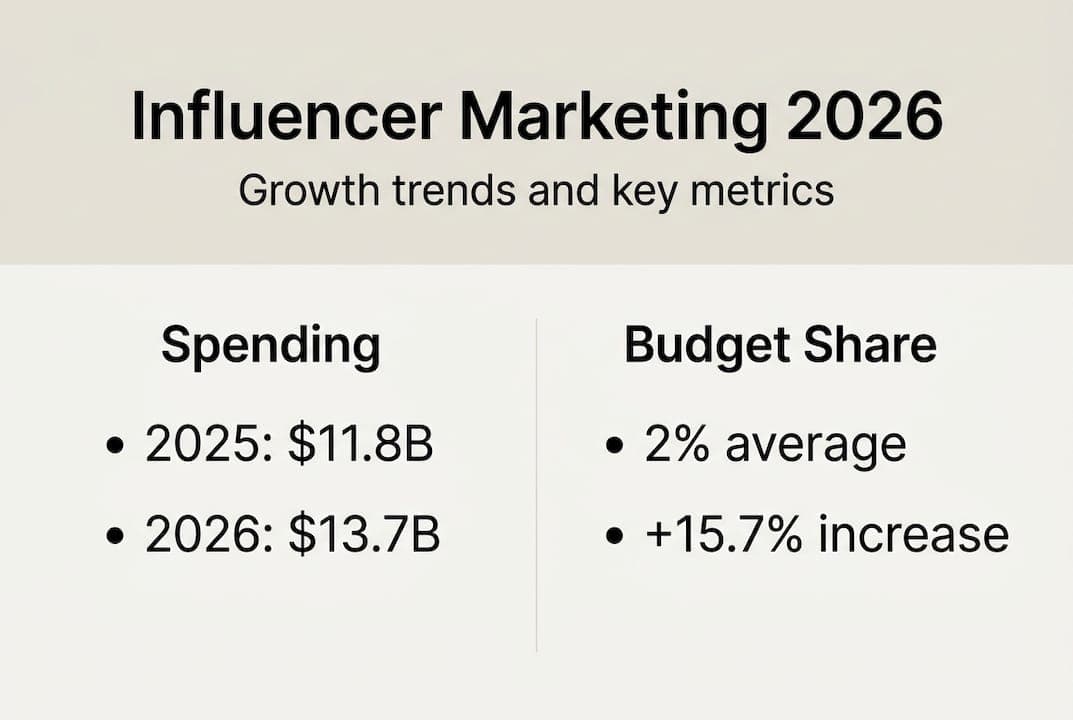
| Metric | 2025 | 2026 Projection |
|---|---|---|
| US influencer spend | ~$11.8B | ~$13.7B |
| Average budget share | 20% | 23% |
| Brands using it strategically | ~19% | ~21.2% |
What's driving this growth? The HubSpot 2026 survey points to brands shifting away from spray-and-pray sponsorships toward outcome-focused, disciplined programs. The brands increasing budgets are doing so because they've built measurement systems that prove ROI, not because they're following a trend.
Key reasons brands are scaling influencer budgets:
- Verified revenue attribution from creator content
- Lower cost-per-acquisition compared to paid social
- Compounding organic reach when content gets repurposed
- Stronger brand trust signals compared to traditional ads
"The brands winning at influencer marketing in 2026 aren't the ones spending the most. They're the ones measuring the best." For deeper influencer marketing insights, the gap between tactical and strategic execution is where most programs either succeed or stall.
Choosing the right influencers: Tier, fit, and targeting
Understanding the market's growth, the next step is mastering which influencers actually move the needle. Follower count is the most misleading metric in this space, and the data backs that up hard.

Micro-influencers delivered best success at 32.4%, compared to macro at 30.2% and mega at just 13.1%. Audience fit is the deciding variable, not reach.
| Tier | Followers | Avg. Engagement | Best For |
|---|---|---|---|
| Micro | 10K–100K | 3–7% | Niche targeting, authenticity |
| Macro | 100K–1M | 1–3% | Broad awareness, mid-funnel |
| Mega | 1M+ | 0.5–1.5% | Mass reach, brand recognition |
Micro-influencers win on trust. Their audiences are tighter, more loyal, and more likely to act on recommendations. When someone with 40,000 followers in a specific niche recommends your product, it reads like a friend's advice, not an ad. That's a conversion advantage you can't buy with a celebrity deal.
Checklist for evaluating creator-audience fit:
- Does their audience demographic match your target customer?
- What's their engagement rate on non-sponsored posts?
- Do they have a history of authentic product integrations?
- Is their content tone consistent with your brand voice?
- Are their followers real? Check for engagement-to-follower ratio anomalies.
For brands building organic growth with influencers, the creator selection process is where most programs win or lose before a single piece of content goes live.
Pro Tip: Run a test campaign with three to five micro-influencers before committing to a macro or mega deal. You'll get real engagement data and audience feedback at a fraction of the cost.
Building a scalable influencer content system
Selecting the right creators is only part of the formula. Next is building repeatable systems for scale. Without structure, influencer programs become chaotic, inconsistent, and nearly impossible to measure.
The brands that scale influencer marketing treat it like a repeatable program with defined goals, KPIs, and creator selection criteria. And successful strategies combine audience engagement metrics with full-funnel revenue impact, not just top-of-funnel awareness.
Here's a four-step system that works:
- Ideation and briefing: Create a standardized creative brief template. Include brand guidelines, campaign objectives, key messages, content format requirements, and posting schedules. Leave room for creator voice.
- Approval workflow: Build a clear review process with defined turnaround times. Avoid over-editing creator content. The goal is brand safety, not brand control.
- Multi-format distribution: Repurpose every piece of creator content. A TikTok video becomes a YouTube Short, an Instagram Reel, a blog embed, and a paid social ad. One piece of content should live in at least four places.
- Iterative measurement: After each campaign cycle, review performance by creator, format, and platform. Use that data to refine your next brief.
For content repurposing tactics that extend the life of creator content, the key is building distribution into your brief from day one, not as an afterthought. And for scaling reach across channels, pairing influencer content with strong content distribution strategies multiplies your organic impact significantly.
Pro Tip: Start with micro-influencer seeding campaigns to generate authentic content at low cost. Identify your top three performers by engagement and conversion, then amplify those creators with paid promotion.
Measurement that matters: ROI, attribution, and full-funnel impact
With scalable systems in place, robust measurement unlocks performance and highlights what works. Most influencer programs fail not because the content is bad, but because the measurement is weak.
The ROI formula is straightforward: (Total Revenue – Total Costs) / Total Costs × 100. But applying it correctly requires clean attribution. You need to know which revenue came from which creator, on which platform, and through which content format.
| Metric | What it measures | Why it matters |
|---|---|---|
| Revenue attribution | Direct sales tied to creator content | Proves program ROI |
| Brand lift | Awareness and sentiment change | Shows upper-funnel impact |
| Engagement rate | Content resonance | Predicts conversion potential |
| Search volume lift | Organic interest increase | Ties influencer to SEO growth |
A strong measurement framework connects influencer activity to:
- Sales data: Use unique promo codes and UTM parameters per creator.
- Search growth: Track branded search volume spikes after campaign launches.
- Newsletter signups: Measure list growth during and after influencer campaigns.
- Organic traffic: Monitor referral traffic from creator content placements.
For marketing analytics for ROI, the shift from vanity metrics to revenue metrics is the single biggest upgrade most programs need. And for understanding broader content marketing ROI insights, influencer content should be evaluated on the same performance standards as any other content investment.
Pro Tip: Review attribution data monthly, not quarterly. Influencer content has a short performance window. Fast iteration is how you compound results over time.
Avoiding common pitfalls and future-proofing your program
As you optimize your influencer program, avoiding typical pitfalls sets you up for sustainable growth. The most common mistakes aren't creative failures. They're operational ones.
Top failure modes include measurement and attribution gaps, fraud risk from fake followers, and weak brand fit between creator and product. Mature programs add controls to address all three systematically.
Common pitfalls to watch for:
- Over-indexing on reach: Prioritizing follower count over engagement and audience alignment
- Skipping the vetting process: Not auditing creator audience quality before signing agreements
- Weak brand fit: Partnering with creators whose audience has no interest in your product category
- Missing measurement controls: Running campaigns without UTM tracking, promo codes, or attribution windows
- No approval workflow: Letting content go live without brand safety review
For advanced influencer strategies that build long-term program health, the investment in operational infrastructure pays off faster than most marketers expect. And for managing influencer marketing risks, the brands that build controls early avoid the costly campaign failures that force reactive damage control later.
"Mature influencer programs don't just run better campaigns. They build institutional knowledge that makes every future campaign smarter, faster, and more profitable."
Pro Tip: Invest in workflows for risk management, content approvals, and attribution tracking before scaling creator outreach. Infrastructure first, volume second.
Our perspective: Why most brand influencer programs underperform
Having covered best practices and errors, here's a candid take on what makes programs succeed or stall. Most brands approach influencer marketing the same way they approach a one-time ad buy. They find a creator, pay for a post, and wait. That's not a program. That's a transaction.
The uncomfortable truth is that operational overhead is what separates high-performing influencer programs from mediocre ones. Measurement systems, approval workflows, creator relationship management, and attribution modeling are not exciting. But they're what actually drive results. The brands that treat creators as an extension of their marketing team, briefing them on strategy, giving them feedback, and building long-term relationships, consistently outperform brands that chase trending creators with one-off deals.
For building an organic influencer framework that compounds over time, the mindset shift from "campaign" to "program" is the most important change you can make in 2026. Competitors chasing trends will keep burning budget. You can build something that gets smarter every month.
Accelerate growth with automated organic traffic tools
Ready to go further? Connect influencer marketing to data-driven organic growth. Influencer content drives attention, but pairing it with a strong SEO foundation is what turns that attention into lasting organic traffic.
BabyloveGrowth.ai gives marketing professionals and business owners the tools to automate content creation, track organic performance, and build a compounding SEO strategy that works alongside your influencer efforts. Our organic traffic tool helps you capture the search demand your influencer campaigns generate, turning brand awareness into measurable rankings. Pair that with our SEO workflow automation to keep your content engine running without adding headcount. Start your free trial and see how automated organic growth amplifies every influencer dollar you spend.
Frequently asked questions
What are the key steps for launching a successful influencer marketing program?
Start by defining clear goals and KPIs, then select influencers based on audience fit rather than follower count. The repeatable program approach of structured briefs, creator vetting, and revenue-based measurement is what separates scalable programs from one-off campaigns.
How should influencer marketing ROI be measured?
Apply the ROI formula of (Total Revenue – Total Costs) / Total Costs × 100, using unique promo codes and UTM parameters per creator for clean attribution. Iterate your strategy monthly based on what the data shows, not what the likes suggest.
Why are micro-influencers considered effective?
Micro-influencers outperform larger tiers with a 32.4% success rate versus 13.1% for mega-influencers because their audiences are tighter, more engaged, and more likely to trust product recommendations. Audience alignment drives conversion, not raw reach.
What are common reasons influencer campaigns fail?
Most campaigns fail because of attribution and measurement gaps, weak brand fit between creator and product, or inadequate vetting that lets fraud risk go undetected. Building operational controls before scaling is the most reliable way to prevent these failures.