Digital presence for SMB growth: 75% judge by design


TL;DR:
- Most small businesses underestimate the importance of a strong digital presence for trust and growth.
- Key assets include websites, Google profiles, reviews, social media, and content, which work together to build reputation.
- Using AI and automation can enhance efficiency, scale digital strategies, and overcome capacity limitations.
Your website, reviews, and social profiles are forming first impressions before a single conversation happens. 75% of consumers judge a business's credibility by its website design alone, and 81% read online reviews before making a purchase decision. For small and medium-sized businesses, that's not a marketing statistic — it's a survival signal. This guide breaks down exactly what digital presence means, why it compounds into real growth, and how automation and AI are making it possible for lean teams to compete with much larger players. You'll walk away with a clear framework and practical next steps.
Table of Contents
- What does digital presence mean for SMBs?
- Why digital presence drives trust and growth
- Key components: From websites to reviews and beyond
- Maximizing digital impact with SEO automation and AI
- Overcoming roadblocks: Cost, capacity, and 'offline doesn't matter' objections
- Our take: What most SMBs get wrong about digital presence
- Next steps: Automate and amplify your digital presence
- Frequently asked questions
Key Takeaways
| Point | Details |
|---|---|
| First impressions matter | A professional website and strong online presence directly shape customer trust. |
| Digital channels are essential | Websites and core listings outperform other channels for small business visibility and growth. |
| Leverage automation wisely | Using AI and automation for SEO and content saves time while amplifying reach if done authentically. |
| Overcome barriers with focus | Start small, automate strategically, and prioritize resources on high-impact online assets. |
What does digital presence mean for SMBs?
Digital presence is the total picture of how your business appears online. It's not just your website. It's every place a potential customer might encounter your brand — your Google Business Profile, your social media pages, your customer reviews, your blog content, and even the mentions of your business in other articles or directories.
Think of it this way: your digital presence is your business's reputation on the internet, running 24 hours a day whether you're managing it or not.
Here are the core components that make up a complete digital presence:
- Website: Your owned hub. This is where you control the narrative, showcase your services, and convert visitors into leads or buyers.
- Google Business Profile: Critical for local search visibility. Customers searching "near me" will find you here first.
- Social media: Platforms like Facebook, Instagram, and LinkedIn build community and keep your brand visible between purchase cycles.
- Online reviews: Ratings on Google, Yelp, or industry-specific platforms act as social proof and directly influence trust.
- Content (blog, video, podcasts): Organic content builds authority and drives search traffic over time.
A common misconception among local businesses is that digital presence is irrelevant if you rely on word of mouth or repeat customers. That thinking is costly. Even referrals Google you before they call. 9 in 10 SMBs use at least one digital channel, and websites consistently rank as the most effective.
"Your digital presence isn't a marketing add-on — it's the front door of your business for most customers."
Understanding the benefits of SEO for businesses is the next logical step once you see the full picture. And if you're starting from scratch, learning how to build a brand online with AI-driven strategies gives you a structured path forward.
Why digital presence drives trust and growth
With clarity on what digital presence includes, let's explore why it's such a potent driver of trust and business growth.
Trust is the currency of commerce. Before a customer hands over money, they need to believe you're legitimate, capable, and worth their time. Digital channels are now the primary place where that trust gets built or broken.

Consider these numbers: 75% judge credibility by website design, 81% read reviews before deciding, and 84% of SMBs already use digital channels for promotion. These aren't vanity metrics — they're signals that your digital presence is doing sales work even when your team isn't.
| Digital touchpoint | Trust signal | Growth impact |
|---|---|---|
| Website | First impression, credibility | Lead generation, conversions |
| Google Business Profile | Local search visibility | Foot traffic, calls, reviews |
| Social media | Community, brand personality | Awareness, repeat engagement |
| Online reviews | Social proof | Purchase decisions, retention |
| Blog/content | Authority, expertise | Organic search traffic |
The compounding effect is what makes digital presence so powerful. A well-optimized website drives search traffic. That traffic reads reviews. Reviews build trust. Trust converts visitors into buyers. Buyers leave more reviews. The cycle feeds itself.
Digital services empower SMEs significantly, with e-commerce and Google Ads showing strong ROI even for businesses with modest budgets. The key insight is that digital isn't just for big brands with large marketing teams — it scales down effectively.For SMBs specifically, the SEO benefits are especially compelling because organic traffic doesn't require ongoing ad spend. And pairing that with SEO strategies for small businesses gives you a repeatable system rather than a one-time campaign.
Key components: From websites to reviews and beyond
To get a clearer picture, let's break down the essential components of digital presence and their specific roles.
78% of SMBs have websites, 59% use Facebook, and 52% have Google Business Profiles — yet websites remain the most effective single asset. That gap between having a digital presence and using it effectively is where most businesses lose ground.
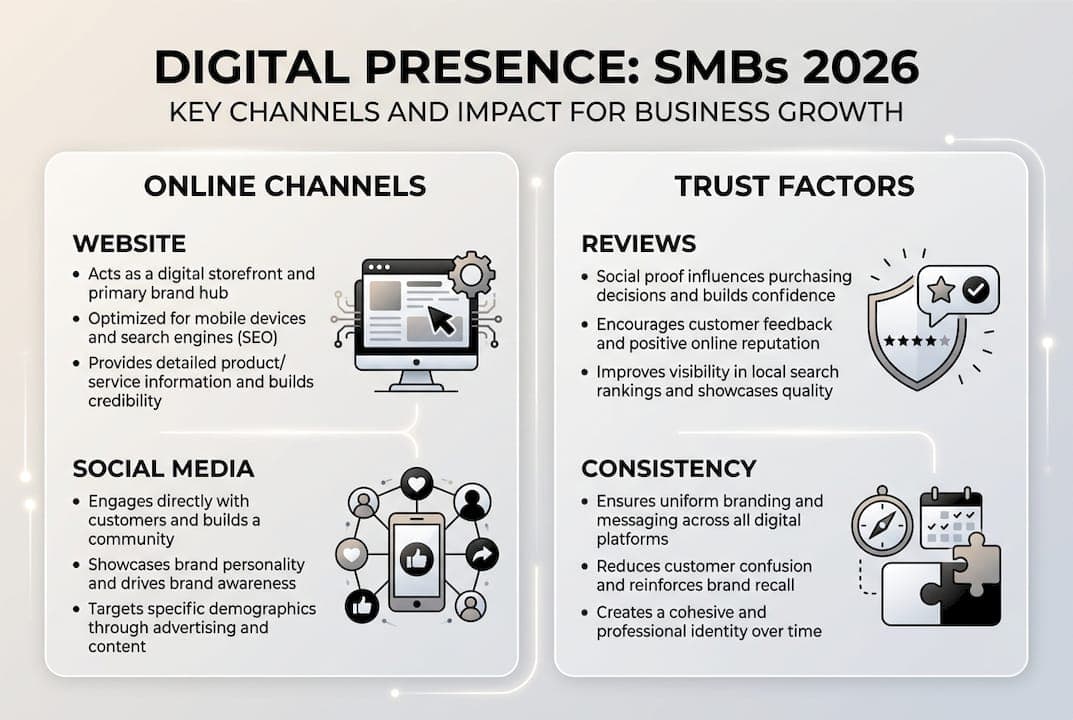
Here's a breakdown of the five most impactful digital assets and what you can do to strengthen each one:
| Asset | Influence level | Resource cost | Quick win |
|---|---|---|---|
| Website | Very high | Medium | Improve page speed and clear CTAs |
| Google Business Profile | High | Low | Add photos and respond to reviews |
| Online reviews | High | Low | Ask every satisfied customer to leave one |
| Social media | Medium | Medium | Post consistently on one platform first |
| Blog/content | High (long-term) | Medium | Publish one optimized article per week |
Here's a practical sequence to follow:
- Audit your website for speed, mobile responsiveness, and clarity of message. If a visitor can't tell what you do in five seconds, you're losing them.
- Claim and complete your Google Business Profile. Add photos, hours, services, and a business description. This is free and high-impact.
- Build a review generation habit. After every positive interaction, ask the customer to leave a Google review. Make it easy by sending a direct link.
- Pick one social platform where your audience actually spends time and post three to four times per week with consistent branding.
- Start a content calendar. Even one blog post per week, optimized for a specific search query, builds authority over months.
Pro Tip: Consistency matters more than perfection. Use the same business name, address, phone number, and logo across every platform. Inconsistent information confuses both customers and search engines, and it erodes the trust you're working to build.
If you want to accelerate this, learning how to build an effective brand strategy with AI can help you systematize the whole process.
Maximizing digital impact with SEO automation and AI
Beyond foundational channels, modern SMBs can supercharge their digital presence with SEO automation and smart use of AI.
The numbers here are striking. 98% of SMBs use AI tools, with 51% applying them specifically to marketing. Yet only 40% invest enough in digital tools to see compounding SEO results. That gap represents a real competitive opportunity for businesses willing to go a step further.
SEO automation handles the repetitive, time-consuming tasks that most small teams simply can't keep up with manually: keyword research, content scheduling, internal linking, performance tracking, and backlink outreach. When these are automated, your team can focus on strategy and creativity instead of execution.
Here's what a practical AI-powered workflow looks like for an SMB:
- Content creation: Use AI to generate first drafts based on target keywords, then edit for your brand voice and add unique insights from your experience.
- Keyword clustering: AI tools can group related keywords and build topic clusters that help you dominate a niche rather than scatter your efforts.
- Performance monitoring: Automated dashboards flag ranking drops or traffic changes before they become serious problems.
- Backlink building: Automated outreach tools identify relevant sites and manage the relationship-building process at scale.
Post-2026 Google updates have been unforgiving toward scaled AI content that lacks originality. Businesses that survived and thrived are those combining unique data, real customer stories, and genuine expertise with the efficiency of automation.
Pro Tip: Don't automate everything. Your brand voice, your customer stories, and your specific expertise cannot be replicated by a tool. Use AI to scale the structure and distribution of your content, but keep the human insight at the center.
Exploring the AI benefits in SEO gives you a clear picture of where automation adds the most value. And if you run an online store, the AI in eCommerce SEO examples are directly applicable to your product pages and category structure. For a broader system, an AI content marketing platform can tie all of these workflows together.
"The businesses winning in organic search aren't the ones with the biggest budgets — they're the ones with the most consistent, authentic content backed by smart automation."
Overcoming roadblocks: Cost, capacity, and 'offline doesn't matter' objections
Even with all the advantages, it's natural for business owners to face doubts or practical barriers. Let's tackle the most common ones.
66% of SMBs cite capacity as their biggest challenge with digital marketing, and 10% believe digital is either irrelevant to their business or too costly to pursue. These are understandable concerns, but they're also addressable with the right approach.
Here are the three most common objections and how to respond to each:
- "We don't have the budget." Many high-impact digital activities are free or low-cost: Google Business Profile, social media posting, and review generation cost nothing but time. Start there before investing in paid tools or ads.
- "We don't have the time." This is where automation earns its keep. A well-configured AI content tool can produce a week's worth of social posts or a blog article in under an hour. The upfront setup time pays off quickly.
- "Our customers aren't online." This one is almost never true in 2026. Even B2B buyers and older demographics research purchases online. If your competitors are showing up in search and you're not, you're invisible to a growing segment of potential customers.
The practical path forward for resource-limited teams is to focus first. Don't try to be everywhere. Pick the two or three channels where your customers are most active, build a consistent presence there, and automate what you can.
Pro Tip: Identify your single highest-traffic digital channel and invest 80% of your effort there. Master one channel before expanding. Spreading thin across six platforms with inconsistent posting is far less effective than dominating two with quality content.
For a deeper look at scaling efficiently, the SEO strategies for SMB growth guide covers proven approaches that work even with limited resources.
Our take: What most SMBs get wrong about digital presence
Here's the uncomfortable truth: most SMBs either overcomplicate digital presence or completely underestimate it. We've seen both patterns play out repeatedly.
The overcomplicated version looks like chasing every new platform, buying expensive tools before mastering free ones, and copying strategies designed for enterprise brands with full marketing departments. The result is scattered effort, wasted budget, and burnout.
The underestimated version is the business that still relies entirely on referrals and word of mouth, assuming that's enough. It was enough in 2015. It isn't in 2026.
What actually separates top-performing SMBs post-2026 is simpler than most expect: a clear, fast website with an obvious value proposition, consistent information across all platforms, a steady stream of authentic reviews, and content that reflects real expertise rather than generic AI output.
The future of digital marketing belongs to businesses that blend automation efficiency with genuine human insight. Start small, measure what works, automate the repeatable parts, and protect your unique voice. That combination is harder to replicate than any tool or tactic.
Next steps: Automate and amplify your digital presence
If you've made it this far, you already understand that digital presence isn't optional — it's the foundation of modern business growth. The question is how to build and maintain it without burning out your team.
Babylovegrowth.ai is built specifically for SMBs and marketers who need results without the complexity. The SEO automation platform handles content planning, keyword targeting, and publishing on autopilot. The backlink building automation grows your domain authority without manual outreach. And the organic traffic tool gives you a clear view of what's working and where to focus next. Start with a free trial and see how much faster your digital presence grows when the right systems are doing the heavy lifting.
Frequently asked questions
Why is digital presence critical for small businesses in 2026?
75% of consumers judge business credibility by website design and 81% read reviews before deciding, meaning your digital presence is actively shaping purchase decisions before any direct contact.
What digital channels make the biggest impact for SMBs?
Websites, Google Business Profile, and social media are the most effective channels, with websites leading for both visibility and trust-building across 78% of SMBs.
How can SMBs streamline digital marketing with limited capacity?
AI and SEO automation let SMBs scale their online activities while cutting manual work significantly, and 98% already use AI tools with 51% applying them directly to marketing.
What common mistakes do businesses make with digital presence?
The biggest mistake is prioritizing trendy platforms over foundational assets — a clear, fast website and consistent business information across all directories will outperform a viral social post almost every time.