CTA importance: boost conversions with strong CTAs


TL;DR:
- Effective CTAs are essential for guiding visitors toward specific business actions.
- They should be clear, benefit-driven, urgent, well-designed, and strategically placed.
- Ongoing testing and refinement are key to maximizing conversion and business growth.
Most business owners think a call to action is just a button slapped at the bottom of a page. That belief quietly kills conversions every day. The truth is, a well-crafted CTA is the single most direct line between your content and your business goals. Effective CTAs can increase conversion rates by a significant margin when designed with intention. This guide walks you through why CTAs matter, what separates a weak one from a great one, how to measure their impact, and how to apply them across your marketing to generate real leads and sales.
Table of Contents
- Why calls to action matter in digital marketing
- Key elements of a high-converting call to action
- How CTAs impact engagement and conversion rates
- Applying CTAs for lead generation and business growth
- Why most CTAs fail (and what actually works)
- Turn effective CTAs into real business growth
- Frequently asked questions
Key Takeaways
| Point | Details |
|---|---|
| CTAs drive user action | Calls to action are crucial for guiding visitors toward key business objectives. |
| Design and placement matter | Strategic language, design, and location boost CTA effectiveness and conversions. |
| Testing leads to growth | Regularly testing and refining CTAs delivers continuous improvements in outcomes. |
| Lead generation depends on CTAs | Effective CTAs are vital for attracting and converting quality leads. |
Why calls to action matter in digital marketing
Every piece of content you publish has a job to do. Without a clear CTA, that content completes its job halfway. It informs the visitor, maybe entertains them, and then lets them drift away. No next step, no conversion, no measurable result for your business.
CTAs are the bridge between your message and your revenue. Think of your website as a conversation. You share helpful content, build trust, demonstrate value, and then the CTA tells the visitor what to do next. Without it, the conversation just... stops. That silence costs money.
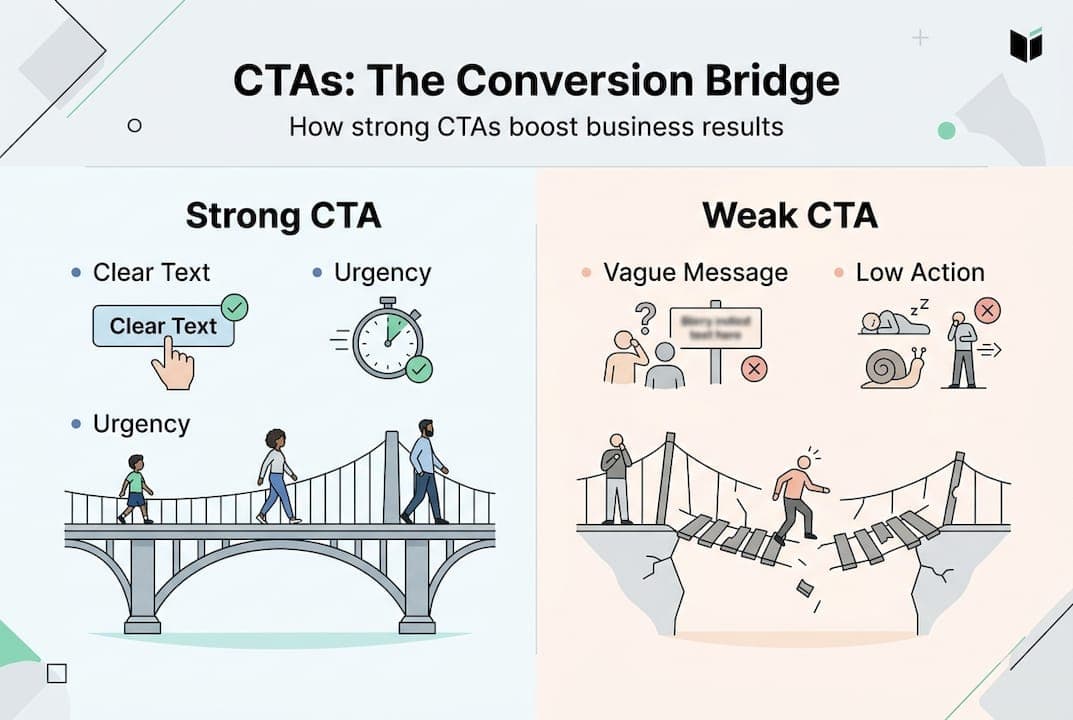
Here is a quick picture of where CTAs make the biggest difference:
- Homepage: Direct first-time visitors toward a free trial, a consultation, or a featured product
- Blog posts: Move readers from awareness to consideration with offers like downloadable guides or newsletter sign-ups
- Product pages: Push purchase-ready visitors to complete checkout or start a free demo
- Email campaigns: Re-engage cold leads with time-sensitive offers or personalized recommendations
- Social media ads: Turn passive scrollers into active prospects with a single click
The businesses that win online are not the ones with the most content. They are the ones whose content consistently moves people forward. A page without a CTA is like a sales meeting where no one asks for the order.
Building compelling CTAs requires understanding your visitor's mindset at each stage of their journey. A first-time visitor needs a lower-commitment ask, like a free resource. A returning visitor who has already engaged is ready for a stronger offer. Matching CTA intensity to visitor intent is what separates average marketers from top performers.
The bottom line: every page on your website should have exactly one primary CTA that aligns with the visitor's likely intent at that moment. Not three CTAs, not zero. One clear, relevant action.
Key elements of a high-converting call to action
Knowing CTAs matter is one thing. Knowing what makes them actually work is another. Effective CTA techniques consistently point to five core elements: clarity, urgency, value, design, and placement.
Here is how each element works in practice:
- Clear action verbs: Start your CTA with a verb that leaves zero ambiguity. "Get your free report" beats "Learn more" every time because it tells the visitor exactly what will happen when they click.
- Value proposition: The CTA must answer "What's in it for me?" instantly. "Start saving time today" communicates a benefit. "Submit" does not.
- Urgency or scarcity: Limited time offers and low-stock alerts create a reason to act now rather than later. "Only 3 spots left" or "Offer ends Friday" move people off the fence.
- Design and color contrast: Your CTA button needs to visually pop. If it blends into the page, it gets ignored. High contrast colors, white space around the button, and readable font size all matter.
- Placement: Above the fold for high-intent pages, within content for nurturing pages, and repeated at the end of long-form content.
Pro Tip: Test button text that uses first-person language. Changing "Get your free trial" to "Start my free trial" consistently outperforms in A/B tests because it makes the action feel personal and owned by the user.
Here is a comparison of weak versus strong CTAs so the difference is crystal clear:
| Weak CTA | Strong CTA | Why it works |
|---|---|---|
| Submit | Send me the guide | Personal and specific |
| Click here | Claim your free audit | Clear benefit stated |
| Learn more | See how it works in 2 min | Reduces perceived effort |
| Sign up | Join 10,000 smart marketers | Social proof included |
| Buy now | Get instant access today | Urgency without pressure |
Notice the pattern. Strong CTAs are specific, benefit-driven, and reduce the visitor's hesitation. Weak CTAs are vague and offer no reason to act.

Best practices for crafting CTAs emphasize that clarity, relevance, and urgency are the three non-negotiable pillars. You can have the most beautiful button in the world, but if the words on it do not speak directly to what your visitor wants, it will not convert.
How CTAs impact engagement and conversion rates
Let's look at what the data actually shows. Because when you see the numbers, the case for investing in CTA quality becomes impossible to ignore.
Effective CTA placement strategies demonstrate that smart CTA language and positioning can increase conversion rates by significant margins, sometimes doubling results on the same page with no other changes.
| CTA change made | Observed conversion lift |
|---|---|
| Personalized CTA text vs. generic | Up to 202% more conversions |
| Button above the fold vs. below | 47% more clicks on average |
| Action verb added to button text | 28% improvement in clicks |
| Urgency phrase added | 14% lift in immediate action |
| High-contrast button color | 35% increase in click-through rate |
"The biggest mistake we see businesses make is treating their CTA as an afterthought. The CTA is the entire point of the page. Everything else is just context."
Three common pitfalls that silently hurt your results:
- Too many CTAs: When you give visitors five options, they often choose none. Decision fatigue is real, and it kills conversions.
- Mismatched intent: A "Buy now" CTA on a blog post aimed at cold audiences pushes people away instead of pulling them in.
- No visual hierarchy: When the CTA does not stand out visually, visitors simply do not see it, no matter how good the copy is.
The fix for all three is the same: simplify. One primary CTA per page, matched to visitor intent, and designed to grab the eye.
Testing is what separates guessing from growing. Pair strong CTA design with solid landing page optimization and you create a compounding effect. Each small improvement builds on the last, and over time, your conversion rate climbs steadily.
Applying CTAs for lead generation and business growth
Understanding the theory is great. Putting it to work is where growth actually happens. Well-placed CTAs play a vital role in lead generation, turning passive readers into active prospects at scale.
Here is a practical step-by-step framework for implementing CTAs based on your business objective:
- Define the goal first. Are you capturing email leads, booking consultations, driving product purchases, or growing a community? Your CTA language and offer change depending on the answer.
- Match the CTA to the content type. A how-to blog post pairs naturally with a downloadable checklist CTA. A product page pairs with a free trial or demo CTA. Alignment matters.
- Write three CTA variations. Create one focused on benefit, one on urgency, and one on social proof. You need options before you can test.
- Place strategically. Put your primary CTA above the fold on high-intent pages. Add a secondary CTA mid-content and repeat the primary at the bottom for long-form pages.
- A/B test one variable at a time. Change only the button text OR the color OR the placement in each test. Changing everything at once tells you nothing useful.
- Measure click-through rate and downstream conversion. Clicks alone do not tell the story. What happens after the click matters just as much.
For businesses in different sectors, the implementation looks slightly different. A service business benefits most from consultation or audit CTAs that reduce perceived risk. An e-commerce brand drives results with limited-time discount CTAs. A SaaS company converts best with free trial or demo CTAs that let the product sell itself.
Pro Tip: Use content-driven lead generation as your CTA foundation. Content that educates first and sells second creates warmer leads who are far more likely to convert when they hit your CTA.
Combining strong CTAs with smart digital marketing techniques creates a system where your content consistently delivers measurable business results, not just traffic numbers.
Why most CTAs fail (and what actually works)
Here is the uncomfortable truth: most businesses treat CTA optimization as a one-time task. They set it and forget it. Then they wonder why their conversion rates are stagnant six months later.
Generic CTAs underperform because they are built for an imaginary average visitor. Real visitors are specific people with specific needs at specific moments. A CTA that tries to speak to everyone ends up resonating with no one.
What actually works is treating your CTA as a living part of your marketing strategy, not a checkbox. The businesses we see growing fastest are the ones running ongoing tests, analyzing what clicks but does not convert, and continuously refining their offers.
Building compelling CTAs is not about finding the magic formula. It is about building a feedback loop where data tells you what your specific audience responds to. That insight cannot be borrowed from a competitor or copied from a case study. It has to be earned through iteration.
The marketers who win are not the ones who guessed right the first time. They are the ones who kept testing until they found what worked.
Turn effective CTAs into real business growth
You now have a clear framework for building CTAs that actually drive results. The next question is how to scale those results without spending all your time manually testing and tweaking every element.
Babylovegrowth.ai is built for exactly this challenge. Our SEO automation platform helps you publish AI-optimized content that naturally integrates high-converting CTAs, driving organic traffic that is already primed to engage. Pair that with our organic traffic tool to identify which content drives the most qualified visitors, and use our backlink building software to build the authority your pages need to rank. Start your free trial today and put your CTA strategy on autopilot.
Frequently asked questions
What makes a call to action effective?
An effective CTA uses clarity, relevance, and urgency to grab attention and give visitors a compelling reason to act right now. It speaks directly to a specific audience need rather than using vague, generic language.
Where should I place CTAs on my website for the best results?
CTA placement affects conversion rates significantly, with above-the-fold and mid-content positions consistently outperforming buried footer placements. The best placement is always where the visitor's attention and intent are highest.
How do CTAs impact lead generation?
CTAs are vital in lead generation because they create the specific moment where a visitor decides to exchange their information or time for your offer. Without a clear CTA, even the best content fails to capture leads.
Should CTAs be tested and updated regularly?
Yes, testing and refinement are what separate stagnant conversion rates from steadily improving ones. Audience behavior shifts over time, and your CTAs need to shift with it to stay effective.