Content quality for SEO: the real driver of growth


Most marketers assume the path to better rankings is simple: publish more, rank more. In 2026, that logic is actively working against you. Search engines, including Google and AI-powered engines like ChatGPT and Perplexity, have grown sophisticated enough to reward information gain, the degree to which your content adds something new and genuinely useful. Brands chasing volume without substance are seeing penalties, not payoffs. This guide breaks down what content quality actually means, why it has become the single most important factor in organic growth, and how you can build a practical system to evaluate and improve every piece you publish.
Table of Contents
- Why content quality is the foundation of modern SEO
- The core elements that define high-quality content
- How content quality impacts key SEO and engagement metrics
- Practical frameworks to evaluate and boost your content quality
- Why content quality will always outperform quantity—our take
- Level up your SEO with smarter content quality tools
- Frequently asked questions
Key Takeaways
| Point | Details |
|---|---|
| Content quality drives SEO | High-quality content is essential for strong search rankings and long-term organic growth. |
| Key elements to prioritize | Meeting user intent, depth, structure, originality, and natural keywords define superior content. |
| Quality outperforms quantity | Publishing less but better, more original content yields greater engagement and backlinks than higher volume. |
| Frameworks empower improvement | Regular audits and structured checklists help maintain and elevate your content quality over time. |
Why content quality is the foundation of modern SEO
Content quality is not about word count or keyword density. At its core, it means meeting user intent with information that is accurate, well-organized, and genuinely more useful than what already exists. That last part matters more than most people realize.
Google's algorithm updates over the past several years have moved the goalposts significantly. The Helpful Content system, spam policies, and the rise of AI-generated content at scale have all pushed search engines to become much better at detecting shallow, repetitive, or derivative writing. If your article says the same thing as the top ten results, just rearranged, you are not adding value. You are adding noise.
The concept of information gain is central here. Search engines want to surface content that teaches users something they could not easily find elsewhere. That might mean a unique data point, a fresh perspective, a more thorough explanation, or a practical example that competitors missed. Key mechanics of quality content for SEO include intent matching, depth, structure, and originality, and all four need to work together.
Here is what a quality-first approach actually delivers:
- Higher organic rankings because search engines can identify depth and relevance
- More natural backlinks from other creators who find your content worth citing
- Better user engagement strategies that signal to Google your content satisfies the query
- Lower bounce rates as readers stay longer and explore more pages
- Protection from algorithm penalties that target thin or spammy content
Pro Tip: Before publishing any piece, ask yourself: "Does this article answer the question better than the current top result?" If the honest answer is no, keep working on it.
The shift from quantity to quality is not a trend. It is the new baseline. Brands that treat content as a checkbox activity will keep losing ground to those who treat it as a genuine product.
The core elements that define high-quality content
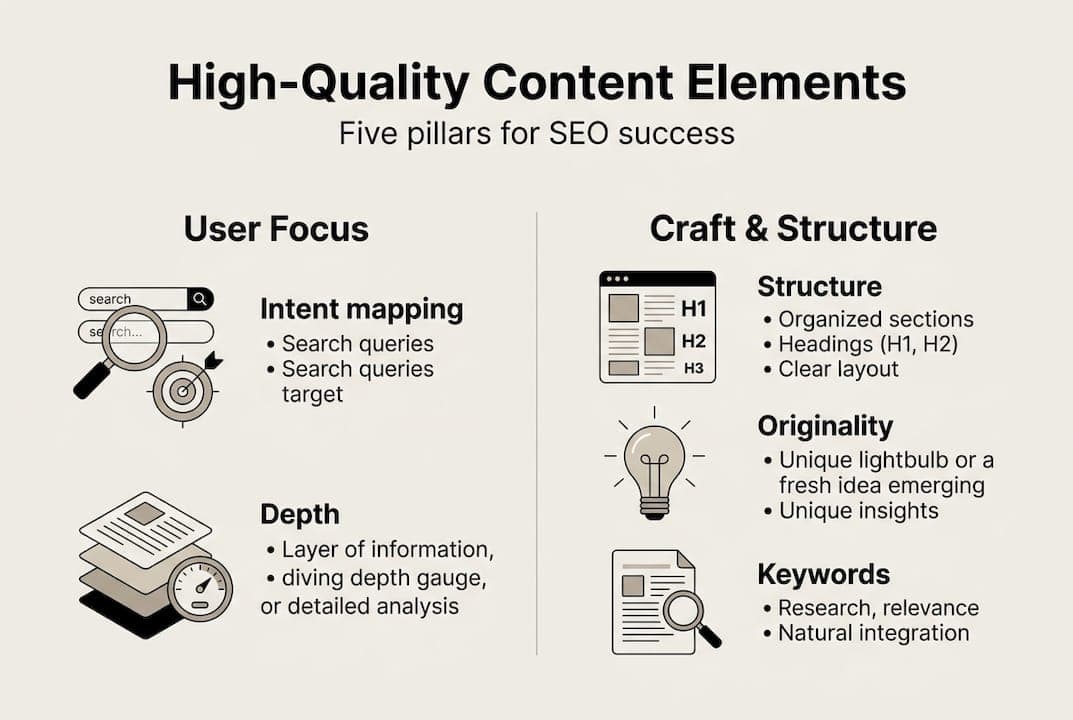
Breaking down quality into its parts makes it much easier to build a repeatable process. There are five elements that consistently separate content that ranks and converts from content that disappears.
1. Intent mapping means understanding not just what someone typed into a search bar, but what they actually need. A search for "email marketing tips" could mean a beginner wanting a starting point or an experienced marketer looking for advanced tactics. Getting this wrong means writing a great article for the wrong audience.
2. Depth goes beyond surface answers. Shallow content covers the obvious. Deep content explains the why, addresses edge cases, and anticipates follow-up questions. This is where enhancing user experience and SEO overlap directly: a reader who gets a complete answer stays longer and trusts your brand more.

3. Structure makes depth accessible. Even the most thorough article fails if it is a wall of text. Clear headings, short paragraphs, bullet lists, and visuals help readers scan, find what they need, and absorb information faster. User experience in SEO is directly tied to how well your formatting guides the reader through the content.
4. Originality is what earns citations and backlinks. Unique data, first-hand experience, or a genuinely different perspective gives other creators a reason to reference your work.
5. Strategic keyword integration means using your target terms naturally, in context, without forcing them into sentences where they feel awkward. Mechanics of quality include in-depth coverage and structured formatting working alongside natural keyword use.
| Element | Weak execution | Strong execution |
|---|---|---|
| Intent mapping | Generic overview | Specific, audience-matched answer |
| Depth | Surface-level tips | Full explanation with examples |
| Structure | Long paragraphs, no headings | Scannable, logical flow |
| Originality | Rephrased competitor content | Unique data or perspective |
| Keyword use | Forced, repetitive | Natural, contextual |
"Content that earns trust earns rankings. The two are not separate goals."
When all five elements align, you create something that works for both the reader and the algorithm.
How content quality impacts key SEO and engagement metrics
The connection between content quality and measurable outcomes is well-documented and direct. Let's look at the numbers.
High-quality content earns 61% more backlinks and sees stronger organic growth than mass-produced content. Backlinks remain one of the strongest ranking signals, and they are almost impossible to earn consistently with thin content. Other sites only link to work they trust and find genuinely useful.Here is how quality affects the metrics you track every day:
| Metric | Low-quality content | High-quality content |
|---|---|---|
| Average ranking position | Page 3 or lower | Page 1, top 5 |
| Backlinks earned | Minimal, slow | Consistent, compounding |
| Time on page | Under 1 minute | 3 to 5 minutes |
| Bounce rate | 70 to 90% | 40 to 55% |
| Featured snippet eligibility | Rare | Common |
Regular content refresh cycles also play a role here. Updating existing high-quality content keeps it competitive and signals to search engines that your site is actively maintained. Updating website content with new data, examples, or expanded sections can recover rankings that have slipped over time.
Mass-produced AI content without editorial oversight is now treated as spam by Google's systems. The risk is not just stagnation. It is active penalization that can wipe out months of progress. Quality acts as your insurance policy against algorithm volatility.
The compounding effect is real: one exceptional article can generate backlinks, social shares, and organic traffic for years. Ten mediocre articles rarely add up to the same result.
Practical frameworks to evaluate and boost your content quality
Knowing quality matters is not enough. You need a system to check it before you publish and improve it after.
Here is a pre-publish checklist you can use for every piece:
- Match the intent — Does the article answer the specific question your target reader has, at the right level of depth?
- Check your sources — Are all claims backed by credible, recent data?
- Scan the structure — Can a reader find the key answer in under 30 seconds by skimming?
- Test for originality — Does this article say something that the top five results do not?
- Read it out loud — Does it sound natural, or does it feel like it was written for a robot?
- Verify keyword placement — Are your target terms used naturally, not stuffed?
Benchmarks show top pages are more comprehensive and consistently outperform shallow, generic content in both rankings and engagement. Depth is not optional if you want to compete.
For ongoing improvement, build these habits into your workflow:
- Run quarterly content audits to identify underperforming pages
- Use reader feedback and comments to find gaps in your coverage
- Track improving content freshness as a KPI, not just a task
- Build a content creation workflow that includes a quality review step before every publish
- Study your top-performing articles and identify what made them work, then replicate those patterns
Pro Tip: Use a simple 1 to 10 scoring rubric across the five quality elements (intent, depth, structure, originality, keyword use) before publishing. Any article scoring below 7 in two or more categories should go back for revision. Pair this with effective SEO headlines to maximize click-through rates from search results.
The goal is not perfection on the first draft. It is building a repeatable system that consistently produces content worth ranking.
Why content quality will always outperform quantity—our take
We have watched countless brands burn through content budgets publishing three to five articles a week, only to see rankings plateau or drop. The pattern is almost always the same: early traction from volume, followed by diminishing returns, followed by a manual or algorithmic penalty that erases the gains.
Google's updates in 2025 and 2026 have made one thing unmistakably clear: the engines are getting better at detecting effort. Not word count. Not publishing frequency. Actual intellectual effort.
The marketers winning right now are the ones treating every article as a product. They ask: "Would someone pay for this information?" If the answer is no, they do not publish it.
Chasing quantity traps you in a cycle where your team is always producing but never improving. Quality forces you to slow down, think harder, and master content creation as a discipline. That discipline compounds over time in a way that volume never will. One authoritative article in your niche is worth more than fifty forgettable ones. Build fewer things, but build them to last.
Level up your SEO with smarter content quality tools
If you are ready to move beyond theory and put these quality-first methods into practice, the right tools can accelerate your results significantly.
At Babylovegrowth.ai, we built our platform specifically for marketers who want to stop guessing and start growing. Our keyword discovery platform surfaces high-intent opportunities your competitors are missing, while our AI keyword research tool helps you map content to the exact queries your audience is searching. Need to scale your authority? Our automated backlink software builds the link equity that quality content deserves. From content audits to structured data markup, every feature is designed to help you produce less, rank more, and grow sustainably.
Frequently asked questions
What are the main attributes of high-quality content?
High-quality content matches user intent, provides comprehensive depth, is well-structured, original, and naturally integrates keywords. Key mechanics of quality content for SEO include all four of these working together.
Does longer content always mean higher quality and better SEO?
Not always. While top pages are often longer, what matters most is information gain, relevance, and depth that genuinely meets user needs rather than length for its own sake.
How does content quality impact backlink acquisition?
Quality content earns significantly more backlinks because it offers unique insights or thorough answers that others want to reference. Top pages earn 61% more backlinks due to superior content quality and depth.
What tools or frameworks can help assess my content quality?
Content quality can be evaluated with structured checklists, scoring frameworks, user feedback, and regular content audits. Structured metrics and frameworks help you assess and improve content quality on a consistent, repeatable basis.