Content Freshness: A 2026 Guide for Marketers


TL;DR:
- Content freshness reflects how current, relevant, and useful webpage content remains to its audience. It is a crucial ranking factor for both search engines and AI tools, with recency directly influencing visibility. Substantive updates, such as significant content expansions and data refreshes, outperform minor edits and boost rankings, especially when aligned with technical signals like schema and headers.
Content freshness is defined as the degree to which a webpage's content remains current, relevant, and useful to its intended audience at any given point in time. Search engines and AI-powered tools treat it as a direct ranking signal, not a secondary consideration. 50% of AI search citations come from content less than 13 weeks old. That single statistic tells you where the visibility battle is being fought. For content strategists and digital marketers, understanding what drives freshness scores, and how to act on them, is now a core competency.

How does content freshness affect SEO and AI rankings?
Content freshness, known in technical SEO as a query-dependent ranking signal, carries different weight depending on how time-sensitive a search query is. News queries demand near-real-time results. Evergreen queries reward accuracy and depth. Both, however, respond to substantive updates.
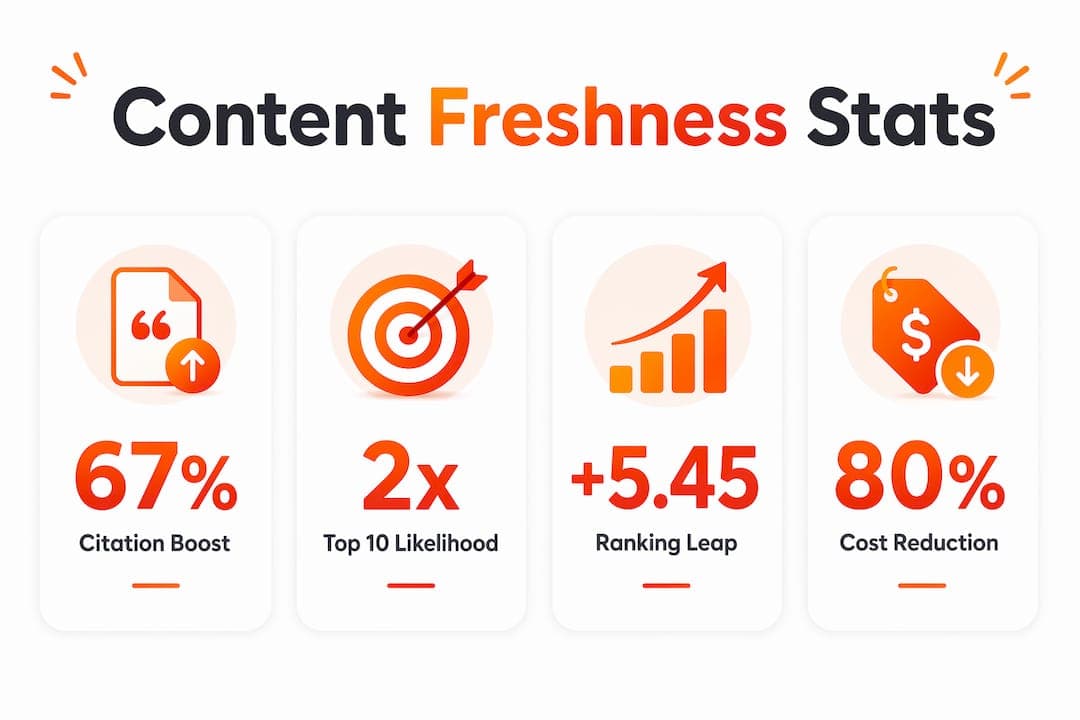
The data from 2026 is specific. Updated pages earn a 67% citation advantage over older, untouched content in generative search engines like Perplexity and ChatGPT. That advantage compounds over time because AI systems are trained to weight recency as a proxy for reliability. A page that was accurate in 2023 but has not been touched since signals potential obsolescence to both crawlers and language models.
The ranking mechanics work through multiple layers. Google measures freshness through HTTP Last-Modified headers, visible publication and update dates, and schema JSON-LD dateModified tags. All three signals need to align. A page where the visible date says "Updated March 2026" but the body content has not changed will not fool Google or any major AI search engine. In fact, changing only the date stamp without substantive edits can trigger a ranking penalty.
Updated pages are also twice as likely to enter Google's top 10 compared to newly published pages, with a 7.7% success rate for updates versus 4.0% for new content. Publishing new articles is not the most efficient path to page one. Refreshing what already has authority is.
| Update Type | Ranking Impact | Notes |
|---|---|---|
| Major expansion (31–100% new content) | +5.45 positions average | Statistically significant (p=0.026) |
| Minor edits (under 10% change) | No measurable gain | Falls in "moderate update trap" |
| Date-only change | Potential penalty | Detected by Google and AI engines |
| Internal link + schema refresh | Moderate positive signal | Often underused by content teams |
| Full structural rewrite | High positive signal | Best combined with new data |
Pro Tip: When you update a page, sync your visible date, your dateModified schema tag, and your HTTP Last-Modified header on the same day. Mismatched signals reduce the freshness credit you receive.
Superficial vs. substantive updates: what actually moves rankings?
The single most common mistake content teams make is treating minor edits as meaningful refreshes. Fixing a typo, swapping one image, or adding a sentence does not register as a substantive update to Google's algorithms or to AI citation systems. This is the "moderate update trap," and it wastes time while creating a false sense of progress.
Major content expansions of 31–100% updates gain statistically significant ranking improvements averaging +5.45 positions. Minor or moderate updates fail to produce positive effects at all. The threshold matters. A 15% change to a 2,000-word article is not enough to move the needle. Adding a new section with fresh data, restructuring the argument, or replacing outdated statistics with 2025–2026 figures crosses the threshold.Substantive updates that consistently produce results include:
- Adding new sections that address questions the original article missed
- Replacing outdated statistics with current research from sources like Amsive, Workshop Digital, or Foglift
- Refreshing internal links to point to newer, more relevant pages on your site
- Updating schema markup to reflect the current
dateModifiedand any new FAQ or HowTo structured data - Rewriting introductions to align with current search intent rather than the intent that existed when the article was first published
What does not work is equally clear. Changing only the publication date, adding a single paragraph without removing outdated content, or making cosmetic formatting changes produces no ranking benefit. AI search engines like Perplexity have freshness signals that correlate strongly with citation frequency at r=0.68. That correlation is driven by metadata and visible content changes together, not one or the other.
Pro Tip: Before updating a page, run a word count comparison between the current version and your planned revision. If you are not changing at least 30% of the body content, the update is likely cosmetic. Aim for 40% or more on competitive queries.
What are the best strategies for keeping content fresh?
The most effective approach to maintaining content freshness combines a structured update calendar with clear criteria for what constitutes a meaningful refresh. Ad hoc updates driven by gut feel produce inconsistent results. A system produces compounding gains.
Set update frequency by competitiveness
Competitive pages targeting high-volume keywords need monthly attention. Pages targeting long-tail or low-competition queries can hold a quarterly cadence. Brands maintaining consistent monthly update cadences stabilize visibility, while only 30% of brands remain visible in consecutive AI search answers without consistent freshness maintenance. Monthly updates for your top 20 pages is a realistic starting point for most content teams.
Build a practical content refresh workflow
A repeatable workflow removes the guesswork from refreshing website content. Here is a numbered process that works:
- Audit performance data. Pull Google Search Console data for the page. Identify queries where impressions are high but click-through rate is declining. That gap signals intent misalignment.
- Benchmark the competition. Check the top 5 ranking pages for your target keyword. Note what sections they cover that your page does not.
- Identify outdated content. Flag any statistics, product references, or recommendations that predate 2024. Replace them with current data.
- Expand substantively. Add at least one new section or significantly rewrite an existing one. Target a 30–40% content change minimum.
- Refresh internal links. Update links to point to your most recent, most relevant supporting pages. Remove links to pages that no longer exist or have been redirected.
- Update schema and metadata. Sync your
dateModifiedschema tag, your meta description, and your visible date on the same day you publish the update. - Measure and iterate. Track rankings, organic sessions, and engagement metrics for 30–60 days post-update. Use that data to prioritize your next refresh cycle.
Use AI tools as a starting point, not a finish line
AI writing tools can accelerate the drafting of new sections or the rewriting of outdated paragraphs. They cannot replace editorial judgment about what a specific audience needs or what angle differentiates your content from the 50 other pages ranking for the same keyword. Content clarity and intent alignment are the competitive edges in AI-driven SEO. A tool can generate text. Only a strategist can decide whether that text answers the right question for the right reader.
Content refreshes provide 3–5 times higher ROI than net-new content creation, with roughly 80% less production cost. That math makes a strong case for shifting budget toward updating existing pages rather than constantly publishing new ones.
How do you measure content freshness and its SEO impact?
Measuring the impact of improving content relevance requires tracking both technical signals and business outcomes. Neither alone gives you the full picture.
The technical signals to monitor are:
- HTTP Last-Modified headers: Confirm these update automatically when you publish changes. Some CMS platforms do not update this header unless specifically configured.
dateModifiedschema: Audit this quarterly using Google's Rich Results Test or Schema Markup Validator.- Crawl frequency: Pages that Google crawls more often are receiving freshness credit. Google Search Console's crawl stats report shows this directly.
The business metrics that reflect freshness impact include organic sessions, keyword ranking positions, click-through rate from search, and time on page. Workshop Digital's analysis of 273 content refreshes found organic sessions growing +447.7% after strategic content refreshes, with clicks increasing over 2,000%. Those numbers represent the ceiling, not the average, but they illustrate the compounding effect of consistent, substantive updates.
| Freshness Signal | What It Measures | SEO Impact |
|---|---|---|
dateModified schema | Last editorial update date | High: directly read by AI crawlers |
| HTTP Last-Modified header | Server-level change timestamp | Medium: used by Googlebot for recrawl priority |
| Visible date on page | User-facing recency signal | High: affects CTR and AI citation weight |
| Internal link updates | Content network currency | Medium: signals active maintenance |
| New inbound links post-update | External validation of refresh | High: amplifies freshness signal |
Pro Tip: Set a recurring calendar event every 30–60 days to audit your top 10 pages by organic traffic. A systemic maintenance calendar syncing technical and editorial updates is more effective than sporadic refreshes triggered only by ranking drops.
Key takeaways
Consistent, substantive content updates are the single most reliable method for maintaining search visibility and AI citation frequency in 2026.
| Point | Details |
|---|---|
| Freshness drives AI citations | 50% of AI search citations favor content under 13 weeks old, making recency a direct visibility factor. |
| Substantive updates win | Only updates changing 31–100% of content produce statistically significant ranking gains. |
| Date-only changes backfire | Changing timestamps without editing body content is detected and can cause ranking penalties. |
| Monthly cadence stabilizes rankings | Brands updating top pages monthly retain AI search visibility far better than those updating sporadically. |
| Refreshes beat new content for ROI | Content refreshes deliver 3–5x higher ROI than publishing new pages at roughly 80% lower production cost. |
The part most content teams get wrong about freshness
By Tilen
Most content teams treat freshness as a publishing schedule problem. They set a calendar, hit their update dates, and wonder why rankings still drift. The calendar is not the issue. What goes into the update is.
The research is clear that minor edits produce no measurable ranking benefit. But I have watched teams spend hours tweaking sentence structure, updating one statistic, and calling a page "refreshed." That is not a refresh. That is maintenance theater.
What actually works is treating each update as a mini-editorial project. Ask: what does this page get wrong today that it got right two years ago? What question is the reader now asking that this page does not answer? What competitor has published something better, and why? Those questions lead to substantive changes. Substantive changes lead to ranking gains.
The other thing I would push back on is the assumption that AI tools solve the freshness problem. They accelerate drafting. They do not replace the judgment call about whether a page is genuinely more useful after the update. Freshness is a function of usefulness, not word count or publication date. A page that is longer but no clearer has not gotten fresher. It has gotten noisier.
The teams winning in AI search right now are the ones treating their content catalog the way a good editor treats a magazine. Every piece gets reviewed on a schedule. Every update has to earn its place. Nothing gets published, or republished, just to fill a slot.
— Tilen
How Babylovegrowth helps you stay ahead of content decay
Keeping dozens of pages fresh on a consistent schedule is where most content teams lose ground. The strategy is clear. The execution is where things break down.
Babylovegrowth is built for exactly this problem. The platform's organic traffic tool tracks ranking shifts and engagement signals across your content catalog, so you can see which pages are decaying before they drop off page one. Paired with Babylovegrowth's AI-driven content scheduling and automated link building, you get a system that keeps your pages technically fresh and authoritative without requiring a full-time team to manage it. If you are serious about compounding your SEO gains through consistent content maintenance, Babylovegrowth gives you the infrastructure to do it at scale.
FAQ
What is content freshness in SEO?
Content freshness is a ranking signal that measures how recently and substantially a webpage has been updated. Google evaluates it through HTTP Last-Modified headers, visible dates, and dateModified schema tags.
How often should i update my website content?
Competitive pages targeting high-volume keywords benefit from monthly updates. Lower-competition pages can hold a quarterly cadence. Brands on monthly update schedules retain significantly better AI search visibility than those updating sporadically.
Do minor edits count as a content refresh?
No. Research shows that only updates changing 31–100% of a page's content produce statistically significant ranking improvements. Minor edits fall into the "moderate update trap" and produce no measurable SEO benefit.
How does content freshness affect AI search citations?
AI search engines like Perplexity and ChatGPT heavily favor recent content. Fifty percent of AI citations come from content under 13 weeks old, and updated pages earn a 67% citation advantage over untouched pages.
Is refreshing old content better than publishing new content?
For most content teams, yes. Content refreshes deliver 3–5 times higher ROI than net-new content creation, with roughly 80% lower production cost, because updated pages retain existing domain authority while gaining freshness signals.