Content Creation Strategies for 2025: Boost Your Results Fast


Content creation is changing faster than ever and success now hinges on a blend of technology, strategy, and true audience understanding. Here’s something you might not expect. Over 80 percent of marketers globally are already using AI to shape their content, transforming how brands connect with people. Yet staying ahead in 2025 isn’t about sheer volume or clever tools. It is about building content that hits real user pain points, adapts for every platform, and never stops improving. This shift is upending the old playbook and opening up wild new opportunities for those ready to rethink their entire approach.
Table of Contents
- Key Components Of Winning Content Creation Strategies
- Proven Processes To Plan And Produce Effective Content
- Optimizing Content For Seo And Audience Growth
- Tools And Tips For Streamlined Content Creation
Quick Summary
| Takeaway | Explanation |
|---|---|
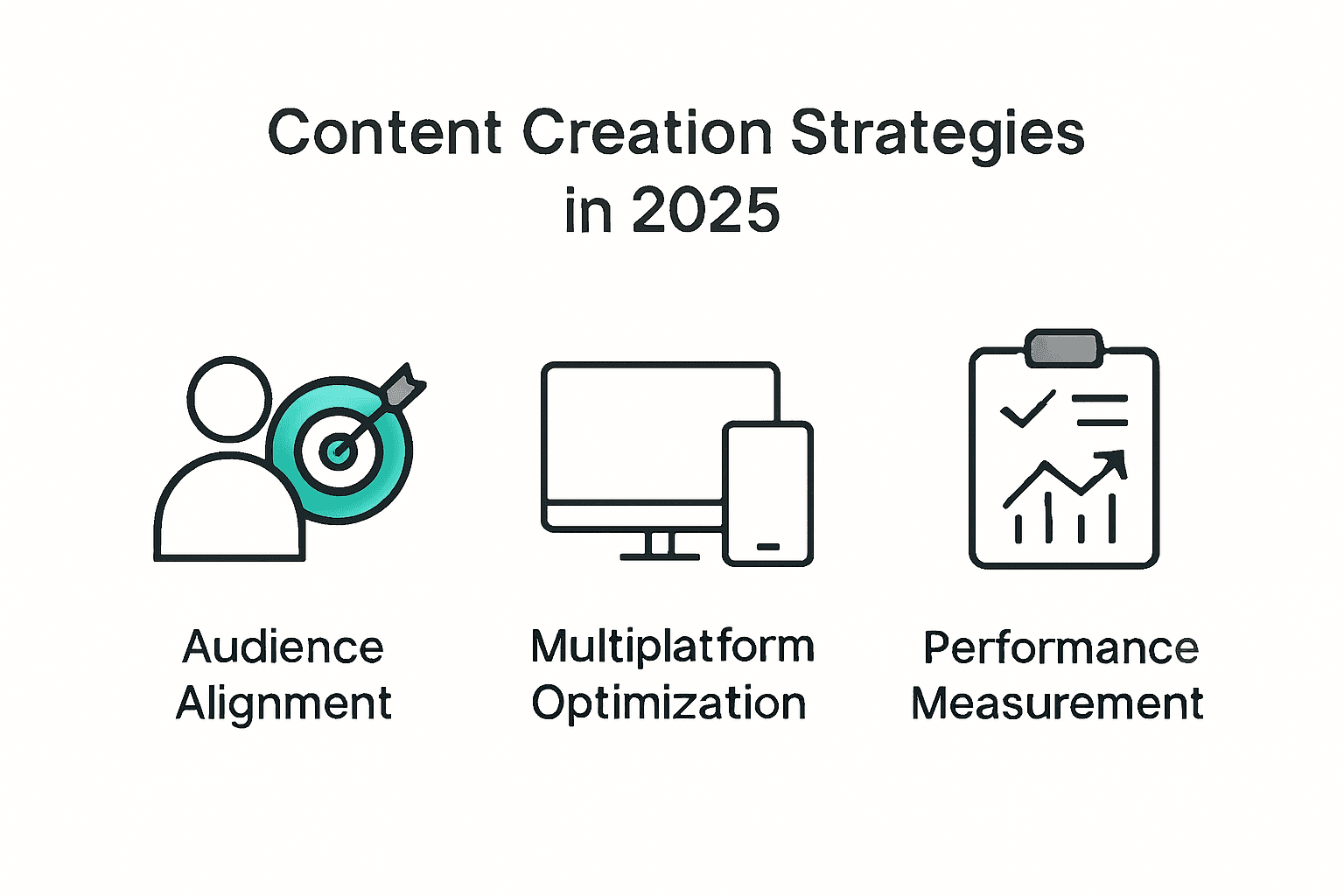
| Strategic Planning and Audience Alignment | Effective content creation begins with precise audience mapping and in-depth understanding of their pain points and preferences, leveraging data analytics and AI tools for nuanced content profiling. |
| Multiplatform Content Optimization | Content strategies need to adapt across various platforms, ensuring consistent messaging while customizing the presentation for each, including social media and voice search. |
| Performance Measurement and Continuous Improvement | Successful strategies involve ongoing measurement of performance metrics beyond traditional ones, utilizing advanced analytics for data-driven decisions and iterative improvements. |
| AI-Powered Content Governance | Integrating AI-powered tools for content governance enhances quality control, ensuring consistency, regulatory compliance, and brand alignment throughout the content production process. |
| Technological Integration and Workflow Optimization | Streamlining content creation requires a comprehensive ecosystem of specialized tools and strategic workflows that enhance productivity while maintaining quality and creativity. |
Key Components of Winning Content Creation Strategies
Content creation strategies have evolved dramatically, requiring businesses to adapt rapidly to emerging digital landscapes. Successful content strategies now demand a sophisticated approach that combines technological innovation, audience understanding, and strategic execution.
Strategic Planning and Audience Alignment
Developing winning content creation strategies begins with precise audience mapping and strategic planning. Over 80% of marketers worldwide are now using AI to enhance their digital marketing approaches, signaling a fundamental shift in content development methodologies. Effective strategies require deep audience insights that go beyond basic demographics.
Successful content strategies prioritize understanding audience pain points, preferences, and consumption habits. This means creating content that speaks directly to specific user needs rather than generic messaging. Marketers must leverage data analytics and AI-powered tools to develop nuanced content profiles that resonate with target segments.
Multiplatform Content Optimization
In 2025, content creation strategies must transcend traditional website publishing. Research indicates that modern audiences search and consume content across diverse platforms including social media, voice search interfaces, and emerging AI tools. This requires a flexible, adaptable content approach that maintains consistent messaging while tailoring presentation for each platform.
Key optimization strategies include:
- Adaptive Content Format: Create content that can be easily transformed across different media types
- Platform-Specific Optimization: Develop variations that suit each platform's unique engagement mechanisms
- Cross-Channel Consistency: Maintain brand voice and core messaging across all platforms
Performance Measurement and Continuous Improvement
Winning content creation strategies are not static but dynamic systems of continuous refinement. Research from industry experts reveals that 65% of successful teams maintain a documented content marketing strategy focused on measurable outcomes. This approach enables businesses to track performance, identify successful patterns, and rapidly iterate their content approaches.
Effective measurement involves tracking multiple performance indicators beyond traditional metrics. Modern content strategies integrate advanced analytics that provide granular insights into audience engagement, conversion potential, and content effectiveness. By implementing robust tracking mechanisms, businesses can make data-driven decisions that progressively enhance their content creation strategies.
The future of content creation demands a holistic, technology-enabled approach that combines strategic planning, platform versatility, and continuous performance optimization. Organizations that embrace these principles will be best positioned to create compelling, impactful content that drives meaningful audience engagement and business growth.
Proven Processes to Plan and Produce Effective Content
Creating effective content requires a systematic approach that combines strategic planning, creative execution, and data-driven optimization. Successful content production in 2025 demands more than just generating material businesses must develop robust processes that ensure consistent quality and audience relevance.
Content Discovery and Ideation
The foundation of effective content production starts with intelligent discovery and ideation processes. Research from marketing experts reveals that 78% of audiences prefer consuming short video content in 2025, underscoring the importance of understanding audience preferences during the initial planning stage. Successful content teams leverage multiple strategies to generate compelling ideas:
- Audience Insight Mining: Use advanced analytics and AI tools to uncover genuine audience interests
- Competitive Content Analysis: Identify content gaps and opportunities within your industry
- Trend Monitoring: Track emerging topics and discussions relevant to your target market

Sophisticated content discovery goes beyond superficial trend tracking. It requires deep ecosystem analysis that connects audience needs with your brand's unique value proposition. AI-powered tools now enable businesses to conduct rapid, comprehensive research that reveals nuanced content opportunities previously impossible to identify.
Strategic Content Production Workflow
Developing a streamlined content production workflow is crucial for consistent output. Data from industry analysts indicates that brands succeeding in 2025 make data-driven decisions and strategically deliver content through preferred channels. An effective workflow typically involves several key stages:
- Comprehensive research and audience mapping
- Detailed content brief development
- Collaborative creation process
- Rigorous quality assurance
- Multi-channel optimization
Modern content teams integrate collaborative technologies that enable seamless communication and efficient production. Cloud-based platforms and AI-assisted writing tools help teams maintain high-quality standards while accelerating content creation timelines.
Performance Tracking and Continuous Optimization
Content production is not a one-time event but an ongoing process of refinement. Successful strategies incorporate continuous measurement and adaptation mechanisms. Advanced analytics now provide granular insights into content performance across different platforms and audience segments.
Tracking goes beyond basic metrics like views or clicks. Sophisticated content teams analyze deeper engagement indicators such as time spent, interaction rates, and conversion potential. These insights allow for precise content strategy adjustments that progressively improve audience connection and business outcomes.
Proven content production processes in 2025 blend human creativity with technological innovation. By implementing structured workflows, leveraging advanced research tools, and maintaining a data-driven optimization approach, businesses can develop content strategies that truly resonate with their target audiences. The key lies in flexibility, continuous learning, and a commitment to understanding evolving audience preferences.
Optimizing Content for SEO and Audience Growth
Content optimization in 2025 demands a sophisticated approach that goes beyond traditional keyword stuffing and generic strategies. Successful SEO now requires an intelligent blend of technical precision, audience understanding, and strategic content development.
Advanced Keyword and Intent Optimization
Research from marketing experts reveals that 39% of marketers prioritize on-page content optimization through strategic keyword integration. Modern SEO strategies focus on understanding user intent rather than simply targeting exact match keywords. This means developing content that comprehensively addresses user questions, provides actionable insights, and delivers genuine value.Successful keyword optimization involves:
- Semantic Keyword Research: Identify related concepts and user search patterns
- User Intent Mapping: Understand the underlying motivations behind search queries
- Long-Tail Keyword Integration: Target specific, nuanced search phrases
Advanced AI tools now enable marketers to conduct deep semantic analysis, uncovering complex relationships between search terms and user needs. This approach allows for more natural, contextually rich content that genuinely serves audience requirements.
Technical SEO and Content Architecture
Content structure plays a critical role in search engine visibility. Modern SEO demands a technical approach that considers multiple optimization factors beyond traditional on-page elements. Successful content strategies integrate:
- Mobile-first design and responsive content
- Fast page loading speeds
- Clear content hierarchies
- Structured data markup
- Comprehensive internal linking
Technical optimization requires understanding search engine algorithms while maintaining a user-centric approach. This means creating content that is both technically sound and genuinely engaging. Industry data indicates that 46% of B2B marketers plan to increase content marketing investments in 2025, highlighting the growing importance of sophisticated SEO strategies.
Performance Measurement and Continuous Refinement
Optimizing content is an ongoing process of measurement and adaptation. Advanced analytics now provide granular insights into content performance across different platforms and audience segments. Successful teams track multiple performance indicators that go beyond traditional metrics like rankings and traffic.
Key performance tracking involves:
- Engagement depth
- Conversion potential
- User interaction patterns
- Content relevance across different audience segments
By implementing robust tracking mechanisms, businesses can make data-driven decisions that progressively enhance their content's search visibility and audience connection. The most successful SEO strategies view optimization as a continuous learning process that adapts to evolving search technologies and user behaviors.
Optimizing content for SEO and audience growth in 2025 requires a holistic approach that blends technical expertise, deep audience understanding, and continuous innovation. Organizations that master this complex interplay will be best positioned to create content that not only ranks well but truly resonates with their target audiences.
Tools and Tips for Streamlined Content Creation
Content creation in 2025 demands sophisticated tools and strategic approaches that maximize efficiency while maintaining high-quality output. Successful teams leverage advanced technologies and intelligent workflows to transform complex content production processes into streamlined, productive experiences.
Comprehensive Content Creation Tool Integration
Research from industry experts reveals that integrating specialized content creation tools significantly enhances workflow efficiency. Modern content teams require a comprehensive ecosystem of tools that cover multiple production stages. These tools span research, writing, design, analytics, and collaboration platforms.Key tool categories for effective content creation include:
- Research Tools: Platforms like AnswerThePublic and Google Trends for audience insight mining
- Writing Assistance: AI-powered writing platforms that help draft and refine content
- Visual Design: Graphic design and video production tools
- SEO Optimization: Advanced keyword and content performance analysis platforms
Successful integration involves selecting tools that communicate seamlessly, reducing manual transfer of information and minimizing potential errors. The goal is creating a unified workflow where different technologies complement each other, enabling creators to focus on strategic and creative aspects of content production.
AI-Powered Content Governance and Quality Control
Advanced content governance platforms now enable organizations to automatically audit and refine both AI-generated and human-created content. These sophisticated systems ensure consistency, brand alignment, and regulatory compliance across multiple content types and languages.Effective content governance involves:
- Automated style and tone verification
- Compliance checks for industry-specific regulations
- Multilingual content standardization
- Brand voice consistency monitoring
By implementing intelligent content governance tools, businesses can maintain high-quality standards while accelerating production timelines. These platforms provide real-time feedback and suggestions, helping teams create more precise, aligned, and impactful content.
Strategic Workflow Optimization
Streamlining content creation goes beyond tool selection. It requires developing strategic workflows that maximize team productivity and creativity. Effective strategies in 2025 emphasize creating flexible processes that adapt to changing project requirements and team capabilities.
Key workflow optimization principles include:
- Establishing clear content creation protocols
- Implementing collaborative project management systems
- Creating modular content frameworks
- Developing continuous learning and skill development programs
Successful teams recognize that tools are enablers, not replacements for human creativity. The most effective content creation strategies balance technological innovation with human insight, allowing teams to produce remarkable content efficiently.
Navigating content creation in 2025 requires a holistic approach that combines cutting-edge tools, intelligent workflows, and a deep understanding of audience needs. Organizations that master this complex ecosystem will transform content production from a challenging task into a strategic competitive advantage.
Frequently Asked Questions
What are the key components of winning content creation strategies for 2025?
Effective content creation strategies for 2025 involve strategic planning and audience alignment, multiplatform content optimization, and ongoing performance measurement for continuous improvement.
How can I optimize my content for different platforms?
To optimize content for various platforms, create adaptive content formats, tailor messages specific to each platform's audience, and ensure cross-channel consistency in branding and messaging.
What role does AI play in content creation strategies?
AI is essential in modern content creation, enabling marketers to analyze audience data, generate insights for content development, and maintain quality control through automated governance tools.
How can I measure the performance of my content?
Measuring content performance involves tracking multiple indicators such as engagement depth, conversion potential, and user interaction patterns, utilizing advanced analytics for deeper insights.
Ready to Turn Content Overwhelm Into Lasting Results?
Many businesses face the frustration of pouring hours into content, only to feel unsure if it truly connects with their audience or outranks competitors. The article above highlights a crucial pain point for marketers in 2025: balancing smarter content strategies, multiplatform optimization, and AI-powered innovation while never losing the personal touch. If developing a winning plan, optimizing for SEO, and keeping up with the rapid pace of modern content is leaving you stretched thin, you are not alone.

Take control right now by letting BabyLoveGrowth.ai simplify your journey. Tap into in-depth business analysis and get a customized 30-day content roadmap tailored for your SEO goals. Experience effortless content production that resonates with your audience while you focus on what matters most. See how automated SEO content can help you soar above the competition. Discover your personalized path to content growth today.