Branding Through Digital Marketing: AI Strategies for 2026


TL;DR:
- Building brand clarity before digital marketing ensures messaging is strong and differentiated.
- Consistency across digital channels maintains trust and reinforces brand identity.
- Human oversight paired with AI tools is essential to create authentic and distinctive branding.
Most business owners make the same critical mistake: they jump straight into digital marketing before they've built a solid brand foundation. They run ads, post on social media, and chase keywords, then wonder why the results feel hollow. The truth is that digital marketing without brand clarity is like turning up the volume on a song nobody likes. AI-driven digital marketing has changed the game, but only for businesses that understand their brand first. In this article, you'll find a practical, step-by-step approach to building strong, AI-powered branding that actually drives visibility and long-term growth.
Table of Contents
- Why brand clarity comes before digital marketing
- Building consistency across digital channels
- Harnessing AI for effective branding and marketing
- Practical steps for applying AI-driven branding online
- The uncomfortable truth about branding with AI
- Boost your brand's online impact with our AI solutions
- Frequently asked questions
Key Takeaways
| Point | Details |
|---|---|
| Brand clarity first | Define your brand before launching digital marketing to stand out and avoid price competition. |
| Consistency drives trust | Maintain a cohesive brand presence across all channels for greater recognition and loyalty. |
| AI needs oversight | AI tools can amplify branding but require human review to avoid generic, undifferentiated results. |
| Practical action plans | A step-by-step AI branding roadmap ensures strategic execution and measurable results. |
| Invest in governance | Strong brand governance protects your brand’s distinctiveness in the digital landscape. |
Why brand clarity comes before digital marketing
Think about the last time you chose one business over another, even when the competitor was cheaper. Odds are, the brand you picked felt more trustworthy, more aligned with what you valued, or simply more memorable. That's brand clarity at work. Without it, your digital marketing becomes generic and interchangeable, and you end up competing on price alone, which is a race to the bottom for any small or medium business.
Brand first before marketing is the sequence that prevents your business from sliding into commodity territory. When you clarify your brand values, your voice, and your positioning before you touch a single ad campaign or SEO strategy, every piece of digital content you create carries real weight. It speaks to the right people with a clear message, rather than shouting into the void.The risks of skipping this step are real and measurable. Businesses that launch digital campaigns without a defined brand often attract the wrong audience, generate inconsistent messaging across platforms, and earn lower customer loyalty over time. They also struggle to justify premium pricing, because nothing they put out communicates why they're worth more.
Here's what achieving brand clarity actually looks like in practice:
- Define your core values. What does your business stand for beyond making money? Write these down in plain language, not corporate jargon.
- Identify your ideal customer. Get specific about who they are, what they worry about, and what kind of brand voice they respond to.
- Craft your unique positioning statement. This is one clear sentence explaining who you serve, what you offer, and why you're different.
- Document your brand personality. Are you formal or conversational? Bold or reassuring? This guides all future content decisions.
- Align your visual identity. Colors, fonts, and logo usage should reflect the personality you've just defined.
Learning how to build a brand online with AI-driven strategies becomes far more effective once these foundations are in place. Likewise, working through a solid AI brand strategy guide helps you map those values into digital content that actually converts.
"The sequence matters more than most businesses realize. Get the brand defined before you activate digital tactics, or you'll always be marketing a product rather than building a business." — The Marketing Juice
Building consistency across digital channels
Once your brand is defined, consistency is the next essential piece. You can have the clearest brand values in the world, but if your Instagram profile looks completely different from your website, and your email newsletters sound like they were written by someone else entirely, customers will feel the disconnect even if they can't explain it. Trust erodes quietly when brands feel inconsistent.

Consistency across digital channels isn't just a nice-to-have, it requires active governance. Governance simply means having documented rules about how your brand looks, sounds, and behaves in every customer touchpoint.
Here's a comparison of what consistent versus inconsistent branding looks like across key platforms:
| Platform | Consistent branding | Inconsistent branding |
|---|---|---|
| Website | Clear tone, matching colors, aligned messaging | Mixed fonts, different value propositions per page |
| Social media | Same visual style, brand voice maintained | Random posting styles, off-brand humor or imagery |
| Email marketing | Recognizable templates, consistent subject line tone | Different layouts, varying degrees of formality |
| Paid ads | On-brand visuals and copy that match landing pages | Mismatched promises, disconnected landing pages |
| Content marketing | Unified editorial voice, consistent topic authority | Random topics, multiple competing voices |
The elements that make a brand feel cohesive across all platforms include:
- A defined color palette used in every visual asset
- One or two approved fonts applied consistently
- A tone of voice guide with real examples of on-brand versus off-brand language
- A logo usage guide covering sizing, spacing, and background rules
- A content calendar that reinforces a consistent brand narrative over time
Pro Tip: Review every digital asset quarterly, including social media bios, website headers, and email templates. Brands drift over time as different team members contribute content. A quarterly audit catches inconsistencies before they compound into a bigger problem.
Exploring brand consistency tips for business growth in 2026 can give you a deeper framework for auditing your current presence. Pairing that with strategies for fostering brand loyalty through AI content helps you turn consistent branding into actual customer retention.
Harnessing AI for effective branding and marketing
After establishing consistency, it's time to leverage AI wisely in your branding efforts. AI tools can dramatically speed up content creation, keyword research, and competitive analysis. But there's a real danger hiding inside the convenience: without careful oversight, AI produces content that sounds fine but feels generic. Every competitor using the same AI tool gets nearly identical output, which means your brand can disappear into a sea of indistinguishable content.
AI risks generating "vanilla" output that lacks the personality and differentiation your brand needs to stand out. Human oversight isn't optional here. It's what separates brands that grow from brands that just produce a lot of content.
Here's a look at how common AI-driven branding tools perform and where the differentiation risks show up:
| AI tool type | Key capabilities | Differentiation risk |
|---|---|---|
| AI content generators | Fast article and copy production | High: outputs can sound templated |
| AI SEO analyzers | Keyword research, competitor gap analysis | Medium: insights are widely available |
| AI image generators | On-brand visuals at scale | Medium: styles can overlap with competitors |
| AI chatbots for engagement | Customer interaction, personalization | Low to medium: depends on training |
| AI analytics platforms | Audience behavior, campaign tracking | Low: data interpretation adds human value |
To blend AI efficiency with genuine brand differentiation, follow these steps:
- Feed your brand voice into every AI tool. Before generating any content, input your brand values, tone of voice guidelines, and target audience details as part of your prompt. This narrows the output significantly.
- Use AI for structure, not the final product. Let AI draft outlines, suggest keywords, and generate initial copy. Then have a human editor shape it into something that genuinely reflects your brand's personality.
- Run a "sameness check" before publishing. Search for key phrases in your AI-generated content and see if competitors are saying the same thing. If they are, rewrite until your take is distinctly yours.
- Rotate creative inputs regularly. Use different prompts, angles, and creative briefs to prevent your AI-generated content from falling into repetitive patterns.
- Capture real customer stories for content. AI can't replicate authentic testimonials or case studies. These are your most powerful differentiation tools and they're entirely human.
Pro Tip: Always run AI-generated content through your brand voice checklist before it goes live. Ask yourself: would your best customer immediately recognize this as coming from your brand? If the answer is no, revise before publishing.
Building AI SEO strategies for brand visibility alongside robust AI analytics for brand awareness creates a feedback loop where your branding gets smarter over time. Understanding the broader impact of AI on digital marketing also helps you stay ahead of shifts that could affect how your audience discovers and engages with your brand.
Practical steps for applying AI-driven branding online
You've seen the tools. Now here's how to put them into action with a step-by-step approach that closes the gap between knowing and doing.
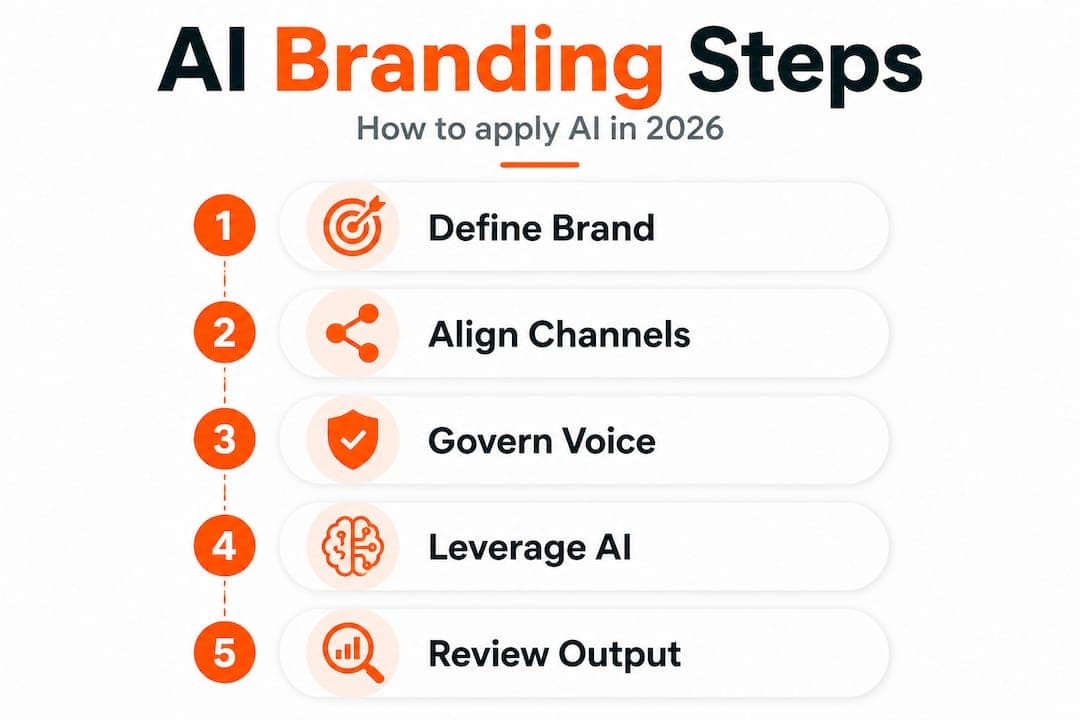
Businesses that adopt AI-driven marketing see measurable improvements in output volume, content quality consistency, and search visibility when governance is built into every stage. But that governance piece is what most businesses skip. Human oversight for differentiation isn't a one-time review; it's a recurring commitment built into your workflow.
Here's a practical roadmap for launching AI-driven branding initiatives:
- Conduct a brand audit before you start. Document what currently exists: all digital profiles, content samples, and visual assets. This gives you a baseline and reveals inconsistencies to fix before AI amplifies them.
- Build your AI content brief library. Create a set of reusable prompt templates that include your brand values, tone, target audience, and key differentiators. These become the foundation for every AI-assisted piece you create.
- Select AI tools aligned with your goals. Don't adopt every available tool. Choose one for content generation, one for SEO analysis, and one for performance tracking. Master these before expanding your toolkit.
- Establish a human review checkpoint. Every AI-generated piece goes through at least one human review before publishing. This person checks for brand voice alignment, factual accuracy, and genuine differentiation.
- Set a content publishing cadence. Consistency in publishing frequency reinforces brand reliability. Use AI to maintain that cadence without sacrificing quality by relying on your brief library and review process.
- Track brand-specific metrics. Beyond traffic and rankings, measure brand awareness indicators like direct search volume for your business name, branded keyword performance, and social mentions. These tell you whether your branding is actually landing.
- Iterate based on audience signals. Review which content generates the strongest engagement and adjust your AI prompts and brand messaging accordingly every 60 to 90 days.
Using strategic AI marketing planning as your operational framework keeps every one of these steps connected to a bigger growth objective rather than isolated tactics.
The uncomfortable truth about branding with AI
Here's the take that most articles won't give you: AI is an extraordinary accelerator for businesses that already know who they are, and a very expensive echo chamber for businesses that don't.
We've seen businesses pour time and budget into AI-driven content production, only to build a louder version of a brand that was already unclear. The AI generated hundreds of articles. The articles ranked for keywords. The traffic came. And the conversions didn't, because the brand behind all that content lacked a compelling reason for anyone to choose it over a competitor.
AI-generated content risks "vanilla" sameness precisely because it draws from the same massive pool of existing information. When every business in your market uses AI to write about the same topics with similar prompts, the outputs converge. They're not wrong, exactly. They're just not you.
The businesses winning with AI-driven branding right now are the ones treating AI as a production tool, not a strategy tool. Strategy still requires human judgment, lived experience, and real understanding of your customers. AI can tell you what keywords are trending. It cannot tell you why your particular customers stayed loyal through a difficult period, or what emotional need your product actually fulfills.
"The brands that stand out in an AI-saturated market are the ones that put something irreplaceable into their content: a genuine point of view built by humans."
Invest in human creative leadership alongside your AI tools. A brand strategist, a skilled editor, or even a founder willing to share an authentic perspective adds something no model can replicate. Pairing that human leadership with smart AI-powered content marketing at scale is where the real competitive advantage lives.
The uncomfortable message is that AI rewards the brands that did the hard strategic work first. There are no shortcuts to brand clarity. But once you have it, AI becomes the most powerful amplifier you've ever had.
Boost your brand's online impact with our AI solutions
If this article sparked a sense of urgency about your brand's digital presence, you're in the right place.
At Babylovegrowth.ai, we help small and medium businesses build real online visibility through AI-driven content and backlink strategies that are optimized for both Google and ChatGPT. Our platform starts with a personalized 30-day content plan built around your brand, not a generic template. From there, our automated SEO workflow keeps your content consistent and your rankings climbing, while our automated backlink building tool strengthens your domain authority at scale. If you're ready to stop guessing and start growing with a system that puts your brand first, explore what Babylovegrowth.ai can do for your business today.
Frequently asked questions
Why is brand definition important before digital marketing?
Defining your brand first ensures your marketing communicates a clear, differentiated message rather than competing on price alone. Brand clarity before marketing is the sequence that protects your positioning and makes every digital tactic more effective.
How can AI enhance branding without making it generic?
AI amplifies your branding output, but human oversight is what keeps the content unique and aligned with your brand voice. Without review, AI produces "vanilla" output that looks like every competitor's content.
What is brand governance, and why does it matter online?
Brand governance is a documented set of rules covering your visual identity, tone of voice, and messaging standards. Governance across digital channels prevents inconsistency that erodes customer trust over time.
What risks should businesses watch for with AI-driven branding?
The biggest risk is assuming AI-generated content automatically differentiates your brand. Because AI output risks sameness, every piece needs a human review to ensure it genuinely reflects your unique positioning before it's published.