What is email marketing? Guide to cost-effective growth


Email marketing delivers an astounding $36 return for every dollar spent, making it one of the most profitable digital channels available. This direct digital communication strategy uses email to engage customers, build brand awareness, retain loyal audiences, and drive consistent sales. This guide teaches you cost-effective, measurable strategies to launch and optimize email campaigns that fuel organic growth for your business.
Table of Contents
- Introduction To Email Marketing
- Why Email Marketing Remains Cost-Effective And Powerful
- How Personalization And Segmentation Drive Organic Customer Growth
- Common Misconceptions And Pitfalls In Email Marketing
- Essential Tools And Automation Strategies For Effective Campaigns
- Benchmark KPIs And Real-World Use Cases
- Practical Steps For Small To Medium Businesses To Start And Optimize Email Marketing
- Boost Your Email Marketing With BabyLoveGrowth Solutions
- Frequently Asked Questions About Email Marketing
Key takeaways
| Point | Details |
|---|---|
| Email marketing delivers exceptional ROI | Campaigns are scalable and measurable with returns far exceeding most digital channels. |
| Personalization and segmentation boost engagement | Tailored content significantly increases open rates, clicks, and conversions. |
| Automation tools enhance efficiency | Automated workflows save time while improving campaign performance and consistency. |
| Tracking KPIs is essential | Monitor open rates, click rates, and conversions to refine and optimize campaigns. |
| Avoid common pitfalls | Poor segmentation and excessive emailing harm engagement and subscriber trust. |
Introduction to email marketing
Email marketing is direct digital communication that uses email to connect with customers, prospects, and audiences. It serves three primary goals: building brand awareness, retaining existing customers, and driving sales through targeted messaging. The core mechanisms include list building, segmentation, personalization, and automation.
Successful email marketing starts with permission-based lists where subscribers opt in to receive your messages. This consent-based approach ensures compliance with regulations and builds trust with your audience. You collect email addresses through website forms, lead magnets, social media, and customer transactions.
Segmentation divides your email list into smaller groups based on demographics, behavior, purchase history, or engagement levels. This targeted approach allows you to send relevant messages to each group. Personalization takes segmentation further by customizing email content with recipient names, product recommendations, and dynamic content that matches individual preferences.
Automation streamlines your campaigns by triggering emails based on specific actions or timelines. Welcome sequences greet new subscribers, abandoned cart reminders recover lost sales, and re-engagement campaigns win back inactive contacts. These automated workflows run continuously without manual intervention, saving time while maintaining consistent communication.
Key components of email marketing include:
- Building permission-based subscriber lists through opt-in forms
- Segmenting audiences by behavior, demographics, and engagement
- Personalizing content to match subscriber preferences and history
- Automating workflows to trigger timely, relevant messages
- Monitoring performance metrics to refine and optimize campaigns
Why email marketing remains cost-effective and powerful
Email marketing generates an average return of $36 for every $1 spent, far exceeding returns from social media advertising, display ads, and many other digital channels. This exceptional ROI makes email marketing the most cost-efficient customer acquisition and retention strategy for small to medium businesses. Low infrastructure costs, minimal per-message expenses, and powerful automation tools allow you to scale campaigns without proportional cost increases.
Unlike paid advertising that requires continuous budget allocation, email marketing provides sustainable returns through owned audience relationships. You control your subscriber list and can communicate directly without paying platform fees or bidding for visibility. This ownership translates to predictable costs and long-term value from each subscriber relationship.
Email campaigns scale effortlessly from hundreds to millions of subscribers with minimal cost increases. Automation platforms charge based on list size, but per-message costs remain negligible compared to paid advertising. A business spending $200 monthly on email automation can reach 10,000 subscribers repeatedly, while the same budget might deliver only 400 clicks through paid search ads.
| Channel | Average ROI | Cost per 1000 Reaches | Control Level |
|---|---|---|---|
| Email Marketing | $36 per $1 spent | $5 to $15 | Full ownership |
| Social Media Ads | $2 to $4 per $1 spent | $25 to $100 | Platform dependent |
| Paid Search | $2 to $3 per $1 spent | $50 to $200 | Bidding competition |
| Display Advertising | $1 to $2 per $1 spent | $10 to $50 | Limited targeting |
The comparison reveals email marketing's superior efficiency for businesses prioritizing sustainable growth. Social media algorithms control organic reach, requiring paid promotion to reach your own followers. Email delivers messages directly to inboxes, ensuring visibility without competing for attention in crowded feeds. This direct access combined with email campaigns and SEO winning strategies creates compounding returns over time.
Automation multiplies cost-efficiency by running campaigns continuously without manual effort. Welcome series, nurture sequences, and re-engagement campaigns operate 24/7, converting subscribers while you focus on other business priorities. Integration with customer data platforms enables sophisticated personalization at scale, delivering relevant messages that drive higher conversion rates.
Pro Tip: Prioritize automation from day one by setting up core workflows like welcome sequences, abandoned cart recovery, and post-purchase follow-ups to maximize returns with minimal ongoing effort.
How personalization and segmentation drive organic customer growth
Personalization in email marketing increases transaction rates by up to 6 times compared to generic broadcasts, transforming casual subscribers into loyal customers. Tailored emails acknowledge individual preferences, purchase history, and behavior patterns, creating relevant experiences that build trust and encourage repeat engagement. This relevance drives organic growth as satisfied customers become brand advocates who refer others and increase lifetime value.
Segmented email lists consistently outperform untargeted broadcasts across all key metrics. Open rates increase by 15% to 30%, click-through rates jump 50% to 100%, and conversion rates often double when messages align with subscriber interests and needs. These improvements compound over time, generating sustainable growth without additional acquisition costs.
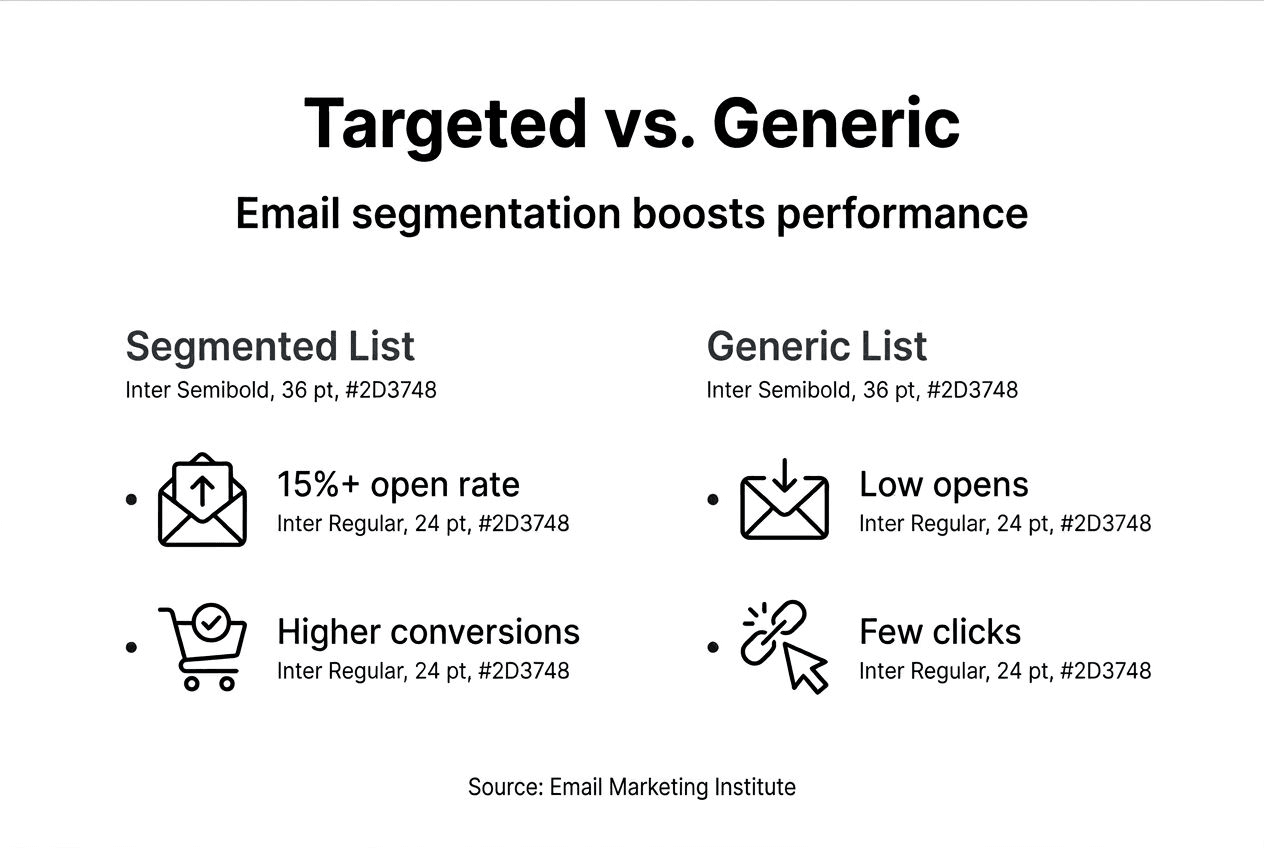
Lifecycle segmentation nurtures leads through each customer journey stage, from awareness to advocacy. New subscribers receive educational content and brand introductions, active customers get product recommendations and exclusive offers, while lapsed contacts receive win-back campaigns. This targeted approach respects where each subscriber stands in their relationship with your brand.
| Segmentation Type | Impact on Open Rate | Impact on CTR | Best Use Case |
|---|---|---|---|
| Demographic | 10% to 20% increase | 15% to 25% increase | Age, location, job role targeting |
| Behavioral | 20% to 35% increase | 40% to 60% increase | Purchase history, browsing activity |
| Engagement Level | 25% to 40% increase | 50% to 80% increase | Active vs inactive subscribers |
| Lifecycle Stage | 30% to 45% increase | 60% to 100% increase | Lead nurturing, retention campaigns |
Personalization examples that drive measurable results include:
- Dynamic product recommendations based on browsing history and past purchases
- Personalized subject lines featuring subscriber names or relevant interests
- Customized content blocks showing different offers to different segments
- Triggered emails based on specific actions like cart abandonment or content downloads
- Location-based offers and event invitations matching subscriber geography
Behavioral data provides the richest personalization opportunities. Track email opens, link clicks, website visits, purchase frequency, and cart abandonment to understand subscriber interests and intent. Use this intelligence to refine segments continuously and deliver increasingly relevant messages. The connection between personalized marketing and ecommerce success demonstrates how tailored experiences drive both immediate sales and long-term customer loyalty.
Advanced personalization leverages AI to predict subscriber preferences and optimize send times for each individual. Machine learning algorithms analyze historical engagement patterns to determine when each subscriber is most likely to open and act on emails. This precision timing combined with relevant content creates powerful conversion opportunities.
Pro Tip: Use behavioral data to refine segmentation continuously by tracking which content types, offers, and messaging styles generate the best response from each segment, then adjust your strategy accordingly.
Common misconceptions and pitfalls in email marketing
Many marketers mistakenly believe email marketing is outdated, replaced by social media and messaging apps. Reality contradicts this assumption: 90% of adults prefer email for business communications, and email usage continues growing year over year. While social platforms come and go, email remains the universal digital communication standard that works across all demographics and industries.
The misconception that bigger lists automatically mean better results leads to poor practices. Businesses often buy email lists or scrape contacts without permission, resulting in low engagement, high spam complaints, and damaged sender reputation. These untargeted lists generate minimal returns while risking blacklisting that prevents future emails from reaching any inboxes.
Over-emailing ranks among the most common pitfalls, destroying subscriber relationships through message fatigue. Sending daily promotional emails without regard for subscriber preferences triggers unsubscribes and spam reports. Respect for subscriber time and inbox space builds trust, while excessive messaging erodes goodwill and engagement.
Common mistakes that reduce email marketing effectiveness:
- Purchasing email lists instead of building organic, permission-based audiences
- Sending identical messages to entire lists without segmentation or personalization
- Ignoring mobile optimization when 60% of emails are opened on mobile devices
- Failing to test subject lines, content, and calls to action before sending
- Neglecting to clean lists by removing inactive subscribers and bounced addresses
- Writing misleading subject lines that damage trust and increase spam complaints
- Overlooking compliance requirements like unsubscribe links and physical addresses
Poor segmentation wastes opportunities by treating all subscribers identically. A new subscriber needs different content than a loyal customer who has made multiple purchases. Sending product announcements to people who just bought that product frustrates recipients and signals that you are not paying attention to their relationship with your brand.
The solution combines consent-based list building, intelligent segmentation, and respectful communication frequency. Ask subscribers to confirm their preferences, send only relevant content to each segment, and provide easy preference management. This approach maintains healthy lists with engaged subscribers who actually want to hear from you.
Essential tools and automation strategies for effective campaigns
Email service providers form the foundation of successful campaigns, offering templates, automation workflows, list management, and analytics. Popular platforms include Mailchimp, ConvertKit, ActiveCampaign, and HubSpot, each serving different business sizes and needs. Small businesses benefit from user-friendly interfaces and affordable pricing, while growing companies need advanced segmentation and integration capabilities.
Automation saves up to 70% of manual time while increasing engagement by 80% through timely, relevant messaging. Automated workflows trigger based on subscriber actions, dates, or behaviors, delivering the right message at the perfect moment. Welcome sequences introduce new subscribers to your brand, nurture campaigns educate prospects over time, and re-engagement series revive inactive contacts.
AI-powered tools enhance personalization and timing by analyzing subscriber behavior patterns and predicting optimal engagement moments. These systems test subject lines automatically, recommend content based on individual preferences, and adjust send times for each subscriber. The integration of AI in content marketing extends to email, enabling sophisticated personalization at scale.
Key automation tool categories include:
- Email service providers for campaign creation, sending, and basic automation
- Marketing automation platforms for complex workflows and multi-channel campaigns
- AI optimization tools for subject line testing, send time optimization, and content recommendations
- Analytics platforms for deep performance insights and attribution tracking
- Integration tools connecting email platforms with CRM, ecommerce, and other business systems
When selecting tools, prioritize platforms that integrate seamlessly with your existing technology stack. Email marketing works best when connected to your website, CRM, ecommerce platform, and analytics tools. These integrations enable sophisticated segmentation based on customer data and automate personalized messages triggered by specific behaviors.
SMB-friendly platforms balance affordability with essential features. Look for intuitive interfaces that reduce learning curves, flexible pricing that grows with your list, and reliable deliverability that ensures messages reach inboxes. Many platforms offer free tiers for small lists, allowing you to start without upfront investment. Comparing best AI content tools helps identify solutions that maximize efficiency while minimizing costs.
Automation workflows worth implementing immediately include welcome sequences that introduce new subscribers to your brand and value proposition, abandoned cart recovery emails that recapture lost sales, post-purchase follow-ups that request reviews and encourage repeat purchases, and birthday or anniversary messages that strengthen customer relationships. These automated touchpoints run continuously, generating returns without ongoing manual effort.
The strategic combination of email campaigns and SEO strategies amplifies results across channels. Email drives traffic to optimized content, while SEO attracts subscribers to email signup forms. This synergy creates compounding growth as each channel reinforces the other.
Benchmark KPIs and real-world use cases
Key performance indicators measure email marketing success and guide optimization decisions. Open rate shows the percentage of recipients who opened your email, indicating subject line effectiveness and sender reputation health. Click-through rate measures the percentage who clicked links within your email, revealing content relevance and call-to-action strength. Conversion rate tracks the percentage who completed desired actions like purchases or form submissions, directly connecting email to revenue.
Typical benchmark open rates vary by industry but average 20% to 25% across sectors. Retail and ecommerce see 15% to 20%, while professional services achieve 25% to 30%. Click-through rates average 2% to 4%, with higher engagement in B2B industries. Conversion rates range from 1% to 5%, depending on offer complexity and audience quality.
| Industry | Average Open Rate | Average CTR | Average Conversion Rate |
|---|---|---|---|
| Retail/Ecommerce | 18% | 2.5% | 2% |
| Professional Services | 28% | 3.8% | 4% |
| Healthcare | 24% | 3.2% | 3.5% |
| Technology/SaaS | 22% | 3.5% | 3% |
| Nonprofits | 26% | 3% | 2.5% |
Unsubscribe rate indicates content relevance and messaging frequency appropriateness. Healthy lists maintain unsubscribe rates below 0.5%, while rates above 1% signal problems with targeting, content quality, or sending frequency. Revenue per email measures the average value generated by each message sent, providing clear ROI visibility.
A real-world case study demonstrates AI-driven segmentation impact. A small online retailer with 8,000 subscribers implemented behavioral segmentation and AI-powered personalization. They divided their list into five segments based on purchase history, browsing behavior, and engagement level. Each segment received tailored product recommendations and customized messaging.
Results after 90 days showed open rates increased from 19% to 34%, click-through rates jumped from 2.1% to 5.8%, and conversion rates improved from 1.3% to 4.2%. Most significantly, revenue per email increased 340%, demonstrating how targeted, personalized campaigns outperform generic broadcasts. The retailer achieved these results while reducing overall email volume by 30%, proving that relevance matters more than frequency.
Tracking these metrics enables continuous improvement:
- Monitor open rates to optimize subject lines and sender name recognition
- Analyze click-through rates to refine content and call-to-action placement
- Track conversion rates to identify high-performing segments and offers
- Watch unsubscribe rates to gauge content relevance and frequency appropriateness
- Calculate revenue per email to measure direct financial impact
Successful email marketing requires ongoing measurement and iteration. Test subject lines, content formats, sending times, and segmentation strategies systematically. Use A/B testing to compare variations and implement winning approaches. This data-driven optimization compounds over time, progressively improving campaign performance and ROI.
Practical steps for small to medium businesses to start and optimize email marketing
Building permission-based email lists starts with offering valuable incentives for subscribers. Create lead magnets like ebooks, templates, checklists, or exclusive content that solve specific problems for your target audience. Place signup forms prominently on your website, blog posts, and landing pages. Use exit-intent popups to capture visitors before they leave, and promote your email list through social media channels.
Segmenting lists based on behavior and demographics enables targeted messaging that drives higher engagement. Start with basic segments like new subscribers, active customers, and inactive contacts. Expand to more sophisticated segments using purchase history, content interests, geographic location, and engagement frequency. The more granular your segments, the more relevant your messages become.
Creating personalized content tailored to each segment requires understanding subscriber needs and preferences. Map content to customer journey stages, delivering educational material to new subscribers and promotional offers to engaged customers. Use dynamic content blocks that change based on segment characteristics, showing different products or messages to different groups within the same email.
Setting up automated email workflows ensures consistent communication without manual effort. Begin with these essential automations:
- Welcome series introducing new subscribers to your brand, values, and offerings over 3 to 5 emails
- Abandoned cart recovery reminding shoppers about items left behind and offering incentives to complete purchases
- Post-purchase follow-up thanking customers, requesting reviews, and recommending complementary products
- Re-engagement campaigns targeting inactive subscribers with special offers or content to revive interest
- Birthday or anniversary emails celebrating subscriber milestones with exclusive rewards
Measuring KPIs and iterating campaigns regularly drives continuous improvement. Review performance metrics weekly, identifying trends and outliers. Test one variable at a time through A/B testing, comparing subject lines, content formats, calls to action, or sending times. Implement winning variations and continue testing to progressively optimize results.
Best practices to avoid common mistakes and improve engagement:
- Optimize for mobile devices since most emails are opened on phones
- Keep subject lines under 50 characters for mobile display
- Write clear, compelling calls to action that tell readers exactly what to do next
- Clean your list quarterly by removing inactive subscribers and invalid addresses
- Respect subscriber preferences by honoring unsubscribe requests immediately
- Test emails across multiple email clients before sending to ensure proper rendering
- Monitor sender reputation and deliverability to maintain inbox placement
Integrating email marketing with broader digital strategies amplifies results across channels. Coordinate email campaigns with content marketing, social media, and SEO link building efforts. Use email to promote new blog content, drive traffic to optimized landing pages, and encourage social sharing. This integrated approach creates synergies that multiply the impact of each individual channel.
Boost your email marketing with BabyLoveGrowth solutions
Ready to scale your email campaigns and organic growth? BabyLoveGrowth's automated publishing platform streamlines campaign creation and scheduling, ensuring consistent communication without manual effort. Our backlink exchange ecosystem amplifies email-driven traffic by strengthening your site authority and search visibility.
Track campaign performance in real-time with our organic traffic tool, monitoring how email drives website visits, conversions, and revenue. Integration with SEO and content tools creates a holistic digital marketing system that compounds returns across channels. Start your free trial today and transform your email marketing into a powerful growth engine.
Frequently asked questions about email marketing
How do I start an email marketing campaign if I'm new?
Begin by selecting an email service provider that fits your budget and needs. Create a simple lead magnet like a helpful guide or checklist to attract subscribers. Place signup forms on your website and social media profiles. Set up a welcome email series to introduce new subscribers to your brand and deliver immediate value.
Why is personalization so important in email marketing?
Personalized emails generate up to six times higher transaction rates because they acknowledge individual preferences and needs. Generic broadcasts feel impersonal and irrelevant, leading to low engagement and unsubscribes. Tailored content builds trust and demonstrates that you understand and value each subscriber, driving stronger relationships and better results.
What are the best KPIs to track for email campaigns?
Focus on open rate to measure subject line effectiveness, click-through rate to gauge content relevance, and conversion rate to track revenue impact. Monitor unsubscribe rate to ensure messaging frequency and content quality remain appropriate. Revenue per email provides the clearest ROI picture, connecting email efforts directly to business outcomes.
How often should I email my subscribers to keep engagement?
Frequency depends on your industry, content value, and subscriber preferences. Most businesses succeed with one to four emails weekly, balancing visibility with respect for inbox space. Let subscribers choose their preferred frequency through preference centers. Monitor engagement metrics and unsubscribe rates to find your optimal sending cadence.
Can automation tools really improve email marketing results?
Automation dramatically improves results by delivering timely, relevant messages triggered by subscriber actions. Automated workflows save 70% of manual time while increasing engagement by 80% through perfect timing. Welcome sequences, cart recovery, and nurture campaigns run continuously, generating returns while you focus on other priorities. The consistency and personalization enabled by automation are impossible to match manually.