How to Write SEO Titles in 2025: Easy Guide for Maximum Impact


SEO titles decide whether your webpage rises to the top or vanishes in a sea of results. Here is something that will make you rethink your entire approach: titles with clear keyword placement can boost click-through rates by up to 20 percent. Most people chase clever wording or overstuff keywords, yet the real winners treat SEO titles like strategic invitations, not slogans. Discover what actually works in 2025—and why everything you thought you knew might be off target.
Table of Contents
- Understanding What Makes An SEO Title Effective
- Essential Steps To Write SEO Titles That Rank
- Common SEO Title Mistakes And How To Avoid Them
- Pro Tips For Small Businesses And Marketers
Quick Summary
| Takeaway | Explanation |
|---|---|
| Effective SEO titles balance technical optimization and user engagement | Titles must incorporate keywords, communicate content value, and create emotional connections. Avoid clickbait to maintain trust and relevance. |
| Keyword placement and selection are crucial | Place primary keywords near the beginning of titles and ensure they are relevant to the content to enhance visibility and alignment with user intent. |
| Unique title structures can significantly boost engagement | Use strategies like numbered lists, questions, and problem-solution formats to create compelling titles that resonate with audience expectations. |
| Avoid common mistakes like keyword stuffing and generic titles | Focus on clarity and relevance, keeping titles concise and avoiding misleading language. Titles should accurately reflect page content. |
| Small businesses should maximize resources with strategic title creation | Emphasize clear, value-driven messaging in titles and regularly analyze performance to refine approaches for better engagement. |
Understanding What Makes an SEO Title Effective
SEO titles are the critical first point of contact between your content and potential readers in search results. They serve as a gateway that determines whether users will click through to your webpage or scroll past. In 2025, creating an effective SEO title requires a strategic blend of technical optimization and compelling copywriting.
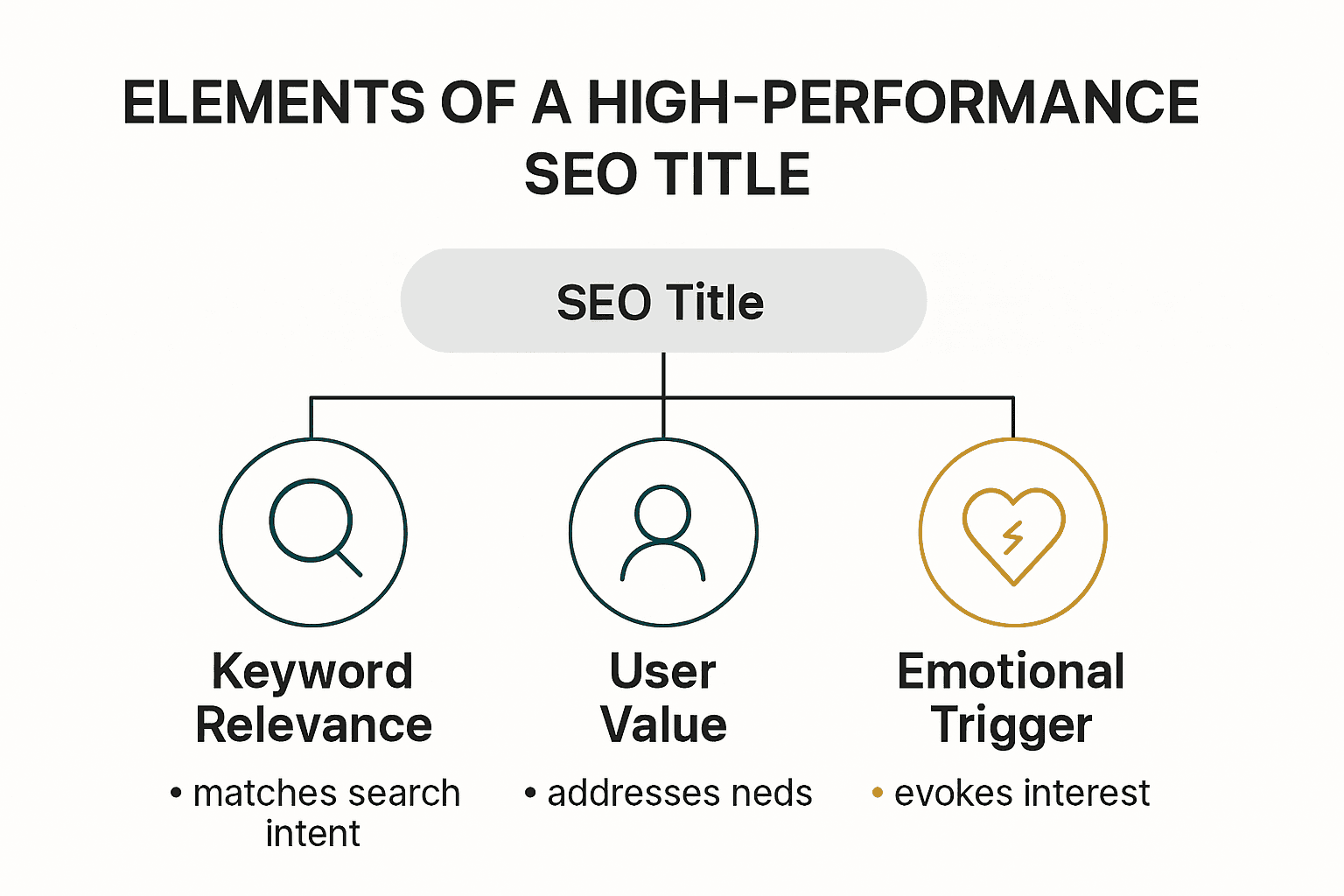
The Core Elements of a High-Performance SEO Title
An exceptional SEO title is not just about stuffing keywords. According to Search Engine Land, effective titles in 2025 must balance technical precision with user engagement. This means crafting a concise message that accomplishes multiple objectives simultaneously.
Key components include:
- Keyword Relevance: Naturally incorporating primary search terms
- User Value: Clearly communicating the content's benefit
- Emotional Trigger: Creating curiosity or addressing a specific need
The anatomy of a powerful SEO title goes beyond mere technical requirements. SEO AI Research emphasizes that titles must truthfully represent page content while maintaining user trust. This means avoiding clickbait tactics and delivering genuine value.
Psychological Triggers in Title Creation
Successful SEO titles tap into fundamental psychological mechanisms that drive user behavior. They transform from simple text snippets into compelling invitations that spark curiosity and promise solutions. Revenue Zen highlights that the most effective titles create an immediate emotional connection.
Consider the psychological elements that make users want to click:
- Problem Solving: Indicate a clear solution
- Urgency: Suggest time-sensitive information
- Exclusivity: Hint at unique or insider knowledge
Professional marketers understand that an SEO title is more than a technical checkbox. It's a strategic communication tool designed to capture attention in a crowded digital space. Each word must work hard to differentiate your content and provide a compelling reason for users to engage.
In 2025, search algorithms have become increasingly sophisticated. They don't just look for keyword matches but assess the holistic relevance and user intent behind a title. This means your SEO title must demonstrate genuine alignment with the content, user expectations, and search query context.
Mastering SEO titles requires continuous learning and adaptation. What worked yesterday might not resonate today. By staying attuned to evolving search behaviors, user preferences, and algorithmic changes, you can craft titles that not only rank well but truly connect with your target audience.
Remember: An extraordinary SEO title is your content's first and most critical marketing moment. Make every character count.
Essential Steps to Write SEO Titles That Rank

Crafting SEO titles that rank requires a strategic approach combining technical precision and creative copywriting. The goal is not just to appear in search results but to compel users to click and engage with your content.
Keyword Placement and Selection Strategy
Selecting and positioning keywords is a critical first step in creating ranking SEO titles. Revenue Zen emphasizes that primary keywords should be placed as close to the beginning of the title as possible. Search engines give more weight to terms appearing first, and this approach also aligns with how users quickly scan search results.
Keyword selection guidelines:
- Relevance: Choose keywords directly related to your content
- Search Volume: Target terms with meaningful search traffic
- User Intent: Align keywords with what users actually seek
According to Backlinko, it is crucial to use only one main keyword per title. This prevents keyword stuffing and maintains clarity. A focused approach signals to search engines the precise topic of your content.
Crafting Compelling Title Structures
Beyond keyword placement, the structure of your SEO title plays a significant role in attracting clicks. SEO AI Research recommends keeping titles between 35-65 characters to ensure they display correctly in search results. This constraint forces you to be concise and impactful.
Effective title structures often include:
- Number-driven Titles: "7 Proven Strategies..."
- Question-based Formats: "How to Solve..."
- Problem-Solution Approach: "Fix [Problem] with..."
Each title structure serves a psychological trigger. Numbers provide specificity, questions spark curiosity, and problem-solution formats promise immediate value. The key is matching the structure to your content and audience expectations.
Professional SEO practitioners understand that titles are more than technical tags. They are the first point of interaction with potential readers. A well-crafted title can significantly improve click-through rates, which in turn can positively influence search rankings.
Consider your title a mini-advertisement. It must communicate value, spark interest, and differentiate your content in a crowded digital space. This means going beyond generic phrases and creating unique, specific titles that promise clear benefits.
Remember that search algorithms are becoming increasingly sophisticated. They do not just look for keyword matches but assess the overall relevance, user intent, and engagement potential of your content. Your title is the first signal in this complex evaluation process.
Mastering SEO titles is an ongoing process of testing, learning, and adapting. What works today might need refinement tomorrow. Stay curious, analyze your performance, and continuously optimize your approach.
Below is a table summarizing the key steps and considerations for creating high-performing SEO titles, based on the preceding content.
| Step | What to Do | Why It Matters |
|---|---|---|
| Keyword Placement | Put main keyword near beginning of title | Increases visibility in search results |
| Keyword Selection | Use only one relevant, high-traffic keyword per title | Prevents stuffing, ensures clarity |
| Title Length | Keep titles between 35-65 characters | Fits display on search engines, concise messaging |
| Structure | Use numbers, questions, or problem-solution formats | Captures attention, triggers engagement |
| Relevance & User Value | Make sure title matches content and delivers value | Builds trust, reinforces expectations |
| Emotional/Psych Triggers | Spark curiosity, urgency, or offer solutions | Drives higher click-through rates |
Common SEO Title Mistakes and How to Avoid Them
Navigating the complex world of SEO titles requires more than just good intentions. Even experienced content creators can fall into predictable traps that diminish their content's search performance and user engagement.
Keyword Misuse and Optimization Errors
Keyword strategy remains a critical aspect of SEO title creation. Search Atlas warns that overly long or poorly optimized meta titles can significantly undermine your content's visibility. Titles exceeding 70 characters risk being truncated or rewritten by search engines, potentially losing critical context.
Common keyword mistakes include:
- Keyword Stuffing: Cramming multiple keywords unnaturally
- Irrelevant Keyword Selection: Using terms unrelated to content
- Exact Match Obsession: Prioritizing exact keyword matches over readability
Structural and Strategic Title Errors
Beyond keyword placement, many content creators make structural mistakes that compromise their SEO effectiveness. EZ Rankings highlights that over-optimization can trigger search engine penalties, particularly when using repetitive or unnatural language.
Avoid these structural pitfalls:
- Generic Titles: Blending in instead of standing out
- Misleading Language: Creating titles that don't match content
- Ignoring User Intent: Failing to address what users actually seek
Professional SEO practitioners understand that titles are more than technical elements. They are strategic communication tools designed to bridge user curiosity and content value. Each title must work hard to differentiate your content in an increasingly competitive digital landscape.
The most effective titles balance technical optimization with genuine user engagement. This means moving beyond formulaic approaches and developing a nuanced understanding of how search algorithms and human readers interpret content.
Consider your title a precision instrument. It must communicate value, spark interest, and provide a clear promise of what readers will discover. Vague or overly complex titles often result in lower click-through rates and reduced search performance.
Remember that search algorithms are continuously evolving. What worked six months ago might not be as effective today. Continuous learning, testing, and adaptation are crucial in maintaining a competitive SEO strategy.
Ultimately, avoiding SEO title mistakes requires a holistic approach. Combine technical knowledge, creative writing skills, and a deep understanding of your target audience's needs and search behaviors.
Below is a checklist table highlighting the most common SEO title mistakes to avoid, as well as the recommended best practices, to help you review your titles before publishing.
| Mistake or Practice | Description | Avoid/Do This? |
|---|---|---|
| Keyword Stuffing | Using too many keywords unnaturally | Avoid |
| Irrelevant Keyword Selection | Adding keywords unrelated to page content | Avoid |
| Exact Match Obsession | Over-prioritizing exact keyword matches | Avoid |
| Title Over 65-70 Characters | Writing very long titles | Avoid |
| Generic or Vague Titles | Lacking specifics, blending in | Avoid |
| Misleading Language | Promising what the content does not deliver | Avoid |
| Use 1 Main, Relevant Keyword | Focus on a single core keyword | Do |
| Keep Title Concise | Stay within 35-65 characters | Do |
| Align Title with User Intent | Ensure topic matches what user seeks | Do |
Pro Tips for Small Businesses and Marketers
Small businesses and marketers face unique challenges when creating SEO titles. Limited resources and intense competition demand strategic, cost-effective approaches to maximize digital visibility and attract potential customers.
Maximizing Limited Resources
SEO AI Research provides critical insights for small businesses looking to optimize their SEO titles. The key is creating clear, precise titles within 35-65 characters that accurately represent page content and drive user engagement.Strategic optimization techniques:
- Targeted Keyword Placement: Focus on one primary keyword per title
- Clarity over Complexity: Prioritize straightforward, understandable language
- Value-Driven Messaging: Communicate immediate benefit to the reader
Creative Engagement Strategies
Small businesses can differentiate themselves by implementing creative title structures that capture attention. SEO AI Research recommends using specific techniques to make titles more compelling:
- Numbered Lists: "5 Quick Marketing Strategies"
- Question Formats: "Need More Website Traffic?"
- Problem-Solution Approach: "Boost Sales with Simple Techniques"
These formats tap into psychological triggers that encourage clicks. Numbers provide specificity, questions spark curiosity, and problem-solution titles promise immediate value.
Marketing success in 2025 requires understanding that SEO titles are more than technical tags. They are your content's first impression—a critical moment of potential connection with your audience. Each title must work hard to communicate your unique value proposition.
Budget-conscious businesses cannot afford wasted marketing efforts. This means every SEO title must be a strategic asset. Analyze your performance regularly. Track which titles generate the most engagement and iteratively improve your approach.
Remember that authenticity matters more than tricks. Your title should genuinely reflect your content's value. Misleading titles might generate initial clicks but will ultimately damage your brand's credibility and search performance.
Professional marketers understand that SEO is an ongoing learning process. What works today might need adjustment tomorrow. Stay curious, experiment with different approaches, and always prioritize your audience's needs.
Small businesses have a significant advantage in creating personalized, targeted content. Use this strength in your SEO titles. Show your unique perspective, address specific customer pain points, and demonstrate why your solution stands out in a crowded marketplace.
Frequently Asked Questions
What is an SEO title and why is it important?
An SEO title is the clickable headline that appears in search engine results. It is crucial because it influences both click-through rates and search engine rankings. A well-optimized title can attract more users to your content, improving visibility and engagement.
How can I create effective SEO titles for my content?
To create effective SEO titles, ensure they include relevant keywords placed naturally, clearly communicate the content's value, and engage users emotionally. Aim for a concise structure, ideally between 35-65 characters, and consider using formats like questions, lists, or problem-solving statements.
What are common mistakes to avoid when writing SEO titles?
Common mistakes include keyword stuffing, using irrelevant keywords, creating vague or misleading titles, and exceeding character limits. It’s essential to focus on clarity and accurately represent your content to maintain user trust and enhance your title's effectiveness.
How do I optimize SEO titles for click-through rates?
To optimize for click-through rates, place primary keywords near the beginning, craft intriguing and value-driven titles, and experiment with engaging structures like numbers or questions. Ensuring titles resonate with user intent and emotion can significantly enhance engagement.
Turn Powerful SEO Titles Into Real Results—Effortlessly
Struggling to craft that perfect SEO title and drive more clicks? If you found yourself nodding along to the pain points in the article—like low visibility, keyword confusion, or wasted time over-analyzing titles—you're not alone. Many small business owners and marketers want to write high-impact titles that actually boost organic traffic, but often get lost between keyword placement and the balance between clarity and click-worthiness. Now imagine if every single title you used was already engineered for maximum impact, every piece of content matched your business strategy, and you never had to juggle technical details again.
See how BabyLoveGrowth.ai makes this possible with AI-powered content tailored for real ranking potential. Sign up today and start transforming your SEO with a three-step process: analyze your business, receive your custom 30-day plan, and get unique SEO-optimized articles—ready to publish and built to win today’s search. Stop guessing and let your growth accelerate—visit BabyLoveGrowth.ai now to see how easy SEO titles and content can be.
Recommended Articles
- SEO Trends for 2024: Key Shifts Every Marketer Should Know
- BabyLoveGrowth | The #1 Ranked AI Writer for SEO
- SEO Strategies for Bloggers: Proven Tactics for 2025 Success
- Winning SEO Outreach Strategies for 2025: Guide for SMBs
- Blogging Tips for 2025: Proven Strategies for Growth
- Top Cost Effective SEO Strategies for 2025: Boost Growth Online