Why use content calendars? Streamline strategy and boost results


TL;DR:
- A content calendar provides a structured, centralized schedule for consistent marketing publishing.
- Using a content calendar boosts efficiency through batching, repurposing, and proactive gap spotting.
- Most SMBs underestimate the ROI and strategic value of maintaining an organized content planning system.
Most marketing managers at small to medium-sized businesses are producing content constantly but still feel like they're falling behind. The problem isn't effort. It's the absence of a system. Without structure, content gets rushed, duplicated, or dropped entirely, and the result is wasted budget and missed opportunities. A content calendar isn't just a place to write down publish dates. It's the operational backbone of a high-performing content strategy. Content calendars help teams spot gaps and overlaps early, turning reactive scrambling into predictable, strategic execution. This article walks you through what content calendars are, why they work, and how to build one that actually drives results.
Table of Contents
- From confusion to clarity: What is a content calendar?
- Why content calendars boost marketing efficiency
- Planning for growth: Content calendar impacts on strategy and ROI
- Practical steps: How to implement and get the most from your content calendar
- Why most SMBs underestimate the power of a content calendar
- Ready to supercharge your content strategy?
- Frequently asked questions
Key Takeaways
| Point | Details |
|---|---|
| Creates structure | A content calendar brings order, ensuring every campaign stays on track and nothing gets missed. |
| Boosts efficiency | Teams save time and effort by batching tasks, spotting gaps, and repurposing more strategically. |
| Improves ROI | Planned content distribution via calendars drives significantly higher return on investment. |
| Enables data-driven growth | Content calendars make it easier to measure results and refine strategy for stronger growth. |
From confusion to clarity: What is a content calendar?
A content calendar is a centralized, visual schedule that maps out every piece of marketing content your team plans to create and publish. Think of it as a shared source of truth for your entire content operation. Instead of relying on scattered emails, sticky notes, or memory, everything lives in one place.
At its core, a well-built content calendar tracks these key elements:
- Topic or working title for each piece of content
- Format (blog post, social media update, video, email, podcast)
- Assigned creator or owner responsible for delivery
- Target channel (website, LinkedIn, Instagram, newsletter)
- Draft due date and final publish date
- Status (in progress, in review, scheduled, published)
When all of these elements are visible in one view, something powerful happens. Teams stop guessing and start executing. Managers can see at a glance what's coming, who owns it, and whether anything is at risk of slipping.
"The shift from content chaos to predictable execution is one of the most underrated competitive advantages a marketing team can build. Switching to calendar-driven planning changes how teams think, communicate, and deliver."
If you want to plan a content calendar that actually holds up under pressure, the key is starting with structure before you worry about volume. Even a simple spreadsheet beats a pile of Slack messages. Over time, teams that adopt content marketing automation can layer in AI-powered tools to handle the repetitive parts, freeing up strategists to focus on what matters most: the ideas.
Why content calendars boost marketing efficiency
Once you understand what a content calendar is, the efficiency gains become obvious. But the depth of those gains often surprises even experienced marketers.
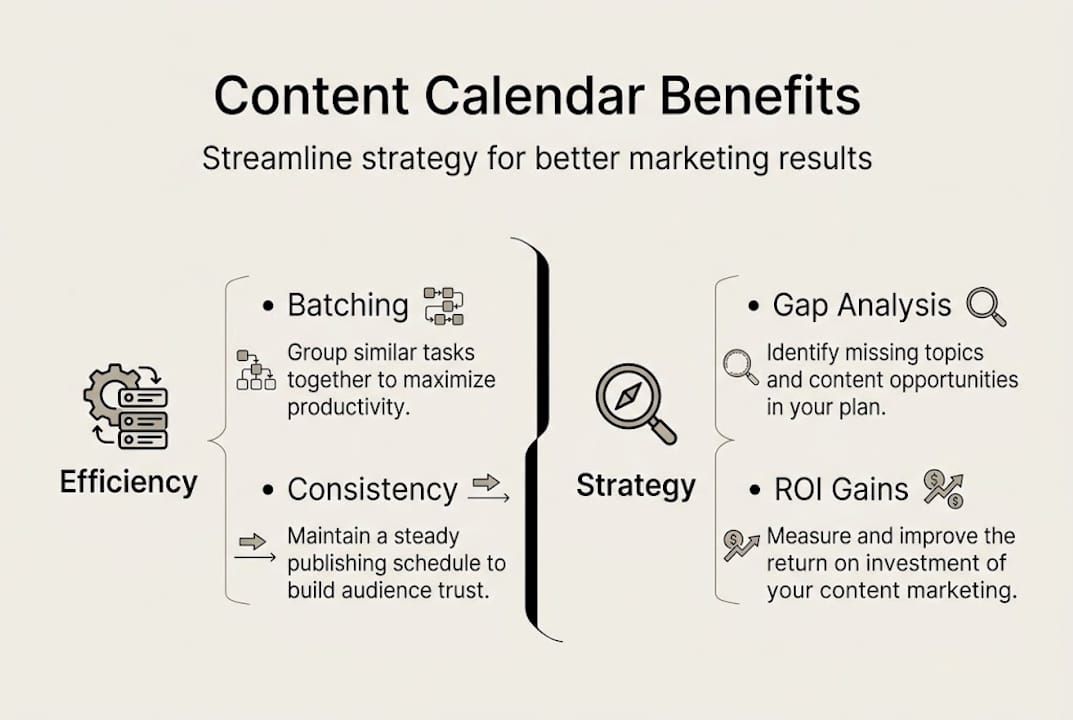
One of the biggest wins is batching. Instead of writing one blog post, then pivoting to a social caption, then back to an email, your team groups similar tasks together. Writers write. Designers design. Editors review. This reduces the cognitive cost of constant context-switching, which research consistently shows kills productivity.
Calendars also make repurposing systematic rather than accidental. When you can see three months of content at once, it's easy to spot a blog post that could become five LinkedIn updates, a short video, and an email sequence. Without that visibility, repurposing rarely happens.
Here are the top efficiency benefits SMB teams consistently report:
- Reduced last-minute rushes because deadlines are visible weeks in advance
- Fewer missed publishing dates because ownership is clearly assigned
- Better cross-team coordination because everyone sees the same plan
- Faster content approvals because review cycles are built into the schedule
These gains compound over time. A team that streamlines their content creation with a solid calendar structure produces more, wastes less, and maintains higher quality without burning out.
Content calendars also boost efficiency through batching, repurposing, and spotting gaps before they become problems. That proactive visibility is something ad-hoc planning simply cannot offer.
Pro Tip: Schedule a 30-minute calendar review session at the start of each month. Use it to update topics based on recent performance data, remove anything that no longer fits your strategy, and confirm ownership for the weeks ahead. This one habit prevents most of the common calendar breakdowns.
Planning for growth: Content calendar impacts on strategy and ROI
Efficiency improves your process, but strategic planning with a content calendar is what actually moves the business needle. The two are connected but distinct.
When you map content across weeks and months, you gain visibility into content gaps. Maybe you've published ten blog posts about your product features but nothing about the problems your customers face. A calendar makes that imbalance impossible to ignore. You can course-correct before publishing another piece that misses the mark.

Here's how ad-hoc content planning compares to a calendar-driven approach:
| Factor | Ad-hoc planning | Calendar-driven planning |
|---|---|---|
| Publishing consistency | Irregular, reactive | Consistent, predictable |
| Content gaps | Discovered late or never | Spotted and filled proactively |
| Team alignment | Fragmented | Unified around shared goals |
| Performance tracking | Difficult to attribute | Tied to specific publish cycles |
| ROI visibility | Low | High |
The metrics that improve most noticeably when teams adopt calendar-driven planning include:
- Publishing consistency, which directly impacts SEO rankings
- Organic visibility, because search engines reward regular, relevant content
- Audience engagement, because planned content aligns better with audience needs
- Conversion rates, because content is mapped to the buyer journey intentionally
Content calendars enable data-driven refinement and can deliver returns of 3:1 or higher when teams use performance data to continuously improve their strategy.
For real-world proof of what this looks like in practice, explore content marketing ROI examples from brands that have made the shift. If you're still building the case internally, the argument for boosting organic growth through structured planning is hard to argue against once you see the data.
Practical steps: How to implement and get the most from your content calendar
Knowing the value of a content calendar is one thing. Building one that your team actually uses is another. Here's a straightforward process to get started.
- Audit your existing content to understand what you already have and what's missing
- Define your content types and channels so you know what you're scheduling
- Choose a tool that fits your team's size, workflow, and budget
- Assign clear ownership for every content type and every stage of production
- Set a publishing cadence that's realistic, not aspirational
- Build in review checkpoints at draft, edit, and pre-publish stages
- Track KPIs tied to each content piece so you can refine over time
Choosing the right tool matters more than most teams realize. Here's a quick comparison of common options:
| Tool type | Best for | Key features | Limitations |
|---|---|---|---|
| Spreadsheet (Google Sheets) | Lean teams, tight budgets | Flexible, familiar, free | Manual updates, no automation |
| Project management tools (Asana, Trello) | Teams with complex workflows | Task assignment, deadlines, integrations | Steeper learning curve |
| Dedicated content platforms | Mid-size teams scaling fast | Editorial workflows, approvals, analytics | Higher cost |
| AI-powered platforms | Teams prioritizing SEO and scale | Automated planning, keyword integration, publishing | Requires onboarding |
Calendars help marketers analyze performance and refine strategy over time, which is why building analytics tracking directly into your calendar from day one is worth the extra setup effort.
Pro Tip: Add a "performance notes" column to your calendar. After each piece publishes, log the key metric (traffic, engagement, leads) directly in the row. Over time, patterns emerge that tell you exactly what to create more of.
For a full breakdown of what to include at each stage, the content marketing checklist covers every step. Teams ready to scale faster should also look at AI content marketing tools that can automate keyword research, content briefs, and publishing schedules.
Why most SMBs underestimate the power of a content calendar
Here's the honest truth: most SMB marketing teams treat content calendars as a nice-to-have rather than a core discipline. They set one up, use it for a few weeks, and then let it drift when things get busy. That's exactly when the calendar matters most.
What we've seen working with dozens of small and mid-sized teams is that the biggest benefits aren't always the obvious ones. Yes, you publish more consistently. Yes, you waste less time. But the unexpected wins are what stick with people. Teams report fewer missed deadlines, less friction between marketing and leadership, and a noticeable improvement in morale when everyone knows what's expected and when.
The upfront investment is small. A few hours to set up the structure, a standing monthly review, and clear ownership rules. That's it. The return on that investment shows up in fewer fires, better content, and a team that feels in control rather than constantly catching up.
Building content plans for organic growth isn't a luxury for well-resourced teams. It's the minimum viable structure for any SMB that wants content to actually drive business results.
Ready to supercharge your content strategy?
A content calendar gives your team the structure to plan smarter, publish consistently, and track what's working. But building and maintaining one manually takes time that most SMB teams don't have to spare.

Babylovegrowth.ai takes the manual work out of content planning entirely. Our AI keyword discovery platform identifies the exact topics your audience is searching for, and our AI content marketing tools turn those insights into fully planned, SEO-optimized content calendars automatically. From 30-day content plans to daily SEO articles and automated publishing, we handle the operational side so your team can focus on strategy and growth. If you're ready to stop reacting and start planning with precision, we're built for exactly that.
Frequently asked questions
What is the primary purpose of a content calendar?
A content calendar organizes all marketing content in one place, ensuring consistent, strategic publishing and improved team efficiency. It serves as a centralized visual schedule for every piece of content your team plans to create.
Do content calendars really improve ROI for SMBs?
Yes, content calendars often yield 3:1 or higher ROI by improving strategy, consistency, and enabling data-driven refinements to your content mix over time.
How do you start a content calendar for a small business?
Begin by listing all content types, set publishing dates, assign responsibilities, and select a tool. Follow the step-by-step process to assemble your first calendar and scale it as your team grows.
What mistakes should be avoided when building a content calendar?
Avoid overcomplicating the tool, neglecting performance review, and failing to assign clear ownership for each task. Schedule monthly review sessions to keep your calendar accurate and relevant.
Recommended
Smart SEO,
Faster Growth!
Most Read Articles
Generative Engine Optimization (GEO)
Learn how Generative Engine Optimization (GEO) helps your content rank in AI search engines like ChatGPT and Google AI. This comprehensive guide explains the differences between SEO and GEO, why it matters for your business, and practical steps to implement GEO strategies for better visibility in AI-generated responses.
DylenJan 18, 2025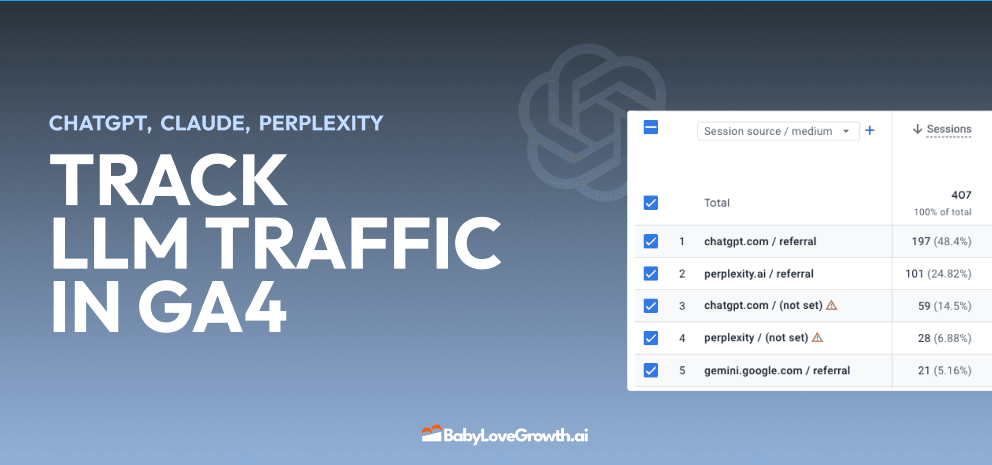
Track LLM Traffic in Google Analytics 4 (GA4)
Learn how to track and analyze traffic from AI sources like ChatGPT, Claude, Perplexity, and Google Gemini in Google Analytics 4. This step-by-step guide shows you how to set up custom filters to monitor AI-driven traffic and make data-driven decisions for your content strategy.
DylenMar 18, 2025
How to Humanize AI Text with Instructions
Learn practical techniques to make AI-generated content sound more natural and human. This guide covers active voice, direct addressing, concise writing, and other proven strategies to transform robotic text into engaging content.
DylenApril 7, 2025
Open AI Revenue and Statistics (2024)
Comprehensive analysis of OpenAI financial performance, user engagement, and market position in 2023. Discover key statistics including $20B valuation, $1B projected revenue, and 100M+ monthly active users.
DylenOctober 03, 2025