Why Pursue Long-Term SEO: Sustained Growth for Agencies


Every SEO specialist knows the frustration when a client expects overnight results, only to question the value of ongoing efforts a few weeks later. In reality, SEO is an ongoing investment rather than a one-time project, and success relies on consistent adaptation in response to changing search engine algorithms. For agencies aiming to keep clients satisfied in the long run, understanding core SEO fundamentals and addressing common misconceptions helps build trust and drive sustainable, organic growth through automation and thoughtful strategy refinement.
Table of Contents
- Long-Term SEO Fundamentals And Misconceptions
- Types Of SEO Strategies And Timeframes
- How Automation Transforms Sustained SEO Efforts
- Role Of AI In Scalable Organic Growth
- Common Pitfalls In Short-Term SEO Approaches
- Comparing Long-Term SEO With Paid Alternatives
Key Takeaways
| Point | Details |
|---|---|
| Ongoing SEO Process | SEO is a dynamic process that requires continuous adaptation and strategic investment for long-term success. |
| Holistic Optimization | Successful SEO strategies involve a comprehensive approach that includes content updates, technical improvements, and user experience enhancements. |
| Automation and AI's Role | Integrating automation and AI tools enhances SEO efforts by streamlining tasks and enabling data-driven decision-making. |
| Avoiding Short-term Pitfalls | Agencies should steer clear of quick-fix tactics; sustainable growth demands a focus on long-term strategies that prioritize user value and technical health. |
Long-term SEO fundamentals and misconceptions
SEO is not a static strategy but an ongoing, dynamic process demanding consistent adaptation and strategic refinement. Digital marketing agencies must recognize that search engine optimization represents a complex, multifaceted approach requiring continuous investment and sophisticated understanding.
Several critical SEO misconceptions persist that can undermine agencies' organic growth strategies:
- Keyword stuffing remains an effective ranking technique
- Meta tags have minimal impact on search performance
- Social media signals do not influence search rankings
- SEO results can be achieved through one-time interventions
- Technical optimization is less important than content creation
Realistic long-term SEO demands a holistic approach that integrates systematic search optimization practices across multiple dimensions. Successful strategies involve consistent content updates, technical website improvements, user experience enhancements, and alignment with evolving search engine algorithms.
Understanding SEO fundamentals requires recognizing its core principles: relevance, quality, authority, and searcher intent. Agencies must develop comprehensive approaches that go beyond superficial tactics and focus on sustainable, strategic growth. This means creating authoritative content, maintaining technical website health, building credible backlink networks, and continuously monitoring performance metrics.
Key Long-Term SEO Fundamental Elements:
- Regular content audits and updates
- Technical website performance optimization
- User experience design and improvement
- Comprehensive keyword research and targeting
- Adaptive strategy based on analytics insights
Search engines increasingly prioritize websites demonstrating expertise, authoritativeness, and trustworthiness. Modern SEO is less about manipulating algorithms and more about genuinely serving user needs through high-quality, relevant content.
Long-term SEO success requires viewing optimization as an ongoing strategic investment, not a one-time project.
Pro tip: Develop a quarterly SEO review process that systematically evaluates your strategies, content performance, and technical website health to ensure continuous improvement and adaptation.
Types of SEO strategies and timeframes
Digital marketing agencies must understand that SEO strategies are not monolithic but rather a nuanced collection of approaches tailored to specific business objectives and timeline requirements. Identifying strategic ranking factors involves recognizing the complex interplay between different optimization techniques and their potential impact across varying timeframes.
Primary SEO Strategy Categories:
- Short-term Strategies (0-3 months)
- Quick technical website optimizations
- Immediate keyword targeting
- Rapid content improvements
- Mid-term Strategies (3-12 months)
- Comprehensive content development
- Link building campaigns
- Local SEO enhancements
- Long-term Strategies (12+ months)
- Brand authority development
- Comprehensive industry thought leadership
- Sustainable organic growth initiatives
Successful SEO implementation requires a strategic approach that balances immediate performance needs with sustainable long-term growth objectives. Agencies must develop adaptive strategies that can quickly respond to algorithm changes while maintaining a consistent, quality-focused optimization framework.
Modern SEO strategies demand a holistic approach that integrates technical optimization, content creation, user experience design, and continuous performance monitoring. Key optimization dimensions include:
- Content relevance and quality
- Technical website performance
- User engagement metrics
- Authoritative backlink acquisition
- Semantic search alignment
Effective SEO is not about quick wins, but building a robust digital presence that compounds value over time.
Pro tip: Develop a dynamic SEO roadmap that includes quarterly performance reviews and allows flexible strategy adjustments based on evolving search landscape trends.
How automation transforms sustained SEO efforts
Automation has become a game-changing force in digital marketing, revolutionizing how agencies approach search engine optimization strategies. Scaling brand visibility through intelligent automation represents a critical evolution in modern SEO practices, enabling agencies to achieve more sophisticated and efficient optimization outcomes.
Key Automation Transformation Aspects:
- Rapid data collection and analysis
- Consistent content optimization
- Automated technical website monitoring
- Intelligent keyword research
- Predictive performance tracking
- Streamlined reporting processes
Modern SEO automation tools dramatically reduce manual labor while increasing precision and strategic depth. By leveraging artificial intelligence and machine learning algorithms, digital marketing agencies can now perform complex optimization tasks that would previously require extensive human intervention. These technologies enable continuous performance monitoring, real-time strategy adjustments, and data-driven decision-making.
Strategic Automation Benefits:
- 24/7 website performance monitoring
- Instant algorithm change detection
- Comprehensive competitive analysis
- Dynamic content recommendation
- Predictive ranking potential assessment
- Automated technical SEO audits
Automation transforms SEO from a reactive process to a proactive, intelligence-driven strategy that anticipates and adapts to digital marketing challenges.
Digital marketing agencies that successfully integrate automation can significantly reduce operational costs, minimize human error, and create more scalable optimization frameworks. The key is selecting tools that provide genuine strategic insights rather than simply generating reports.

Pro tip: Implement a quarterly review of your automation tools to ensure they continue delivering actionable insights and align with your evolving SEO strategy.
Role of AI in scalable organic growth
Artificial intelligence is transforming digital marketing strategies by enabling unprecedented levels of optimization and scalability. Automating digital ecosystem performance represents a critical breakthrough for agencies seeking sustainable organic growth through intelligent technological interventions.
AI-Powered SEO Capabilities:
- Advanced predictive analytics
- Automated content optimization
- Real-time performance tracking
- Intelligent keyword discovery
- Personalized user experience mapping
- Dynamic strategy recalibration
Modern AI technologies fundamentally reshape how digital marketing agencies approach organic growth by providing sophisticated data analysis and strategic insights. Machine learning algorithms can process vast amounts of performance data, identifying nuanced patterns and opportunities that human analysts might overlook. These intelligent systems continuously learn and adapt, creating increasingly refined optimization strategies that evolve with changing digital landscapes.
Strategic AI Integration Benefits:
- Faster decision-making processes
- More precise audience targeting
- Reduced operational inefficiencies
- Enhanced competitive intelligence
- Predictive performance modeling
- Continuous learning and adaptation
Artificial intelligence transforms organic growth from a manual, time-consuming process into an intelligent, self-optimizing ecosystem.
Successful agencies recognize that AI is not a replacement for human expertise but a powerful augmentation tool. By leveraging machine learning capabilities, digital marketing professionals can focus on high-level strategic planning while AI handles complex data processing and routine optimization tasks.
Here's a summary of how AI and automation reshape SEO agency operations:
| Technology | Core Function | Business Impact |
|---|---|---|
| Automation Tools | Routine task optimization | Frees up human resources |
| AI Algorithms | Data-driven strategy shifts | Enables predictive trend analysis |
| Real-Time Tracking | Immediate performance alerts | Faster response to opportunities |
| Personalization | User intent recognition | Increases conversion rates |
Pro tip: Develop a hybrid approach that combines AI-driven insights with human strategic oversight to maximize organic growth potential.
Common pitfalls in short-term SEO approaches
Digital marketing agencies frequently fall into destructive patterns when pursuing quick SEO results, undermining their long-term growth potential. Monitoring SEO performance strategically helps agencies recognize and avoid critical short-term optimization mistakes that can derail sustainable organic growth.
Critical Short-Term SEO Misconceptions:
- Prioritizing rankings over user experience
- Focusing exclusively on keyword density
- Neglecting technical website infrastructure
- Implementing sporadic, unstructured content strategies
- Ignoring comprehensive performance analytics
- Chasing algorithm loopholes instead of quality
Many agencies mistakenly view SEO as a sprint rather than a marathon, attempting to manipulate search engine algorithms through quick, superficial tactics. These approaches typically result in temporary gains followed by significant ranking penalties and diminished credibility. Sustainable SEO requires a holistic, patient approach that balances technical optimization, content quality, and genuine user value.
Dangerous Short-Term SEO Tactics to Avoid:
- Keyword stuffing
- Purchasing low-quality backlinks
- Creating thin, generic content
- Duplicating content across multiple pages
- Implementing aggressive, non-organic link schemes
- Ignoring mobile optimization requirements
Short-term SEO tactics are like building a house on sand - impressive initially, but destined to collapse under real-world scrutiny.
Successful digital marketing agencies understand that meaningful organic growth requires consistent, strategic investment. This means developing robust content strategies, maintaining technical website health, building authentic audience relationships, and continuously adapting to evolving search engine algorithms.
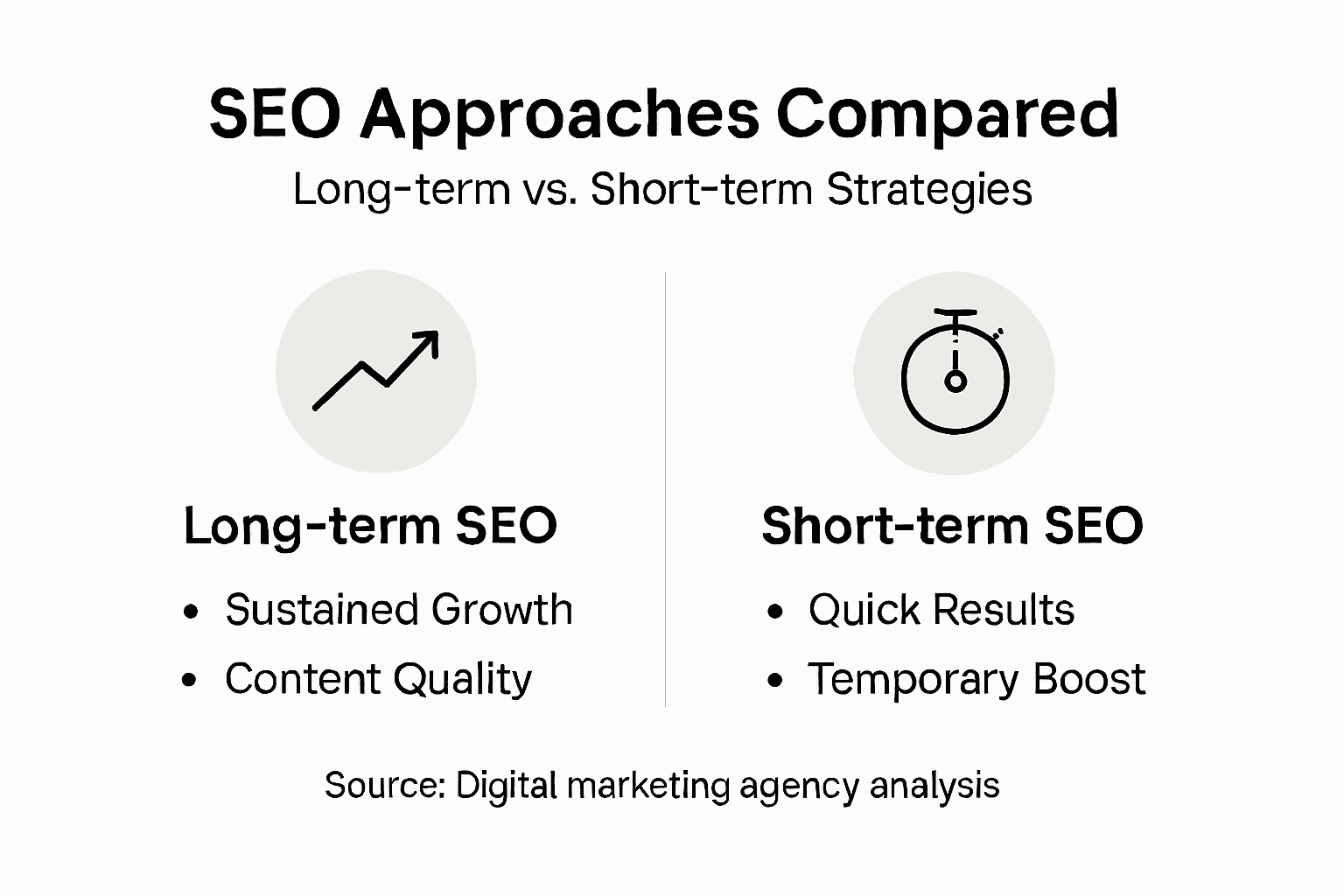
To better understand the distinction between long-term and short-term SEO, here's a comparison of their characteristics and business outcomes:
| Aspect | Long-Term SEO | Short-Term SEO |
|---|---|---|
| Investment Timeline | 12+ months commitment | 0-3 months effort |
| Growth Pattern | Sustainable, compounding | Quick, often temporary |
| Risk Level | Low (less risk of penalty) | High (algorithm penalties likely) |
| Impact on Credibility | Builds trust and authority | Can damage reputation |
| Cost Efficiency | Improves over time | Costs spike for quick fixes |
| Scalability | Highly scalable | Limited scalability |
Pro tip: Develop a comprehensive SEO roadmap that prioritizes sustainable growth metrics over immediate ranking improvements, focusing on long-term user value and authentic engagement.
Comparing long-term SEO with paid alternatives
Digital marketing agencies must understand the fundamental differences between organic search strategies and paid advertising approaches. Strategic investment in SEO growth reveals critical distinctions that can dramatically impact long-term marketing performance and brand visibility.
Comparative Analysis of Marketing Channels:
- Organic SEO
- Sustainable results
- Compound growth over time
- Lower long-term costs
- Higher credibility
- Enhanced user trust
- Paid Advertising
- Immediate visibility
- Direct cost per interaction
- Limited long-term impact
- Higher acquisition expenses
- Temporary traffic generation
Paid advertising provides instantaneous visibility but operates like a financial faucet - the moment funding stops, traffic disappears. Organic SEO, conversely, builds a robust digital foundation that continues generating value even after initial investment, creating a compounding effect of brand authority and search engine credibility.
Key Performance Differentiators:
- Cost per acquisition trends
- Traffic sustainability
- Brand perception
- Audience engagement depth
- Long-term marketing scalability
- User trust and credibility
Paid advertising is renting visibility, while SEO represents genuine property ownership in the digital landscape.
Successful agencies recognize that a balanced approach combining strategic organic growth with targeted paid campaigns delivers the most comprehensive marketing results. This hybrid model leverages the immediacy of paid channels while simultaneously building enduring digital presence through consistent SEO investment.
Pro tip: Develop a strategic marketing mix that allocates resources to both organic and paid channels, with a progressive shift towards increasing organic investment over time.
Unlock Sustainable Growth with AI-Powered SEO Solutions
Long-term SEO success demands a strategic, evolving approach that blends content quality, technical optimization, and continuous performance monitoring. If you are struggling with outdated short-term tactics or feeling overwhelmed by the complexity of maintaining a consistent organic growth strategy, Babylovegrowth.ai provides the perfect solution. Our platform harnesses AI-driven automation to simplify keyword discovery, content planning, backlink building, and technical audits so that you can focus on building brand authority and achieving lasting search engine rankings.
Experience the power of a system designed for scalable organic growth aligned with modern SEO fundamentals discussed in this article. With features like daily SEO articles, structured data markup, and Reddit conversation targeting, you ensure your content stays relevant and authoritative across Google and emerging AI-driven search engines. Discover how our tools can automate routine SEO tasks and deliver actionable insights to keep you ahead of algorithm changes.

Take the next step toward a future-proof SEO strategy by exploring our AI-powered SEO platform. Visit Babylovegrowth.ai today to see how embracing automation and expert SEO guidance can turn long-term organic growth from a challenge into your strongest competitive advantage.
Frequently Asked Questions
What is long-term SEO?
Long-term SEO is a strategic approach to search engine optimization that focuses on sustainable growth over an extended period, typically 12 months or more. It involves consistent investment in content quality, technical optimization, user experience, and adapting to search engine algorithm changes.
Why is it important for agencies to pursue long-term SEO?
Pursuing long-term SEO is crucial for agencies as it builds a solid digital foundation that leads to sustainable organic traffic, enhanced brand authority, and improved credibility over time, ultimately resulting in compounding growth and lower costs compared to paid advertising.
What are common misconceptions about long-term SEO?
Common misconceptions about long-term SEO include the belief that keyword stuffing is effective, technical optimization is less important than content, and that SEO results can be achieved through one-time efforts rather than requiring ongoing investment and strategy refinement.
How can agencies measure the success of their long-term SEO efforts?
Agencies can measure the success of their long-term SEO efforts through performance metrics such as organic traffic growth, keyword rankings, user engagement rates, backlink quality, and overall return on investment (ROI) from their SEO initiatives.
Recommended
Smart SEO,
Faster Growth!
Most Read Articles
Check Keyword Rankings Free with Google API (2026)
A practical guide to checking your keyword rankings for free using the Google Search Console API.
DylenApril 28, 2026
Generative Engine Optimization (GEO)
Learn how Generative Engine Optimization (GEO) helps your content rank in AI search engines like ChatGPT and Google AI. This comprehensive guide explains the differences between SEO and GEO, why it matters for your business, and practical steps to implement GEO strategies for better visibility in AI-generated responses.
DylenJan 18, 2025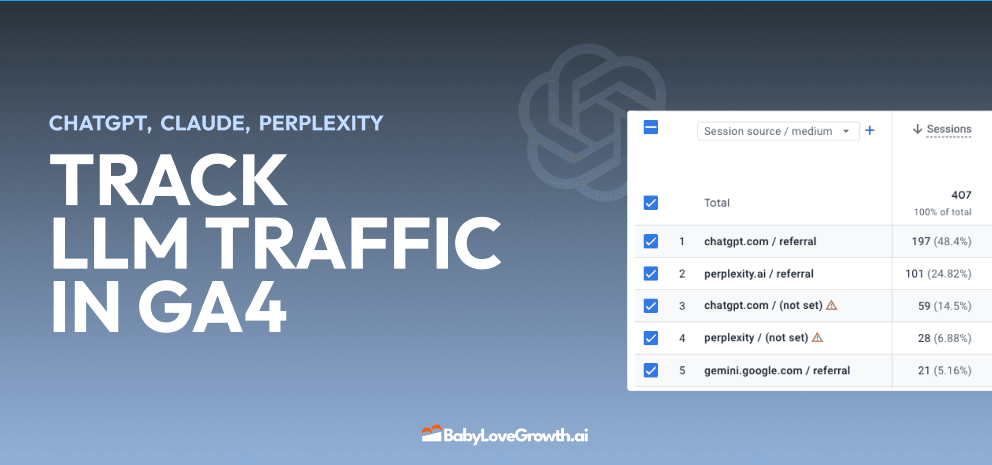
Track LLM Traffic in Google Analytics 4 (GA4)
Learn how to track and analyze traffic from AI sources like ChatGPT, Claude, Perplexity, and Google Gemini in Google Analytics 4. This step-by-step guide shows you how to set up custom filters to monitor AI-driven traffic and make data-driven decisions for your content strategy.
DylenMar 18, 2025
How to Humanize AI Text with Instructions
Learn practical techniques to make AI-generated content sound more natural and human. This guide covers active voice, direct addressing, concise writing, and other proven strategies to transform robotic text into engaging content.
DylenApril 7, 2025
Moz DA vs Ahrefs DR: Which Metric Should You Actually Use?
Moz Domain Authority and Ahrefs Domain Rating look similar but measure very different things. Learn what each score actually tells you, when to use each one, and what to track instead for real SEO results in 2026.
DylenApr 23, 2026
Open AI Revenue and Statistics (2024)
Comprehensive analysis of OpenAI financial performance, user engagement, and market position in 2023. Discover key statistics including $20B valuation, $1B projected revenue, and 100M+ monthly active users.
DylenOctober 03, 2025
"Search Google or Type a URL": What It Means & What to Do
Learn what "Search Google or type a URL" actually means, how your browser decides whether to search or navigate, and what to do if your address bar starts behaving unexpectedly. Includes browser settings guides for Chrome, Firefox, Edge, and Safari.
DylenApr 21, 2026