Why optimize for Google: essential SEO strategies for 2026


Google processes approximately 8.5 billion search queries every single day, controlling nearly 90% of global search volume. This staggering dominance means that if you're not optimizing for Google, you're essentially invisible to the vast majority of online searchers actively looking for solutions like yours. While emerging AI search engines and alternative platforms generate buzz, Google's market leadership remains the foundation of any serious organic traffic strategy. This guide breaks down why Google optimization stays essential in 2026 and reveals the specific tactics you need to capture that massive search audience effectively.
Table of Contents
- Google's Dominance In Global Search Traffic And Organic Visibility
- Core Google SEO Mechanics You Must Master In 2026
- Nuances And Strategic Layers: Balancing Google With Bing And AI Search Engines
- Applying Insights: Practical Steps To Optimize Effectively For Google In 2026
- Discover Tools To Supercharge Your Google SEO Efforts
Key takeaways
| Point | Details |
|---|---|
| Google dominates search traffic | Google accounts for 89 to 92% of global search traffic in 2026, making it the primary platform for organic visibility. |
| Organic search drives most traffic | Organic search drives 53% of website traffic, higher than any other channel including paid and social. |
| Master core SEO factors | Understanding E-E-A-T, Core Web Vitals, and topical authority directly increases your Google ranking potential. |
| AI optimization is critical | Optimizing for zero-click searches and AI features ensures visibility even when users don't click through. |
| Diversification supplements strategy | Including Bing and AI platforms adds value but does not replace a Google-first SEO approach. |
Google's dominance in global search traffic and organic visibility
Google's sheer scale makes it impossible to ignore. The platform handles roughly 8.5 billion daily queries, representing between 89% and 92% of all global search activity. No other search engine comes remotely close to this volume. For digital marketers and business owners, this concentration means Google is where your potential customers are actively searching for solutions, products, and information.
The traffic impact extends beyond raw query numbers. Organic search generates 53% of all website visits, making it the single most valuable traffic channel. Paid advertising, social media, and email combined cannot match the sustained, high-quality traffic that organic Google rankings deliver. This explains why organic traffic matters so profoundly for sustainable business growth.
Ranking position dramatically affects your visibility and click potential. The top organic result on Google captures a 27.6% click-through rate, while positions two and three see sharp dropoffs. By the time you reach page two, you're essentially invisible. This winner-takes-most dynamic makes first-page rankings not just desirable but essential for meaningful traffic acquisition.
Consider these key advantages of Google's dominance:
- Massive audience concentration reduces the need to fragment marketing efforts across multiple platforms
- Established ranking factors and algorithm patterns provide clearer optimization pathways
- Extensive data and tools available for Google SEO make strategy refinement more precise
- Higher search volume translates to more opportunities for niche keyword targeting
Pro Tip: Track your Google Search Console data weekly to identify which queries drive impressions but low clicks, then optimize those pages specifically to capture that existing visibility.
Google's market position creates a compounding advantage. The more users rely on Google, the more advertisers and content creators optimize for it, which in turn reinforces user habits. Understanding this dominance helps you allocate resources strategically, focusing SEO investment where audience concentration and search engine market share data confirm the highest return potential.
Core Google SEO mechanics you must master in 2026
Google's ranking algorithm has evolved dramatically, especially with AI integration reshaping how content gets evaluated and surfaced. Mastering the core mechanics means understanding both traditional SEO fundamentals and emerging AI-driven ranking factors that now determine visibility.

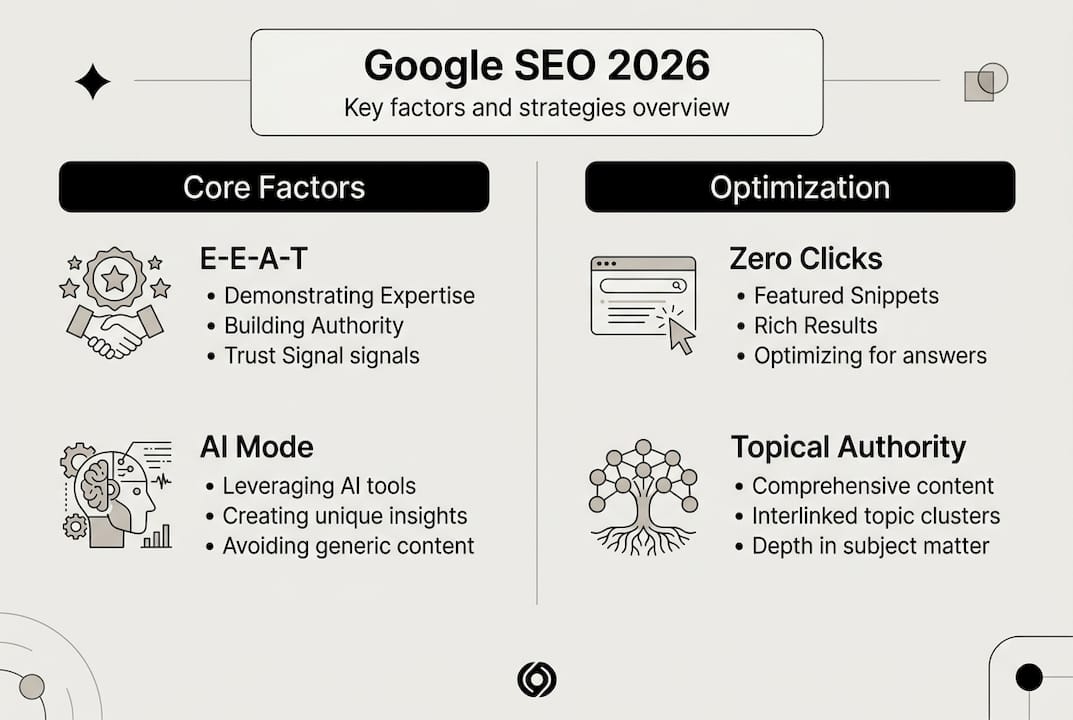
E-E-A-T stands for Experience, Expertise, Authoritativeness, and Trustworthiness. Google uses these quality signals to assess whether your content deserves to rank for specific queries. Experience means demonstrating first-hand knowledge of your topic. Expertise requires showing deep understanding through comprehensive, accurate information. Authoritativeness comes from external validation like backlinks and mentions. Trustworthiness involves transparency, citations, and secure technical implementation.
Core Web Vitals measure user experience through three specific metrics: Largest Contentful Paint (loading speed), First Input Delay (interactivity), and Cumulative Layout Shift (visual stability). Pages that load quickly, respond immediately to user actions, and maintain stable layouts rank higher because they deliver better experiences. Google explicitly confirms Core Web Vitals impact rankings, making technical performance non-negotiable.
On-page SEO elements form the foundation of how Google understands your content:
- Title tags that clearly signal topic relevance and include target keywords naturally
- Heading hierarchy (H1, H2, H3) that structures content logically for both users and crawlers
- Schema markup using JSON-LD to provide structured data about your content type and entities
- Internal linking that distributes authority and helps Google understand topical relationships
- Meta descriptions that improve click-through rates even though they don't directly affect rankings
AI Mode and zero-click optimization address a fundamental shift in search behavior. Over 50% of searches now result in zero clicks because Google provides direct answers in featured snippets, AI Overviews, and knowledge panels. To capture this visibility, structure content with clear, concise answers to specific questions. Use question-based headings that mirror actual search queries. Implement FAQ schema to increase chances of appearing in rich results.
Pro Tip: Optimize content for AI search by placing direct answers in the first 50 words after each question heading, then expanding with supporting details.
Topical authority has become crucial as Google moves from keyword matching to semantic understanding. Building authority means creating comprehensive content clusters around core topics, linking related articles together, and demonstrating depth across multiple subtopics. Sites with strong topical authority rank for broader keyword sets and recover faster from algorithm updates.
Structured data implementation through JSON-LD schema generator tools helps Google parse your content semantically. Article schema, FAQ schema, HowTo schema, and Product schema all increase your chances of appearing in enhanced search features. These markups don't guarantee rich results, but pages without them are essentially invisible to AI-powered search features.
Nuances and strategic layers: balancing Google with Bing and AI search engines
While Google dominates, ignoring other platforms entirely means missing strategic opportunities. Bing holds between 4% and 9% of search market share, which sounds small until you consider the absolute numbers. That percentage represents millions of daily searches, particularly concentrated in B2B contexts, desktop users, and specific demographics.
Bing's AI integration through Copilot creates unique advantages for certain query types. Users who engage with Bing's conversational search often demonstrate higher purchase intent, leading to better conversion rates for commercial queries. The platform emphasizes exact-match keywords more heavily than Google, making it potentially easier for newer sites to gain initial traction.
Small and emerging websites sometimes find faster ranking success on Bing due to different algorithmic priorities:
- Bing weights social signals more heavily, rewarding active social media presence
- Exact-match domains and keywords carry more influence than on Google
- Lower competition for many keywords creates easier entry points
- Bing Places for Business offers simpler local SEO opportunities
Google's title rewriting behavior reveals important strategic nuances. The platform rewrites approximately 76% of page titles to better match user intent and query context. This means your carefully crafted titles often get replaced dynamically. Focus on intent alignment rather than perfect keyword placement, and use multiple heading variations to give Google semantic options.
The zero-click phenomenon affects both platforms but manifests differently. Google's AI Overviews and featured snippets dominate the search results page, often providing complete answers without requiring clicks. Bing's Copilot similarly surfaces direct answers but tends to attribute sources more visibly. Optimizing for zero-click visibility through structured data and direct answer formatting benefits both platforms simultaneously.
| Factor | Google Optimization | Bing Optimization |
|---|---|---|
| Market Share | 89 to 92% global | 4 to 9% global |
| Ranking Priority | E-E-A-T, topical authority, user experience | Exact-match keywords, social signals, domain authority |
| AI Integration | AI Overviews, featured snippets | Copilot conversational search |
| Content Depth | Comprehensive, semantically rich | Clear, keyword-focused |
| Technical Factors | Core Web Vitals critical | Page speed important but less weighted |
Pro Tip: Implement a Google-first strategy covering 80% of your SEO effort, then allocate 20% to Bing and AI platform optimization where core tactics overlap naturally.
Expert perspectives suggest that multi-platform SEO for AI search creates resilience against algorithm changes and expands total addressable audience. However, the fundamentals remain consistent across platforms. Quality content, technical excellence, authoritative backlinks, and user-focused optimization work everywhere. The nuances involve adjusting emphasis and tactics rather than completely separate strategies.
Diversification makes sense when you've already captured strong Google positions and want incremental gains. For most businesses, achieving first-page Google rankings delivers far more value than top Bing positions simply due to volume differences. Optimize for Google first, then layer additional platform strategies as resources allow.
Applying insights: practical steps to optimize effectively for Google in 2026
Translating strategy into action requires systematic implementation of proven tactics aligned with current Google priorities. Start by conducting comprehensive keyword research that goes beyond search volume to understand user intent and topical relevance. Use AI-powered keyword discovery tools to identify question-based queries, semantic variations, and content gap opportunities that competitors miss.
Technical SEO forms your foundation. Follow this priority sequence:
- Audit and optimize Core Web Vitals scores using Google PageSpeed Insights and Search Console
- Implement mobile-first design ensuring perfect functionality on smartphones and tablets
- Create and submit XML sitemaps while maintaining clean URL structures
- Fix crawl errors, broken links, and redirect chains that waste crawl budget
- Implement HTTPS across your entire site with valid SSL certificates
- Optimize images with compression, lazy loading, and descriptive alt text
Structured data implementation dramatically improves AI visibility and zero-click potential. Use JSON-LD format to add schema markup for your content type. Article schema helps Google understand publication details. FAQ schema increases featured snippet chances. HowTo schema captures instructional query visibility. Product schema enhances e-commerce listings. The keyword discovery platform can identify which schema types align with your target queries.
Content quality signals require deliberate attention to E-E-A-T factors:
- Add author bios with credentials and expertise indicators
- Include citations and links to authoritative sources supporting factual claims
- Update content regularly to maintain freshness and accuracy
- Demonstrate first-hand experience through case studies, data, and specific examples
- Build topical authority by creating comprehensive content clusters on core subjects
Pro Tip: Run monthly audits using an AI SEO audit tool to catch technical issues, content gaps, and AI crawlability problems before they impact rankings.
User experience optimization balances algorithmic requirements with genuine human needs. Fast load times matter, but so does engaging, scannable content. Clear navigation helps users and crawlers. Strategic internal linking distributes authority while guiding user journeys. Video and visual content increase engagement metrics that signal quality to Google.
| Optimization Area | Key Metrics | Target Benchmarks |
|---|---|---|
| Page Speed | Largest Contentful Paint | Under 2.5 seconds |
| Interactivity | First Input Delay | Under 100 milliseconds |
| Visual Stability | Cumulative Layout Shift | Under 0.1 |
| Mobile Usability | Mobile-Friendly Test | 100% pass rate |
| Content Depth | Word Count | 1500+ for competitive topics |
Monitoring and iteration separate successful SEO from stagnant strategies. Track rankings weekly for target keywords. Analyze Search Console data to identify impression opportunities with low click-through rates. Monitor competitor movements and algorithm updates. Adjust tactics based on performance data rather than assumptions. The prioritize Google for volume approach while layering Bing optimization creates maximum coverage.
Backlink acquisition remains a top-three ranking factor. Focus on earning links from relevant, authoritative sites in your industry. Guest posting, digital PR, resource page outreach, and creating linkable assets all build authority. Use backlink building software to identify opportunities and track link profile growth systematically.
Staying current with search trends and algorithm updates protects your rankings. Follow official Google channels, trusted SEO news sources, and industry experts. Test new features and formats early. Adapt quickly when Google announces ranking factor changes. The combination of solid fundamentals and agile adjustment creates sustainable organic growth.
Discover tools to supercharge your Google SEO efforts
Implementing the strategies outlined above becomes dramatically easier with specialized tools designed for modern SEO challenges. BabyLoveGrowth offers a comprehensive suite that addresses every aspect of Google optimization, from initial keyword research through ongoing performance monitoring.

The keyword discovery platform leverages AI insights to uncover high-value opportunities your competitors miss, identifying question-based queries and semantic variations that align perfectly with user intent. Meanwhile, the AI SEO audit tool ensures your site maintains technical excellence and AI crawlability, catching issues before they impact rankings. Building authority through strategic backlink building software completes the optimization cycle, helping you earn the quality links that signal expertise and trustworthiness to Google. Take the next step by exploring these tools to transform your organic visibility and capture the valuable traffic waiting in Google's massive search ecosystem.
FAQ
Is Google optimization still necessary with rising AI search engines?
Absolutely. Google maintains nearly 90% of global search market share, processing 8.5 billion queries daily. While AI search engines like ChatGPT and Perplexity are growing, they represent a tiny fraction of total search volume. Optimizing for Google ensures you capture the largest possible organic traffic pool, which remains essential for sustainable business growth in 2026.
How do zero-click searches affect SEO strategies in 2026?
Over 50% of Google searches now result in zero clicks due to featured snippets, AI Overviews, and knowledge panels providing direct answers. This shift requires optimizing for visibility even without clicks by using structured data, clear answer formatting, and question-based headings. Zero-click optimization actually increases overall brand exposure and positions you as an authority, even when users don't immediately visit your site.
Should I optimize for Bing if Google dominates search traffic?
Bing holds 4 to 9% of search volume and grows in specific niches like B2B and desktop users. Optimizing for Bing makes sense as a supplementary strategy after you've captured strong Google positions, especially since core SEO fundamentals overlap significantly. However, Bing optimization should complement rather than replace your Google-first approach due to the massive volume difference.
What are the most important Google SEO ranking factors to focus on?
Prioritize E-E-A-T signals demonstrating expertise and trustworthiness, Core Web Vitals for technical performance, comprehensive on-page optimization including schema markup, and topical authority through content depth. AI optimization for zero-click searches and direct answers has become equally critical. Content quality and user experience remain paramount, as Google's algorithms increasingly evaluate how well pages serve searcher intent rather than just matching keywords.
Recommended
Smart SEO,
Faster Growth!
Most Read Articles
Generative Engine Optimization (GEO)
Learn how Generative Engine Optimization (GEO) helps your content rank in AI search engines like ChatGPT and Google AI. This comprehensive guide explains the differences between SEO and GEO, why it matters for your business, and practical steps to implement GEO strategies for better visibility in AI-generated responses.
DylenJan 18, 2025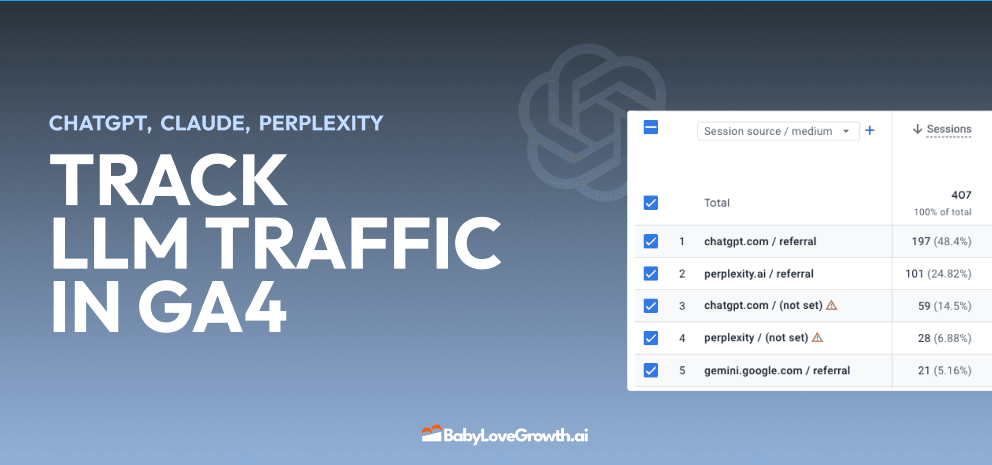
Track LLM Traffic in Google Analytics 4 (GA4)
Learn how to track and analyze traffic from AI sources like ChatGPT, Claude, Perplexity, and Google Gemini in Google Analytics 4. This step-by-step guide shows you how to set up custom filters to monitor AI-driven traffic and make data-driven decisions for your content strategy.
DylenMar 18, 2025
How to Humanize AI Text with Instructions
Learn practical techniques to make AI-generated content sound more natural and human. This guide covers active voice, direct addressing, concise writing, and other proven strategies to transform robotic text into engaging content.
DylenApril 7, 2025
Open AI Revenue and Statistics (2024)
Comprehensive analysis of OpenAI financial performance, user engagement, and market position in 2023. Discover key statistics including $20B valuation, $1B projected revenue, and 100M+ monthly active users.
DylenOctober 03, 2025