Why Measure SEO Performance for Agencies


Every agency owner recognizes the challenge of proving real results in search engine optimization. Tracking the right metrics gives you the power to show clients meaningful progress and uncover opportunities for true growth. This guide reveals core SEO performance metrics and practical measurement essentials you need to build transparent, results-driven strategies that help your clients thrive in the North American market.
Table of Contents
- Defining SEO Performance Measurement Essentials
- Core SEO Metrics And Their Impact
- Real-World Benefits For Agencies And Clients
- Aligning Metrics With Strategic Business Objectives
- Common Pitfalls When Measuring SEO Success
Key Takeaways
| Point | Details |
|---|---|
| SEO Performance Measurement | Agencies must track key metrics to optimize organic search strategies, including organic traffic, search engine rankings, and technical SEO health. |
| Core Metrics | Important metrics such as traffic, engagement, and conversion rates directly impact business growth and inform data-driven decision-making. |
| Strategic Alignment | SEO performance should align with broader business objectives to effectively demonstrate value and drive organizational growth. |
| Common Pitfalls | Avoid focusing solely on vanity metrics and ensure a multi-source approach for accurate performance insights. |
Defining SEO Performance Measurement Essentials
SEO performance measurement is a systematic approach that enables digital marketing agencies to assess and optimize their organic search strategies. At its core, the process involves tracking key metrics that demonstrate how effectively a website attracts, engages, and converts search engine traffic. Tracking search engine visibility requires a comprehensive understanding of multiple performance dimensions.
The essential components of SEO performance measurement can be broken down into several critical areas:
-
Organic Traffic Analysis
- Total website visitors from search engines
- Traffic sources and search queries
- Traffic quality and conversion potential
-
Search Engine Rankings
- Position tracking for target keywords
- Ranking progression over time
- Competitor ranking comparisons
-
Technical SEO Health
- Website crawlability and indexing status
- Page load speeds
- Mobile responsiveness
- Structured data implementation
Agencies must recognize that SEO performance is not a static metric but a dynamic landscape requiring continuous monitoring and strategic adaptation. Search engine indexing strategies play a crucial role in understanding how content visibility can be enhanced.
Engagement metrics provide deeper insights into the effectiveness of SEO efforts. These include:
- Bounce rate
- Average session duration
- Pages per session
- Conversion rates
Pro tip: Develop a standardized monthly SEO performance dashboard that tracks these key metrics to provide transparent, actionable insights for clients and internal teams.

Core SEO Metrics and Their Impact
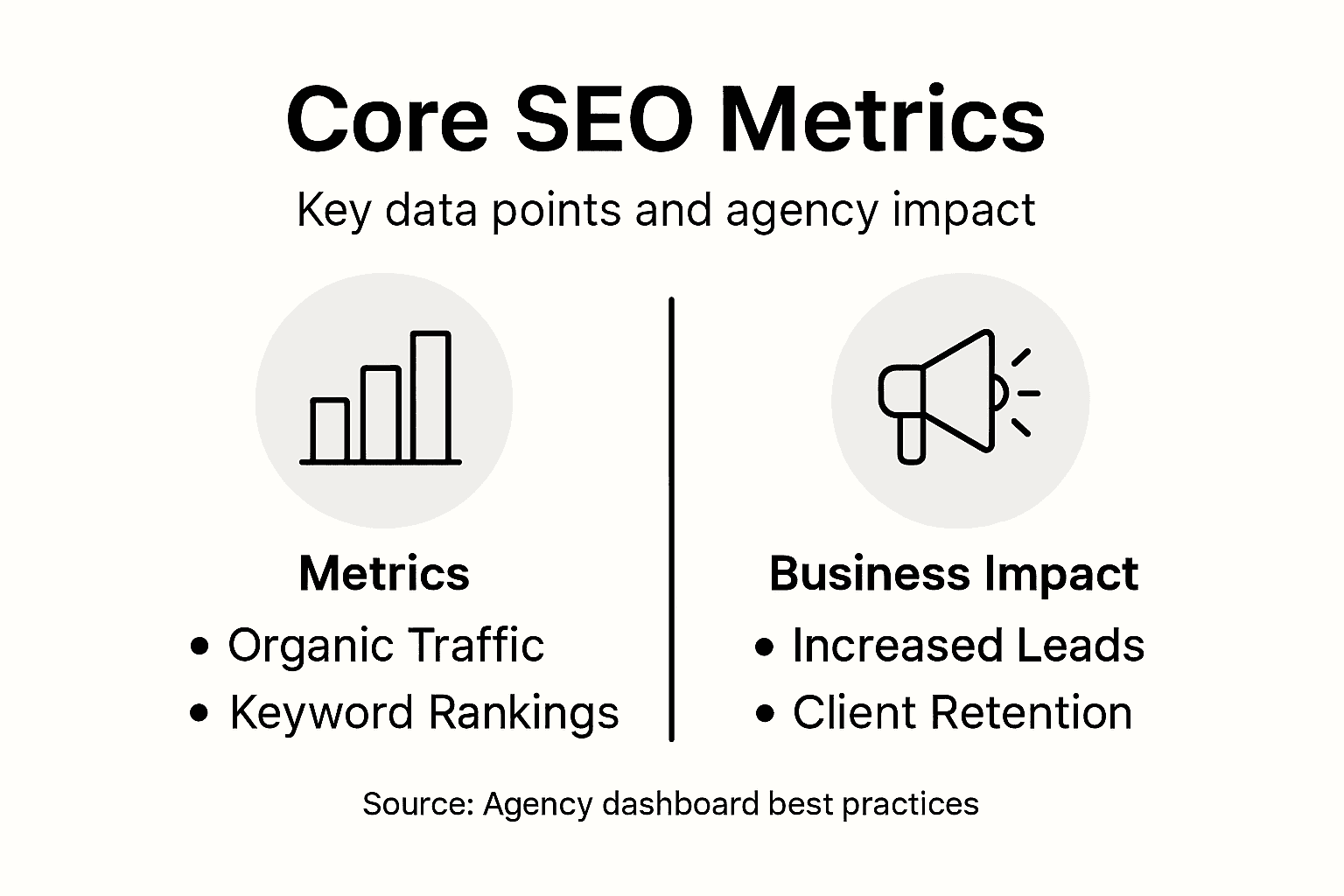
Digital marketing agencies rely on comprehensive SEO performance metrics to evaluate and optimize their clients' online visibility. Core website metrics demonstrate how effectively a website attracts, engages, and converts potential customers through organic search channels. Understanding these metrics allows agencies to develop data-driven strategies that directly impact business growth.
The most critical SEO metrics can be categorized into several key performance indicators:
-
Traffic Metrics
- Total organic visitors
- Traffic source breakdown
- New vs. returning visitor ratio
-
Engagement Metrics
- Average time on page
- Bounce rate
- Pages per session
-
Conversion Metrics
- Conversion rate
- Goal completions
- Revenue generated from organic search
Understanding the interconnected nature of these metrics is crucial. User behavior tracking reveals nuanced insights into how potential customers interact with website content. For instance, a high bounce rate combined with low average session duration might indicate misaligned content or poor keyword targeting.
Advanced agencies go beyond surface-level metrics by analyzing deeper performance indicators:
- Keyword ranking progression
- Domain authority growth
- Backlink quality and quantity
- Organic click-through rates
Pro tip: Create a standardized monthly reporting template that visualizes these key metrics, enabling quick performance assessment and strategic adjustments.
Here's a summary table illustrating how core SEO metrics align with business outcomes:
| SEO Metric Type | Example Metrics | Business Impact |
|---|---|---|
| Traffic Metrics | Organic visitors, sources | Drives brand awareness |
| Engagement Metrics | Time on page, bounce rate | Reveals content effectiveness |
| Conversion Metrics | Goal completions, revenue | Direct influence on ROI |
| Advanced Metrics | Keyword growth, backlinks | Strengthens market position |
Real-World Benefits for Agencies and Clients
Measuring SEO performance provides transformative advantages for both digital marketing agencies and their clients. Content optimization strategies enable businesses to enhance their online visibility, attract high-quality traffic, and generate meaningful engagement without substantial advertising expenses.
The key benefits for agencies include:
-
Strategic Advantages
- Data-driven decision making
- Transparent client reporting
- Measurable performance improvements
- Competitive market positioning
-
Client Value Propositions
- Increased organic website traffic
- Higher search engine rankings
- Cost-effective marketing approach
- Improved brand credibility
For clients, SEO measurement translates into tangible business outcomes. Organic search performance allows companies to understand user behavior, target ideal customer segments, and develop content that resonates with their audience's specific needs and preferences.
The most significant real-world impacts include:
- Reduced customer acquisition costs
- Enhanced digital market presence
- More qualified lead generation
- Sustainable long-term growth strategy
Pro tip: Develop comprehensive quarterly SEO performance reports that clearly demonstrate ROI and strategic progress to maintain strong client relationships.
Aligning Metrics With Strategic Business Objectives
Successful digital marketing agencies understand that SEO performance must directly connect to broader business goals. Strategic performance frameworks enable agencies to transform raw SEO data into meaningful business insights that drive organizational growth and competitive advantage.
Key strategic alignment approaches include:
-
Metric Mapping
- Connect SEO performance to revenue goals
- Track customer acquisition costs
- Measure market share expansion
- Demonstrate tangible business value
-
Objective Alignment
- Brand visibility improvements
- Customer engagement metrics
- Competitive positioning
- Lead generation efficiency
Agencies must develop comprehensive strategy visualization techniques that translate technical SEO performance into clear business language. This approach helps stakeholders understand how search engine optimization contributes to broader organizational objectives.
The most effective strategic metric alignment involves:
- Establishing clear performance benchmarks
- Creating cross-functional reporting frameworks
- Developing predictive performance models
- Implementing continuous improvement processes
Pro tip: Design quarterly executive dashboards that map SEO metrics directly to business key performance indicators, enabling leadership to quickly understand strategic impact.
Common Pitfalls When Measuring SEO Success
Digital marketing agencies frequently encounter critical challenges when attempting to measure SEO performance. Web analytics measurement mistakes can significantly undermine the effectiveness of SEO strategies and lead to misguided decision-making.
The most prevalent SEO measurement pitfalls include:
-
Metric Misinterpretation
- Overemphasizing vanity metrics
- Ignoring contextual data
- Misunderstanding correlation vs. causation
- Failing to connect metrics to business goals
-
Analytical Limitations
- Relying on single data sources
- Inadequate tracking configurations
- Neglecting qualitative insights
- Inconsistent measurement frameworks
Agencies must be vigilant about technical SEO evaluation challenges that can distort performance understanding. These challenges often stem from incomplete data collection, improper tool configuration, and failure to adapt to evolving search engine algorithms.
Critical errors to avoid in SEO performance measurement:
- Focusing solely on keyword rankings
- Ignoring user experience metrics
- Treating SEO as a one-time project
- Overlooking technical website health
Pro tip: Implement a multi-source data validation approach that cross-references metrics from different analytics platforms to ensure comprehensive and accurate performance insights.
The following table compares common SEO measurement pitfalls with recommended solutions:
| Pitfall | Impact on Performance | Recommended Solution |
|---|---|---|
| Overemphasis on vanity metrics | Misleading progress | Focus on actionable business metrics |
| Single data source reliance | Incomplete insights | Use multiple analytics platforms |
| Ignoring qualitative insights | Missed user behavior trends | Incorporate user feedback analysis |
| Inconsistent measurement methods | Unreliable tracking | Apply standardized reporting frameworks |
Elevate Your SEO Performance Measurement with AI-Powered Precision
Measuring SEO performance is a complex challenge for agencies aiming to connect organic traffic data with real business growth. Common pain points like misinterpreting vanity metrics, lacking cross-platform insights, and needing continuous strategic alignment highlight the critical importance of accurate, actionable SEO analytics. If you want to overcome these hurdles and harness clear, data-driven SEO metrics such as keyword ranking progression, conversion rates, and engagement indicators, you need solutions that not only track but also optimize your entire SEO workflow.
Unlock the potential of your SEO campaigns today with Babylovegrowth.ai. Our AI-powered SaaS platform automates keyword discovery, content planning, and technical audits while integrating structured data and backlink strategies tailored for measurable growth. Benefit from automated monthly reporting and actionable insights that bridge the gap between SEO performance and business objectives. Ready to transform your SEO measurement from guesswork to strategy? Visit Babylovegrowth.ai now to start scaling your agency’s organic success and gain a competitive edge in the evolving search landscape.
Frequently Asked Questions
Why is it important to measure SEO performance?
Measuring SEO performance is crucial for agencies as it provides valuable insights into how effectively a website attracts, engages, and converts organic search traffic. This data helps in optimizing marketing strategies and ensuring continuous improvement.
What key metrics should agencies track for SEO performance?
Agencies should track various key metrics, including organic traffic analysis, search engine rankings, technical SEO health, and engagement metrics like bounce rate and average session duration to assess the effectiveness of their SEO strategies.
How can measuring SEO performance benefit clients?
Measuring SEO performance can lead to increased organic website traffic, improved search engine rankings, and enhanced brand credibility for clients. It allows businesses to understand user behavior and tailor their content to meet audience needs.
What are common pitfalls when measuring SEO success?
Common pitfalls include focusing on vanity metrics, relying on single data sources, ignoring user experience metrics, and failing to connect SEO metrics to broader business goals. Avoiding these errors ensures a more accurate understanding of performance.