What is thought leadership? Guide for strategic brand authority


TL;DR:
- Genuine thought leadership influences industry thinking, requiring strategic positioning and evidence.
- It differs from content marketing by focusing on shaping perceptions rather than just attracting interest.
- Building authority involves rigorous research, diverse expertise, and the courage to take defensible stances.
Most business leaders believe they are doing thought leadership when they publish expert blog posts, share opinions on LinkedIn, or produce weekly newsletters. They are not. The gap between content production and genuine thought leadership is wide, and misunderstanding it costs brands real authority. True thought leadership is a strategic discipline, not a publishing schedule. It shapes how entire industries think, not just how many clicks a post earns. This article breaks down what thought leadership actually is, why the distinction matters for your brand's long-term visibility, and how to build a strategy that creates lasting influence rather than just traffic.
Table of Contents
- Defining thought leadership: Beyond content marketing
- Core types of thought leadership and their strategic impact
- How thought leadership is built: Process, evidence, and execution
- AI's role and risks in thought leadership today
- Our take: Why authentic thought leadership still wins in 2026
- Supercharge your brand's authority with our tools
- Frequently asked questions
Key Takeaways
| Point | Details |
|---|---|
| Thought leadership defined | It’s the strategic use of credible expertise and strong viewpoints to influence key decision-makers. |
| Four core types | Visionary, analytical, methodological, and contrarian approaches serve different strategic goals. |
| Building a framework | True thought leadership demands rigorous research, expert synthesis, and phased outreach. |
| AI’s impact and limits | AI increases efficiency but cannot replace the originality and credibility of human insight. |
| Winning in 2026 | Brands achieve authority by investing in authentic, evidence-backed ideas with lasting influence. |
Defining thought leadership: Beyond content marketing
Content marketing and thought leadership are not the same thing, even though most brands treat them as interchangeable. Content marketing is designed to attract, engage, and convert audiences by delivering useful information. It is fundamentally a distribution and demand-generation tool. Thought leadership, on the other hand, is designed to shift how decision-makers think about a problem, a category, or an industry. The goal is influence, not just reach.
The difference shows up in what each approach requires. Content marketing rewards consistency, keyword targeting, and audience alignment. You can see strong content marketing examples that drive traffic without ever taking a bold position. Thought leadership demands something harder: a defensible point of view, backed by evidence, that challenges or reframes how peers and buyers understand a critical issue.
| Dimension | Content marketing | Thought leadership |
|---|---|---|
| Primary goal | Drive traffic and conversions | Shape industry perception |
| Audience | Broad, interest-based | Decision-makers and peers |
| Core requirement | Consistency and relevance | Original POV and evidence |
| Success metric | Clicks, leads, engagement | Influence, citations, trust |
| Risk level | Low | High (requires taking a stance) |
One useful framework for building real thought leadership is the POV Pyramid. It has three layers: problem framing (defining the issue in a way others have not), the evidence ladder (stacking credible data, expert input, and case studies), and the actionable model (giving your audience a concrete way to respond). As suprmind.ai explains, thought leadership differs from content marketing by staking defensible positions to influence decisions among decision-makers, using exactly this kind of structured approach.
"Most brands confuse volume with authority. Thought leadership is not about publishing more. It is about saying something that changes how smart people think."
This distinction is not academic. Brands that invest in genuine thought leadership earn media placements, speaking opportunities, and buyer trust that no SEO campaign alone can generate.
Core types of thought leadership and their strategic impact
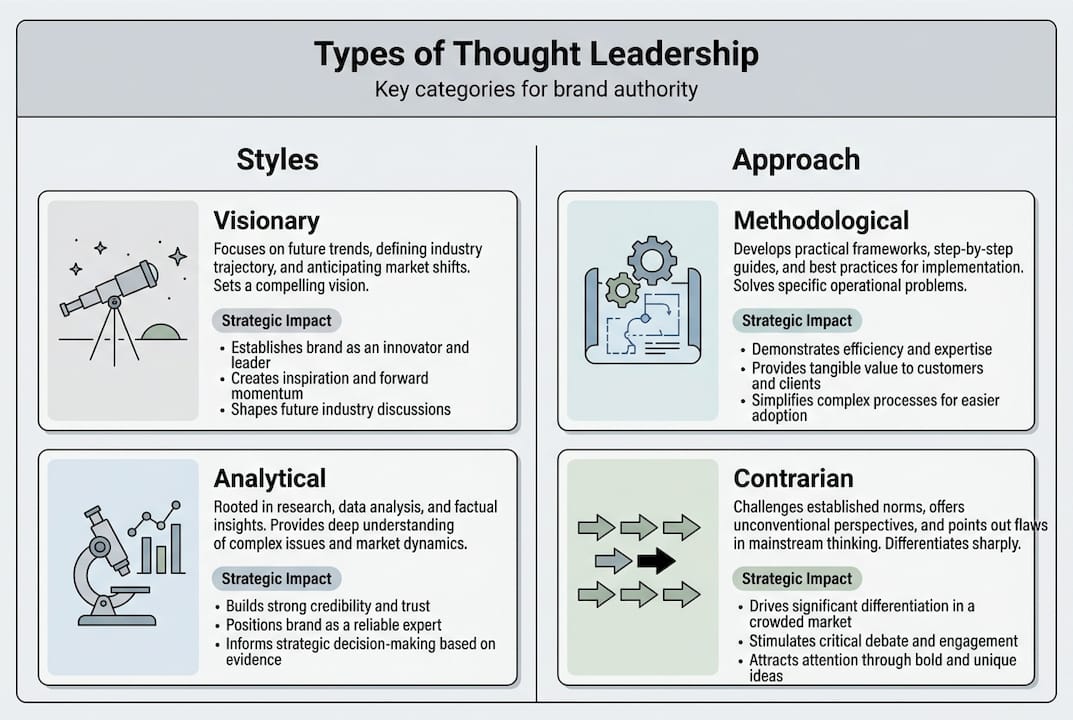
Understanding thought leadership as a category is only the first step. The next is recognizing that it comes in distinct forms, each with a different strategic purpose. Choosing the right type for your situation is what separates effective thought leaders from those who simply produce content with strong opinions.
According to suprmind.ai's taxonomy, the four main types are visionary, analytical, methodological, and contrarian, and each serves a different function in shaping industry conversation.
| Type | Core focus | Best used when |
|---|---|---|
| Visionary | Future trends and market direction | Your brand wants to define where an industry is heading |
| Analytical | Data frameworks and evidence-based insight | You have proprietary data or research worth sharing |
| Methodological | Processes and operational models | Your expertise is in how things get done, not just what |
| Contrarian | Challenging accepted norms | Conventional wisdom is holding your industry back |
Here is how each type plays out in practice:
- Visionary thought leadership works for brands positioned as innovators. It forecasts market shifts and invites audiences to see the future through your lens.
- Analytical thought leadership builds credibility through rigor. It is especially powerful when tied to original research or proprietary datasets.
- Methodological thought leadership wins trust from practitioners. If your audience wants to know how to do something better, this is your lane.
- Contrarian thought leadership is high risk and high reward. Done well, it earns outsized attention. Done poorly, it reads as provocative without substance.
Staying current on content marketing trends will help you identify which type resonates most in your industry right now.
Pro Tip: The most durable thought leaders blend at least two types. A visionary claim lands harder when backed by analytical evidence. A contrarian position becomes credible when paired with a methodological alternative.
How thought leadership is built: Process, evidence, and execution
Thought leadership does not happen by accident. The brands that consistently earn authority follow a structured process, even when their final output looks effortless and opinionated.
Here is a practical breakdown of how rigorous thought leadership gets built, based on established mechanics used by leading practitioners:
- Research planning. Identify the specific question or tension your thought leadership will address. Gather datasets, expert perspectives, and existing literature. Define what you already know versus what needs validation.
- Multi-expert synthesis. Pull insights from subject matter experts across different disciplines. A single expert's view is opinion. Multiple expert views, synthesized carefully, become a framework.
- Bias reduction. Actively seek out counterarguments to your central claim. This step is where most brands fail. Addressing opposing evidence makes your position stronger, not weaker.
- Structured drafting with red-teaming. Write your core argument, then have internal or external critics attack it. Revise based on the strongest objections.
- Phased rollout. Launch with an anchor article or report, then extend reach through LinkedIn posts, webinars, podcast appearances, and media pitches.
For strong content ideation for SEO that supports this process, systematic research planning is the foundation.
Pro Tip: Including a steel-manned version of the opposing view inside your thought leadership piece signals intellectual honesty. Readers trust authors who acknowledge complexity.
The process matters because ad hoc writing, no matter how smart the author, rarely produces the kind of evidence-backed, structurally sound argument that moves decision-makers. Rigor is what separates a compelling LinkedIn post from a piece that gets cited in industry reports.

AI's role and risks in thought leadership today
AI tools have changed how content gets produced, and thought leadership is not immune. The question is not whether to use AI. It is where AI helps and where it actively undermines your credibility.
The risks of over-relying on AI are measurable. Pure AI content ranks 23% lower than human-authored content and carries a 3.2x higher deindexation risk. That is not a minor SEO footnote. It means that brands using AI to generate thought leadership at scale are actively damaging their search visibility and authority signals.
"AI threatens traditional thought leadership by commoditizing content. What it cannot replicate is lived experience, situational judgment, and the courage to stake a defensible position."
That said, AI is genuinely useful in the right parts of the process. Here is where it adds value without replacing what matters:
- Research acceleration. AI tools can surface relevant studies, synthesize literature, and identify gaps in existing arguments faster than manual research.
- Draft structuring. AI can help organize a complex argument into a logical sequence before a human expert refines it.
- Counterargument generation. AI is useful for stress-testing your position by generating opposing views you may not have considered.
- Repurposing. Once a human-led anchor piece exists, AI can help adapt it into social posts, email summaries, or presentation scripts.
Understanding the future impact of AI on marketing helps you see where automation fits and where it does not. And if you are thinking about AI-driven brand loyalty, the same principle applies: AI amplifies human strategy, it does not replace it.
The brands winning at thought leadership in 2026 use AI as a research and workflow assistant, not as the author. Human originality, expert evidence, and a clear point of view remain irreplaceable.
Our take: Why authentic thought leadership still wins in 2026
Most brands dramatically underestimate how much effort real thought leadership requires. They see a viral LinkedIn post from a CEO and assume the insight came quickly. It rarely did. Behind that post is usually months of research, dozens of expert conversations, and a willingness to say something that not everyone will agree with.
AI has made it easier to produce content that looks like thought leadership. That is exactly the problem. When every brand can generate polished, well-structured opinion pieces in minutes, the only differentiator left is genuine insight rooted in real experience.
We believe the brands that will own authority in 2026 are the ones investing in unique evidence, recurring credibility, and the courage to take positions that carry professional risk. That is what building a brand with AI actually means: using technology to amplify human judgment, not to replace it. The web is full of competent content. What it is short on is perspective that makes you stop and reconsider what you thought you knew.
Supercharge your brand's authority with our tools
Putting a rigorous thought leadership strategy into practice takes time, research infrastructure, and consistent execution. That is where Babylovegrowth.ai makes a real difference for business leaders and marketers who want results without rebuilding their entire workflow.
Our platform automates the research, content ideation, and publishing workflows that underpin effective thought leadership. From generating a 30-day content plan built around your brand's unique positioning to scaling your reach through our backlink exchange ecosystem, we give you the infrastructure to build authority systematically. Use our organic traffic tool to identify the exact topics where your thought leadership will earn the most visibility on Google and ChatGPT, so every piece you publish works harder for your brand.
Frequently asked questions
What makes thought leadership different from traditional content marketing?
Thought leadership stakes defensible positions to influence how decision-makers think and act, while content marketing focuses on attracting and converting a broader audience through useful, consistent information.
How does AI affect thought leadership?
Pure AI content ranks 23% lower and faces a 3.2x higher deindexation risk, making it a poor substitute for human-led thought leadership, though AI remains useful for research support and workflow efficiency.
What are the main types of thought leadership?
The four core types are visionary, analytical, methodological, and contrarian, each designed to achieve a distinct strategic goal from forecasting trends to challenging accepted industry norms.
Recommended
Smart SEO,
Faster Growth!
Most Read Articles
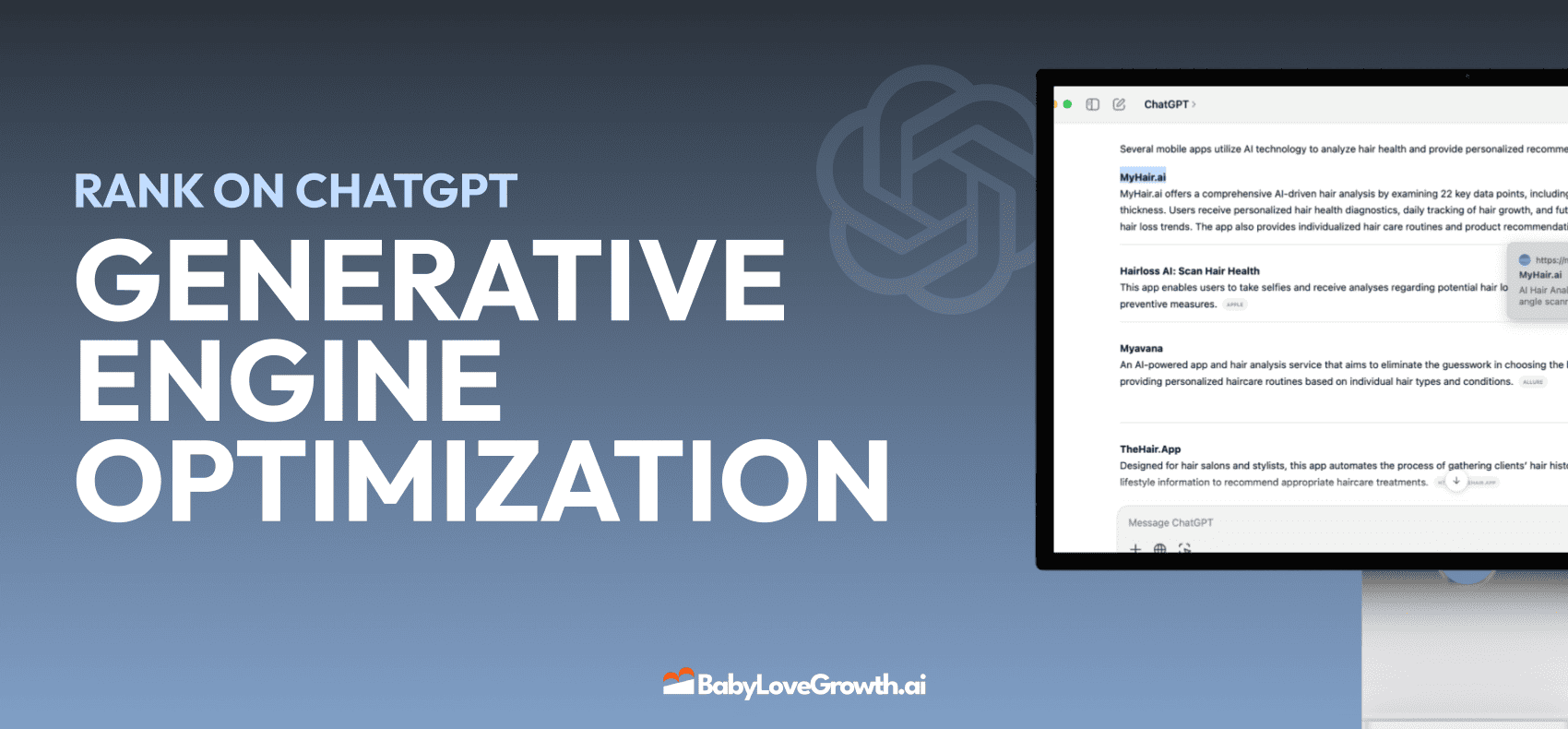
Generative Engine Optimization (GEO)
Learn how Generative Engine Optimization (GEO) helps your content rank in AI search engines like ChatGPT and Google AI. This comprehensive guide explains the differences between SEO and GEO, why it matters for your business, and practical steps to implement GEO strategies for better visibility in AI-generated responses.
DylenJan 18, 2025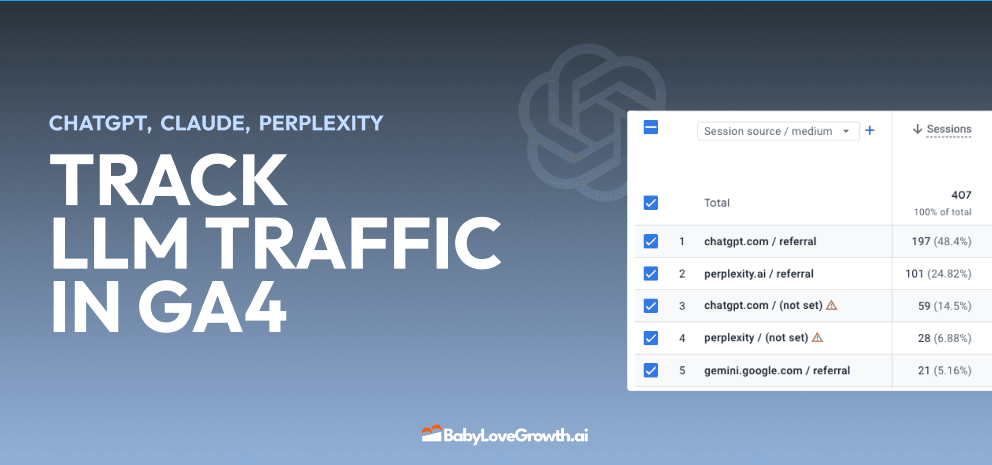
Track LLM Traffic in Google Analytics 4 (GA4)
Learn how to track and analyze traffic from AI sources like ChatGPT, Claude, Perplexity, and Google Gemini in Google Analytics 4. This step-by-step guide shows you how to set up custom filters to monitor AI-driven traffic and make data-driven decisions for your content strategy.
DylenMar 18, 2025
How to Humanize AI Text with Instructions
Learn practical techniques to make AI-generated content sound more natural and human. This guide covers active voice, direct addressing, concise writing, and other proven strategies to transform robotic text into engaging content.
DylenApril 7, 2025
Open AI Revenue and Statistics (2024)
Comprehensive analysis of OpenAI financial performance, user engagement, and market position in 2023. Discover key statistics including $20B valuation, $1B projected revenue, and 100M+ monthly active users.
DylenOctober 03, 2025