What Is Content Syndication: Boosting E-Commerce Reach


Many e-commerce marketers worry that sharing the same content on multiple sites will invite duplicate penalties or dilute their brand. Misunderstandings about content syndication often hold back potential gains in organic traffic and reach. By understanding the difference between myths and reality, digital professionals can use content syndication models that grow visibility and protect content authority while building connections with targeted audiences.
Table of Contents
- Content Syndication Defined And Common Myths
- Major Types Of Content Syndication Models
- How Content Syndication Works For Seo
- Risks, Duplicate Content, And Legal Issues
- Best Practices To Maximize Syndication Success
Key Takeaways
| Point | Details |
|---|---|
| Content Syndication Enhances Visibility | Licensing original content for syndication increases reach and engagement across various platforms without losing ownership. |
| Myths About Search Engine Impact | Properly implemented syndication with canonical links can improve search rankings rather than harm them. |
| Three Main Syndication Models | Licensed, paid, and owned syndication each offer unique benefits suited to different business goals and audience targeting. |
| Legal Protections Are Essential | Draft clear agreements to protect intellectual property rights and prevent potential legal disputes in syndication. |
Content Syndication Defined and Common Myths
Content syndication represents a strategic digital marketing approach where original content is republished across multiple third-party platforms to expand audience reach and visibility. Content distribution strategies have evolved from traditional print media practices, allowing businesses to leverage existing content for broader engagement.
At its core, content syndication involves licensing your original content to other websites, publications, or platforms who then republish it with proper attribution. This process differs from content republishing or guest posting because it involves a formal agreement where the original creator maintains ownership while granting specific redistribution rights. Syndicating content enables e-commerce businesses to tap into established audiences without creating entirely new materials for each platform.
Several persistent myths can mislead marketers about content syndication effectiveness. First, many believe syndication automatically generates poor search engine results or duplicate content penalties. However, when executed strategically with canonical links and proper attribution, syndication can actually enhance online visibility. Another common misconception is that syndicated content provides minimal value compared to original pieces. In reality, well-crafted syndicated content can drive significant traffic and generate quality leads across diverse digital channels.
Pro tip: When syndicating content, always establish clear republication guidelines and use canonical links to preserve your original content's search engine ranking integrity.
Major Types of Content Syndication Models
Content syndication encompasses several distinct models that enable businesses to strategically distribute their digital content across multiple platforms. Product content syndication models represent sophisticated strategies for efficiently sharing digital assets while maintaining strategic control over intellectual property.
The primary content syndication models include three fundamental approaches: licensed syndication, paid syndication, and owned syndication. Licensed syndication involves formal agreements where content creators grant specific permissions for republication, typically with defined usage terms and attribution requirements. Paid syndication utilizes dedicated platforms that distribute content for a fee, allowing businesses to reach targeted audiences through established media networks. Owned syndication represents the most direct approach, where organizations strategically share content across channels they directly control, such as their own websites, social media platforms, and affiliated digital properties.
Each syndication model offers unique advantages for e-commerce businesses seeking to expand their digital footprint. Licensed syndication provides controlled exposure with clear legal boundaries, paid syndication enables precise audience targeting through professional distribution channels, and owned syndication allows maximum flexibility and brand consistency. The selection of an appropriate syndication strategy depends on specific business objectives, target audience characteristics, and available resources.
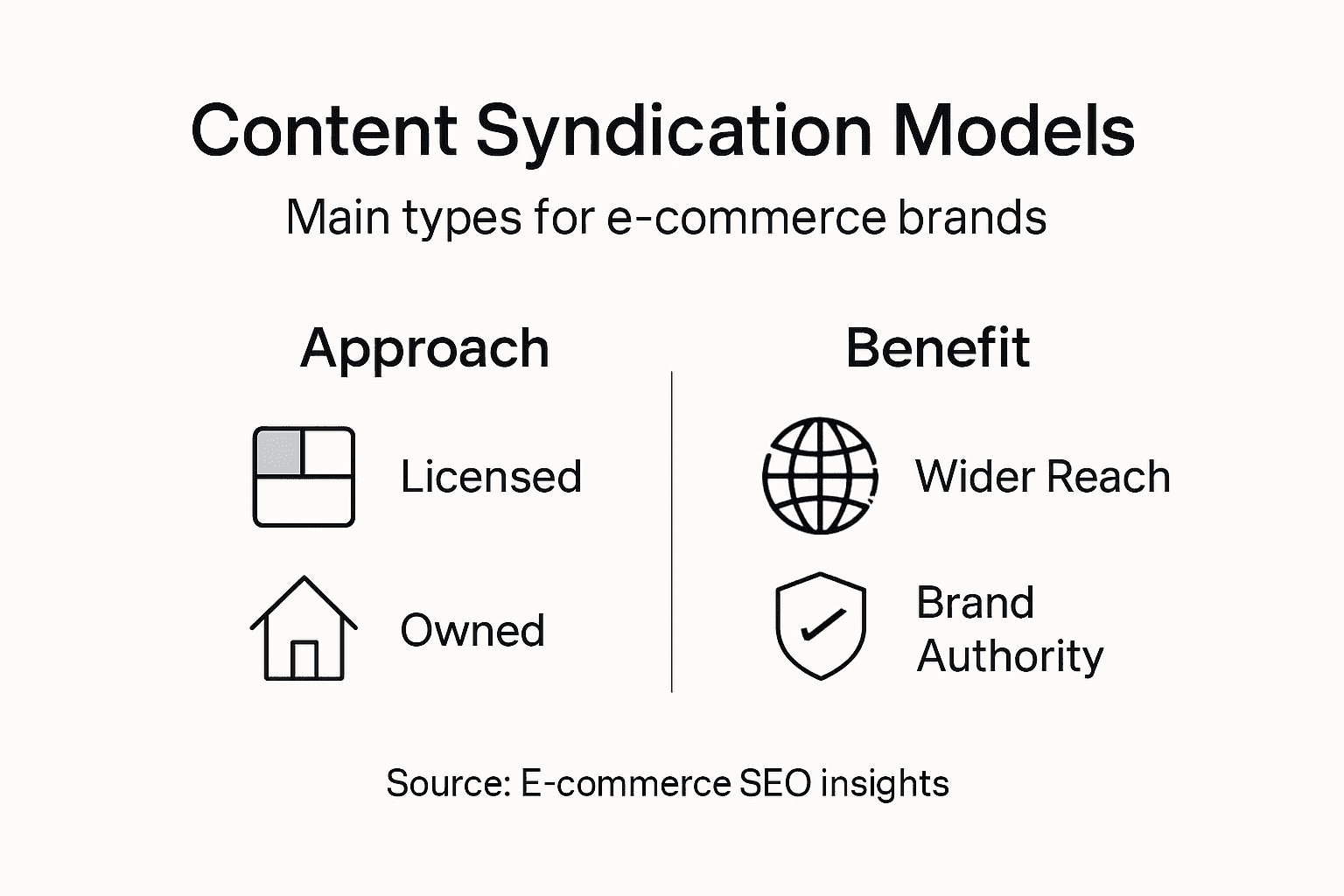
Here's a quick comparison of the main types of content syndication models and their typical advantages:
| Syndication Model | Key Feature | Audience Reach | Business Benefit |
|---|---|---|---|
| Licensed | Formal permissions and agreements | Moderate to High | Clear control and legal safety |
| Paid | Distribution for a set fee | Highly targeted | Rapid reach and lead generation |
| Owned | Reuse on owned channels | Limited to owned audience | Maximum brand consistency |
Pro tip: Carefully evaluate your content's potential reach and alignment with each syndication model before selecting a distribution strategy to maximize your digital marketing effectiveness.
How Content Syndication Works for SEO
Content syndication serves as a powerful strategic approach for enhancing search engine optimization by expanding digital content's reach and visibility. SEO content syndication strategies require meticulous planning to maximize organic search performance while protecting the original content's ranking potential.

The fundamental mechanism of content syndication for SEO involves carefully republishing original content on reputable third-party websites with canonical links and proper attribution. These canonical links signal to search engines that the original source remains the primary content location, preventing potential duplicate content penalties. When executed correctly, syndication can generate valuable backlinks, increase domain authority, and expose the content to broader audiences across different digital platforms. This approach allows businesses to amplify their content's visibility without compromising their primary website's search engine rankings.
Successful SEO-focused content syndication demands a strategic approach that balances exposure with search engine guidelines. High-quality syndication partners should have relevant domain authority, align with the content's target audience, and follow strict republication protocols. E-commerce businesses must carefully vet potential syndication platforms, ensuring they provide contextual relevance, maintain content integrity, and offer meaningful engagement opportunities that contribute to overall search engine performance.
Pro tip: Always use canonical links and monitor syndicated content performance to ensure your SEO strategy remains precise and effective.
Risks, Duplicate Content, and Legal Issues
Content syndication presents complex legal and strategic challenges that e-commerce businesses must carefully navigate. Digital content syndication risks encompass a broad range of potential legal and operational complications that require proactive management and strategic planning.
The primary legal risks associated with content syndication center around intellectual property protection and potential copyright infringement. Businesses must establish clear licensing agreements that explicitly define content usage rights, attribution requirements, and permissible modifications. Without robust legal frameworks, organizations risk unauthorized content alterations, misrepresentation of brand messaging, and potential legal disputes across different jurisdictional boundaries. These risks are particularly pronounced in global digital markets where content distribution can quickly transcend original publication contexts.
Duplicate content represents another significant concern in content syndication strategies. Search engines like Google penalize websites with substantial duplicate content by potentially reducing search rankings or completely excluding pages from indexing. To mitigate these risks, businesses should implement canonical links, carefully select syndication partners with high-quality and contextually relevant platforms, and maintain strict guidelines about content reproduction. This approach ensures that original content receives proper attribution while minimizing potential negative SEO consequences.
Pro tip: Always draft comprehensive syndication agreements that explicitly outline content usage rights, modification limits, and attribution requirements to protect your intellectual property.
Best Practices to Maximize Syndication Success
Content syndication demands a strategic approach that goes beyond simple content distribution. Winning content syndication strategies require meticulous planning and targeted execution to achieve meaningful business outcomes.
Successful syndication begins with rigorous platform selection, focusing on websites with high domain authority and audiences that closely match your target demographic. E-commerce businesses should prioritize platforms that not only have substantial reach but also demonstrate genuine relevance to their specific industry and customer base. This means carefully vetting potential syndication partners based on their audience demographics, engagement metrics, and content alignment. Sophisticated marketers understand that syndication is not about widespread republication, but about strategic placement that delivers genuine value and drives qualified traffic.
Optimizing content for syndication involves creating modular, adaptable pieces that can seamlessly integrate across different platforms while maintaining core messaging integrity. This requires developing content clusters that can be easily repurposed, using consistent branding elements, and ensuring each piece maintains high-quality standards. Technical considerations like proper canonical linking, clear attribution, and search engine optimization become critical in preventing potential duplicate content penalties and preserving the original content's ranking potential.
Below is a summary of crucial best practices for maximizing content syndication success:
| Best Practice | Why It Matters | Suggested Action |
|---|---|---|
| Strategic platform selection | Ensures high-quality engagement | Vet audiences and industry fit |
| Content modularity | Supports flexible reuse | Design adaptable content pieces |
| SEO optimization | Maintains rankings | Implement proper canonical links |
| Syndication tracking | Enables strategy refinement | Monitor performance and refine |
Pro tip: Create a comprehensive syndication tracking system that monitors content performance across different platforms, allowing you to continuously refine and improve your distribution strategy.
Maximize Your Content Syndication Impact with AI-Powered SEO
Content syndication offers e-commerce businesses a powerful way to extend reach and boost SEO through strategic content distribution. However, challenges like avoiding duplicate content penalties, ensuring proper attribution, and consistently optimizing for search engines can create hurdles that stall growth. If you want to overcome these pain points and harness the true power of syndication, leveraging automated, AI-driven solutions is key.
At Babylovegrowth.ai, we simplify organic growth by delivering high-quality, AI-generated content designed to rank highly on Google and ChatGPT. Our 30-day personalized content plans and backlink exchange ecosystem help you maintain SEO integrity even as you syndicate your content across multiple platforms. We understand the importance of canonical links, content modularity, and strategic distribution to preserve your original content’s authority while expanding visibility.
Unlock automated SEO success today and watch your e-commerce reach grow with confidence.

Ready to boost your brand with content syndication done right? Visit Babylovegrowth.ai now to start your free trial and take advantage of AI-powered SEO that puts your business ahead. Don’t wait. Your competitors are already leveraging syndication strategies enhanced by automation and smart optimization.
Frequently Asked Questions
What is content syndication?
Content syndication is a digital marketing strategy where original content is republished on various third-party platforms to increase visibility and audience reach while retaining ownership of the content.
How does content syndication affect SEO?
Content syndication can enhance SEO by allowing the original content to gain backlinks and exposure on reputable sites, provided that canonical links and proper attribution are used to prevent duplicate content penalties.
What are the different types of content syndication models?
The three primary types of content syndication models are licensed syndication, paid syndication, and owned syndication, each offering unique advantages based on the level of control and target audience reach.
What are best practices for successful content syndication?
Best practices include selecting strategic platforms with high domain authority, creating modular content for flexibility, optimizing content for SEO, and tracking performance to refine syndication strategies.
Recommended
Smart SEO,
Faster Growth!
Most Read Articles
Generative Engine Optimization (GEO)
Learn how Generative Engine Optimization (GEO) helps your content rank in AI search engines like ChatGPT and Google AI. This comprehensive guide explains the differences between SEO and GEO, why it matters for your business, and practical steps to implement GEO strategies for better visibility in AI-generated responses.
DylenJan 18, 2025
Track LLM Traffic in Google Analytics 4 (GA4)
Learn how to track and analyze traffic from AI sources like ChatGPT, Claude, Perplexity, and Google Gemini in Google Analytics 4. This step-by-step guide shows you how to set up custom filters to monitor AI-driven traffic and make data-driven decisions for your content strategy.
DylenMar 18, 2025
How to Humanize AI Text with Instructions
Learn practical techniques to make AI-generated content sound more natural and human. This guide covers active voice, direct addressing, concise writing, and other proven strategies to transform robotic text into engaging content.
DylenApril 7, 2025
Open AI Revenue and Statistics (2024)
Comprehensive analysis of OpenAI financial performance, user engagement, and market position in 2023. Discover key statistics including $20B valuation, $1B projected revenue, and 100M+ monthly active users.
DylenOctober 03, 2025