What is brand recognition? A 2026 guide for marketers


You've likely seen it happen: a customer walks into a store, glances at a shelf full of products, and instantly reaches for the one with the familiar logo. That's brand recognition at work, not brand awareness. Many marketers confuse these terms, but understanding the distinction can transform how you build customer loyalty. This guide clarifies what brand recognition really means and shows you how to measure and improve it for lasting business growth.
Table of Contents
- Understanding Brand Recognition: Definition And Core Concepts
- The Importance Of Brand Recognition For Business Growth
- Measuring And Improving Brand Recognition Effectively
- Brand Recognition Versus Brand Awareness: Key Differences And Why They Matter
- Enhance Your Brand Recognition With BabyLoveGrowth
- Frequently Asked Questions About Brand Recognition
Key takeaways
| Point | Details |
|---|---|
| Brand recognition is aided awareness | Consumers identify your brand when they see visual or auditory cues like logos, colors, or taglines. |
| It drives purchase decisions | Two-thirds of software buyers pick brands they already recognize, leading to higher sales even against similar competitors. |
| Measurement focuses on target audiences | Track recognition among people who actually need your solution, not vanity metrics like total impressions. |
| Consistent branding builds recognition | Repeated exposure to coherent visual elements and messaging strengthens consumer memory and trust. |
| Recognition precedes loyalty | It's the first step in the customer journey toward deeper brand relationships and repeat purchases. |
Understanding brand recognition: definition and core concepts
Brand recognition describes how well consumers can identify a brand through visual or auditory cues like logos, packaging, taglines, or jingles. When someone sees golden arches and immediately thinks of a specific fast food chain, that's recognition in action. It represents the simplest form of brand awareness, where consumers respond to prompted stimuli rather than recalling brands from memory unprompted.
This differs fundamentally from broader brand awareness. Recognition requires a trigger, a visual or audio prompt that helps consumers connect the dots. Awareness encompasses both aided recognition and unaided recall, where customers think of your brand spontaneously when considering a product category. Think of recognition as the foundation: before customers can prefer your brand, they must first recognize it exists.
Why does this matter for your marketing strategy? Recognition forms the crucial first interaction point between consumers and your brand. Without it, you're invisible at the moment of purchase decision. Strong recognition creates mental shortcuts that guide buying behavior, especially in crowded markets where choice paralysis threatens every transaction.
The path from stranger to loyal customer starts here. Recognition builds familiarity, familiarity breeds trust, and trust converts to sales. A product marketing approach that ignores this foundational step wastes resources on later-stage tactics that can't succeed without the groundwork.
Key recognition cues that trigger brand identification:
- Visual elements including logos, color schemes, typography, and packaging design
- Audio signatures like jingles, brand music, or distinctive voice tones in ads
- Taglines and slogans that create verbal associations with your company
- Product shapes or unique design features that stand out on shelves
- Mascots or characters that personify your brand identity
Pro Tip: Test your brand recognition by showing your logo to people outside your industry. If they can't identify your company within three seconds, your visual branding needs work.
The importance of brand recognition for business growth
The numbers tell a compelling story about recognition's business impact. When software buyers choose vendors, 94% select the brand they already had in mind before starting their search. That statistic should terrify any business struggling with visibility. If customers don't recognize you first, you've already lost the sale before you knew the opportunity existed.
Strong brand recognition drives higher sales and profit margins even when competitors offer identical quality. Consumers pay premium prices for recognized brands because familiarity reduces perceived risk. Would you rather buy from a company you've seen advertised repeatedly or an unknown alternative? Most people choose the devil they know, which explains why household names command market dominance despite cheaper alternatives.Recognition creates trust, and trust converts to revenue faster than any other marketing metric.
This trust factor compounds over time. Each positive experience with a recognized brand reinforces the relationship, making repeat purchases nearly automatic. Customers who recognize your brand require less convincing, shorter sales cycles, and lower acquisition costs. They've already done the mental work of categorizing you as legitimate and relevant.
The point of purchase moment crystallizes recognition's value. Standing before dozens of similar products, consumers default to brands they recognize within seconds. That split-second decision represents months or years of brand building paying dividends. Without recognition, your product remains invisible regardless of superior features or lower prices.

Measuring and improving brand recognition effectively
Measuring brand recognition requires focusing on recognition by target audiences who actually need your solution, not vanity metrics like total social media followers. A million impressions mean nothing if they're reaching people who will never buy. Instead, test whether your ideal customers can identify your brand when prompted with your logo or tagline.
Brand recognition represents aided brand awareness, where customers identify your brand after seeing a cue. This differs from unaided awareness, where they recall your name spontaneously. Understanding this distinction shapes how you measure success. For recognition testing, show respondents your logo alongside competitors and ask which they've seen before. Track the percentage who correctly identify yours.Practical measurement methods include:
- Logo recognition surveys where participants match logos to company names
- Prompted recall tests showing visual elements and asking for brand identification
- Social listening to track branded search volume and direct mentions
- Website analytics measuring direct traffic and branded keyword searches
- Customer surveys asking how they first heard about your company
The data reveals patterns about which brand elements resonate strongest. Maybe your color scheme works but your tagline falls flat. Perhaps your logo gets recognized but people can't remember your company name. These insights guide refinement.
Descriptive logos outperform abstract designs for building recognition. When your logo literally depicts what you do, consumers form stronger memory associations. A plumbing company using wrench imagery creates clearer mental connections than geometric shapes. Consider how your visual identity communicates your value proposition at a glance.
Pro Tip: Run quarterly recognition tests with new prospects to track improvement over time. Consistent measurement reveals whether your branding investments actually move the needle.
Strategies to strengthen recognition:
- Maintain visual consistency across all marketing channels and customer touchpoints
- Repeat your core brand elements in every advertisement and content piece
- Create emotional connections through storytelling that links to your brand identity
- Invest in high-frequency advertising to build familiarity through repeated exposure
- Partner with complementary brands to borrow recognition from established names
| Recognition Tactic | Time to Impact | Cost Level | Effectiveness |
|---|---|---|---|
| Consistent visual branding | 3-6 months | Low | High |
| Paid advertising frequency | 1-3 months | High | Very High |
| Content marketing | 6-12 months | Medium | Medium |
| Strategic partnerships | 2-4 months | Medium | High |
| Social media presence | 4-8 months | Low to Medium | Medium |
Improving brand visibility through AI SEO accelerates recognition building by putting your brand in front of searchers actively looking for solutions. When prospects repeatedly encounter your content while researching their problems, they begin recognizing your name before ever visiting your website. This creates warm leads who arrive already familiar with your brand.
Building an effective brand strategy with AI tools streamlines the recognition process. Automation handles repetitive branding tasks while you focus on creative elements that differentiate your company. The combination of consistent execution and strategic creativity drives recognition faster than manual efforts alone.
Brand recognition versus brand awareness: key differences and why they matter
Brand awareness encompasses broader knowledge than recognition alone. While recognition requires visual or audio cues to trigger identification, awareness includes spontaneous recall where consumers think of brands without prompts. These stages represent different depths of customer familiarity and require distinct marketing approaches.
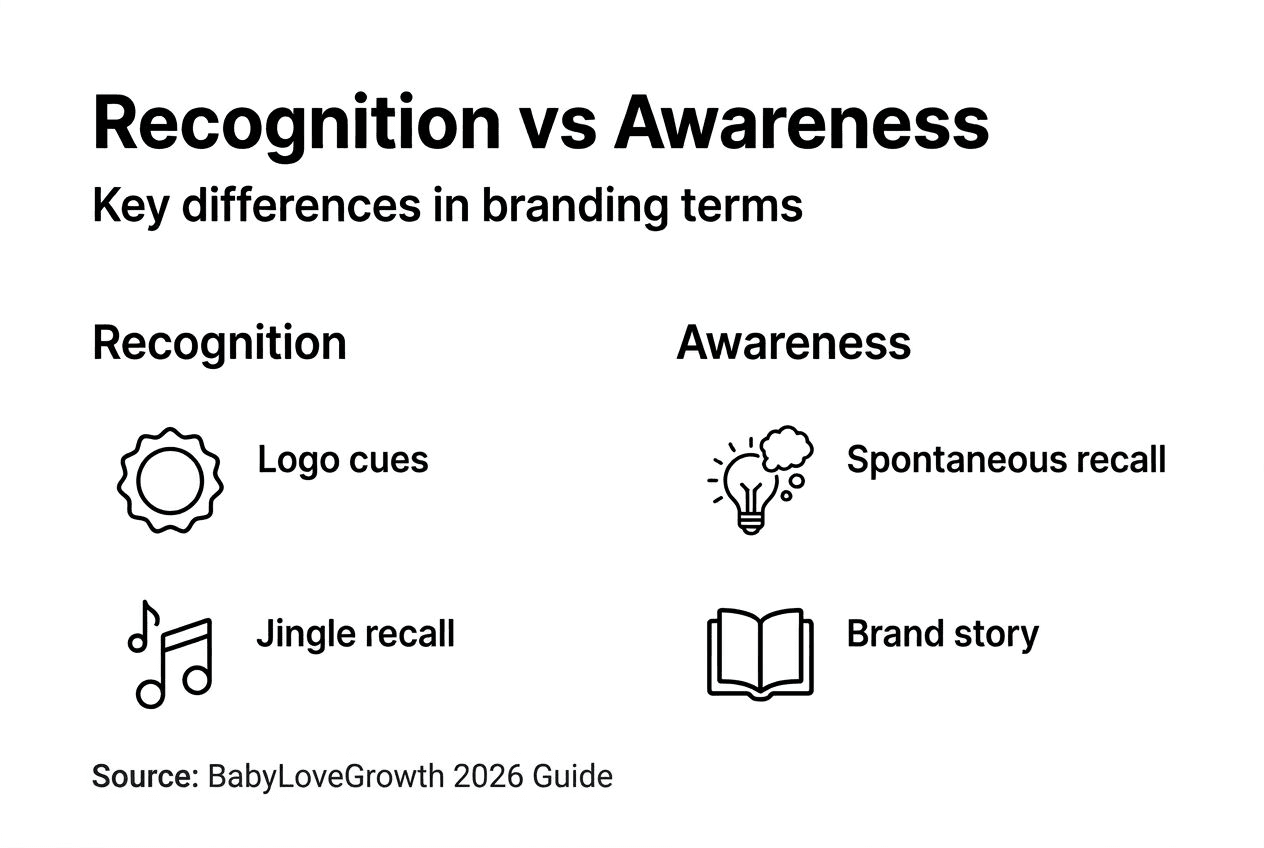
Spontaneous brand awareness exceeds recognition by requiring consumers to retrieve brand names from memory independently. Ask someone to name athletic shoe brands and they might say Nike, Adidas, and Puma without seeing logos. That's unaided awareness, a more advanced stage than recognizing those brands when shown their swoosh, three stripes, or jumping cat.
The progression follows predictable stages:
- Recognition: Customers identify your brand when prompted with visual or audio cues
- Aided awareness: They acknowledge familiarity when your name is mentioned among competitors
- Top of mind awareness: Your brand comes to mind first when considering a product category
- Brand dominance: Customers use your brand name generically for the entire category
Why do these distinctions matter for your marketing strategy? Each stage demands different tactics and budget allocation. Building recognition requires consistent visual branding and repeated exposure. Developing top of mind awareness needs emotional storytelling and category education. Trying to achieve advanced awareness without first establishing recognition wastes resources.
Customer behavior shifts across these stages. Someone who merely recognizes your logo might consider you among many options. A customer with top of mind awareness starts their buying journey by searching specifically for your brand. The latter converts faster, costs less to acquire, and exhibits higher lifetime value.
| Metric | Brand Recognition | Brand Awareness |
|---|---|---|
| Measurement method | Aided recall with visual prompts | Unaided recall without cues |
| Customer familiarity | Can identify brand when shown | Remembers brand spontaneously |
| Marketing stage | Initial exposure and visibility | Deeper engagement and preference |
| Conversion likelihood | Moderate, depends on competition | Higher, brand is top choice |
| Required investment | Consistent visual presence | Emotional connection and education |
Tracking search visibility metrics helps distinguish between recognition and awareness online. Branded search volume indicates awareness, people thinking of your company unprompted. Meanwhile, click-through rates on display ads with your logo measure recognition, consumers responding to visual cues.
Adapt your messaging based on where prospects fall in this spectrum. For audiences with low recognition, focus on introducing your brand identity clearly and repeatedly. With recognized audiences, shift toward differentiating your value proposition and building preference. Mismatching message to audience stage leaves money on the table.
Enhance your brand recognition with BabyLoveGrowth
Building brand recognition demands consistent visibility across search results where your target customers spend their research time. When prospects repeatedly encounter your brand while exploring solutions, recognition grows organically alongside your authority.
BabyLoveGrowth automates this visibility through AI-powered content and strategic backlinks. Our SEO automation platform generates optimized articles that rank on Google and ChatGPT, placing your brand in front of searchers at crucial decision moments. Each article reinforces your brand identity while delivering genuine value.
The SEO link building platform amplifies recognition by securing quality backlinks that boost your domain authority. Higher rankings mean more eyes on your content, multiplying the recognition-building repetitions that turn strangers into familiar faces. Our organic traffic tool provides actionable insights about which content drives the most visibility for your brand.
Stop wasting time on manual SEO tasks that delay recognition building. Let automation handle the repetitive work while you focus on crafting the unique brand identity that sets you apart. Schedule a demo to see how BabyLoveGrowth accelerates your path from unknown to unforgettable.
Frequently asked questions about brand recognition
What exactly is brand recognition in simple terms?
Brand recognition is when customers can identify your company after seeing your logo, hearing your jingle, or noticing other distinctive brand elements. It's the ability to say "I know that brand" when prompted with visual or audio cues, even if they can't recall specific details about your products.
How does brand recognition differ from brand awareness?
Recognition requires a prompt like showing someone your logo, while awareness means customers remember your brand spontaneously without cues. Recognition is aided recall, awareness encompasses both aided and unaided recall. Think of recognition as the first step toward deeper awareness.
How can businesses measure brand recognition accurately?
Show target customers your logo alongside competitors and track the percentage who correctly identify your brand. Conduct surveys asking if respondents have seen your brand before. Monitor branded search volume and direct website traffic. Focus measurements on your ideal customer profile, not general populations.
Why does strong brand recognition lead to more sales?
Consumers prefer familiar brands because recognition reduces perceived purchase risk. When faced with similar products, 94% of buyers choose brands they already recognize. Recognition shortens sales cycles, increases conversion rates, and allows premium pricing even against equal-quality competitors.
What are quick ways to improve brand recognition?
Maintain absolute visual consistency across all marketing channels. Increase advertising frequency to build familiarity through repetition. Create content that educates your target audience while prominently featuring your brand elements. Use descriptive logos that clearly communicate what you do. Partner with established brands to borrow recognition credibility.