What is a content audit? Key strategies to boost traffic


TL;DR:
- Regular content audits significantly increase organic traffic and improve search rankings.
- Using AI tools streamlines audits, making them faster and more comprehensive.
- Ongoing, iterative audits are essential for maintaining and boosting website performance over time.
Most business websites are quietly bleeding traffic. Outdated blog posts rank for nothing, thin pages confuse search engines, and duplicate content splits authority across URLs that should never have existed. Yet 60% of marketers skip regular content audits, leaving real SEO gains on the table. A content audit is the fastest way to stop that leak. It tells you exactly what is working, what is dragging your site down, and where your biggest growth opportunities are hiding. This guide walks you through the full process, from defining what a content audit actually is, to the tools and frameworks that turn findings into measurable traffic growth.
Table of Contents
- What is a content audit and why does it matter?
- Key elements and steps in a content audit
- Popular tools and technologies for content auditing
- Applying content audit findings: Actionable improvements
- A smarter approach: Why content audits aren't just a 'one and done' fix
- Make your next audit faster with AI-powered tools
- Frequently asked questions
Key Takeaways
| Point | Details |
|---|---|
| Content audits explained | A content audit is a strategic review of website assets to spot strengths, weaknesses, and opportunities for growth. |
| Step-by-step approach | Following a structured audit process improves efficiency and maximizes business results. |
| Leverage AI tools | Combining automation with expert oversight yields deeper insights and faster optimizations. |
| Iterate for growth | Making content audits a recurring habit delivers long-term traffic and SEO gains. |
What is a content audit and why does it matter?
A content audit is a systematic review of every piece of content on your website. That means blog posts, landing pages, product descriptions, videos, and anything else indexed by search engines. The goal is simple: understand what each piece of content is doing for your business, and decide whether it should stay as is, get improved, be merged with something else, or be removed entirely.
Here is where most marketing managers get it wrong. They assume a content audit is a one-time spring cleaning exercise, or that it only applies to enterprise sites with thousands of pages. Neither is true. Even a 30-page website can have content that actively hurts its rankings by sending confusing signals to Google about what the site is actually about.
The business case for regular audits is clear. Sites that regularly review their content freshness impact see 37% higher organic traffic compared to those that publish and forget. That is not a marginal gain. For a site getting 5,000 monthly visitors, that is potentially 1,850 additional visits per month without spending a dollar on ads.
Content audits also improve user experience. When visitors land on accurate, well-structured pages that answer their questions, they stay longer, click deeper, and convert more often. Search engines notice that behavior and reward it with better rankings.
Common myths about content audits:
- "My content is fine because it still gets some traffic." Traffic alone does not mean a page is performing well. A page ranking on position 8 for a high-value keyword could rank on position 2 with a targeted update.
- "Audits are only for big brands with large teams." Small teams often see the fastest results because they have fewer pages to fix and can move quickly.
- "Publishing new content is more valuable than fixing old content." Updating existing pages is often faster and more effective than creating from scratch, especially for competitive keywords.
"Content that is never revisited is content that slowly stops working. The brands winning in search are the ones treating their content library as a living asset, not a static archive."
Pro Tip: Start your first audit by pulling your top 20 pages by traffic in Google Analytics. Look at their rankings, bounce rates, and conversion data. You will almost always find at least two or three pages with obvious improvement opportunities that take less than an hour to fix.
Pairing your audit with a solid content calendar planning process ensures that improvements are scheduled and tracked, not just identified and forgotten.
Key elements and steps in a content audit
Knowing why audits matter is one thing. Knowing how to actually run one is where most teams get stuck. Here is a structured process that works for SMB marketing teams without requiring a dedicated SEO analyst.
Step-by-step content audit process:
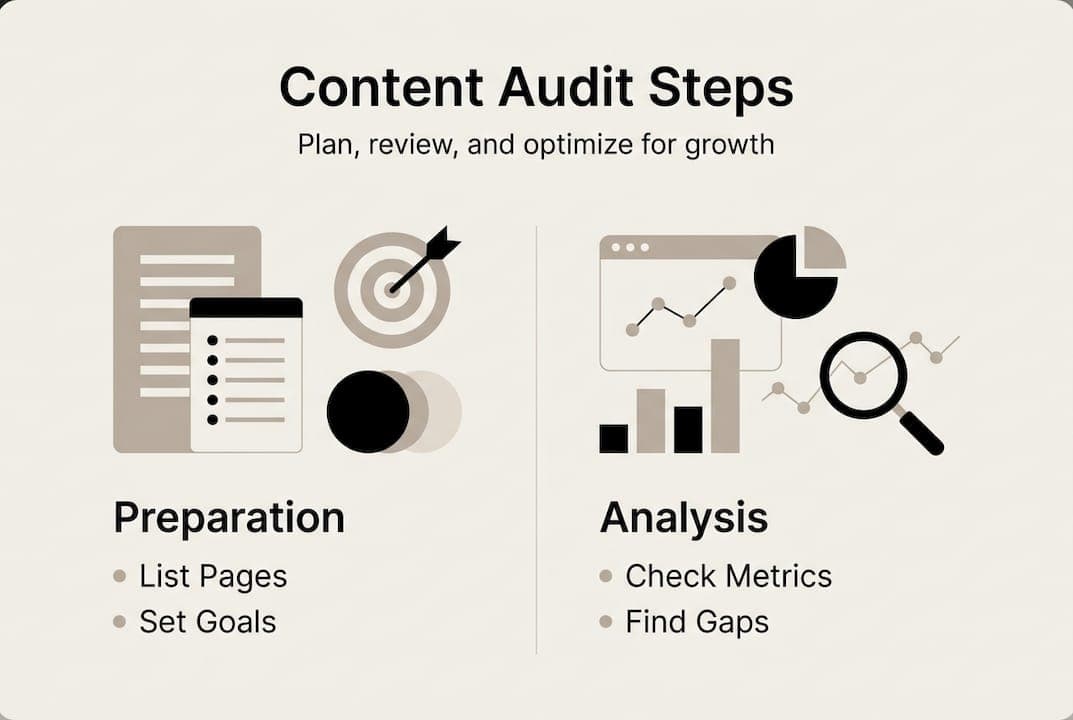
- Build your content inventory. Export a list of every URL on your site using a crawling tool. Include the page title, URL, word count, last updated date, and page type. A spreadsheet works fine at this stage.
- Map each page to a business goal. Every page should have a clear purpose: driving organic traffic, capturing leads, supporting customers, or converting buyers. Pages without a clear goal are candidates for removal or consolidation.
- Pull performance data. Connect your inventory to Google Analytics and Google Search Console. Add columns for monthly traffic, average position, click-through rate, bounce rate, and conversions. This is where the picture gets interesting.
- Score each page. Use a simple scoring system: pages with strong traffic and good engagement get a "keep" label. Pages with high impressions but low clicks need title and meta description work. Pages with low traffic and no clear purpose get flagged for improvement, merging, or removal.
- Prioritize your action list. Sort by potential impact. A page ranking on position 6 for a keyword with 2,000 monthly searches is worth more of your time than a page getting 10 visits per month on a topic nobody searches for.
Following a structured AI-powered SEO audit workflow can save up to 50% of the time typically spent on manual audit steps. That efficiency matters when you are managing marketing alongside a dozen other priorities.

| Factor | Manual audit | Automated audit |
|---|---|---|
| Speed | Slow (days to weeks) | Fast (hours) |
| Cost | Low tool cost, high labor | Higher tool cost, low labor |
| Depth | High (catches nuance) | Medium (misses context) |
| Scalability | Limited | Excellent |
| Best for | Small sites, strategic review | Large sites, routine checks |
For inspiration on what a well-executed audit looks like in practice, reviewing examples of successful audits from similar-sized brands can help you calibrate your own benchmarks.
Pro Tip: Save your audit spreadsheet as a reusable template. Add a "date reviewed" column so future audits build on previous data rather than starting from scratch every time.
Popular tools and technologies for content auditing
The right tools turn a content audit from a painful manual process into something your team can actually sustain. Here is a practical look at what is available and how each fits into a real workflow.
Core tools most marketing teams use:
- Google Search Console: Free and essential. Shows which pages get impressions and clicks, average ranking positions, and crawl errors. Always start here.
- Google Analytics 4: Reveals user behavior. Which pages have high bounce rates? Where do users drop off? Which pages actually drive conversions?
- Screaming Frog SEO Spider: Crawls your site and exports a full URL inventory with metadata, response codes, and on-page signals. The free version handles up to 500 URLs.
- Semrush or Ahrefs: Keyword ranking data, backlink profiles, and content gap analysis. Useful for understanding why certain pages are underperforming relative to competitors.
| Tool | Best for | Pricing | AI features |
|---|---|---|---|
| Google Search Console | Ranking and click data | Free | Basic insights |
| Screaming Frog | Full site crawl | Free / $259/yr | Limited |
| Semrush | Competitive analysis | From $140/mo | Yes |
| Ahrefs | Backlink and keyword data | From $129/mo | Yes |
| Babylovegrowth.ai | AI-powered full audit | SaaS pricing | Advanced |
AI is changing what audits can catch. AI-driven tools cut repetitive audit tasks and surface content gaps that manual review consistently misses. Instead of spending hours cross-referencing spreadsheets, AI tools flag thin content, identify keyword cannibalization, and recommend specific improvements automatically.
For a broader view of how these tools fit into your overall strategy, the 2026 content marketing checklist and SEO audit workflow tips are worth reviewing alongside your tool selection. If you are evaluating platforms more broadly, the roundup of top marketing automation tools covers how audit capabilities fit into a full marketing stack.
Pro Tip: Do not try to use every tool at once. Pick one crawling tool and one analytics source, run your first audit, and add complexity only after you have a repeatable baseline process.
Applying content audit findings: Actionable improvements
An audit that produces a spreadsheet and nothing else is a wasted effort. The real value is in what you do with the data. Most content on a typical SMB website falls into one of four categories, and each requires a different response.
The four actions framework:
- Keep: High-traffic, high-engagement pages that are accurate and well-optimized. Leave them alone unless data shows a ranking drop.
- Improve: Pages with decent traffic or strong keyword rankings but underperforming click-through rates, thin content, or outdated information. These are your highest-priority quick wins.
- Merge: Two or more pages covering the same topic and splitting traffic between them. Consolidate into one stronger page and redirect the others.
- Remove: Pages with zero traffic, no backlinks, no clear purpose, and no realistic path to improvement. Removing them cleans up your site architecture and concentrates authority on pages that matter.
How to prioritize your action list:
- Fix pages ranking in positions 4 through 10 for valuable keywords first. A small improvement here delivers the biggest traffic jump.
- Update pages with high impressions but low click-through rates. Better titles and meta descriptions can double clicks without changing the content itself.
- Merge thin or duplicate pages. This is often the fastest way to consolidate ranking signals.
- Remove or noindex pages with no value. This is the step most teams skip, but it genuinely helps.
One quick win most SMBs overlook: internal linking. After an audit, you will often find strong pages that are poorly linked from the rest of the site. Adding two or three internal links from high-traffic pages to underperforming ones can lift rankings within weeks.
Ongoing iteration based on audit findings leads to measurable SEO and conversion improvements that compound over time. The brands that treat their content library as a dynamic system, not a static archive, consistently outperform those that only publish new content.
Pro Tip: Document every change you make and the date you made it. Then check performance data 30 and 60 days later. This creates a feedback loop that makes every future audit smarter.
A smarter approach: Why content audits aren't just a 'one and done' fix
Here is something agencies rarely tell their clients: the first content audit almost never produces the biggest results. The second and third ones do.
The reason is simple. Your first audit establishes a baseline. You fix the obvious problems, update the low-hanging fruit, and remove the junk. But search engines take time to re-crawl and re-evaluate your changes. By your second audit, you have real before-and-after data. You can see which updates moved the needle and which ones need more work. That feedback loop is where the real optimization happens.
Most marketing teams treat a content audit as a project with a start and end date. The smarter approach is to treat it as a quarterly habit, built into your team's regular marketing review cycle. A continuous SEO audit strategy does not require a full site review every quarter. It means checking your top 50 pages every 90 days, running a full crawl twice a year, and staying alert to ranking drops that signal content decay.
The brands seeing the most dramatic organic growth are not the ones publishing the most content. They are the ones maintaining the quality of what they already have, consistently and systematically.
Make your next audit faster with AI-powered tools
Running a thorough content audit manually takes time that most marketing managers simply do not have. That is exactly where AI-powered tools change the equation.
At Babylovegrowth.ai, we built our platform specifically for teams that need audit-level insights without the audit-level workload. Our AI SEO Audit scans your site, flags underperforming content, and surfaces prioritized recommendations you can act on immediately. Pair that with keyword discovery with AI to identify the gaps your current content is not covering, and you have a complete picture of where your organic growth is coming from and where it should be going next. Less spreadsheet time. More results.
Frequently asked questions
How often should a business run a content audit?
Most SMBs should audit content at least once or twice per year. Regular audits maximize SEO results and content ROI by catching ranking drops and outdated information before they cost significant traffic.
What metrics matter most in a content audit?
Focus on organic traffic, average ranking position, click-through rate, bounce rate, and conversions per page. Successful audits use these metrics together to build a complete picture of each page's performance.
Can content audits help boost website ranking?
Yes. Sites conducting regular audits see up to 37% more organic traffic. Audit-led optimizations improve content quality and relevance signals, both of which directly influence search rankings.
Are automated tools better than manual audits?
Neither alone is optimal. AI-powered tools accelerate the process and surface patterns at scale, but manual review catches the strategic and contextual issues that automation misses. Use both together for the best outcome.