Website auditing: techniques, benefits & AI SEO strategies


TL;DR:
- Regular website audits diagnose technical, content, and UX issues that impact SEO and conversions.
- AI accelerates audits, automates error detection, and prioritizes fixes for faster optimization.
- A consistent, workflow-based approach enhances site health, boosts rankings, and maximizes marketing ROI.
Website auditing: techniques, benefits & AI SEO strategies
Most marketers think website auditing is something you hand off to a developer and forget about. That assumption is quietly costing businesses rankings, leads, and revenue. A website audit is one of the most strategically powerful tools in any digital marketer's playbook, and with AI now accelerating the process, there's no reason to leave it to chance or gut instinct. This article breaks down exactly what website auditing is, the types of audits that matter most, how AI is reshaping the process, and a practical workflow you can implement immediately to improve your site's performance.
Table of Contents
- What is website auditing?
- Types of website audits and their benefits
- How AI is revolutionizing website audits
- Building an effective website audit workflow
- Why marketers must rethink website auditing
- Optimize your site with AI-powered auditing tools
- Frequently asked questions
Key Takeaways
| Point | Details |
|---|---|
| Website auditing basics | Auditing your website means systematically assessing its technical, content, and SEO health. |
| Audit types and benefits | Technical, content, and SEO audits target specific site issues and can boost search visibility. |
| AI-driven efficiency | AI tools automate audits, uncover hidden errors, and save significant time for marketers. |
| Workflow for results | A step-by-step audit process ensures clear findings and ongoing optimization for better performance. |
| Strategic approach | Continuous, strategic audits deliver the highest ROI and prevent costly website mistakes. |
What is website auditing?
A website audit is a systematic, structured evaluation of your site's overall health. Think of it like a full physical exam for your website. Just as a doctor checks your blood pressure, reflexes, and organ function to surface hidden problems, a website audit examines the technical, content, and structural layers of your site to find anything blocking visibility, traffic, or conversions.
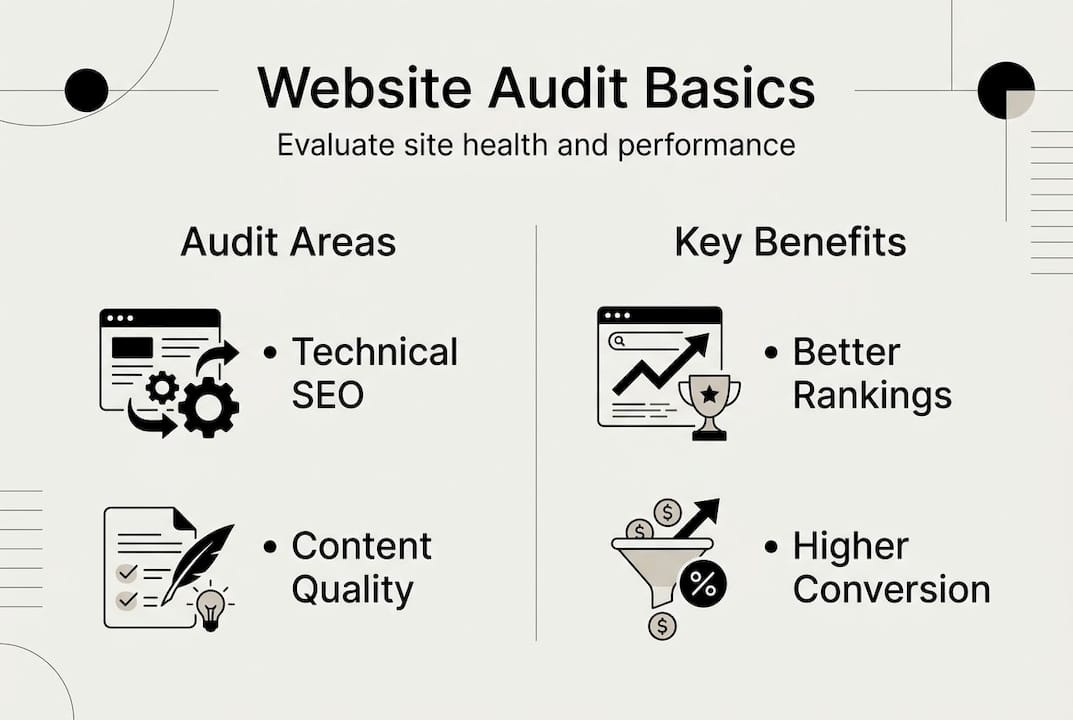
The main goals of a website audit include:
- Identifying technical errors that prevent search engines from indexing your pages
- Spotting content gaps or quality issues that reduce relevance and authority
- Uncovering UX (user experience) problems that increase bounce rates
- Evaluating backlink quality to assess domain authority
- Finding crawlability issues that make your site invisible to bots
Every one of these factors influences where you rank on Google and whether visitors convert into customers. Ignoring even one category can create invisible drag on your SEO performance.
Here's a quick overview of the core audit areas and what each one targets:
| Audit area | What it examines | Common issues found |
|---|---|---|
| Technical SEO | Crawlability, indexing, site speed | Broken redirects, slow pages, duplicate content |
| Content quality | Relevance, depth, structure | Thin content, keyword gaps, missing metadata |
| UX and design | Navigation, mobile usability | Poor CTA placement, confusing layout |
| Backlink profile | Link quality and quantity | Toxic backlinks, low domain authority |
| Crawlability | Site architecture, internal links | Orphaned pages, crawl errors |
For marketers and business owners, the value here is clarity. Rather than guessing why organic traffic dropped or why conversion rates are sluggish, a structured audit points you directly at the root cause. You can follow an SEO audit workflow to ensure nothing gets missed, and use an SEO audit checklist to standardize the process across your team.
The biggest takeaway here: auditing is a diagnostic tool, not a punishment. It surfaces what's already happening beneath the surface so you can fix it before it becomes a bigger problem.
Types of website audits and their benefits
Not all audits are created equal. Different business goals call for different audit types, and understanding what each one offers will help you prioritize where to spend your time and resources. Technical, content, and SEO audits each address distinct needs for site improvement, and using them strategically is what separates growth-focused marketers from those spinning their wheels.
Here's a comparison of the five primary audit types:
| Audit type | Primary focus | Key benefit | Best used when |
|---|---|---|---|
| Technical SEO | Site infrastructure | Improves crawlability and indexing | Site has ranking drops or errors |
| Content audit | Content quality and gaps | Boosts relevance and authority | Traffic plateaus or declines |
| SEO audit | Keyword and on-page optimization | Increases organic visibility | Launching new content strategy |
| UX audit | User experience and design | Raises engagement and conversions | High bounce rates or low time-on-page |
| Backlink audit | Link profile quality | Protects and strengthens authority | After algorithm updates or penalties |
Breaking down the key audit types:
- Technical SEO audit: This digs into your site's backend. It checks page speed, XML sitemaps, robots.txt configuration, canonical tags, and HTTPS security. A slow-loading page can cost you significantly, since users expect pages to load within two seconds or less before they leave.
- Content audit: This evaluates every piece of content on your site for quality, relevance, and keyword coverage. You'll discover what's ranking, what's not, and what needs updating, consolidating, or deleting entirely. Strong content audit strategies can revive underperforming pages and recover lost traffic.
- SEO audit: Focuses on on-page elements like title tags, header structure, internal linking, and keyword alignment. It's your blueprint for optimizing existing pages without creating new ones.
- UX audit: Examines how real users move through your site. Poor navigation, confusing layouts, and missing calls-to-action are UX problems that hurt conversions even when your SEO is solid.
- Backlink audit: Reviews who is linking to you and whether those links help or hurt. Toxic backlinks from spammy domains can trigger ranking penalties. A clean link profile builds trust with search engines.
For a deep dive into the technical side, the technical SEO audit guide walks through every layer of infrastructure analysis that supports ranking success.

Pro Tip: If you're not sure where to start, run a technical SEO audit first. Technical issues create a ceiling on everything else. No amount of great content or strong backlinks will fully compensate for a site that search engines can't crawl efficiently.
How AI is revolutionizing website audits
Manual audits used to take days or even weeks, and they were still prone to human error. AI has fundamentally changed that. AI-powered tools can cut audit time and enhance the accuracy of SEO analysis by automating crawl simulations, pattern recognition, and issue prioritization at a scale no human team can match.
Here's what AI audit tools can do that traditional tools can't:
- Automated crawl simulation: AI tools simulate how Googlebot navigates your site, surfacing crawl errors, redirect chains, and orphaned pages in minutes instead of hours.
- Intelligent error prioritization: Instead of dumping a raw list of 200 issues, AI ranks them by SEO impact so you fix what matters most first.
- Content gap analysis: AI compares your content against top-ranking competitors and identifies the specific topics and keywords you're missing.
- Ranking projections: Some AI audit platforms model the potential traffic impact of fixing specific issues, giving you a business case for each fix.
- Continuous monitoring: AI doesn't just run one-time audits. It watches your site around the clock and alerts you when new issues appear, before they compound into larger ranking drops.
The speed advantage alone is dramatic. What once required a specialist spending three days manually checking pages can now be completed in under an hour with AI in SEO audits. For marketers managing multiple campaigns, that time savings translates directly into faster optimization cycles and better results.
AI also removes a major bottleneck: the need for deep technical expertise. With a quality AI SEO audit checklist, even a non-technical marketer can run a thorough site assessment, interpret the results, and take action without waiting on a developer. Platforms offering automated SEO audits are making this level of analysis accessible to businesses of every size.
Pro Tip: Set up AI-powered audits to run on a weekly or monthly cadence rather than treating them as a quarterly project. Continuous monitoring catches issues early, when they're cheap to fix, rather than after they've damaged your rankings.
Building an effective website audit workflow
Knowing what to audit and having the right tools only gets you so far. The difference between audits that actually improve rankings and audits that collect dust in a shared folder is a repeatable, action-oriented workflow. A repeatable workflow maximizes auditing efficiency and creates clarity for every person involved in the process.
Here's a step-by-step audit workflow built for marketers and business owners:
- Define your goals. Before touching any tool, clarify what you're trying to improve. Is it organic traffic, crawl coverage, conversion rate, or content performance? Your goal determines which audit type to run first and which metrics to track.
- Select your tools. Choose your crawling tool, keyword analyzer, and reporting platform. The AI SEO audit tool from Babylovegrowth.ai offers a fast starting point, covering crawlability, on-page issues, and technical errors in one place.
- Run the crawl. Execute a full site crawl to collect your raw data. Capture all pages, not just the top-level ones. Deep crawls often surface the most impactful issues hiding in blog posts, product pages, and legacy content.
- Categorize and prioritize issues. Sort findings into three categories: critical (broken pages, indexing blocks), moderate (slow load times, missing meta descriptions), and low-priority (minor formatting issues, duplicate H2 tags). Tackle critical items first.
- Create your action plan. Map each issue to a specific fix, assign ownership, and set deadlines. A well-structured marketing automation checklist can help you systematize recurring audit tasks so nothing falls through the cracks.
- Implement and track changes. Fix issues in priority order and monitor the impact using your analytics platform. Watch for ranking shifts, crawl coverage improvements, and changes in organic click-through rates.
- Schedule your next audit. Auditing is not a one-time event. Schedule your next review before you close out this one. Monthly mini-audits for active sites and quarterly full audits keep you ahead of issues.
Essential tools for your workflow:
- Crawling and technical analysis platform
- Keyword rank tracker
- Google Search Console integration
- Content performance dashboard
- Backlink monitoring tool
"The sites that consistently outrank competitors aren't necessarily the ones with the best content. They're the ones that audit regularly, fix what's broken, and iterate faster."
Repeatable workflows also make it easier to delegate. Once your process is documented, a junior team member or VA can handle the data collection and categorization, freeing up senior marketers to focus on strategy and implementation.
Why marketers must rethink website auditing
Here's the uncomfortable truth most SEO guides won't tell you: most marketers treat audits as a reactive measure, something you do after rankings drop or traffic tanks. That's backwards. The highest-ROI version of auditing is proactive, continuous, and strategic.
We've seen businesses spend thousands on paid ads while their organic traffic quietly hemorrhages because of a redirect error that a 30-minute audit would have caught. Auditing isn't overhead. It's the foundation that makes everything else work better. Every dollar you spend on content, backlinks, or ads performs better when your site's technical and content health is strong.
The contrarian take? Auditing is probably the highest-ROI marketing activity available to most businesses, yet it's consistently underfunded and undervalued. AI makes this even more true. When you run an effective audit workflow with AI-powered tools, you're not just fixing errors. You're building a compounding advantage. Each issue you fix raises the ceiling for every other marketing effort you make. Small, consistent improvements to site health stack up over months into dramatic gains in visibility, traffic, and revenue that no single campaign can replicate.
Optimize your site with AI-powered auditing tools
You now have a clear picture of what website auditing involves, which types matter most, and how to build a workflow that generates real results. The next step is putting these strategies into practice with tools designed to make the process faster and smarter.

Babylovegrowth.ai gives digital marketers and business owners an AI-powered platform built for exactly this. From automated technical audits and crawlability analysis to keyword discovery, content planning, and backlink building, the platform handles the heavy lifting so you can focus on growth. Whether you're running your first full site audit or optimizing a large-scale content operation, Babylovegrowth.ai provides the structure, automation, and insights to move the needle on organic visibility across Google, ChatGPT, Claude, and Perplexity. Start with the free AI SEO audit tool and see what your site is actually missing.
Frequently asked questions
What is the main purpose of website auditing?
Website auditing helps identify and fix issues that affect your site's SEO, performance, and marketing effectiveness. Auditing encompasses analyzing performance, content quality, and technical health to surface opportunities for growth.
How often should you audit your website?
Most experts recommend auditing your website every 6 to 12 months, or whenever major changes are made to your site's structure, content, or hosting environment.
Can AI really improve website audits?
AI-powered tools drastically speed up the audit process and detect hidden issues that manual reviews miss, offering more accurate and actionable insights for faster optimization.
What are the most common issues found during website audits?
Audits frequently uncover broken links, slow loading times, low-quality content, and SEO errors. These common site health issues can significantly reduce your organic visibility if left unaddressed.
Are website audits only for large businesses?
Website audits benefit organizations of every size, from early-stage startups to large enterprises, improving online visibility and creating a stronger foundation for sustainable digital growth.
Recommended
Smart SEO,
Faster Growth!
Most Read Articles
Generative Engine Optimization (GEO)
Learn how Generative Engine Optimization (GEO) helps your content rank in AI search engines like ChatGPT and Google AI. This comprehensive guide explains the differences between SEO and GEO, why it matters for your business, and practical steps to implement GEO strategies for better visibility in AI-generated responses.
DylenJan 18, 2025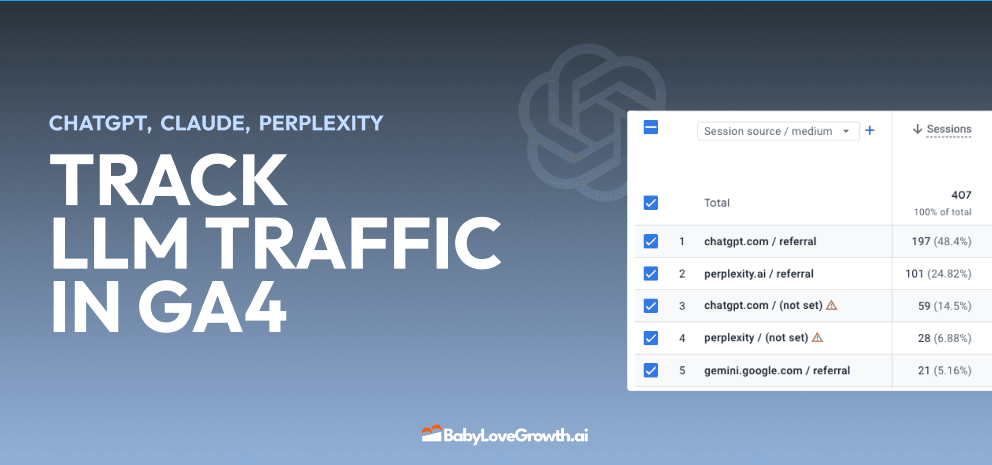
Track LLM Traffic in Google Analytics 4 (GA4)
Learn how to track and analyze traffic from AI sources like ChatGPT, Claude, Perplexity, and Google Gemini in Google Analytics 4. This step-by-step guide shows you how to set up custom filters to monitor AI-driven traffic and make data-driven decisions for your content strategy.
DylenMar 18, 2025
How to Humanize AI Text with Instructions
Learn practical techniques to make AI-generated content sound more natural and human. This guide covers active voice, direct addressing, concise writing, and other proven strategies to transform robotic text into engaging content.
DylenApril 7, 2025
Moz DA vs Ahrefs DR: Which Metric Should You Actually Use?
Moz Domain Authority and Ahrefs Domain Rating look similar but measure very different things. Learn what each score actually tells you, when to use each one, and what to track instead for real SEO results in 2026.
DylenApr 23, 2026
Open AI Revenue and Statistics (2024)
Comprehensive analysis of OpenAI financial performance, user engagement, and market position in 2023. Discover key statistics including $20B valuation, $1B projected revenue, and 100M+ monthly active users.
DylenOctober 03, 2025
"Search Google or Type a URL": What It Means & What to Do
Learn what "Search Google or type a URL" actually means, how your browser decides whether to search or navigate, and what to do if your address bar starts behaving unexpectedly. Includes browser settings guides for Chrome, Firefox, Edge, and Safari.
DylenApr 21, 2026