Unlock audience needs to boost content marketing success


TL;DR:
- Effective audience understanding relies on combining quantitative data with qualitative insights.
- Regularly updating buyer personas ensures content remains relevant and impactful.
- SMEs should start research with internal data and customer conversations, not just external tools.
Most business owners assume that having more data means they know their audience better. That assumption is quietly killing content programs. The real gap isn't the volume of data you collect — it's whether that data reflects what your audience actually needs, fears, and wants to accomplish. 93% of marketers value personalization but only 65% have high-quality data to back it up. This guide walks you through why surface-level research fails, which methods actually work for small and mid-size teams, and how to turn genuine audience understanding into content that drives real business results.
Table of Contents
- Why audience understanding drives content success
- Core methodologies for understanding audience needs
- Buyer personas: building blocks for targeting and personalization
- Common pitfalls, edge cases, and the evolving audience
- From insight to action: using audience understanding in content strategy
- Why most audience research misses the mark (and how SMEs can do better)
- Accelerate your content marketing with automated insights
- Frequently asked questions
Key Takeaways
| Point | Details |
|---|---|
| Audience alignment boosts ROI | Content that matches real audience needs generates more leads at lower cost. |
| Balance quantitative and qualitative | Using both data and direct conversations results in the best customer understanding. |
| Update personas regularly | Keep market insights fresh or risk losing relevance with your target audience. |
| Turn insights into action | Map audience learnings directly to your content, messaging, and campaign priorities. |
Why audience understanding drives content success
Content marketing only works when it speaks directly to what your audience cares about. Generic content gets ignored. Content that addresses a specific pain point, answers a real question, or solves a problem your reader already has — that content gets shared, bookmarked, and acted on.
The business case is hard to argue with. Content generates 3x more leads at 62% less cost than traditional outbound marketing. That efficiency multiplier only kicks in when the content is relevant. Irrelevant content, no matter how well written, burns budget without results.
Here's the uncomfortable truth most marketing teams avoid: they overestimate how well they know their audience. They rely on demographic snapshots, last quarter's campaign data, or assumptions baked in years ago. Meanwhile, 20% of B2B marketers say understanding their audience's informational needs is their single biggest challenge. That's not a data problem. That's a research habit problem.
When you invest in analytics ROI in marketing and pair it with real qualitative insight, you stop guessing and start publishing content that converts. The measurable impacts include:
- Higher organic search rankings because content matches search intent
- Lower bounce rates because visitors find what they came for
- More qualified leads because messaging speaks to real buyer triggers
- Shorter sales cycles because content educates before the first call
"The brands that win with content aren't producing the most — they're producing the most relevant. Relevance comes from understanding, not volume."
Building that understanding requires deliberate effort. It also requires the right engagement strategies for growth that go beyond surface metrics like page views or social likes. The goal is to know what motivates your audience to act, not just what they click.
Core methodologies for understanding audience needs
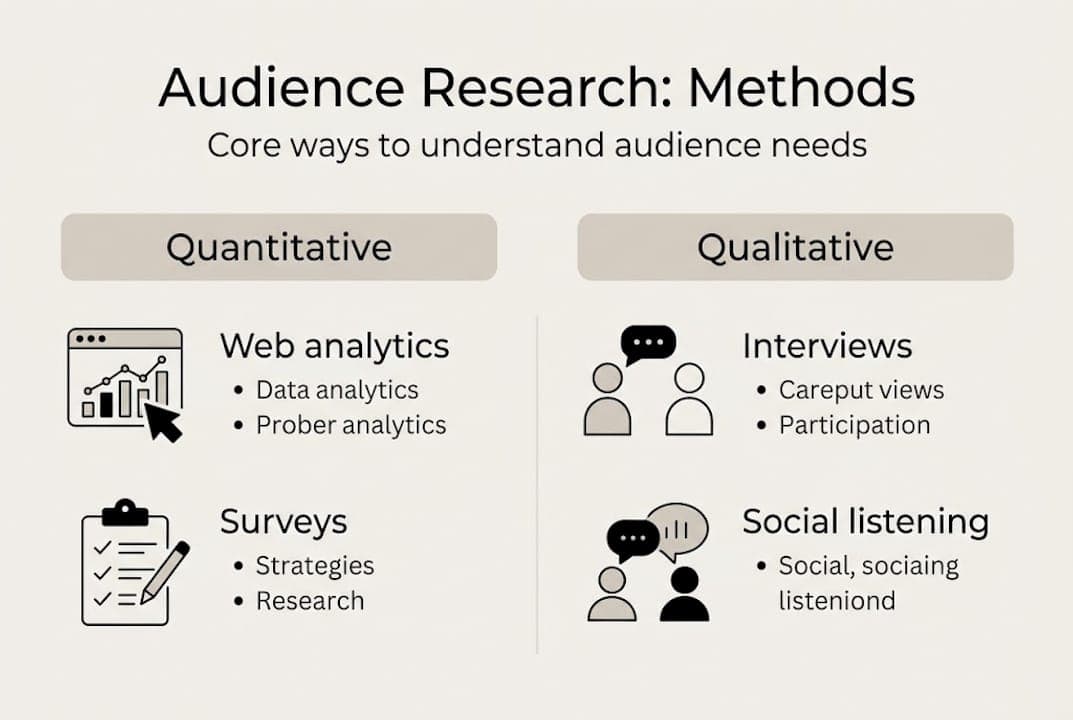
There's no single method that gives you the full picture. The most accurate audience understanding comes from combining quantitative data with qualitative insight. Think of it as triangulation: each method fills in the blind spots of the others.
Quantitative methods give you scale and patterns. Surveys, website analytics, and CRM data show you what large groups of people do. Qualitative methods give you context and meaning. Customer interviews, support ticket analysis, and social listening show you why they do it.
| Method | Type | Best for | Time investment |
|---|---|---|---|
| Web analytics | Quantitative | Behavior patterns | Low |
| Customer surveys | Quantitative | Preferences, satisfaction | Medium |
| 1:1 interviews | Qualitative | Motivations, objections | High |
| Support ticket review | Qualitative | Pain points, language | Low |
| Social listening | Qualitative | Trends, sentiment | Medium |
Here's a practical sequence to get started fast:
- Pull your last 90 days of web analytics and identify your top 10 most visited pages
- Review 50 recent support tickets or sales call notes for recurring language and questions
- Send a 5-question survey to your email list focused on their biggest current challenge
- Schedule 3 to 5 customer interviews with your best and worst customers
- Map what you learn to your existing content and flag the gaps
Pro Tip: When designing effective surveys, keep them under 7 questions and focus on open-ended prompts like "What almost stopped you from buying?" You'll get more usable insight than from a 20-question checkbox survey.
This process works for audience-centric content planning because it grounds your editorial calendar in real language your audience already uses. That language also feeds directly into keyword research and segmentation for SEO, giving your content a structural advantage from the start. For a solid foundation, review SME content marketing basics before building out your research process.
Buyer personas: building blocks for targeting and personalization
A buyer persona is a semi-fictional profile of your ideal customer built from real data. Done well, it becomes the filter every piece of content passes through before it gets published. Done poorly, it's a slide deck that collects dust.

A robust persona includes more than job title and age range. Personas include demographics, behaviors, challenges, and goals and should be updated regularly to stay accurate. Here's what a complete persona template looks like:
| Persona field | Example |
|---|---|
| Role and seniority | Marketing manager, 5 years experience |
| Primary goal | Generate qualified leads without increasing budget |
| Biggest fear | Wasting spend on campaigns that don't convert |
| Preferred content format | Short videos, practical how-to guides |
| Buying trigger | Competitor launches a new product |
| Objection to purchase | "We already have a tool for that" |
| Where they get information | LinkedIn, industry newsletters, Google search |
Most SMEs build one or two personas and treat them as permanent. That's a mistake. Stale personas lead to irrelevant content, and difficult customers actually provide some of the most authentic insights into what your messaging is missing.
Key practices for keeping personas useful:
- Audit each persona every 6 months against real customer data
- Create at least one "edge persona" for a customer type you struggle to serve
- Use negative feedback and churn reasons to update pain points
- Validate personas with your sales and support teams, not just marketing
Pro Tip: Your most difficult customers often reveal where your product or message has gaps. Learning from difficult customers can unlock content angles your competitors haven't considered, because most brands avoid that friction instead of studying it.
Once personas are current, use them to guide reaching digital audiences across channels. Pair them with using analytics for personas to continuously close the loop between what you assume and what the data confirms.
Common pitfalls, edge cases, and the evolving audience
Even teams with solid research processes fall into traps. The three most common mistakes in audience research aren't about tools or budgets — they're about habits.
Mistake 1: Assuming instead of asking. Many marketers project their own preferences onto their audience. They write content they would want to read, not content their customer needs to act.
Mistake 2: Not updating. Buyer personas should reflect changes in the market and customer experiences. A persona built in 2023 may be completely wrong in 2026, especially in fast-moving industries.
Mistake 3: Being too generic. Broad personas that try to represent everyone end up speaking to no one. Specificity is what makes content feel personal.
"Only 52% of marketers use behavioral insights in their personalization efforts, despite personalization being a top priority. The gap between intention and execution is where most SMEs lose ground."
Platform shifts also force audience recalibration. When a social channel changes its algorithm, when a new search behavior emerges, or when economic conditions shift buyer priorities, your existing research can become outdated fast. Tracking B2B content trends helps you anticipate these shifts before they hurt your performance.
AI and automation tools can speed up data processing and surface patterns faster than manual review. But they can't replace the judgment that comes from a real conversation with a real customer. Use AI to scale what you already understand, not to substitute for understanding itself.
An ongoing improvement checklist:
- Review audience data every quarter, not just annually
- Track the importance of personalization as a performance metric, not just a strategy goal
- Explore how AI and brand loyalty interact when automation replaces human touchpoints
- Flag content that underperforms and trace it back to persona assumptions
From insight to action: using audience understanding in content strategy
Research without action is just expensive documentation. The goal is to close the loop between what you learn about your audience and what you publish for them.
Here's a practical sequence for applying audience insights to your content strategy:
- Map each persona to a stage in your buyer journey (awareness, consideration, decision)
- Identify the top 3 questions each persona has at each stage
- Audit your existing content to see which questions are already answered well
- Prioritize content gaps based on search volume and business impact
- Assign content types based on persona preferences (video, long-form, short guides)
- Test one new content piece per persona per month and track engagement
The difference between using updated versus outdated personas is measurable. A team working from a 2023 persona might produce content focused on cost savings, while their 2026 audience is actually more concerned with implementation speed and integration ease. Same product, completely different message needed.
Pro Tip: Build a simple test-learn-optimize cycle. Publish content, measure it against audience engagement for SEO metrics, and feed what you learn back into your personas. This keeps your building engaging content process grounded in reality rather than assumption.
Personalization data quality gaps slow progress for most teams. The fix isn't more data — it's better habits around the data you already have. Check out the SME content playbook for a practical framework to get started.
Why most audience research misses the mark (and how SMEs can do better)
Here's what most content marketing advice gets wrong: it treats audience research as a one-time setup task rather than an ongoing discipline. Big brands can afford to run quarterly research programs with dedicated teams. SMEs can't. So they do it once, file the results, and move on.
The scrappiest and most effective approach we've seen is this: talk to your most difficult customers regularly. Not your happiest ones. Not the ones who leave five-star reviews. The ones who complained, churned, or pushed back hardest. Audits and updates are essential and those difficult customers provide goldmine insights that no survey template will surface.
Conventional audience research optimizes for comfort. It asks easy questions to easy respondents. Real differentiation comes from understanding the friction your audience experiences that your competitors are too polished to acknowledge. Build that into your advanced audience engagement strategy and you'll produce content that genuinely stands out.
Accelerate your content marketing with automated insights
Understanding your audience is only half the equation. Turning those insights into consistent, high-ranking content at scale is where most small teams hit a wall.
Babylovegrowth.ai is built for exactly this challenge. Our platform combines AI-driven content creation with SEO automation tools that translate your audience insights into optimized articles, keyword strategies, and a 30-day content plan tailored to your business. You can strengthen your domain authority through our backlink building software and track every result with our organic traffic growth tool. Stop leaving audience understanding on a whiteboard and start turning it into measurable organic growth.
Frequently asked questions
How do I know if my buyer personas are accurate?
Validate personas by comparing them against actual customer behaviors, sales data, and support interactions. Personas should be audited and refined regularly as markets shift to stay relevant.
How often should I update my audience research?
Review your audience insights at least every 6 to 12 months, or sooner if you notice drops in engagement or conversion. Personas should be updated regularly as audiences evolve and market conditions change.
What's the fastest way for small businesses to start understanding their audience?
Start with your internal sales and support data, then run short customer interviews or surveys to validate what you find. For SMEs, internal data is the best starting point before investing in external research tools.
Is data privacy a concern when gathering audience insights?
Yes, always comply with applicable data protection laws and be transparent with customers about how their data is used. Only 52% of marketers use behavioral insights, with privacy and trust being key factors that limit broader adoption.