Step by Step SEO Strategy to Boost Organic Visibility


Launching successful SEO strategies often means facing complex audits, uncertain objectives, and competitive benchmarks that shift with every algorithm update. For SEO specialists working to enhance client organic visibility, having a clear, AI-driven roadmap makes all the difference. This guide delivers a practical, step-by-step approach that blends comprehensive website assessments, strategic keyword research, and the power of generative AI to optimize campaigns and drive real, measurable search growth.
Table of Contents
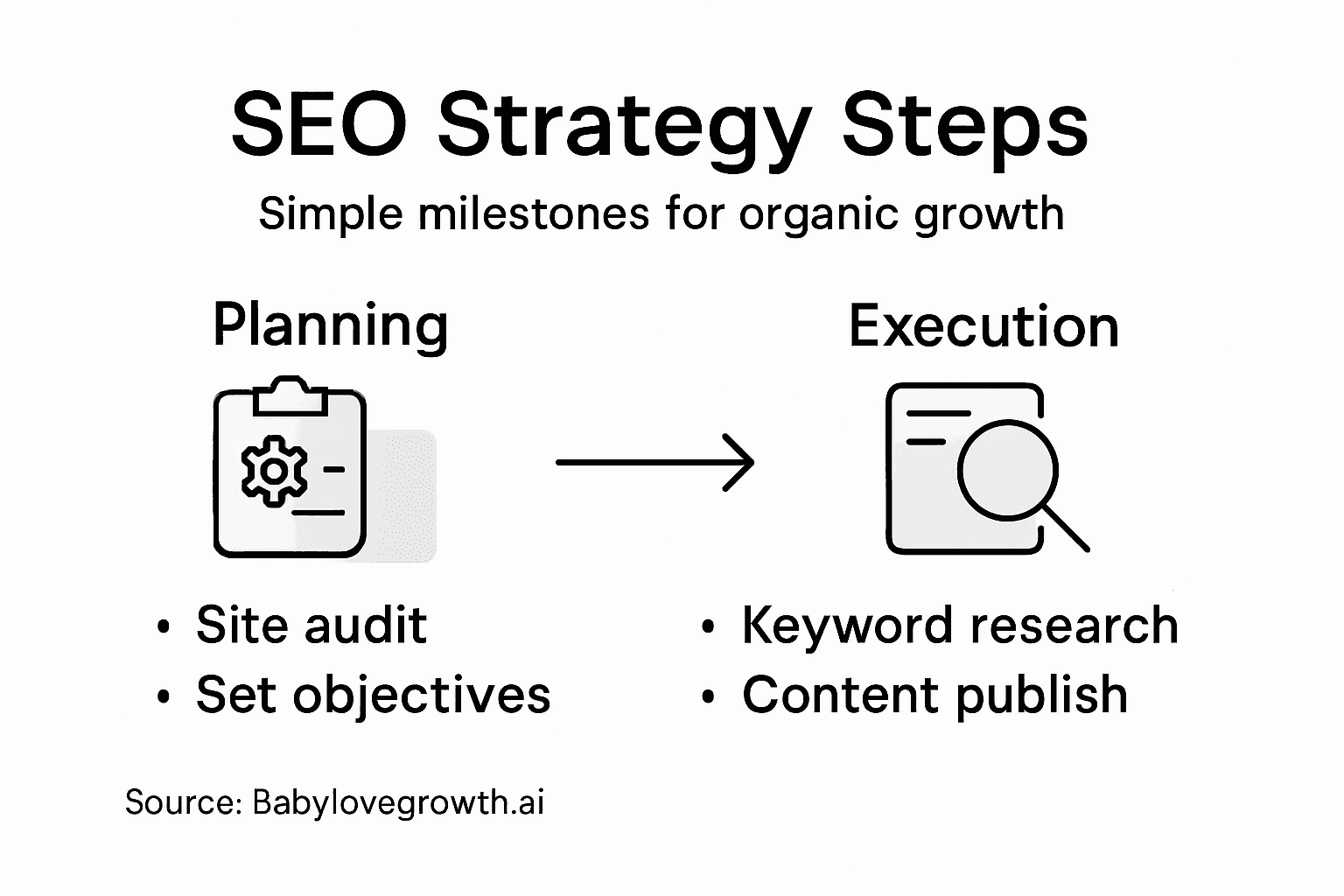
- Step 1: Assess Website And Set Clear SEO Objectives
- Step 2: Research Keywords And Map Content Opportunities
- Step 3: Build AI-Driven Content Plans And Publish
- Step 4: Enhance Links And Technical SEO With Automation
- Step 5: Verify Rankings And Refine Strategies Continuously
Quick Summary
| Key Message | Explanation |
|---|---|
| 1. Conduct a Comprehensive SEO Audit | Evaluate technical infrastructure, content quality, and keyword relevance to understand current online performance. |
| 2. Develop a Data-Driven Keyword Strategy | Identify user intent through keyword research, focusing on both high-volume and niche long-tail keywords to address audience needs. |
| 3. Implement AI in Content Planning | Utilize AI tools for automated content creation and optimization, ensuring a blend of technology and human creativity in your strategy. |
| 4. Automate Technical SEO Processes | Streamline technical SEO tasks through automation to boost website performance and decrease manual workloads. |
| 5. Regularly Monitor SEO Performance | Continuously track keyword rankings, traffic, and conversion rates to make informed adjustments and refine your SEO strategy over time. |
Step 1: Assess Website and Set Clear SEO Objectives
Launching a successful SEO strategy begins with a comprehensive website assessment and strategic objective setting. This critical first step helps you understand your current online performance and map out a targeted approach to improve organic visibility.
Starting your SEO audit requires a systematic evaluation of multiple website elements. Examine key performance indicators across several crucial dimensions:
- Technical infrastructure analysis
- Content quality assessment
- Keyword relevance review
- Site speed and mobile responsiveness check
- Indexing and crawlability evaluation
To set meaningful SEO objectives, focus on specific, measurable goals that align with your broader business strategy. This involves:
- Identifying target audience segments
- Determining primary keyword clusters
- Establishing realistic ranking improvements
- Defining conversion rate targets
- Creating benchmarks for organic traffic growth
Your objectives should be data-driven and reflect both short-term wins and long-term growth potential. Strategic SEO planning requires understanding the four core optimization pillars: technical, on-page, content, and off-page strategies.
Here's how the four core SEO pillars contribute to website success:
| SEO Pillar | Primary Focus | Business Impact |
|---|---|---|
| Technical | Infrastructure & indexing | Improved site performance |
| On-Page | Content & keywords | Higher ranking and relevance |
| Content | Quality & engagement | Increased visitor retention |
| Off-Page | Backlinks & reputation | Greater authority and visibility |
A well-structured SEO strategy transforms website performance by systematically addressing visibility, relevance, and user experience.
Pro tip: Conduct a monthly review of your SEO objectives to ensure continuous alignment with evolving business goals and search engine algorithms.
Step 2: Research Keywords and Map Content Opportunities
Developing a robust keyword strategy is the cornerstone of effective SEO content planning. This step involves uncovering the precise language your target audience uses when searching online, transforming those insights into a strategic content roadmap.
Keyword research is essential for understanding user intent and creating content that directly addresses audience needs. Start by exploring keyword opportunities through these strategic methods:- Long-tail keyword discovery
- User intent analysis
- Search volume evaluation
- Competitive keyword assessment
- Content gap identification
Effective keyword mapping requires a systematic approach to aligning search terms with your content strategy:
- Analyze existing website content
- Identify potential topic clusters
- Match keywords to specific content formats
- Prioritize high-potential keyword opportunities
- Create a comprehensive content plan
Your keyword research should go beyond simple volume metrics. Look for keywords that demonstrate clear user intent, represent genuine audience questions, and align with your brand's expertise. Consider both high-volume terms and niche-specific long-tail keywords that can drive targeted traffic.
Strategic keyword research transforms random content creation into a precision-targeted approach that speaks directly to your audience's needs.
Pro tip: Regularly update your keyword research to stay ahead of evolving search trends and maintain a dynamic, responsive content strategy.
Step 3: Build AI-Driven Content Plans and Publish
Transforming your keyword research into a comprehensive content strategy requires leveraging cutting-edge AI technologies to streamline and optimize your publishing workflow. This critical step focuses on creating a data-driven content plan that maximizes your organic visibility and audience engagement.
Generative AI tools are transforming content creation across digital marketing landscapes, offering unprecedented opportunities for strategic content development. Implement your AI-powered content strategy through these key approaches:- Automated content ideation
- AI-assisted writing frameworks
- Content personalization techniques
- Intelligent topic clustering
- Semantic optimization processes
Building an effective AI-driven content plan involves a structured methodology:
- Select appropriate AI content generation tools
- Define clear content objectives
- Create detailed content briefs
- Generate initial content drafts
- Conduct human-led quality refinement
Successful AI content strategies require a balanced approach that combines technological efficiency with human creativity and strategic oversight. Your goal is to use AI as a powerful assistant that enhances your content creation process, not as a complete replacement for human insight and expertise.
AI-powered content strategies represent the future of digital marketing, enabling creators to produce more targeted, efficient, and engaging content at unprecedented speeds.
Pro tip: Always maintain a critical human perspective when using AI tools, reviewing and refining generated content to ensure accuracy, authenticity, and alignment with your brand voice.
Step 4: Enhance Links and Technical SEO with Automation
Automating your technical SEO and link-building processes can dramatically accelerate your website's search engine performance and reduce manual overhead. This step focuses on implementing smart, scalable automation strategies that optimize your site's technical infrastructure and link profile.
Python scripting can automate SEO processes like analyzing broken links, meta tags, and crawl errors, providing a comprehensive approach to technical optimization. Implement these key automation strategies:- Automated link health monitoring
- Technical SEO audit tools
- Crawl error detection
- Backlink quality assessment
- Structured data validation
Building a robust automated SEO workflow involves a systematic approach:
- Select appropriate automation tools
- Configure comprehensive scanning parameters
- Set up automated reporting mechanisms
- Establish alert thresholds for critical issues
- Create continuous improvement protocols
Successful technical SEO automation requires a nuanced approach that balances technological efficiency with strategic human oversight. The goal is to leverage automation as a powerful diagnostic and optimization tool that provides actionable insights while maintaining the strategic intelligence only human experts can provide.

Compare manual and automated SEO approaches:
| Approach | Key Benefit | Limitation | Best Use Case |
|---|---|---|---|
| Manual | Deep strategy customization | Labor intensive | Complex problem solving |
| Automation | Rapid scalable optimization | Needs human oversight | Routine technical checks |
Automation transforms technical SEO from a time-consuming manual process into a precise, scalable system of continuous website optimization.
Pro tip: Regularly review and recalibrate your automation tools to ensure they evolve alongside changing search engine algorithms and your specific business objectives.
Step 5: Verify Rankings and Refine Strategies Continuously
Successful SEO is not a one-time effort but an ongoing process of monitoring, analyzing, and adapting your digital strategy. This critical step focuses on developing a systematic approach to tracking performance and making data-driven refinements that sustain and improve your organic visibility.
Effective SEO requires continuous monitoring of rankings, traffic performance, and strategic indicators. Implement a comprehensive verification process through these key strategies:- Keyword ranking tracking
- Organic traffic analysis
- Conversion rate monitoring
- Backlink profile assessment
- Competitor performance benchmarking
Building a robust SEO verification framework involves multiple strategic steps:
- Set up advanced analytics dashboards
- Establish baseline performance metrics
- Create periodic review schedules
- Develop responsive adjustment protocols
- Implement iterative optimization cycles
Successful strategy refinement demands a holistic approach that balances quantitative data with qualitative insights. Your goal is to transform raw performance metrics into actionable strategic intelligence that drives continuous improvement and adapts to evolving search landscape dynamics.
Continuous SEO verification is not about perfection but about maintaining a dynamic, responsive approach to digital visibility.
Pro tip: Schedule monthly strategy review sessions that combine data analysis with creative problem-solving to ensure your SEO approach remains agile and innovative.
Unlock Your SEO Potential with AI-Powered Precision
The article highlights common challenges like managing complex keyword research, building effective content plans, and automating technical SEO tasks that feel overwhelming without the right tools. You want to boost organic visibility through a carefully crafted, data-driven strategy that adapts continuously to search engine changes. Babylovegrowth.ai understands the struggle of balancing manual SEO efforts with the need for scalable automation and high-quality content that truly engages your audience.
Imagine having a platform that integrates all your SEO needs: from automated keyword discovery and AI-driven content planning to backlink building and technical audits. With Babylovegrowth.ai, you can streamline your entire SEO process. This SaaS platform not only helps create 30-day content plans and daily SEO articles but also enhances your site with automatic structured data markup and intelligent link strategies. Tailored for brands eager to improve rankings on Google and advanced AI search engines like ChatGPT, this is the tool that turns SEO complexity into clear growth.
Ready to move beyond piecemeal SEO tactics?
Boost your SEO strategy now with Babylovegrowth.ai and experience how AI-powered automation transforms your organic traffic growth.
Start your journey toward effortless SEO success today by visiting our platform. Discover how easy it is to build, execute, and refine your SEO strategy all in one place at Babylovegrowth.ai. Embrace the future of search engine optimization and get the competitive advantage your brand deserves.
Frequently Asked Questions
What are the key steps in a step-by-step SEO strategy to boost organic visibility?
A comprehensive SEO strategy includes assessing the website, researching keywords, building AI-driven content plans, enhancing links and technical SEO with automation, and continuously verifying rankings. Start by conducting a thorough audit of your website's current performance.
How can I assess my website's current SEO performance?
To evaluate your website's SEO performance, analyze key metrics such as site speed, mobile responsiveness, and organic traffic. Use these insights to identify areas of improvement and set measurable objectives for your SEO strategy.
What should I consider when setting SEO objectives?
Focus on specific, measurable goals aligned with your business strategy, such as targeting audience segments and improving ranking for primary keywords. Aim to establish realistic benchmarks for organic traffic growth and conversion rates within 30-60 days.
How can I effectively conduct keyword research for my SEO content plan?
Begin by identifying user intent, evaluating search volume, and analyzing competitors to uncover valuable keywords. Map these keywords to relevant content opportunities and create a prioritized content plan that addresses your audience’s needs.
What role does AI play in content planning for SEO?
AI technologies can streamline content ideation and writing processes, making your content strategy more efficient. Utilize AI tools to generate drafts and conduct topic clustering to enhance your content's relevancy and engagement.
How can I automate technical SEO processes?
Automate routine checks on link health, crawl errors, and backlink quality using appropriate tools and scripts. Set up automated reporting mechanisms to monitor these elements continuously and adjust your strategy to maintain optimal site performance.