SEO Content Writing: Step-by-Step Guide for High Rankings


Most American businesses struggle to stand out online because there are over 1.8 billion websites competing for attention. Finding the right SEO strategy is crucial if you want your content to reach more people and make a lasting impression. By using proven techniques that target the right keywords, stand apart from competitors, and optimize every page, you can attract engaged visitors who are ready to take action.
Table of Contents
- Step 1: Define Targeted Keywords For Your Niche
- Step 2: Research Competitors And Outline Unique Topics
- Step 3: Write And Optimize Content For Seo Success
- Step 4: Integrate Visuals And Internal Backlinks Strategically
- Step 5: Review, Test, And Refine Content For Higher Rankings
Quick Summary
| Key Point | Explanation |
|---|---|
| 1. Identify Targeted Keywords | Focus on specific keywords that match your audience’s search intent to enhance relevance and search engine visibility. |
| 2. Analyze Competitors for Unique Gaps | Conduct a competitive analysis to find content gaps and create distinct topics that provide greater value. |
| 3. Optimize Content with Keywords | Integrate keywords naturally into engaging content that answers user questions while prioritizing readability. |
| 4. Use Visuals and Internal Links | Enhance content attraction and user navigation through quality visuals and relevant internal links thoughtfully placed. |
| 5. Continuously Review and Refine | Regularly analyze content performance using analytics and refine it to improve search rankings based on real-world data. |
Step 1: Define targeted keywords for your niche
Unlocking successful SEO content starts with strategic keyword selection. By identifying targeted keywords specific to your niche, you create a roadmap for creating content that resonates with your ideal audience and search engines.
To define targeted keywords effectively, begin by understanding your business goals and audience needs. Utilize keyword research tools to discover search terms with solid search volume and manageable competition. Focus on long tail keywords that demonstrate specific user intent rather than broad generic terms. For example, instead of targeting "shoes," narrow your focus to "comfortable running shoes for flat feet" which signals more precise audience targeting.
Pro tip: Prioritize keywords with commercial or transactional intent that indicate users ready to take action. These keywords typically include terms like "buy," "best," "review," or "top rated" which suggest the searcher is closer to making a purchasing decision. By selecting keywords strategically, you maximize your content's potential to attract qualified traffic and improve search engine rankings.
Step 2: Research competitors and outline unique topics
Successful SEO content requires a strategic approach to competitive analysis and topic generation. By understanding competitive keywords, you can identify content gaps and develop unique perspectives that set your work apart.
Start by conducting a comprehensive competitive analysis of top-ranking content in your niche. Use SEO tools to examine your competitors topical coverage, identifying areas where you can provide more in-depth, valuable insights. Look for topics they have overlooked or areas where you can offer a more nuanced or practical approach. This means going beyond surface-level information and creating content that truly addresses user needs and questions.
Pro tip: When outlining unique topics, focus on your distinct expertise and perspective. Consider combining multiple angles or introducing personal experiences that competitors cannot easily replicate. Your goal is not just to compete but to create content so compelling and unique that it naturally attracts readers and earns higher search rankings through genuine value and originality.
Step 3: Write and optimize content for SEO success
Creating high-performing SEO content requires a strategic blend of compelling writing and technical optimization. By following content optimization best practices, you can craft articles that both engage readers and rank well in search results.
Start by structuring your content with clear headings and subheadings that naturally incorporate targeted keywords. Write in a conversational tone that prioritizes reader comprehension while strategically placing keywords throughout your text. Focus on creating comprehensive content that thoroughly answers user questions, using relevant examples and actionable insights. Break up text with short paragraphs, bullet points, and visual elements to improve readability and keep readers engaged.

Pro tip: Always prioritize value over keyword density. Search engines increasingly reward content that provides genuine help and addresses user intent. Your goal is to create informative, authentic content that answers questions comprehensively while maintaining a natural flow that sounds human-written rather than mechanically optimized for search algorithms.
Step 4: Integrate visuals and internal backlinks strategically
Enhancing your content's SEO performance requires thoughtful integration of visuals and strategic internal linking. Internal links can significantly boost your website's ranking by helping search engines understand your content structure and improving user navigation.
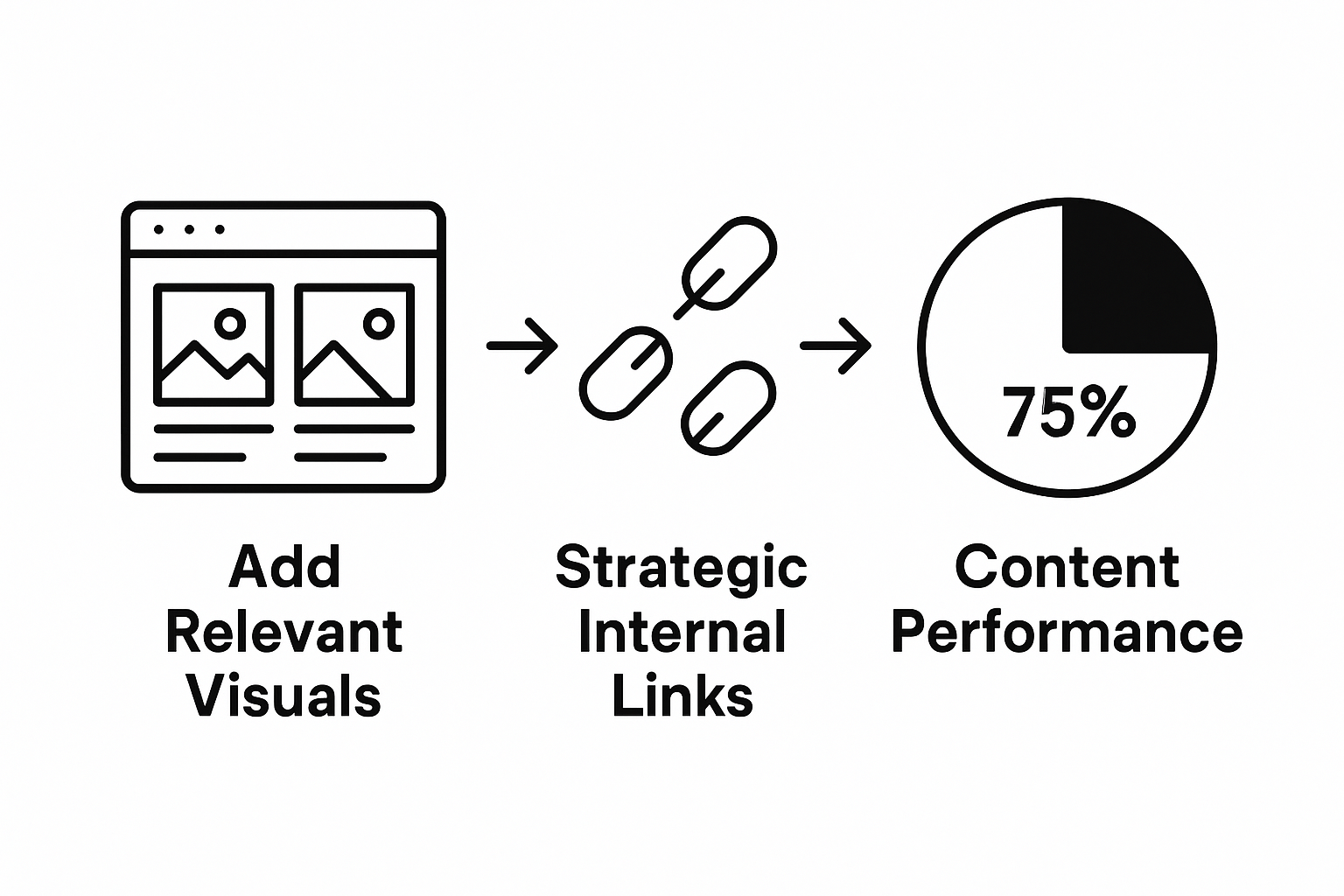
When integrating visuals, choose high-quality images, infographics, and charts that directly support your written content. Optimize these visuals by using descriptive file names, adding alt text with relevant keywords, and ensuring they are compressed for fast loading speeds. For internal backlinks, select anchor text that naturally fits within your content and links to related, contextually relevant articles on your website. Focus on creating a logical network of interconnected content that guides readers through a comprehensive learning journey.
Pro tip: Balance is key when adding internal links. Aim for 3 to 5 internal links per 1000 words, ensuring each link provides genuine value and helps readers dive deeper into related topics. Your goal is to create a seamless, informative experience that keeps readers engaged and helps search engines better understand the depth and relevance of your content.
Step 5: Review, test, and refine content for higher rankings
Successful SEO requires continuous optimization and strategic refinement of your content. By understanding how to rank higher on Google, you can develop a systematic approach to improving your content performance and search engine visibility.
Start by conducting comprehensive performance reviews using analytics tools to track key metrics like organic traffic, bounce rates, and average time on page. Pay close attention to which content pieces are performing well and analyze the reasons behind their success. Use this data to identify opportunities for improvement such as updating outdated information, enhancing readability, or expanding on topics that demonstrate high user engagement. Compare your content against top-ranking competitors and look for gaps you can fill with more comprehensive or unique insights.
Pro tip: Implement A B testing for critical elements like headlines, meta descriptions, and content structures. Small strategic adjustments can yield significant improvements in search rankings. Your goal is to create a dynamic content optimization process that continuously evolves based on real performance data and user behavior patterns.
Power Your SEO Content Strategy with AI-Driven Automation
Struggling to consistently target the right keywords or keep your content uniquely optimized for Google and ChatGPT? The article highlights key challenges like defining targeted keywords, researching competitors, and optimizing content to rank higher. Many business owners and marketers face these exact hurdles when trying to maintain a steady flow of high-quality SEO content that truly offers value and ranks well.
Babylovegrowth.ai simplifies this journey by delivering automated, AI-generated articles paired with a 30-day personalized content plan and a seamless backlinks exchange ecosystem. This means you can focus on creating meaningful content while our platform handles keyword integration, competitor insights, and internal linking strategies to help you achieve higher rankings faster and more efficiently.
Discover how to automate your SEO success now

Ready to transform your SEO content writing process into a streamlined, growth-driven engine? Visit Babylovegrowth.ai to start your free trial and experience a new level of organic traffic growth with AI-powered content and backlink strategies. Take the next step toward scaling your visibility while eliminating the guesswork from SEO. Explore our SEO solutions and see how automated SEO on autopilot can work for your business today.
Frequently Asked Questions
How do I define targeted keywords for my SEO content?
To define targeted keywords effectively, start by understanding your business goals and audience needs. Use keyword research tools to identify specific terms with solid search volume and manageable competition.
What should I consider when researching competitors' content?
When researching competitors, conduct a comprehensive analysis of their top-ranking content to identify content gaps. Look for topics they have overlooked or areas where you can offer more valuable insights that address user needs.
How can I optimize my content for SEO while ensuring it remains engaging?
To optimize your content for SEO, structure your writing with clear headings and strategically incorporate targeted keywords. Prioritize creating comprehensive, valuable content that thoroughly answers user questions while maintaining readability through short paragraphs and bullet points.
What role do visuals and internal links play in SEO content writing?
Visuals and internal links enhance user engagement and help search engines understand your content structure. Integrate high-quality images and related articles through internal links to create a seamless experience that encourages readers to explore your site further.
How do I review and refine my SEO content for better search rankings?
Start by conducting performance reviews using analytics tools to track key metrics like organic traffic. Analyze which content pieces perform well and identify areas for improvement, and implement A/B testing to refine critical elements like headlines and meta descriptions.
Recommended
Smart SEO,
Faster Growth!
Most Read Articles
Generative Engine Optimization (GEO)
Learn how Generative Engine Optimization (GEO) helps your content rank in AI search engines like ChatGPT and Google AI. This comprehensive guide explains the differences between SEO and GEO, why it matters for your business, and practical steps to implement GEO strategies for better visibility in AI-generated responses.
DylenJan 18, 2025
Track LLM Traffic in Google Analytics 4 (GA4)
Learn how to track and analyze traffic from AI sources like ChatGPT, Claude, Perplexity, and Google Gemini in Google Analytics 4. This step-by-step guide shows you how to set up custom filters to monitor AI-driven traffic and make data-driven decisions for your content strategy.
DylenMar 18, 2025
How to Humanize AI Text with Instructions
Learn practical techniques to make AI-generated content sound more natural and human. This guide covers active voice, direct addressing, concise writing, and other proven strategies to transform robotic text into engaging content.
DylenApril 7, 2025
Open AI Revenue and Statistics (2024)
Comprehensive analysis of OpenAI financial performance, user engagement, and market position in 2023. Discover key statistics including $20B valuation, $1B projected revenue, and 100M+ monthly active users.
DylenOctober 03, 2025