Role of Link Building – Elevating SEO Success


Struggling to cut through the noise and get your brand noticed on search engines is a familiar challenge for any SEO professional or content marketer at a growing e-commerce company. Link building remains one of the most misunderstood yet powerful methods for improving search visibility and site authority. By focusing on relevant and high-quality links, you can stand out among competitors and build lasting trust with Google. This guide uncovers the real strategies behind effective link building, exposes outdated myths, and reveals how to create links that drive genuine results.
Table of Contents
- Defining Link Building and Common Myths
- Types of Links and Their SEO Value
- Modern Link Building Strategies and Tools
- Impact of AI-Powered Link Building Platforms
- Risks, Penalties, and Ethical Considerations
Key Takeaways
| Point | Details |
|---|---|
| Link Quality Matters | Focus on acquiring high-quality, contextual backlinks over sheer quantity for better SEO results. |
| Content is Key | Create valuable, original content that naturally attracts backlinks from reputable sources. |
| Avoiding Risks | Adhere to ethical link building practices to avoid penalties that can harm search visibility and reputation. |
| Leverage AI Tools | Utilize AI-powered link building tools to enhance efficiency and strategic decision-making in your link acquisition efforts. |
Defining Link Building and Common Myths
Link building represents a strategic approach within search engine optimization (SEO) designed to increase a website's authority and search rankings through acquiring high-quality external hyperlinks. At its core, link building involves generating relevant connections between websites that signal credibility and trustworthiness to search engines.
Understanding link building requires dispelling several persistent myths that can mislead digital marketers and SEO professionals:
- Quantity Over Quality: Many mistakenly believe that accumulating massive numbers of links automatically improves rankings
- Easy Quick Fixes: Some assume link building can be accomplished through shortcuts or automated processes
- Universal Link Value: Not all backlinks carry equal weight or relevance
In reality, modern search algorithms prioritize contextual relevance and domain authority when evaluating external links. Search engines like Google have sophisticated mechanisms to distinguish between genuine editorial links and manipulative link schemes.
Effective link building isn't about collecting links, but creating valuable content that naturally attracts authoritative references.
Successful link acquisition strategies focus on producing high-quality, original content that other reputable websites genuinely want to reference. This approach requires consistent effort, strategic planning, and a deep understanding of your target audience's information needs.
Pro tip: Prioritize building relationships with industry thought leaders and creating exceptional content that organically generates backlinks.
Types of Links and Their SEO Value
Link building encompasses multiple link types, each carrying distinct SEO significance. Understanding these different link classifications helps digital marketers develop more strategic optimization approaches.
The primary types of links include:
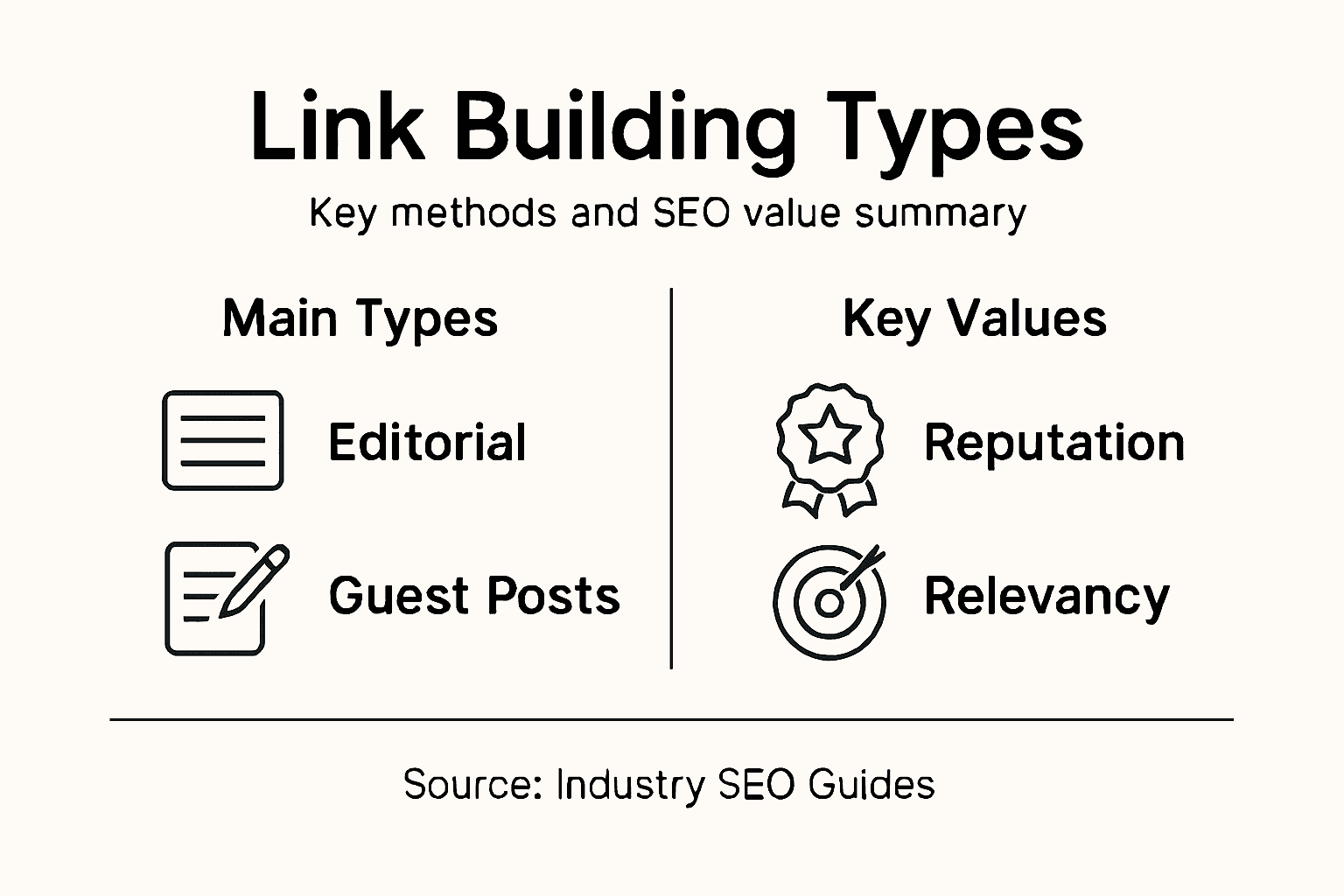
- Editorial Links: Natural references from high-authority websites
- Guest Post Links: Backlinks generated through contributed content
- Resource Links: References from industry-specific directories or resource pages
- Testimonial Links: Backlinks from providing client testimonials
- Contextual Links: Links embedded within relevant content
Not all links deliver equivalent SEO value. Search engines evaluate backlinks using sophisticated algorithms that consider several critical factors:
- Domain authority of the linking website
- Relevance of linking content to target page
- Anchor text context
- Link placement within content
- Overall link diversity
High-quality links act as endorsements, signaling credibility and expertise to search engines.
Companies should prioritize acquiring contextually relevant links from reputable websites within their industry. Quantity matters less than the strategic quality and alignment of external references.

Here's a comparison of common link types and their best use cases for SEO:
| Link Type | Typical Source | Ideal Use Case | SEO Value Impact |
|---|---|---|---|
| Editorial | News & authority sites | Building trust, expertise | Highest |
| Guest Post | Niche blogs, industry sites | Brand exposure, new audience | Moderate to high |
| Resource | Directories, resource pages | Listings, professional boost | Moderate |
| Testimonial | Partner/client websites | Credibility, partnership | Moderate |
| Contextual | In-article references | Deep relevance, organic reach | High |
Pro tip: Focus on building relationships with industry-leading websites and creating exceptional content that naturally attracts authoritative backlinks.
Modern Link Building Strategies and Tools
The landscape of link building has evolved dramatically, with modern strategies focusing on advanced digital outreach methods that prioritize quality and strategic relationship building.
Key modern link building strategies include:
- Content Marketing: Creating high-value, shareable content that naturally attracts backlinks
- Digital PR: Developing relationships with industry publications and influencers
- Competitor Backlink Analysis: Identifying link opportunities through strategic research
- Broken Link Building: Replacing defunct links with relevant, high-quality content
- Interactive Content Creation: Developing resources that inspire organic link sharing
Technological tools have transformed link building approaches, enabling more sophisticated and data-driven strategies. Digital marketers now leverage advanced platforms that provide:
- Comprehensive backlink analysis
- Competitor link tracking
- Outreach management
- Link quality assessment
- Automated link prospecting
Successful link building requires a strategic blend of technological tools and human relationship building.
Manual outreach remains crucial, complementing automated tools. Personalized communication and genuine value proposition continue to drive meaningful link acquisition in an increasingly competitive digital landscape.
Pro tip: Develop a systematic approach to link building that combines technological insights with authentic relationship-driven strategies.
Impact of AI-Powered Link Building Platforms
Artificial intelligence is revolutionizing link building through advanced data-driven optimization strategies that transform traditional digital marketing approaches.
Key capabilities of AI-powered link building platforms include:
- Automated Link Discovery: Identifying high-quality linking opportunities using machine learning algorithms
- Contextual Relevance Analysis: Evaluating link potential based on content alignment and domain authority
- Personalized Outreach: Generating tailored communication strategies for link acquisition
- Predictive Performance Modeling: Forecasting potential link impact on search rankings
- Real-Time Competitive Intelligence: Tracking competitors' link building strategies
AI technologies provide unprecedented insights by analyzing complex link ecosystems. These platforms leverage sophisticated algorithms to:
- Assess link quality with unprecedented precision
- Minimize manual research efforts
- Identify emerging link opportunities
- Predict potential SEO outcomes
- Streamline link acquisition processes
AI-powered platforms bridge the gap between data analysis and strategic link building, enabling more intelligent and efficient optimization.
Despite technological advances, successful link building still requires human creativity and strategic thinking. AI tools serve as powerful assistants, augmenting rather than replacing nuanced marketing expertise.
The following table summarizes key business advantages of AI-powered link building tools:
| AI Feature | Business Benefit | Strategic Impact |
|---|---|---|
| Automated Link Discovery | Saves time on research | Faster campaign launches |
| Contextual Relevance Check | Improves link quality | Better search ranking outcomes |
| Personalized Outreach | Higher response rates | Stronger relationships |
| Performance Modeling | Predicts SEO improvements | Smarter resource allocation |
| Competitive Intelligence | Tracks rivals’ strategies | Staying ahead in search results |
Pro tip: Integrate AI link building tools strategically, using technological insights to inform, not replace, your unique marketing approach.
Risks, Penalties, and Ethical Considerations
Link building strategies carry significant risks when practitioners deviate from established ethical guidelines, potentially triggering severe search engine penalties and reputation damage.
Primary risks in link building include:
- Link Manipulation: Artificial link generation through purchased or exchanged links
- Spam Tactics: Creating low-quality, irrelevant backlinks
- Black Hat Techniques: Using deceptive link schemes
- Unverified Link Sources: Acquiring links from suspicious or low-quality domains
- Algorithmic Penalties: Risking search ranking demotion
Search engines employ sophisticated detection mechanisms to identify and penalize unethical link building practices. These penalties can manifest through:
- Reduced search visibility
- Ranking algorithm downgrading
- Complete website de-indexing
- Permanent reputation damage
- Loss of organic traffic
Ethical link building demands transparency, relevance, and genuine value creation.
Successful digital marketers understand that sustainable SEO requires a long-term perspective focused on creating high-quality, contextually relevant content that naturally attracts authoritative backlinks.
Pro tip: Prioritize relationship-based link acquisition and consistently produce valuable content that earns links organically rather than attempting manipulative shortcuts.
Transform Your SEO Success with AI-Powered Link Building
The article highlights the challenge of acquiring high-quality, contextually relevant backlinks while avoiding outdated, risky tactics that can harm your website's ranking and reputation. If you are focused on overcoming these pain points and want to elevate your organic traffic with proven strategies that combine technological precision and authentic relationship building, it is time to embrace smarter solutions. Concepts like automated link discovery, personalized outreach, and performance modeling are transforming how businesses succeed in competitive search environments.
Discover how Babylovegrowth.ai can empower you to simplify and supercharge your link building efforts. Our SaaS platform offers AI-driven tools that automate backlink building, competitive analysis, and contextual relevance checks so you can confidently grow your brand authority without risking penalties. Dive into our backlink building features to access scalable automation combined with human creativity for maximum SEO impact. Don’t miss your chance to improve rankings not only on Google but also new AI-powered search platforms. Start your journey with Babylovegrowth.ai today and transform your SEO strategy into sustainable growth.
Frequently Asked Questions
What is link building and why is it important for SEO?
Link building is a strategic approach in SEO focused on acquiring high-quality external hyperlinks to improve a website's authority and search rankings. It is important because search engines view backlinks as endorsements, which helps signal credibility and trustworthiness.
What are the main types of links used in link building?
The primary types of links include editorial links, guest post links, resource links, testimonial links, and contextual links. Each type carries different SEO value and serves distinct purposes in enhancing a site's reputation and search visibility.
How can I effectively build backlinks for my website?
Effective backlink building involves creating high-quality, original content that naturally attracts links, developing relationships with industry leaders, and employing strategies like digital PR, broken link building, and competitive analysis.
What are the risks associated with unethical link building practices?
Unethical link building practices can lead to significant risks, including search engine penalties, reduced visibility, ranking downgrades, and potential complete de-indexing from search engines. Ethical link building focuses on transparency, relevance, and value creation.