Organic Search Authority – Why It Drives Growth


Many digital marketers believe organic search authority means packing keywords or chasing the latest ranking trick, but that mindset leads to frustration and wasted resources. In reality, organic search authority is earned through real relevance, content quality, and technical SEO—not shortcuts. This article breaks down the true meaning of organic search authority, highlights how search engines like Google and Bing measure it, and clears up misleading beliefs that hold your clients’ growth back.
Table of Contents
- Defining Organic Search Authority And Misconceptions
- SEO Authority Types And Ranking Algorithms
- Key Benefits For Brand Growth And Visibility
- Risks, Limitations, And Costs To Consider
- Organic Search Authority Vs Paid Strategies
Key Takeaways
| Point | Details |
|---|---|
| Understanding Organic Search Authority | It is cultivated through quality content, technical SEO, and trust signals, not keyword cramming or shortcuts. |
| The Role of Authority Types | Domain, page, and backlink authorities collectively influence search rankings, emphasizing the importance of a comprehensive SEO strategy. |
| Sustainable Growth Focus | Building organic authority takes time and requires continuous effort, but it yields long-term benefits without ongoing ad costs. |
| Synergy Between Paid and Organic | Combining organic and paid strategies enhances visibility and results, with organic authority serving as the foundation for sustainable growth. |
Defining Organic Search Authority and Misconceptions
Organic search authority isn't what most people think it is. Many marketing professionals still believe it's about cramming keywords into content or manipulating rankings through shortcuts. That's fundamentally wrong.
Organic search authority is the visibility and prominence your website earns in unpaid search results, based on genuine relevance and quality—not paid advertising or tricks. It's built through a combination of technical foundation, content excellence, and search engine trust.
What Organic Search Authority Actually Means
Search engines evaluate websites across multiple dimensions to determine authority:
- Content quality and relevance to user search intent
- Technical SEO foundation like site speed, mobile optimization, and proper indexing
- Algorithmic trust signals that search engines use to rank pages
- Schema markup and structured data that help engines understand your content
- User engagement patterns that indicate real value delivery
The core idea: search engines only index and rank pages based on algorithmic decisions about quality and relevance, not on whether you want them to rank.
Common Misconceptions That Hold You Back
Digital marketers in North America often operate under false assumptions about organic authority. Here's what's actually misleading:
Misconception #1: Keyword stuffing builds authority. It doesn't. Modern search engines penalize this. Your content needs natural keyword usage within genuinely helpful information.
Misconception #2: Authority comes overnight. It takes months to build meaningful organic authority. Sustainable growth requires consistent, quality work across content, technical optimization, and user experience.
Misconception #3: Backlinks are everything. They matter, but they're one factor among many. Content quality, technical health, and engagement signals carry equal weight in modern ranking algorithms.
Misconception #4: Organic search is separate from brand. Strong organic traffic depends on brand signals—user behavior, brand mentions, and domain reputation all influence your authority.
Why This Matters for Growth
OrganicAuthority directly determines whether your client's content reaches potential customers at the exact moment they're searching for solutions. When you build genuine authority, you're not competing against every other brand—you're competing against only relevant alternatives.
This is why AI-driven SEO strategies focus on sustainable authority building rather than quick wins. Platforms that automate keyword discovery, content planning, and technical auditing help you build authority at scale without sacrificing quality.
Real organic authority means your website answers the questions your audience is actually asking, when they're asking them, with information search engines trust.
Pro tip: Audit your current site for the three biggest technical SEO gaps (page speed, mobile usability, structured data markup), then fix those first—technical foundation directly impacts your authority potential.
SEO Authority Types and Ranking Algorithms
SEO authority comes in different forms, and understanding each type helps you build a stronger overall ranking position. Search engines don't measure authority in one dimension—they evaluate multiple signals and combine them into ranking decisions.

The Three Core Types of SEO Authority
When you're auditing your client's SEO performance, you need to understand what you're actually measuring:
- Domain authority measures the overall strength and credibility of an entire website based on backlinks, content, and history
- Page authority evaluates individual page strength independent of domain—a single blog post can rank highly even on a newer site
- Backlink authority reflects the quality and quantity of links pointing to your content from other sites
These three types work together. A strong domain authority gives your new content a boost, but high-quality page authority can overcome a weaker domain when content truly matches search intent.
Tools like Moz, Semrush, and Ahrefs each use different computational methods to calculate these scores. Research shows high correlation between authority metrics across tools, meaning their different approaches generally reach the same conclusions about which sites hold authority.
The three core types of SEO authority differ in focus and impact. Here is a side-by-side summary:
| Authority Type | Main Focus | Influence on Rankings | Example Tools |
|---|---|---|---|
| Domain Authority | Entire website strength | Boosts all new pages | Moz, Ahrefs |
| Page Authority | Individual page content | Enables single-page rankings | Semrush, Moz |
| Backlink Authority | Quality of referring links | Increases trustworthiness | Ahrefs, Majestic |
How Ranking Algorithms Actually Use Authority
Modern search algorithms don't rely on a single authority metric. They use sophisticated link analysis systems that identify both quality sources and quality content.
Link analysis algorithms identify hubs and authorities through iterative calculations. An authority is a page linked to by many good hubs. A hub is a page that links to many authoritative resources. This creates a feedback loop where high-quality content attracts links, which signals authority to search engines.When you build authority through proven SEO ranking factors, you're essentially asking search engines: "Can you trust this source?" The algorithm answers by evaluating the network of authority signals surrounding your content.
Why This Matters for Your Clients
Digital marketers often focus only on backlinks, but that's incomplete. Authority builds when content quality, technical performance, user engagement, and link signals align.
This is why AI-driven SEO platforms matter. They help you systematically build authority across all three dimensions—not just acquiring random backlinks, but creating content worthy of those links, ensuring your domain foundation supports it, and letting search engines see the full picture of your authority.
Real SEO authority isn't a vanity metric—it's the accumulated trust signals that determine whether your content ranks for competitive keywords your clients care about.
Pro tip: Focus first on page-level authority for your highest-opportunity keywords by improving content quality, internal linking structure, and ensuring each page addresses complete search intent—this creates quick wins while domain authority grows over time.
Key Benefits for Brand Growth and Visibility
Organic search authority delivers measurable business results. When your clients rank higher in unpaid search results, they attract customers actively looking for their solutions—not just casual browsers.
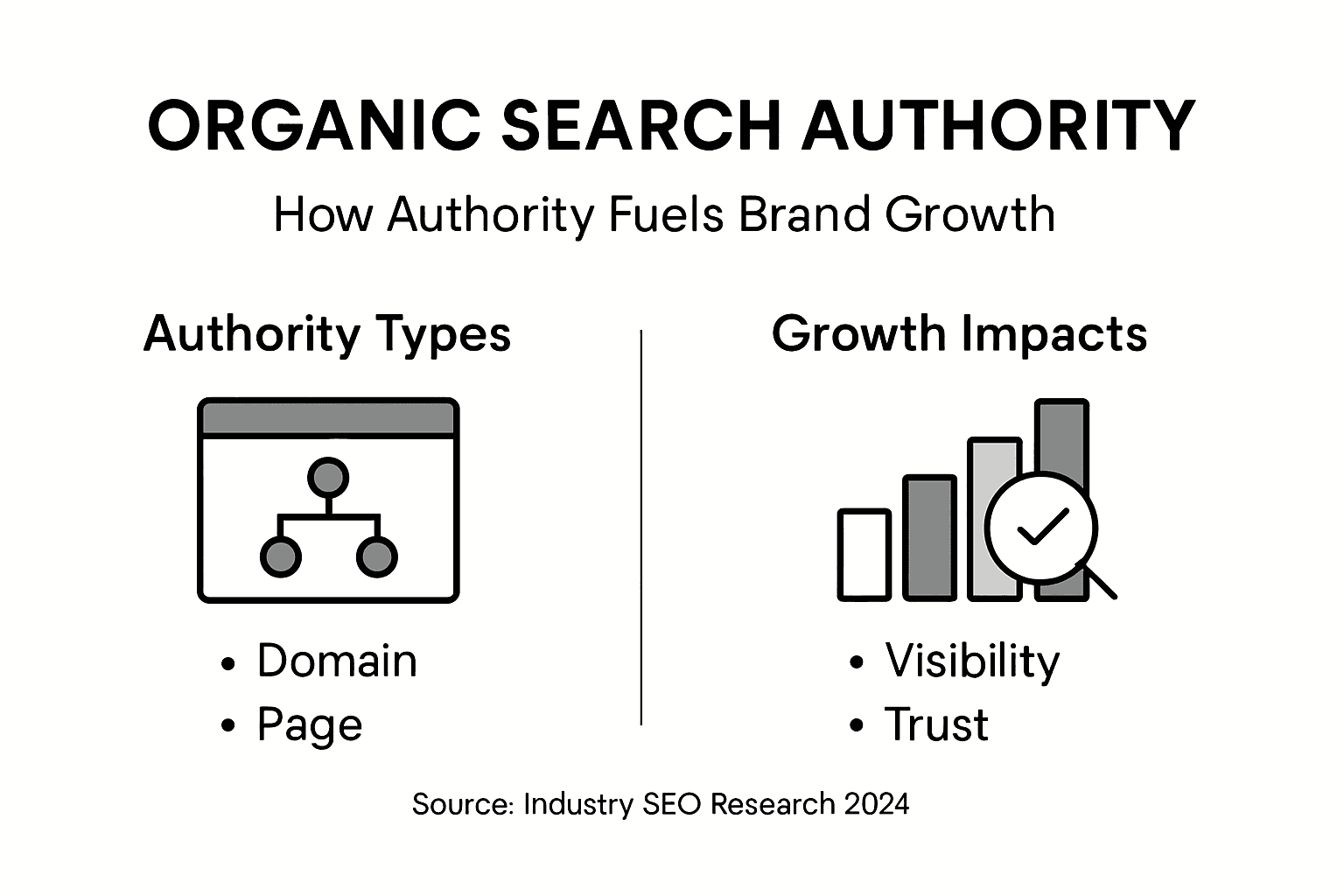
How Organic Authority Drives Real Growth
The benefits of strong organic search authority extend far beyond vanity metrics. Your clients see concrete improvements across multiple business dimensions:
- Increased qualified traffic from users searching for specific solutions your business provides
- Higher click-through rates because top positions earn more clicks than lower rankings
- Better conversion rates since organic search attracts intent-driven visitors ready to take action
- Sustained growth without ongoing paid advertising costs eating into margins
- Enhanced brand credibility when customers see you ranking alongside or above competitors
Empirically, organic search authority drives sustainable growth by attracting qualified leads through relevant, unpaid search results. This isn't about vanity—it's about reaching the right people at the right moment.
Building Trust and Customer Loyalty
When prospects find your content ranking at the top of search results, they perceive your brand as an authority. This trust compounds over time.
Strong organic search authority leads to greater consumer trust and loyalty, resulting in higher traffic volumes and better conversion rates. Customers are more willing to do business with companies they discover organically rather than through interruption-based advertising.This is why search engine ranking directly impacts brand growth. Each ranking position you gain represents hundreds or thousands of additional monthly visitors.
The Long-Term Competitive Advantage
Unlike paid advertising, organic authority compounds. Your investment today creates returns for months and years ahead.
Your competitors might outspend you on ads, but they can't easily outrank you in organic search once you've built genuine authority. This creates a moat around your business that protects market share.
Organic search authority is the only growth channel that actually gets cheaper the longer you invest in it—your rank positions drive more traffic while your cost per acquisition decreases.
Pro tip: Prioritize ranking for keywords showing high search volume paired with lower competition—these "golden keywords" deliver faster authority wins and measurable traffic increases within 60-90 days, validating your SEO investment.
Risks, Limitations, and Costs to Consider
Organic search authority isn't risk-free. While it delivers long-term value, building and maintaining it requires acknowledging real challenges that affect your client strategy and timeline.
The Time and Resource Investment Reality
Organic SEO demands patience and consistent effort. Unlike paid advertising where you see results immediately, organic authority takes months to build.
Building organic authority requires managing evolving algorithm complexity and technical website optimization. Your team must stay current with search engine changes, create high-quality content continuously, and invest in technical improvements.
The real costs stack up quickly:
- Hiring SEO experts or agencies to manage strategy and execution
- Content creation at scale—writing, editing, and publishing quality pieces monthly
- Technical infrastructure improvements for site speed, mobile performance, and indexing
- Link building efforts to develop backlink authority
- Tools and software for keyword research, rank tracking, and performance monitoring
Small businesses often underestimate these expenses. A proper organic program costs between $2,000 and $10,000 monthly depending on competition and scope.
Algorithm Changes and Rank Volatility
Google updates its ranking algorithm hundreds of times yearly. Some updates significantly reshape rankings overnight.
Your client's hard-won rankings could drop if an algorithm update devalues certain optimization practices they've invested in. This creates frustration and uncertainty about ROI. You can't control search engine decisions—only adapt to them.
Search Neutrality and Competition Concerns
Organic search authority faces real limitations in fairness and accessibility. Search engines face antitrust scrutiny over potential bias toward their own services, raising questions about true neutrality in organic results.
Large competitors with bigger budgets and established domain authority have inherent advantages. Breaking through their dominance requires either exceptional content quality or significant time investment.
The Dependency Risk
Building your entire growth strategy around organic search creates vulnerability. Algorithm changes, search traffic shifts, or new competitors can disrupt revenue suddenly.
Successful digital marketers diversify—organic search is one channel among many, not the only one.
Organic search authority delivers real value, but it requires acknowledging that algorithms change, results take time, and you're competing in an ecosystem you don't control.
Pro tip: Set realistic timelines with clients—expect 3-6 months for noticeable ranking improvements and structure contracts with milestone-based expectations rather than guaranteed positions, protecting your credibility when algorithm updates shift results.
Organic Search Authority vs Paid Strategies
Most digital marketers frame organic and paid search as competing strategies. That's a mistake. The data shows they work better together than apart, but they serve fundamentally different purposes in your client's growth engine.
Speed vs Sustainability
Paid search delivers immediate results. Launch a campaign today and see traffic tomorrow. This makes it perfect for time-sensitive opportunities like product launches, seasonal promotions, or urgent lead generation.
Organic search authority takes months to build but compounds indefinitely. Once your client ranks, they earn traffic without ongoing ad spend. This creates sustainable, predictable revenue that paid campaigns can't replicate.
Here's the reality:
Organic and paid search strategies serve different business goals. Key differences are outlined below:
| Aspect | Organic Search Authority | Paid Search Strategies |
|---|---|---|
| Timeframe | Months to achieve | Immediate results |
| Cost Model | Upfront and ongoing effort | Continuous spending |
| Sustainability | Long-term, compounding | Short-term, stops without budget |
| Main Benefit | Sustained trust and credibility | Rapid visibility and quick wins |
- Paid search controls costs but requires continuous spending to maintain visibility
- Organic authority requires upfront investment but reduces cost per acquisition over time
- Paid works for immediate goals; organic works for long-term brand building
- Paid is controllable; organic depends on algorithm decisions
The Synergy Effect
Research demonstrates a powerful dynamic between the two approaches. Organic search authority amplifies paid advertisement effectiveness more than the reverse, creating a positive synergy where combining both strategies yields higher click-through rates, conversion rates, and overall profits than either approach alone.
When your client ranks organically for a keyword, their paid ads for that same keyword perform better. Users see the organic result and the sponsored result, reinforcing credibility and increasing conversion likelihood.
When to Use Each Approach
Paid strategies deliver quick results for product launches and time-sensitive campaigns while organic SEO builds trust and sustained visibility over time. The optimal strategy isn't choosing one—it's layering them.Use paid search when:
- Testing new markets or keywords before committing to organic
- Launching new products requiring immediate visibility
- Targeting high-intent keywords with immediate conversion opportunity
- Scaling during seasonal demand spikes
Prioritize organic authority when:
- Building long-term brand presence and market dominance
- Targeting competitive keywords where paid costs exceed ROI
- Establishing credibility and trust with your audience
- Seeking sustainable growth without escalating ad spend
The Practical Truth
Your clients need both. How to boost organic traffic naturally alongside paid campaigns creates balanced growth. Organic authority provides baseline visibility. Paid campaigns accelerate specific goals.
Think of organic authority as infrastructure—it takes time to build but supports everything else. Paid search is the accelerator you press when you need immediate traction.
The best performing brands use organic authority as their foundation and paid strategies as their amplifier, creating visibility that compounds over time while driving immediate results.
Pro tip: Allocate 60% of search budget to organic development and 40% to paid campaigns—this ratio creates sustainable growth while maintaining flexibility for urgent opportunities, and ensure your paid campaigns target the same keywords you're optimizing organically to maximize synergy.
Unlock Real Growth by Building True Organic Search Authority
The article highlights the challenge many brands face with misconceptions around organic search authority and the long journey to sustainable growth. If you are frustrated by slow results, technical SEO hurdles, or inconsistent content planning, you are not alone. The path to genuine authority requires precise keyword discovery, high-quality content aligned with search intent, and a strong technical foundation — all difficult to manage without the right tools.
Babylovegrowth.ai empowers you to overcome these obstacles with an AI-driven platform designed for lasting results. Benefit from automated content planning, keyword research, and technical site audits that directly address the pain points discussed in the article. With features like automatic structured data markup, backlink network management, and targeted link building, your brand can build credible domain authority and page-level strength the right way.
Take control of your organic visibility and drive qualified traffic that converts. Experience how integrating AI-powered SEO strategies can scale your growth while maintaining quality and relevance.
Start building real organic search authority today by exploring how Babylovegrowth.ai can revolutionize your SEO approach. Visit our platform now and discover tailored solutions for keyword discovery, content execution, and backlink development designed to help you win in competitive search landscapes.
Frequently Asked Questions
What is organic search authority?
Organic search authority refers to the visibility and prominence a website earns in unpaid search results, based on factors like content quality, technical SEO, and algorithmic trust signals. It is crucial for attracting relevant traffic without relying on paid advertising.
How long does it take to build organic search authority?
Building organic search authority typically requires months of consistent effort. Sustainable growth involves ongoing improvements in content quality, technical optimization, and user experience.
What role do backlinks play in organic search authority?
Backlinks are important but are just one component of organic search authority. While they contribute to a site's credibility, factors such as content quality, technical health, and user engagement are equally vital in determining search rankings.
How does organic search authority benefit brand growth?
Organic search authority leads to increased qualified traffic, higher click-through and conversion rates, reduced advertising costs, and enhanced brand credibility. It establishes trust with customers searching for solutions, resulting in long-term business growth.