Master meta descriptions: boost SEO click-through rates


Optimizing meta descriptions can increase search result click-through rates by over 6%, yet many marketers underestimate their power. Meta descriptions are HTML snippets that summarize your page content and appear directly below your title in search results. While they don't directly influence rankings, they shape whether users click your link or scroll past it. This guide reveals exactly how to craft meta descriptions that capture attention, drive clicks, and amplify your organic traffic in 2026.
Table of Contents
- Understanding Meta Descriptions: Definition And Role In SEO
- How Meta Descriptions Impact Click-Through Rates And User Engagement
- Common Misconceptions About Meta Descriptions And SEO
- Best Practices For Writing Effective Meta Descriptions
- The Role Of Meta Descriptions In Voice Search And AI-Driven SEO
- Case Studies And Tools For Creating High-Quality Meta Descriptions
- Conclusion: Leveraging Meta Descriptions For Scalable SEO Success
- Boost Your SEO With AI-Powered Meta Description Automation
- Frequently Asked Questions
Key takeaways
| Point | Details |
|---|---|
| Meta descriptions influence click decisions | Well-crafted descriptions can increase CTR by over 6% and boost engagement signals |
| Optimal length matters | Keep descriptions between 140-160 characters to prevent truncation on most devices |
| Keywords enhance visibility | Natural keyword placement increases snippet display frequency by approximately 37% |
| AI tools accelerate creation | Automated generation saves up to 50% of creation time while maintaining quality |
| Voice search requires adaptation | Shorter, conversational descriptions under 140 characters perform better for voice queries |
Understanding meta descriptions: definition and role in SEO
Meta descriptions are HTML tag snippets summarizing page content that search engines display below your page title on results pages. These snippets serve as your first impression, giving searchers a preview of what they'll find if they click through to your site.
Think of meta descriptions as your elevator pitch to potential visitors. When someone searches for information, they scan results quickly, reading titles and descriptions to determine which pages deserve their attention. Your meta description is the deciding factor between a click and a pass.
Here's what makes meta descriptions essential for SEO:
- They appear prominently on search engine results pages (SERPs) directly under your page title
- They influence user click decisions by providing context and relevance signals
- They don't directly impact rankings but affect engagement metrics that matter
- They give you control over how search engines present your content to users
Google and other search engines don't use meta descriptions as ranking factors. However, they serve a critical function in the user journey from search to click. When your description aligns perfectly with search intent, users recognize your page as the answer they need.
How meta descriptions impact click-through rates and user engagement
Meta descriptions matching user intent increase snippet display frequency to about 37%, creating more opportunities to earn clicks. When Google chooses to display your custom description instead of generating one automatically, you gain control over your messaging and can craft compelling reasons for users to visit.
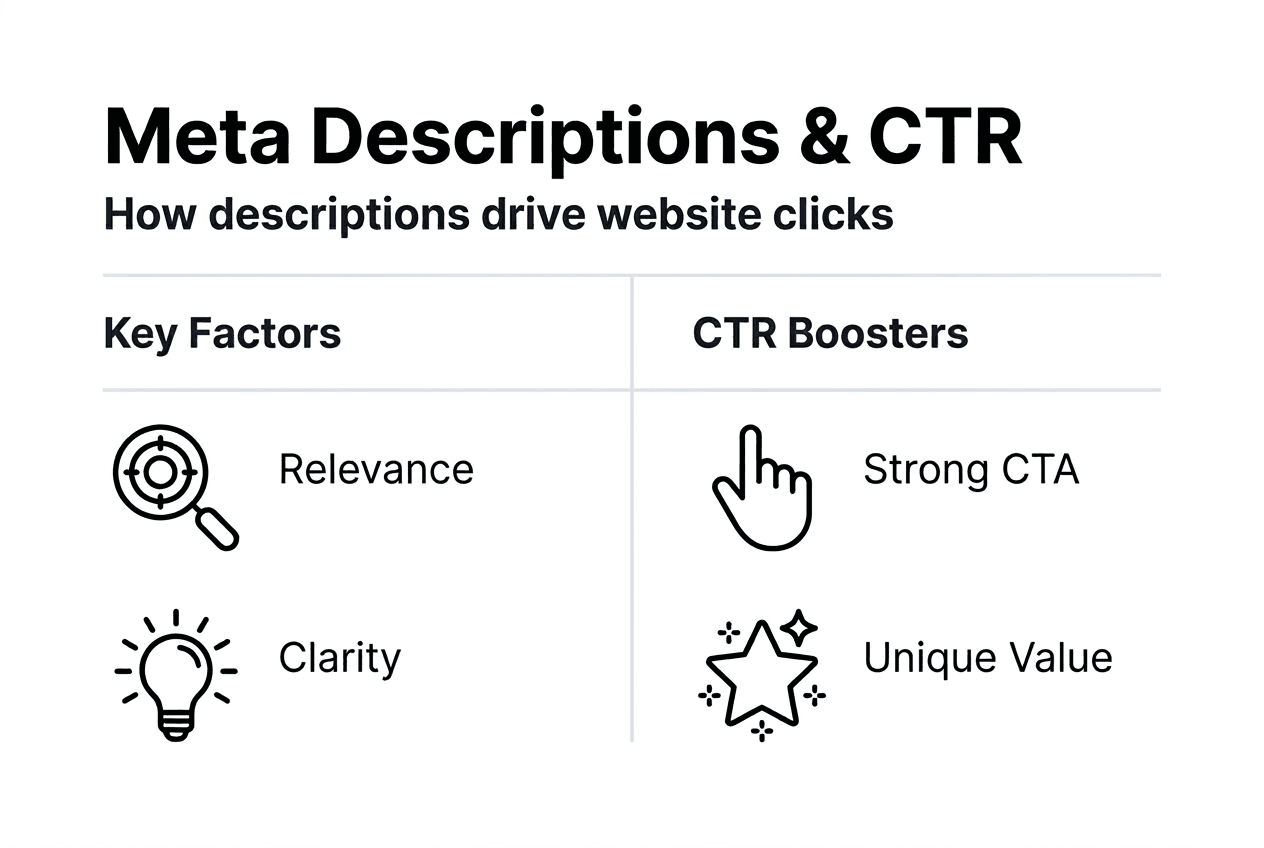
The relationship between meta descriptions and SEO success follows what we call the Meta Description Impact Triangle:
- Searcher Relevance: Descriptions that mirror the user's query language and intent resonate immediately
- Visibility Enhancement: Relevant keywords trigger Google to display your custom description more often
- Engagement Amplification: Higher CTR sends positive signals that indirectly influence rankings over time
Real data demonstrates this impact clearly. Well-crafted meta descriptions can increase CTR by over 6%, translating directly to more organic traffic without improving your ranking position. This represents significant growth potential for businesses competing in crowded search landscapes.
Consider the compound effect: a 6% CTR improvement across dozens or hundreds of pages multiplies into substantial traffic gains. For an e-commerce site with 500 indexed pages receiving 100,000 monthly impressions, a 6% CTR boost delivers 3,000 additional monthly visitors without spending a dollar on ads.
Higher engagement rates from optimized meta descriptions create secondary benefits. When users click through and find content matching their expectations, they stay longer, explore more pages, and convert at higher rates. These behavioral signals tell search engines your content satisfies user needs, potentially improving rankings over time.

For more guidance on maximizing your meta tag strategy, explore our ultimate guide to meta tags for comprehensive optimization techniques.
Common misconceptions about meta descriptions and SEO
Many marketers operate under false assumptions about how meta descriptions function. Meta descriptions do not directly improve rankings, and Google may rewrite or ignore them based on query context. Understanding these realities helps you set appropriate expectations and focus efforts where they matter most.
Here are the most damaging misconceptions:
- Myth: Longer meta descriptions always perform better because they provide more information
- Reality: Descriptions exceeding 160 characters get truncated, cutting off your message at the worst possible moment
- Myth: Stuffing keywords into meta descriptions improizes SEO directly
- Reality: Keyword stuffing damages readability and reduces click appeal without ranking benefits
- Myth: Google always displays your custom meta description
- Reality: Search engines rewrite descriptions in 63% of cases to better match specific queries
- Myth: You can skip meta descriptions if your content is strong
- Reality: Missing descriptions force Google to generate snippets automatically, often pulling disjointed text that fails to convert
The rewriting behavior deserves special attention. Google dynamically generates snippets when it believes other page content better matches the searcher's specific query. This isn't a failure, it's an opportunity. By providing a well-crafted default description, you give Google quality source material even when it chooses to customize the display.
Some pages rank in position one yet receive disappointing traffic because their meta descriptions fail to compel clicks. Your description competes not just with other results but with user attention itself. A boring or unclear description wastes your ranking position's potential.
Best practices for writing effective meta descriptions
Crafting high-performing meta descriptions requires balancing technical constraints with persuasive copywriting. Optimal meta description length is 140-160 characters, with keywords included naturally to maximize snippet display frequency.
Follow these proven strategies:
- Stay within character limits: Target 140-160 characters to avoid truncation across devices and search interfaces
- Lead with value: Front-load the most compelling benefit or answer within the first 120 characters
- Include primary keywords naturally: Place your target keyword early without forcing awkward phrasing
- Create emotional resonance: Use power words that trigger curiosity, urgency, or desire
- Add a clear call to action: Tell users exactly what they'll gain by clicking through
- Match search intent precisely: Align your description with what users actually want to accomplish
- Make every word count: Eliminate filler phrases and focus on concrete benefits
Pro Tip: Write multiple description variations for important pages, then test them over 30-day periods using Google Search Console data. Track CTR changes to identify which messaging resonates most with your audience.
Consider how AI-driven SEO strategies can streamline this optimization process. Rather than manually crafting hundreds of descriptions, intelligent automation can generate high-quality options based on your best-performing patterns.
The most effective descriptions answer the user's implicit question: "Why should I click this result instead of the nine others on this page?" Your answer must be immediate, specific, and compelling enough to overcome inertia.
The role of meta descriptions in voice search and AI-driven SEO
Voice search has fundamentally changed how users interact with search results, creating new optimization requirements. Approximately 65% of voice searches favor meta descriptions under 140 characters due to conversational preferences and audio reading limitations.
Voice assistants read meta descriptions aloud when providing search results, making brevity and clarity more critical than ever. A description optimized for visual scanning may sound awkward or confusing when spoken. Conversational tone and natural phrasing become essential.
Here's how traditional and voice-optimized descriptions differ:
| Aspect | Traditional Meta Description | Voice-Optimized Meta Description |
|---|---|---|
| Length | 150-160 characters | 120-140 characters |
| Tone | Professional, keyword-focused | Conversational, natural speech |
| Structure | Feature lists, benefits | Question-answer format |
| Keywords | Multiple variations included | Single primary phrase |
| Punctuation | Varied, complex | Simple, speech-friendly |
Voice search queries tend to be longer and more specific than typed searches. Users ask complete questions rather than entering keyword fragments. Your meta descriptions should mirror this natural language pattern to signal relevance to both voice assistants and users.
For comprehensive strategies, review our guides on voice search impact on SEO and voice search optimization.
Case studies and tools for creating high-quality meta descriptions
Real-world results prove the impact of meta description optimization. An e-commerce retailer revised meta descriptions across 200 product pages, focusing on benefit-driven language and precise character counts. Within 60 days, organic traffic increased by 12% without any ranking improvements.
Compare the efficiency and results:
| Method | Time Per Description | Consistency Score | Average CTR Improvement |
|---|---|---|---|
| Manual Writing | 8-12 minutes | 65% | 4-6% |
| AI-Generated | 2-3 minutes | 90% | 5-7% |
| AI + Manual Editing | 4-5 minutes | 95% | 7-9% |
Pro Tip: Use AI to generate three description options for each page, then manually select and refine the strongest candidate. This hybrid approach delivers the speed of automation with the nuance of human judgment.
The most sophisticated approach integrates meta description optimization into your broader content workflow. Platforms like BabyloveGrowth's SEO automation platform handle description generation alongside content creation, keyword research, and performance tracking.
Small businesses particularly benefit from automation. Creating custom descriptions for hundreds of pages manually consumes dozens of hours. AI reduces this to minutes while maintaining quality standards that drive results.
Conclusion: leveraging meta descriptions for scalable SEO success
Meta descriptions represent one of the highest-leverage opportunities in SEO. They require minimal time investment yet deliver measurable traffic improvements through increased click-through rates. The 6% CTR boost from optimization compounds across your entire site, generating thousands of additional visitors monthly.
Understanding their true role clarifies where to focus efforts. While meta descriptions don't directly influence rankings, they shape the user decisions that ultimately determine your organic traffic volume. A page ranking fifth with a compelling description often outperforms a page ranking third with a weak one.
AI and data-driven tools have made meta description optimization scalable for businesses of any size. You can now analyze thousands of competitor descriptions, identify winning patterns, and generate optimized variations in minutes rather than weeks. This efficiency lets you focus on strategy while automation handles execution.
Boost your SEO with AI-powered meta description automation
Creating optimized meta descriptions for every page on your site shouldn't consume weeks of manual effort. BabyloveGrowth's SEO automation platform generates high-performing descriptions at scale, analyzing your content and competitors to craft compelling snippets that drive clicks.
Our platform goes beyond meta descriptions to handle your entire SEO workflow on autopilot. Generate rank-high content for Google and ChatGPT, build quality backlinks through our backlink exchange ecosystem, and track your organic growth with our organic traffic tool. Start your free trial today and watch your search visibility grow.
Frequently asked questions
What is a meta description and why does it matter?
Meta descriptions are HTML snippet tags that summarize webpage content and appear below titles in search results. They influence user click decisions by providing context about page content before users visit. Well-crafted descriptions increase click-through rates and drive more organic traffic to your site.
Do meta descriptions directly improve Google search rankings?
No, meta descriptions do not directly affect Google rankings as confirmed by search engine documentation. However, they improve SEO indirectly by increasing click-through rates and engagement signals. Higher engagement from compelling descriptions can influence rankings over time through behavioral factors.
How long should an effective meta description be in 2026?
The ideal length is between 140-160 characters to prevent truncation on most devices and search interfaces. For voice search optimization, descriptions under 140 characters perform better because they're easier for voice assistants to read aloud naturally.
Can AI tools help with writing meta descriptions?
Yes, AI tools significantly reduce meta description creation time while improving optimization consistency across large sites. Combining AI generation with manual editing yields the best results, delivering both efficiency and quality. Explore BabyloveGrowth's SEO automation platform for automated description generation.
What are common mistakes to avoid when writing meta descriptions?
Avoid keyword stuffing which damages readability and reduces click appeal without providing ranking benefits. Never ignore meta descriptions entirely because missing descriptions force Google to generate snippets automatically. Keep length within 140-160 characters to prevent truncation that cuts off your message.