Keyword Density Explained: Impact on SEO Success


Every digital marketer has heard debates about keyword density, yet the reality is often misunderstood. Striking the right balance between keyword frequency and natural writing has become more complex as Google rewards quality over repetition. For e-commerce brands, knowing how keyword density fits into today's SEO strategies helps you avoid penalties and focus on what truly improves rankings. This guide clears up common myths and offers actionable ideas for content that performs in search.
Table of Contents
- Keyword Density Defined And Common Myths
- How To Calculate Keyword Density Effectively
- Optimal Ranges And Search Engine Preferences
- Risks Of Overuse And Penalty Triggers
- Best Practices For Modern Content Seo
Key Takeaways
| Point | Details |
|---|---|
| Keyword Density is No Longer a Major Ranking Factor | Modern search engine algorithms prioritize context and semantic relevance over raw keyword repetition. Focus on content quality instead of specific density numbers. |
| Avoid Keyword Stuffing | Overusing keywords can lead to penalties from search engines, harming your site's visibility. Write naturally for users, not algorithms. |
| Optimize for User Intent | Create content that answers real customer questions and needs, ensuring keywords are integrated naturally based on user searches. |
| Measure Success Holistically | Use keyword density as one of many metrics, focusing on overall content quality, user engagement, and technical optimization to drive SEO success. |
Keyword Density Defined and Common Myths
Keyword density measures how often a specific keyword appears relative to the total word count on a page, expressed as a percentage. It's a straightforward calculation: divide the number of times your target keyword appears by the total words on the page, then multiply by 100.
Here's a practical example. If your page contains 1,000 words and your keyword appears 8 times, your keyword density is 0.8%. Simple math, but the interpretation is where things get fuzzy.
Historically, search engines relied heavily on keyword density as a ranking signal. The idea was simple: if you mentioned your topic frequently, your content must be relevant. That logic made sense in the 1990s, but it doesn't anymore.
Why Keyword Density Matters Less Today
Google shifted its approach years ago. The search engine now prioritizes semantic SEO and contextual relevance over raw keyword repetition. Modern algorithms understand synonyms, related terms, and topic context—they don't need you hammering the same phrase repeatedly.
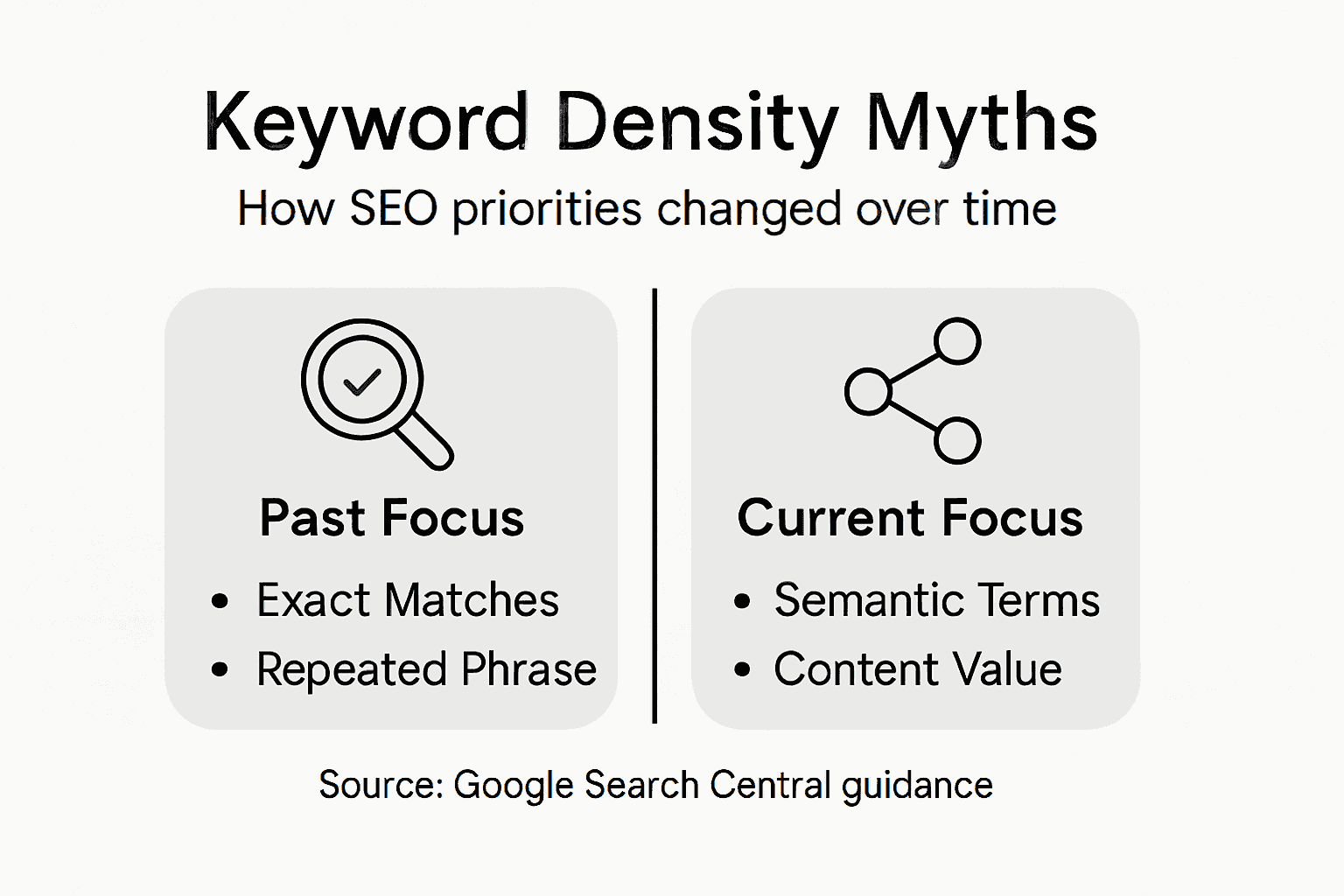
Search engines also watch for keyword stuffing, which is the deliberate overuse of keywords to manipulate rankings. Pages guilty of this practice face penalties, not rewards.
Common Myths About Keyword Density
Many digital marketers still operate under outdated assumptions. Let's address the most damaging ones:
-
Myth: There's a magic keyword density percentage. Reality: No fixed rule exists. A 1% density works for some pages, while 2-3% works for others. Context and quality matter far more than hitting a specific number.
-
Myth: Higher keyword density equals better rankings. Reality: Excessive repetition signals low-quality content to Google. Natural mentions spread throughout well-written pages rank better than artificially inflated keyword counts.
-
Myth: Keyword density is the primary ranking factor. Reality: Factors like content diversity and topic coverage, backlinks, user experience, and content quality matter significantly more.
-
Myth: You need to optimize every page to a specific density. Reality: Write for your audience first. Keyword placement should feel natural, not forced.
What Actually Works
Instead of obsessing over percentages, focus on these practical approaches:
- Use your primary keyword in the title, meta description, and first 100 words
- Include variations and related terms naturally throughout the content
- Prioritize readability and usefulness over keyword repetition
- Write longer, comprehensive content that naturally covers topic variations
- Test different approaches and measure actual ranking performance
Natural keyword usage combined with comprehensive content coverage drives rankings far more effectively than hitting a specific density percentage.
Your e-commerce site or content marketing strategy benefits more from strategic keyword research and optimization than from fixating on density metrics.
Pro tip: Write your content first focusing on helping your audience, then check keyword density as a quality control measure—not as your primary goal. If your density is below 0.5% or above 3%, review the content, but don't force artificial changes just to hit a number.
How to Calculate Keyword Density Effectively
Calculating keyword density is straightforward once you know the formula. The basic approach involves counting keyword occurrences, dividing by total word count, then converting to a percentage.
Here's the formula: (Number of Keyword Occurrences / Total Words) × 100 = Keyword Density %
Let's work through a real example. You wrote a 2,000-word article about "e-commerce SEO tips." Your target phrase appears 14 times throughout the content. The calculation: (14 / 2,000) × 100 = 0.7% keyword density.

Step-by-Step Calculation Process
Follow these steps to calculate accurately:
-
Count your keyword occurrences using your browser's find function (Ctrl+F or Cmd+F). Search for your exact phrase and note the total matches.
-
Count total words on your page, excluding HTML tags and non-visible elements like code snippets.
-
Apply the formula by dividing occurrences by word count and multiplying by 100.
-
Repeat for variations if you want to track different keyword forms or related phrases separately.
When working with multi-word keyword phrases, remember that each variation counts as a separate occurrence. "SEO tips," "tips for SEO," and "SEO strategy tips" are different phrases with different densities.
Tools That Speed Up Calculation
Manual counting works, but tools save time and reduce errors:
- Browser plugins that highlight keywords and calculate density automatically
- SEO analytics platforms that show keyword density across your entire site
- Content optimization tools that track density while you write
- Spreadsheet formulas if you prefer a DIY approach
For e-commerce sites managing dozens of product pages, automated tools prevent calculation mistakes that could skew your optimization decisions.
Common Calculation Mistakes to Avoid
Even experienced marketers make these errors:
- Including HTML tags and meta code in word counts
- Counting partial phrase matches when you need exact phrases
- Forgetting to exclude header navigation or footer text
- Using outdated word counts after editing content
- Calculating density for the wrong keyword entirely
Accurate calculations matter less than tracking your actual rankings—use density as one data point among many, not as your primary optimization metric.
Once you master effective keyword research, you'll naturally write content at appropriate densities without obsessing over exact percentages.
Pro tip: Calculate density at the 50% and 100% completion points while writing, not just at the end. This habit catches over-optimization early and prevents rewriting entire sections later.
Optimal Ranges and Search Engine Preferences
There's no magic keyword density number that guarantees rankings. Google doesn't publish optimal ranges, and frankly, obsessing over specific percentages wastes your time.
Historically, marketers targeted 1-3% density as a safe zone. That advice originated when search engines relied more heavily on keyword frequency. Modern algorithms have moved far beyond this simplistic approach.
Today's search engines prioritize semantic relevance over raw keyword repetition. They understand context, related terms, synonyms, and user intent—not just exact phrase matching.
What Search Engines Actually Care About
Keyword proximity and prominence matter more than overall density percentages. This means where your keyword appears and how naturally it fits within sentences influences rankings more than how many times it appears.
Consider these ranking factors ahead of keyword density:
- Content quality and comprehensiveness covering the full topic
- User intent alignment matching what searchers actually want
- Topical authority showing expertise across related subjects
- Backlink quality and relevance from authoritative sources
- Page experience signals like load speed and mobile responsiveness
- Click-through rates and engagement indicating content value
Keyword density ranks significantly lower than all of these factors.
Here's a quick overview of how ranking factors stack up in importance for SEO:
| Ranking Factor | Impact on SEO | Why It Matters |
|---|---|---|
| Content Quality | Very High | Satisfies user needs |
| User Experience | High | Increases engagement |
| Backlink Quality | High | Signals authority/trust |
| Topical Authority | High | Shows subject expertise |
| Keyword Density | Low | Less important today |
| Semantic Relevance | Very High | Captures search intent |
Why Strict Density Targets Backfire
Forcing your content to hit a specific density percentage often creates awkward, unnatural reading experiences. Readers notice when keywords are shoehorned into sentences that sound robotic or forced.
Google's algorithms detect keyword stuffing—the deliberate overuse of keywords to manipulate rankings. When detected, pages face ranking penalties or deindexing entirely. The risk far outweighs any potential benefit.
Your e-commerce product pages perform better when written for actual customers, not search bots. Natural language that addresses customer pain points and questions ranks better than artificially dense content.
To choose the right keyword approach, compare density-focused and semantic strategies:
| Approach | Key Focus | Strength | Risk/Weakness |
|---|---|---|---|
| Density-Driven | Repetition Percent | Easy to measure | May harm readability |
| Semantic/Contextual | Topic Coverage | Matches user intent better | Takes more planning and research |
The Real Approach
Instead of calculating optimal percentages, focus on these practices:
- Write naturally for your audience first
- Include your target keyword in essential locations (title, first 100 words, headings)
- Use keyword variations and related terms throughout
- Aim for comprehensive coverage that answers searcher questions completely
- Check density afterward as a quality control measure, not a goal
If your density falls between 0.5-2%, you're typically in a safe, natural range. If it's consistently below 0.3% or above 3%, review your content—but prioritize readability over hitting a number.
Search engine preferences have shifted entirely away from density quotas toward content quality, relevance, and user satisfaction metrics that matter far more.
When combined with strong search engine optimization fundamentals, keyword density becomes a secondary concern you naturally handle through quality writing.
Pro tip: Use your target keyword in the page title, H1 heading, and within the first 150 words, then write naturally for the rest. These placements signal relevance to search engines without requiring any specific overall density.
Risks of Overuse and Penalty Triggers
Overusing keywords carries real consequences. Google actively penalizes sites that stuff keywords into content, treating it as a manipulation tactic designed to game search rankings.
Keyword stuffing happens when you force the same phrase repeatedly into sentences where it doesn't naturally belong. This degrades user experience and signals to search engines that you prioritize rankings over content quality.
The penalties are severe. Sites caught stuffing keywords face dramatic ranking drops, reduced visibility, or complete removal from search indexes entirely.
How Google Detects Keyword Overuse
Google's algorithms have become sophisticated at spotting unnatural keyword patterns. Excessive keyword use diminishes content quality and creates obvious red flags for detection systems.
The search engine looks for these warning signs:
- Repetitive phrasing where the same exact phrase appears multiple times in short succession
- Grammatically awkward sentences that sound forced or unnatural when read aloud
- Keyword density spikes that jump from normal to excessive sections
- Keyword-to-content ratio that seems disproportionate compared to industry standards
- Hidden or tiny text stuffed with keywords invisible to regular visitors
- Irrelevant keyword placement in contexts that don't match user intent
Google's systems analyze not just density, but also context, semantic meaning, and user behavior signals to catch manipulation attempts.
Real Consequences for Your Business
For e-commerce sites managing multiple product pages, keyword stuffing penalties cause tangible revenue losses. A single penalized page might lose 80-95% of its organic traffic within weeks.
Recovery is slow. Even after fixing the content, it takes Google weeks or months to re-evaluate and restore rankings. During that time, your competitors capture the traffic and sales you lost.
Worse, the penalty can spread to your entire domain if the practice seems systematic across multiple pages.
Penalty Triggers You Should Avoid
Be cautious with these specific practices:
- Repeating your keyword 5+ times per 100 words
- Using the exact same phrase in consecutive paragraphs
- Hiding keywords in tiny text, white backgrounds, or alt text stuffing
- Creating content primarily around keyword insertion rather than user value
- Targeting unrelated keywords just because they have search volume
One overstuffed page can damage your entire site's credibility with search engines, making recovery difficult even after corrections.
The safer approach prioritizes helpful content that naturally includes keywords in relevant places. Writing for actual readers instead of search algorithms prevents penalties while building long-term organic growth.
Pro tip: If a keyword phrase feels forced when you read it aloud naturally, it's probably overused. Delete or rephrase it. Your actual visitors will thank you, and Google will reward the improved readability with better rankings.
Best Practices for Modern Content SEO
Modern SEO has moved beyond keyword density metrics into a holistic approach combining content quality, user intent, technical optimization, and strategic keyword placement. Success requires balancing these elements thoughtfully.
The shift happened because Google's algorithms now evaluate entire content ecosystems rather than individual metrics. A page with perfect keyword density but poor user engagement ranks below comprehensive, helpful content with natural keyword integration.
Your e-commerce site benefits most from strategies that serve both visitors and search engines simultaneously.
Core Content Strategies That Work
Effective keyword optimization requires selecting keywords aligned with user intent and integrating them naturally throughout your content. This means understanding what your audience actually searches for and why.Focus on these foundational practices:
- User-first writing that addresses real customer questions and pain points
- Topic clustering organizing related keywords around central themes
- Natural keyword placement in titles, headings, and opening paragraphs
- Semantic variations using synonyms and related phrases throughout
- Comprehensive coverage that thoroughly answers search queries
- Readable formatting with short paragraphs, lists, and white space
Keyword density becomes irrelevant when your content answers what searchers need.
Creating High-Quality, Valuable Content
Search engines reward content that demonstrates genuine expertise and provides measurable value. For product pages, this means detailed specifications, honest comparisons, and real customer insights.
Focus your effort on creating something remarkable rather than optimizing metrics. A single comprehensive guide outranks five mediocre articles optimized to death.
Your content should answer questions visitors have before they ask them. Anticipate objections, address concerns, and provide actionable information.
Technical and On-Page Optimization
Beyond content quality, these technical elements matter:
- Meta descriptions that accurately summarize page content and include your primary keyword
- Heading structure (H1, H2, H3) that clearly organizes topics and includes keywords naturally
- URL structure that's clean, descriptive, and keyword-relevant
- Internal linking connecting related content and distributing link authority
- Schema markup helping search engines understand your content type
- Mobile optimization ensuring excellent experience across all devices
Content that genuinely helps your audience will naturally rank better than content optimized purely for search engine formulas.
Building SEO-friendly content means writing first for people, then ensuring search engines can understand and crawl your content easily.
Pro tip: Map your target keywords to actual user intent and customer journey stages—awareness, consideration, decision—rather than just chasing high-volume terms. This strategic approach generates better qualified traffic and higher conversion rates for e-commerce sites.
Unlock SEO Success Beyond Keyword Density
Struggling with keyword density confusion and unsure how to boost your SEO rankings naturally It is time to focus on strategies that truly work for your business growth Keyword stuffing risks penalties while obsessing over percentages wastes precious effort At Babylovegrowth.ai we understand your challenge and deliver AI-driven content solutions that prioritize quality, semantic relevance, and user intent Our platform automates high-quality article creation with strategic keyword optimization optimized for both Google and ChatGPT to drive organic traffic without forcing unnatural keyword repetition

Ready to transform your SEO and leave outdated keyword density myths behind Explore our step-by-step SEO on autopilot method that includes a personalized 30-day content plan and a backlink exchange ecosystem designed for scalable growth Join Babylovegrowth.ai today and start ranking higher with content that speaks to your audience and satisfies search engines naturally Take the first step now toward effortless, sustainable SEO success
Frequently Asked Questions
What is keyword density and how is it calculated?
Keyword density measures the frequency of a specific keyword relative to the total word count on a page, expressed as a percentage. It is calculated by dividing the number of times the keyword appears by the total word count and then multiplying by 100.
How has keyword density changed in importance for SEO?
Keyword density was once a significant ranking factor, but due to Google's advanced algorithms, it now prioritizes semantic relevance and content quality over simple keyword repetition.
What are the risks of keyword stuffing in content?
Keyword stuffing occurs when keywords are overused to manipulate search rankings, leading to penalties from search engines. This can result in lower rankings or even removal from search indices.
What factors should I prioritize instead of keyword density for SEO?
Focus on content quality, user intent alignment, topical authority, and overall user experience. These factors have a greater impact on search rankings compared to simply hitting a specific keyword density percentage.