How to Use User Feedback to Boost SEO Results Effectively


Finding the right way to capture user feedback can feel confusing when every opinion promises a different strategy. For marketers and SEO professionals in e-commerce, understanding these responses is more than just collecting comments. It is about shaping a responsive content approach that drives organic traffic. This guide highlights how digital survey platforms and feedback analytics lay the groundwork for actionable insights, helping you make smarter content decisions and see real results in your search rankings.
Table of Contents
- Step 1: Set Up Effective Feedback Collection Tools
- Step 2: Analyze User Feedback for Actionable Insights
- Step 3: Implement Changes to Content and SEO Strategy
- Step 4: Monitor Impact of Adjustments
- Step 5: Refine Processes Based on Ongoing Feedback
Quick Summary
| Key Point | Explanation |
|---|---|
| 1. Choose Effective Feedback Tools | Identify user-friendly survey platforms that provide real-time data collection and analytics for actionable insights. |
| 2. Analyze Feedback Systematically | Break down feedback into categories to identify themes, patterns, and improvements that impact SEO performance. |
| 3. Implement Data-Driven Changes | Prioritize and apply modifications to your content and SEO strategy based on user insights, addressing key pain points. |
| 4. Monitor SEO Impact Metrics | Establish a robust framework to track performance indicators like organic rankings and user engagement to validate content strategies. |
| 5. Refine Processes Continuously | Create a loop for ongoing feedback analysis and iterative content improvements to keep your strategy responsive and effective. |
Step 1: Set Up Effective Feedback Collection Tools
Setting up the right feedback collection tools is crucial for gaining actionable insights that can transform your SEO strategy. This step will help you select and implement powerful survey mechanisms that capture user experiences and preferences with precision.
Start by identifying digital survey platforms that align with your specific feedback goals. Tools like customizable online survey platforms provide robust features for collecting structured user data efficiently. Consider these key elements when selecting your feedback tools:
- Ease of use for survey participants
- Real-time data collection capabilities
- Advanced analytics and reporting features
- Mobile responsiveness
- Integration with existing analytics platforms
When designing your feedback mechanism, focus on creating clear, concise questions that encourage honest and detailed responses. Avoid leading questions or complex language that might discourage participation. Your survey should feel conversational and straightforward, making users comfortable sharing their genuine experiences.
Choose survey tools that transform raw feedback into actionable SEO insights.
Additionally, consider implementing multiple feedback channels to capture comprehensive user perspectives. This might include:
- Website pop-up surveys
- Email follow-up questionnaires
- Social media polling
- Direct user interviews
The goal is to create a holistic feedback ecosystem that provides nuanced understanding of user interactions with your content.
Here is a comparison of popular feedback collection channels and their best-use scenarios:
| Feedback Channel | Best For | Business Impact |
|---|---|---|
| Website Pop-up Survey | Immediate site experience | Capture in-the-moment insights |
| Email Questionnaire | Post-interaction feedback | Deeper, reflective responses |
| Social Media Poll | Quick audience sentiment | Broad reach, trend detection |
| User Interview | In-depth qualitative insights | Detailed pain points and needs |
Pro tip: Incentivize user feedback by offering small rewards or exclusive content to increase response rates and gather more meaningful insights.
Step 2: Analyze User Feedback for Actionable Insights
Converting raw user feedback into meaningful SEO strategies requires a systematic and strategic approach. Your goal is to transform scattered user comments into clear, actionable recommendations that can significantly improve your content and search performance.
Begin by developing a comprehensive feedback analysis framework that helps you systematically interpret user responses. This involves breaking down feedback into specific categories and identifying recurring themes that impact your SEO performance. Key analysis techniques include:
- Sentiment categorization of user comments
- Frequency analysis of specific user suggestions
- Mapping feedback to existing content gaps
- Identifying potential keyword opportunities
- Tracking user pain points and experience barriers
Divide your analysis into quantitative and qualitative components. Quantitative data provides statistical insights through numerical metrics, while qualitative feedback offers deeper contextual understanding of user experiences. Look for patterns that reveal:
- Content comprehension challenges
- Navigation difficulties
- Unmet user information needs
- Potential technical SEO improvements
Transform user comments from mere feedback into strategic SEO intelligence.
Utilize advanced analytics tools and AI-powered platforms that can help you rapidly process and categorize large volumes of user input. These technologies can identify subtle patterns and connections that manual review might miss, providing a more comprehensive understanding of user interactions with your content.

Pro tip: Regularly cross-reference user feedback with your website analytics to validate insights and create a dynamic, responsive content optimization strategy.
Step 3: Implement Changes to Content and SEO Strategy
Transforming user feedback into concrete content and SEO improvements requires a strategic and systematic approach. Your goal is to create a responsive content strategy that continuously adapts to user insights and search performance dynamics.
Develop a dynamic content strategy by prioritizing feedback-driven modifications across your website. Focus on implementing changes that directly address user pain points and align with your SEO objectives. Key implementation strategies include:- Revise existing content based on user comprehension feedback
- Update keyword targeting to match user search intent
- Improve site navigation and user experience
- Restructure content for better readability
- Fill identified content gaps
Prioritize changes using a structured approach that balances user experience with search engine optimization. Break down your implementation process into actionable steps:
- Rank feedback insights by potential impact
- Create a detailed implementation timeline
- Develop content update templates
- Establish performance tracking mechanisms
- Schedule regular content review cycles
Transform user feedback into a powerful SEO optimization engine.
Utilize advanced analytics and AI tools to track the effectiveness of your content modifications. Continuously monitor key performance indicators such as organic traffic, user engagement metrics, and search rankings to validate the impact of your strategy.
Pro tip: Create a flexible content update workflow that allows rapid iteration and data-driven improvements to maintain your competitive edge in search results.
Step 4: Monitor Impact of Adjustments
Track the effectiveness of your SEO strategy with precision and insight. Your goal is to develop a robust monitoring system that reveals the true impact of the changes you've implemented and provides clear guidance for future optimization.
Measure marketing performance indicators by establishing a comprehensive tracking framework that goes beyond surface-level metrics. Effective monitoring requires a multifaceted approach to understanding your content's performance. Key monitoring strategies include:- Track organic search rankings consistently
- Analyze user engagement metrics
- Monitor conversion rate changes
- Evaluate content interaction depth
- Assess page load speed impacts
Develop a systematic approach to performance evaluation by focusing on these critical steps:
- Set up advanced analytics dashboards
- Define clear performance benchmarks
- Create comparative performance reports
- Implement real-time tracking mechanisms
- Schedule monthly performance reviews
Transform data into actionable SEO optimization strategies.
Utilize advanced analytics platforms that provide granular insights into your content's performance. Look beyond basic metrics to understand user behavior, search intent alignment, and the nuanced ways your content connects with your target audience.
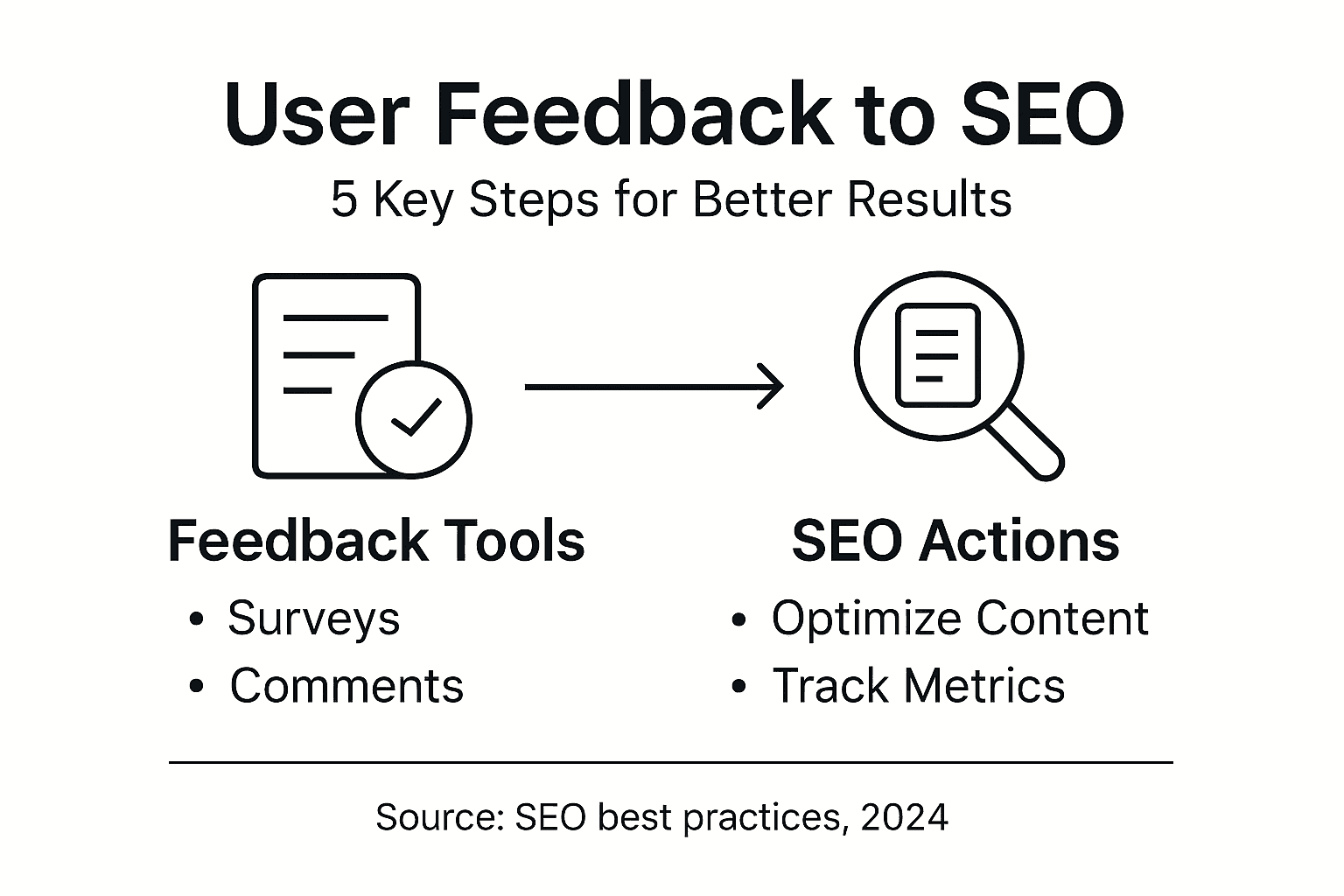
The following table summarizes analytics tools and their role in measuring SEO impact:
| Tool Type | Key Metric Tracked | Improvement Use Case |
|---|---|---|
| Web Analytics | Organic traffic, bounce | Track reach and engagement |
| Rank Tracker | Search ranking positions | Identify keyword performance shifts |
| Heatmapping | Content interaction depth | Optimize content placement |
| Performance Monitor | Page load speed | Enhance user experience and SEO |
Pro tip: Develop a standardized performance reporting template that allows quick visual identification of trends and actionable insights across your SEO initiatives.
Step 5: Refine Processes Based on Ongoing Feedback
Successful SEO requires continuous evolution and adaptation. Your mission is to create a dynamic feedback loop that transforms insights into strategic improvements, ensuring your content remains responsive and competitive.
Develop iterative self-refinement strategies by establishing a systematic approach to analyzing and implementing user feedback. This process involves critically examining your current strategies and making data-driven adjustments that enhance content performance. Key refinement techniques include:- Identify recurring user feedback patterns
- Assess content performance gaps
- Update keyword and content strategies
- Eliminate underperforming content elements
- Experiment with new content formats
Implement a structured approach to continuous improvement by following these essential steps:
- Create a feedback analysis dashboard
- Prioritize actionable insights
- Design iterative content improvement protocols
- Conduct regular performance audits
- Maintain flexibility in your optimization approach
Transform user feedback into a powerful SEO optimization mechanism.
Utilize advanced analytics and AI-driven tools that can help you rapidly process and interpret complex feedback data. Look for subtle patterns and connections that might not be immediately apparent, allowing you to make nuanced improvements to your content strategy.
Pro tip: Develop a quarterly review process that systematically evaluates your feedback collection and implementation strategies, ensuring continuous refinement and adaptation.
Unlock Powerful SEO Growth by Harnessing User Feedback with AI
The challenge of transforming user feedback into actionable SEO strategies calls for smart tools that simplify the process. If you struggle with analyzing scattered insights or implementing continuous content improvements, you are not alone. Many business owners and SEO professionals find it hard to maintain momentum using manual feedback loops and traditional SEO measures. The key pain points highlighted in the article include collecting precise user data, extracting meaningful insights, and executing responsive content updates that align directly with search intent and user needs.
Babylovegrowth.ai offers a seamless solution designed to automate these exact steps. Our AI-powered platform generates optimized, high-quality articles and backs them with a personalized 30-day content plan and backlinks exchange ecosystem. This means you can capitalize on real user feedback by consistently updating and scaling your SEO strategy without the heavy lifting. Ready to stop guessing and start growing consistently with data-driven, AI-enhanced SEO? Explore the full capabilities of our SEO automation platform and discover how to turn feedback into your biggest growth engine.
Take control of your organic traffic growth today with Babylovegrowth.ai. Visit our landing page to start your free trial and watch your SEO soar with automated content creation and smart backlink strategies. Don’t wait to leverage the power of AI to make user feedback work harder for your business.
Frequently Asked Questions
How can user feedback improve my SEO results?
User feedback provides insights into what users like and dislike about your content. By analyzing this feedback, you can identify areas for improvement, allowing you to refine your SEO strategy and better meet user expectations.
What tools can I use to collect user feedback effectively?
Choose digital survey platforms that are easy for users, offer real-time data collection, and can integrate with existing analytics tools. Implement methods such as website pop-up surveys or email questionnaires to maximize the collection of diverse feedback from your audience.
How do I analyze the feedback I receive?
Break down feedback into categories to identify trends and key themes affecting your SEO performance. Use both quantitative metrics and qualitative insights to evaluate user pain points and content opportunities; for instance, track recurring suggestions to address content gaps.
How often should I implement changes based on user feedback?
Aim to revise your content and SEO strategy at regular intervals, such as every quarter. Prioritize the feedback based on potential impact and track your website's performance metrics before and after changes to measure effectiveness.
What metrics should I monitor after making changes?
Monitor key performance indicators such as organic traffic, bounce rates, and user engagement metrics post-implementation. Set benchmarks for these metrics to evaluate the impact of your adjustments and make informed decisions for future refinements.