How to plan digital campaigns that drive organic growth


TL;DR:
- Modern SMB campaigns should focus on clear, measurable goals aligned with business outcomes before content creation.
- AI-powered tools and structured, answer-focused content are essential for success in today's search environment.
- Continuous tracking, optimization, and adapting to AI search changes are crucial to campaign effectiveness.
Most digital campaigns fail quietly. You pour budget into ads, publish a few blog posts, and wait for traffic that never comes. The problem usually isn't effort. It's that most SMB marketing plans were built for a search landscape that no longer exists. Google has changed, AI-powered search is reshaping how people find answers, and the old playbook of stuffing keywords into content just doesn't work anymore. This guide walks you through a practical, modern framework for planning digital campaigns that actually build organic traffic, from setting the right goals to launching content that ranks on both Google and AI-powered platforms.
Table of Contents
- Clarifying your campaign goals and outcomes
- Preparing the essentials: Tools, research, and requirements
- Step-by-step: Planning, building, and launching your digital campaign
- Troubleshooting, optimization, and measuring results
- Why most digital campaign plans fail (and how to rethink yours)
- Accelerate your results with AI-powered campaign tools
- Frequently asked questions
Key Takeaways
| Point | Details |
|---|---|
| Align goals and KPIs | Every digital campaign should start with clear alignment between business objectives and measurable KPIs. |
| Leverage AI tools | Modern AI platforms and keyword research tools streamline campaign planning and boost organic success. |
| Iterate and optimize | Use analytics to troubleshoot, track outcomes, and continuously improve future campaigns. |
| Embrace AEO and GEO | Answer Engine and Generative Engine Optimization help small businesses gain AI search visibility without big budgets. |
Clarifying your campaign goals and outcomes
Every effective digital campaign starts with brutal clarity about what you actually want to achieve. Not "more traffic." Not "better engagement." Specific, measurable outcomes that tie directly to your business.
This sounds obvious, but most SMBs skip it. They launch campaigns based on what competitors seem to be doing, or what a marketing agency recommends, without ever anchoring those activities to real business goals. The result is a lot of content published, a lot of keywords targeted, and very little revenue generated.
Start by choosing one primary business objective. Common examples include:
- Lead generation: Capturing email addresses or consultation requests from qualified prospects
- Sales conversion: Moving warm prospects toward a purchase decision
- Brand awareness: Building recognition within a specific audience segment
- Audience engagement: Growing repeat visits, social shares, or community interaction
- Local visibility: Appearing in local search results and AI-generated local recommendations
Once you have your primary objective, map specific campaign KPIs (key performance indicators) to that goal. If your objective is lead generation, your KPIs might include monthly form submissions, cost per lead, and organic traffic to landing pages. If it's brand awareness, you track branded search volume, social impressions, and direct traffic growth.
This discipline matters more now because SEO planning uses a modern 7-step framework: align goals with business outcomes, conduct keyword research across platforms including AI channels, build technical foundations with schema markup, develop content strategy for Answer Engine Optimization (AEO) and Generative Engine Optimization (GEO), coordinate across teams, and set up performance tracking from day one.
Notice that "write content" isn't step one. Goal alignment is. That shift in sequencing changes everything about how your campaign performs.
Good AI-driven marketing planning also requires you to define your ideal customer persona before touching a keyword tool. Who searches for what you offer? What questions do they ask? What stage of awareness are they at? These answers shape every content decision you make downstream.
A strong brand strategy with AI also means documenting your campaign goals before launch and revisiting them weekly. Goals that live only in someone's head drift. Goals that are written down, shared with the team, and reviewed against real data become the compass that keeps the entire campaign on track.
Pro Tip: Write your campaign goals in this format: "We will achieve [specific metric] by [specific date] by doing [specific activity]." For example: "We will generate 50 qualified leads per month by August 2026 by publishing four SEO-optimized articles weekly targeting bottom-of-funnel keywords." This format forces you to commit to a number, a timeline, and a method all at once.
Preparing the essentials: Tools, research, and requirements
With your objectives set, it's time to ensure you have the right tools and research to build a winning campaign. Jumping into content creation without the right infrastructure is like building a house without a blueprint. You'll make progress, but you'll also waste significant time correcting avoidable mistakes.
Here's a practical overview of what your campaign toolkit should include:
| Category | Tool/Resource | Primary Use |
|---|---|---|
| AI campaign planning | HubSpot Marketing Studio | Campaign creation and execution |
| Keyword research | Semrush or Ahrefs | Gap analysis and opportunity mapping |
| Content scheduling | Buffer, Notion, or Trello | Editorial calendar management |
| SEO technical audit | Screaming Frog or Sitebulb | Site health and schema review |
| AI content creation | ChatGPT, Claude, or Gemini | Draft generation and content ideation |
| Analytics | Google Analytics 4 and Search Console | Performance tracking |
Essential resources for pre-campaign preparation include:
- A competitor content audit (what's ranking in your niche and why)
- A keyword gap analysis using AI-powered keyword discovery to find terms your competitors miss
- A documented buyer journey map showing awareness, consideration, and decision stages
- A technical SEO baseline so you know your site's current health before adding new content
- An AI content calendar template that aligns publishing cadence with campaign goals
One often-overlooked step is auditing your existing content before publishing anything new. Many businesses already have pages that rank on page two of Google and could reach page one with minor updates. Finding and fixing those pages often delivers faster results than creating brand new content.

Pro Tip: Use Ahrefs' "Content Gap" feature or Semrush's "Keyword Gap" tool to compare your domain against two or three direct competitors. Filter for keywords where competitors rank in positions 1 through 10 and you rank beyond position 20. These are your fastest opportunities for organic growth because the search intent is proven and the competition is clearly beatable.
Good research also means understanding where your audience asks questions. In 2026, that means looking beyond Google. People are searching through ChatGPT, Perplexity, and Google's AI Overviews. Your keyword research needs to include the conversational, long-tail phrasing these AI tools favor, not just the short keywords traditional SEO tools emphasize.
Step-by-step: Planning, building, and launching your digital campaign
Once you've assembled your tools and research, you're ready to map out and execute your campaign. Here's a numbered process that reflects how modern AI-integrated campaigns actually get built:
- Finalize campaign objectives and KPIs using the goal format from Section 1
- Run keyword research across Google, AI platforms, and voice search, prioritizing question-based and long-tail phrases
- Audit your technical foundations: check page speed, mobile usability, schema markup, and crawlability
- Build your content plan: assign keywords to specific pages, identify content type (blog, FAQ page, landing page), and set publish dates
- Create and optimize content: write for both human readers and AI search engines using FAQ sections, structured data, and clear answer formatting
- Coordinate cross-team: make sure sales, support, and marketing align on messaging before anything goes live
- Launch and monitor: set up real-time tracking dashboards and review key metrics weekly
To understand why this approach outperforms traditional methods, the comparison below is instructive:
| Traditional approach | Modern AI-integrated approach |
|---|---|
| Target high-volume short keywords | Target conversational, intent-rich long-tail queries |
| Optimize for Google rankings only | Optimize for Google, ChatGPT, and AI Overviews |
| Publish and wait | Publish, monitor, and iterate weekly |
| Content written for algorithms | Content written for humans with structured AI signals |
| Ignore FAQ and schema | Prioritize FAQs and schema markup for featured snippets |
| Measure traffic volume | Measure traffic quality and conversion rate |
The reason FAQ sections and schema markup matter so much right now: AI referral traffic converts 3x better than standard organic traffic, and 70.2% of marketers have already adapted their strategies to account for AI search. That means when your content surfaces inside a ChatGPT or Perplexity response, the visitor who clicks through is significantly more likely to convert than the average Google visitor.
AI content strategies that include structured FAQ blocks, clear answer paragraphs, and schema markup are the fastest way to capture this high-converting traffic. The key is writing content that directly answers the exact question someone asks an AI, then providing enough depth around that answer to demonstrate topical authority.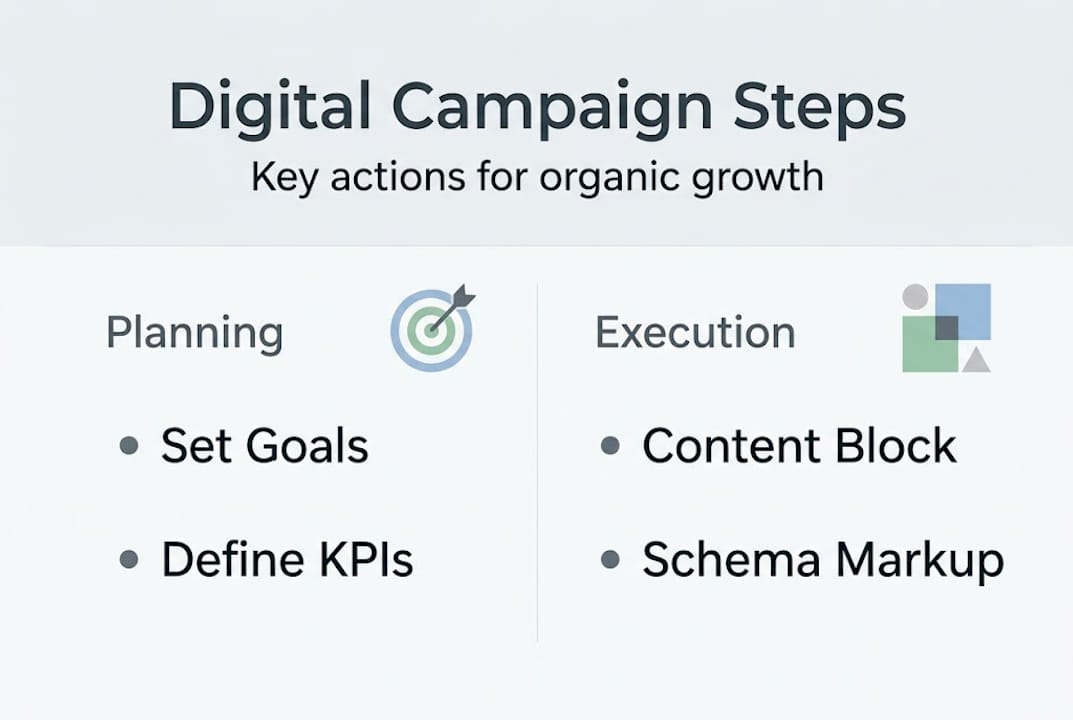
For content automation for SEO, the launch phase should include automated scheduling for social sharing, email distribution, and internal linking updates so each new piece of content connects to your existing pages from day one.
Troubleshooting, optimization, and measuring results
After launching your campaign, continuous improvement and troubleshooting will determine ongoing results. Publishing and walking away is not a strategy. The campaigns that compound over time are built on a habit of reviewing data and acting on it quickly.
Start by tracking these core metrics in your analytics dashboard:
- Organic traffic: Total sessions from unpaid search, broken down by page and keyword
- Conversion rate: The percentage of visitors who complete your target action (form fill, purchase, call)
- Lead quality score: Not just volume, but how many leads match your ideal customer profile
- Engagement rate: Time on page, scroll depth, and return visits
- AI visibility: Whether your content appears in ChatGPT, Perplexity, or Google AI Overview responses
According to the HubSpot 2026 State of Marketing, 30% of marketers still struggle with generating enough leads, and 27% cite poor sales and marketing alignment as their biggest barrier. Meanwhile, 48.57% of marketers name AI-personalized content as their top trend, 40.6% are updating their SEO strategy for AI search, and 86.4% use AI primarily for content creation.
These numbers reveal a gap. Most teams know AI is important, but a significant portion still hasn't fixed the alignment and lead generation problems underneath. The tools won't help if the strategy is broken.
Common campaign mistakes to avoid:
- Publishing without a promotion plan: Great content that nobody shares or links to will not rank, no matter how good the writing is
- Ignoring technical SEO after launch: A slow-loading page or missing schema markup silently kills rankings
- Tracking vanity metrics: High traffic with low conversion means your content is attracting the wrong audience
- Skipping content updates: Pages that ranked well in 2024 may now be outdated, irrelevant to AI search, or beaten by fresher competitors
- Misaligning sales and marketing messaging: When your ads say one thing and your sales team says another, trust breaks down fast
Using an AI-powered content workflow helps catch optimization opportunities faster because AI can analyze performance patterns across dozens of pages simultaneously, something a human analyst would take days to do manually.
Look at your content marketing examples for your best-performing pages and reverse engineer what made them work. Was it the topic depth? The FAQ structure? The internal linking? Apply those patterns to your underperforming pages first before creating anything new.
Pro Tip: Set up a monthly "content audit" ritual. Sort your pages by organic traffic in Google Analytics, then split them into three buckets: growing, flat, and declining. Spend 70% of your optimization time on flat pages because small improvements there often produce the fastest ranking gains. For declining pages, check whether a AI SEO strategies update like adding schema, refreshing statistics, or expanding the FAQ section can reverse the slide.
Why most digital campaign plans fail (and how to rethink yours)
Stepping back, let's explore why old playbooks don't work and where real success now happens.
The most common reason campaigns fail is not budget, team size, or content quality. It's strategic mismatch. Teams design campaigns for a search environment from three years ago while their audience has already moved to AI-assisted discovery.
Traditional SEO focused on ranking a page for a keyword. Modern AI-driven brand growth requires you to rank inside an answer. That shift sounds subtle, but it changes everything about how you structure content, what questions you answer, and how you prove authority to an AI model surfacing your page to a user.
The hidden advantage for SMBs here is real. Generative Engine Optimization for small business shows that smaller companies can compete with large brands specifically because local GEO, schema markup, and well-structured FAQ content levels the playing field. A local HVAC company with a perfectly structured FAQ page and schema markup can surface in an AI response more often than a national brand with a poorly organized site.
The businesses winning in 2026 aren't necessarily the ones with the biggest content teams. They're the ones who understood earliest that the rules changed, and who built their campaigns around answer-focused, structured, AI-readable content from day one.
Accelerate your results with AI-powered campaign tools
Ready to put these strategies into action with advanced tools? The frameworks in this guide work, but execution speed matters. The faster you can publish optimized content, build backlinks, and track performance, the faster organic growth compounds.
Babylovegrowth.ai gives you an organic traffic tool built specifically for businesses that need to grow without depending on paid ads or large agency retainers. The platform's automated publishing platform handles your content calendar so you stay consistent even during busy periods. And the Google and ChatGPT traffic autopilot features are designed to build the kind of backlink and authority signals that push your content into AI-generated answers, where conversion rates are highest. Try it free and see results in your first 30 days.
Frequently asked questions
What is the most important first step when planning a digital campaign?
The most important first step is to align your campaign goals with your overall business outcomes and set measurable KPIs before touching any tools or content, since campaigns built on vague goals almost always produce vague results. SEO planning frameworks consistently show that goal alignment is the single most predictive factor in campaign success.
Which AI tools are recommended for campaign planning in 2026?
HubSpot Marketing Studio and keyword research platforms like Semrush or Ahrefs are among the most widely used and effective tools for AI-driven campaign planning in 2026. Pairing an AI campaign planner with a dedicated keyword gap tool gives you both strategic direction and tactical opportunity discovery.
How does AI improve digital campaign outcomes for small businesses?
AI improves campaign effectiveness by enabling rapid keyword research, personalized content creation, and data-driven optimization that adapts faster than any manual process. Specifically, AI referral traffic converts 3x better than standard organic traffic, making AI visibility a high-value priority for SMBs with limited budgets.
What metrics should be tracked to measure a digital campaign's success?
Track organic traffic, conversion rates, lead quality, and engagement metrics like time on page and return visits to get a complete picture of campaign performance. The 2026 State of Marketing data shows that 30% of marketers still struggle with lead generation, meaning conversion rate tracking is where most teams have the most room to improve.
Recommended
Smart SEO,
Faster Growth!
Most Read Articles
Generative Engine Optimization (GEO)
Learn how Generative Engine Optimization (GEO) helps your content rank in AI search engines like ChatGPT and Google AI. This comprehensive guide explains the differences between SEO and GEO, why it matters for your business, and practical steps to implement GEO strategies for better visibility in AI-generated responses.
DylenJan 18, 2025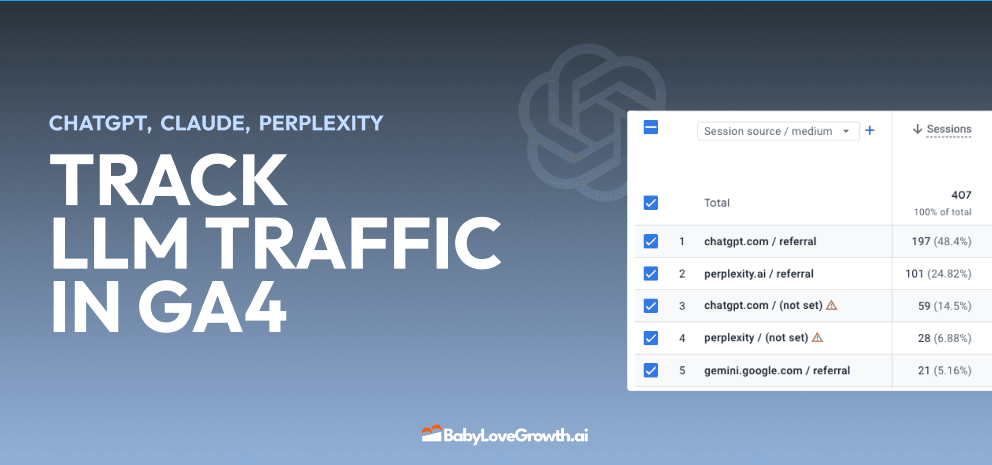
Track LLM Traffic in Google Analytics 4 (GA4)
Learn how to track and analyze traffic from AI sources like ChatGPT, Claude, Perplexity, and Google Gemini in Google Analytics 4. This step-by-step guide shows you how to set up custom filters to monitor AI-driven traffic and make data-driven decisions for your content strategy.
DylenMar 18, 2025
How to Humanize AI Text with Instructions
Learn practical techniques to make AI-generated content sound more natural and human. This guide covers active voice, direct addressing, concise writing, and other proven strategies to transform robotic text into engaging content.
DylenApril 7, 2025
Moz DA vs Ahrefs DR: Which Metric Should You Actually Use?
Moz Domain Authority and Ahrefs Domain Rating look similar but measure very different things. Learn what each score actually tells you, when to use each one, and what to track instead for real SEO results in 2026.
DylenApr 23, 2026
Open AI Revenue and Statistics (2024)
Comprehensive analysis of OpenAI financial performance, user engagement, and market position in 2023. Discover key statistics including $20B valuation, $1B projected revenue, and 100M+ monthly active users.
DylenOctober 03, 2025
"Search Google or Type a URL": What It Means & What to Do
Learn what "Search Google or type a URL" actually means, how your browser decides whether to search or navigate, and what to do if your address bar starts behaving unexpectedly. Includes browser settings guides for Chrome, Firefox, Edge, and Safari.
DylenApr 21, 2026