How to measure brand awareness using AI analytics


Measuring brand awareness accurately remains one of the toughest challenges for small and medium business owners. You know your brand needs visibility, but tracking how many people recognize your company and what they think about it often feels like guesswork. Traditional methods like surveys and manual social media monitoring consume time and deliver incomplete pictures. This guide shows you how AI-driven analytics transforms brand awareness measurement into a precise, actionable process that informs smarter marketing decisions and drives measurable growth for your business.
Table of Contents
- Key takeaways
- Understanding brand awareness and its importance
- Preparing to measure brand awareness: tools and data requirements
- Step-by-step process for measuring brand awareness with AI analytics
- Interpreting results and optimizing brand awareness strategies
- Enhance your brand awareness measurement with BabyLoveGrowth
- FAQ
Key Takeaways
| Point | Details |
|---|---|
| Combine data sources | Combining surveys analytics and social listening yields a more complete actionable view of brand awareness. |
| AI driven insights | AI driven analytics automate data collection and reveal deeper patterns in brand recognition and sentiment. |
| Track key KPIs | Tracking the right KPIs such as branded search volume social mentions and recall helps optimize marketing and boost ROI. |
| Structured measurement approach | A structured step by step process ensures data accuracy and actionability by guiding data collection analysis and reporting. |
Understanding brand awareness and its importance
Brand awareness measures how familiar your target audience is with your company name, products, and values. It differs from brand recognition, which focuses on visual identification, and brand recall, which tests whether customers remember your brand without prompts. For SMBs competing in crowded markets, strong brand awareness creates the foundation for customer trust, purchase preference, and sustainable competitive advantage.
Measuring brand awareness matters because it reveals whether your marketing investments actually reach and resonate with potential customers. Without accurate measurement, you waste budget on campaigns that miss your audience or fail to create memorable impressions. Data-driven awareness tracking lets you identify which channels, messages, and tactics build recognition most effectively, allowing you to allocate resources where they generate the highest returns.
Strong brand awareness delivers concrete business benefits. Customers prefer brands they recognize when making purchase decisions, even if competing products offer similar features or lower prices. Awareness also reduces customer acquisition costs because recognized brands require less convincing and educational content to convert prospects. Additionally, high awareness creates word-of-mouth momentum as satisfied customers more readily recommend brands they clearly remember and associate with positive experiences.
Marketers typically track several core KPIs to quantify brand awareness:
- Search volume for branded keywords and company name variations
- Social media mentions, impressions, and follower growth rates
- Direct website traffic and bookmark metrics
- Survey-based aided and unaided recall percentages
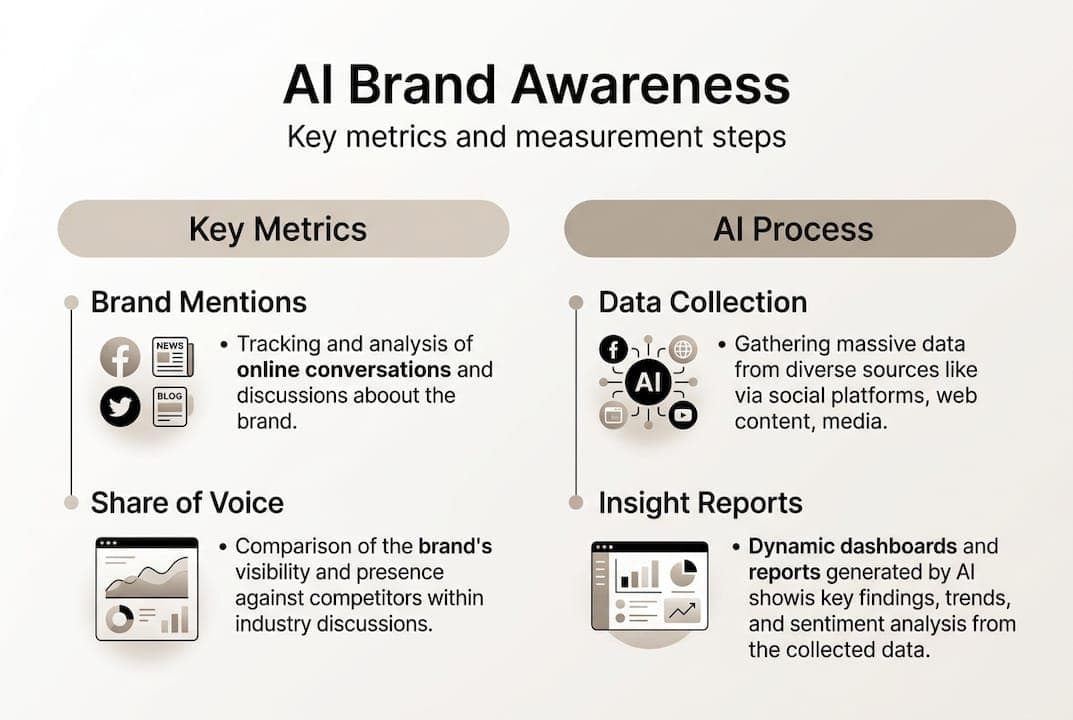
- Share of voice compared to competitors in your industry
- Referral traffic from brand name searches and links
These metrics collectively reveal how many people know your brand, how they discovered it, and what associations they form when they encounter your company name.
Preparing to measure brand awareness: tools and data requirements
Effective brand awareness measurement starts with gathering data from multiple sources that capture different aspects of audience recognition and perception. Social media analytics platforms track mentions, hashtags, impressions, and engagement rates across networks where your audience spends time. Website analytics reveal direct traffic, branded search queries, and user behavior patterns that indicate brand familiarity. Customer surveys provide qualitative insights into recall, recognition, and brand associations that quantitative data alone cannot capture. Feedback from sales teams, customer service interactions, and online reviews adds context about how customers perceive and discuss your brand in real situations.

AI analytics tools revolutionize this data collection and analysis process by automating tasks that previously required manual effort and subjective interpretation. Natural language processing algorithms scan social media conversations, news articles, and forum discussions to identify brand mentions and sentiment patterns at scale. Machine learning models detect correlations between marketing activities and awareness shifts that human analysts might miss. Predictive analytics forecast how current awareness trends will impact future business outcomes, enabling proactive strategy adjustments. These capabilities help digital marketing audiences understand brand perception with unprecedented depth and speed.
Selecting the right measurement tools requires evaluating several criteria. Integration capabilities determine whether tools connect seamlessly with your existing marketing platforms and data sources. Accuracy and validation features ensure the insights you receive reflect genuine audience sentiment rather than bot activity or data artifacts. Reporting flexibility lets you customize dashboards and visualizations that match your specific business questions and stakeholder needs. Cost-effectiveness balances tool capabilities against your budget constraints and expected ROI from improved awareness measurement.
| Tool Type | Primary Use Case | Key Benefit |
|---|---|---|
| Social listening platforms | Track brand mentions and sentiment across social networks | Real-time awareness monitoring |
| Survey tools | Measure aided and unaided brand recall | Direct audience perception data |
| Web analytics | Analyze branded search traffic and site engagement | Quantify online brand interest |
| AI sentiment analyzers | Automate large-scale text analysis of brand discussions | Scale qualitative insights |
| Competitive intelligence | Compare your brand awareness against competitors | Benchmark market position |
Pro Tip: Leverage AI to combine multiple data streams into unified dashboards that reveal how awareness metrics correlate across channels, giving you holistic insights that single-source analysis cannot provide.
Step-by-step process for measuring brand awareness with AI analytics
Implementing a structured measurement process ensures you capture accurate data and derive actionable insights from your brand awareness efforts. Follow these steps to build a comprehensive measurement system:
-
Define your brand awareness objectives by identifying specific business goals such as increasing market share, entering new segments, or supporting product launches that depend on improved recognition.
-
Select relevant KPIs that directly connect to your objectives, such as branded search volume growth, social media reach expansion, or survey recall score improvements that signal progress toward your goals.
-
Deploy AI-powered monitoring tools that automatically track your chosen KPIs across all relevant channels, ensuring continuous data collection without manual intervention or gaps.
-
Establish baseline measurements by analyzing historical data to understand your current awareness levels and create benchmarks for evaluating future performance changes.
-
Collect data systematically over defined time periods, typically monthly or quarterly, to capture enough information for meaningful pattern analysis while maintaining measurement consistency.
-
Apply AI analytics to identify trends, correlations, and anomalies in your awareness data that reveal which marketing activities drive recognition and which underperform expectations.
-
Generate reports that translate raw data into clear insights stakeholders can understand and act upon, highlighting progress toward objectives and recommending strategy adjustments.
-
Review and refine your measurement approach regularly by validating that your KPIs still align with evolving business priorities and that your tools capture emerging awareness channels.
| Measurement Approach | Strengths | Limitations |
|---|---|---|
| Traditional surveys | Direct audience feedback, measures recall accurately | Slow, expensive, limited sample sizes |
| Manual social monitoring | Qualitative context, identifies specific conversations | Time-consuming, subjective, misses scale |
| AI-driven analytics | Fast, scalable, identifies hidden patterns | Requires quality data, initial setup complexity |
| Web analytics alone | Quantifies online interest, tracks behavior | Misses offline awareness, limited sentiment data |
Pro Tip: Regularly update your digital marketing KPIs to align with changing business goals, ensuring your awareness measurement system evolves alongside your marketing strategy and market conditions.
Combining qualitative and quantitative data creates the most comprehensive brand awareness picture. Quantitative metrics like search volume and impression counts reveal the scale of awareness, while qualitative insights from creating effective surveys explain what associations and emotions people connect with your brand. This combination helps you understand not just how many people know your brand, but what they think and feel when they encounter it, informing both reach and messaging strategies.
Interpreting results and optimizing brand awareness strategies
Analyzing brand awareness data effectively requires recognizing patterns that signal success or reveal opportunities for improvement. Steady growth in branded search volume indicates increasing organic interest as more people actively seek information about your company. Rising social media mention rates combined with positive sentiment scores suggest your brand resonates with audiences and generates word-of-mouth momentum. Improving aided recall percentages in surveys demonstrate that your marketing messages successfully embed your brand in audience memory. Conversely, stagnant or declining metrics signal that current strategies fail to build recognition and require strategic pivots.
Adjusting campaigns based on awareness insights follows a systematic optimization process. First, identify which channels and content types correlate most strongly with awareness increases, then reallocate budget toward these high-performing tactics. Second, analyze sentiment patterns to understand which brand messages and positioning angles generate positive associations versus confusion or negative reactions. Third, examine competitor awareness trends using analytics in marketing to identify gaps where your brand can differentiate and capture attention in underserved audience segments. Fourth, test variations of creative elements, messaging frameworks, and channel mixes while measuring their impact on awareness KPIs to continuously refine your approach.
Avoiding common interpretation pitfalls ensures your awareness insights lead to sound strategic decisions:
- Relying exclusively on single data sources creates blind spots that miss important awareness dimensions and skew your understanding of true brand recognition
- Misinterpreting correlation as causation leads to incorrect conclusions about which marketing activities actually drive awareness versus those that coincidentally occur during growth periods
- Neglecting to account for external factors like seasonal trends, competitor campaigns, or industry news that influence awareness metrics independently of your marketing efforts
- Failing to segment data by audience demographics, geographic regions, or customer journey stages obscures important variations in how different groups perceive your brand
- Ignoring negative sentiment signals while celebrating reach increases risks building awareness of brand problems rather than brand value
Continuous measurement and AI-powered insights transform brand awareness from a vague marketing concept into a precise growth driver. Businesses that monitor awareness metrics consistently and adjust strategies based on data achieve sustained visibility improvements and stronger market positions than competitors who measure sporadically or rely on intuition.
Implementing effective brand strategy AI growth requires treating awareness measurement as an ongoing process rather than a one-time project. Markets evolve, competitors launch campaigns, and audience preferences shift constantly. Maintaining continuous monitoring lets you detect changes early and respond proactively before awareness declines impact your business results. AI tools make this continuous measurement practical by automating data collection and analysis that would otherwise consume excessive time and resources.
Enhance your brand awareness measurement with BabyLoveGrowth
Measuring brand awareness effectively requires integrating multiple data sources, analyzing complex patterns, and translating insights into actionable strategies. BabyLoveGrowth's AI-powered platform automates these processes, helping SMBs and digital marketers track brand visibility with precision while focusing on growth rather than manual data work.
Our SEO automation platform streamlines content creation and optimization that builds brand awareness through search visibility. The SEO link building platform expands your brand's reach across relevant websites, increasing mentions and referral traffic that signal growing awareness. Our organic traffic tool provides comprehensive analytics showing how brand searches and content engagement contribute to your overall visibility. These integrated solutions eliminate the complexity of managing multiple tools while delivering the comprehensive data you need to measure and optimize brand awareness effectively. By automating routine measurement tasks, you free resources to focus on creative strategies that actually build recognition and drive business growth.
FAQ
How can I use AI to measure brand awareness?
AI analyzes massive data sets from social media platforms, search engines, and customer surveys to identify brand mentions, sentiment patterns, and audience reach automatically. Machine learning algorithms detect trends and correlations that manual analysis misses, providing deeper insights into how awareness evolves over time. This automation enables more accurate, timely tracking than traditional manual methods while reducing the cost and effort required to maintain continuous monitoring.
What are the best KPIs for measuring brand awareness?
Effective awareness measurement combines several complementary metrics. Brand recall rates from surveys measure how many people remember your brand without prompts. Social media impressions and engagement rates quantify your reach and resonance across platforms. Website traffic from branded search queries reveals how many people actively seek information about your company. Share of voice compared to competitors indicates your relative market visibility. Tracking these top digital marketing KPIs together provides a complete picture of brand awareness across different audience touchpoints.
How often should I measure my brand awareness?
Brand awareness requires continuous monitoring using automated AI tools that track metrics daily or weekly, capturing real-time changes in audience perception and market dynamics. Conduct in-depth quarterly reviews that analyze trends, compare results against objectives, and inform strategic adjustments to your marketing approach. This combination of ongoing tracking and periodic deep analysis ensures you respond quickly to awareness shifts while maintaining strategic perspective on long-term brand building progress.
What common mistakes should I avoid in measuring brand awareness?
Avoid relying on single data sources like social media alone, which creates incomplete awareness pictures that miss important recognition channels. Do not misinterpret incomplete data by drawing conclusions before collecting sufficient information across multiple touchpoints and time periods. Never neglect ongoing measurement and adjustment, as one-time awareness studies quickly become outdated in dynamic markets. Failing to segment data by audience groups obscures important variations in how different demographics perceive your brand. Comprehensive, regular analysis using multiple data sources and AI-powered tools helps you avoid these common pitfalls and build accurate awareness insights.