How to identify your target audience for better results


TL;DR:
- Most small businesses fail to target the right audience, leading to wasted marketing funds.
- Knowing your audience improves ad effectiveness, customer loyalty, and product development.
- Using tools like analytics, CRM, and surveys helps refine and validate target audience profiles through continuous testing.
Most small businesses don't lose money because their product is bad. They lose it because they're selling to the wrong people. 98% of SMBs feel confident reaching their target audience through ads, yet most still struggle with precision. The result is wasted budget, low conversions, and a frustrating cycle of "why isn't this working?" This guide walks you through how to analyze, research, and test your audience using real tools and proven steps, so every marketing dollar you spend is aimed at someone who actually wants what you offer.
Table of Contents
- Why identifying your target audience matters
- Essential tools and prerequisites to identify your audience
- Step-by-step process to identify and segment your target audience
- Common mistakes and special cases: niche vs broad targeting
- A smarter way to identify and refine your audience
- Tools to streamline audience identification and marketing
- Frequently asked questions
Key Takeaways
| Point | Details |
|---|---|
| Audience clarity drives ROI | Precise targeting significantly improves ad spend efficiency and customer conversion rates. |
| Qualitative research beats surveys | Direct interviews with your best clients yield more actionable insights than broad surveys. |
| Start niche, scale broad | Begin with focused audience segments and expand as your business grows for optimal results. |
| Iterative refinement is essential | Continuously testing, measuring, and refining your audience leads to sustained marketing success. |
Why identifying your target audience matters
When you know exactly who you're talking to, everything changes. Your ad copy gets sharper. Your email subject lines get higher open rates. Your product pages convert better. Audience clarity is not a nice-to-have; it's the foundation of every profitable marketing decision you'll make.
Think about analytics and ROI. Businesses that use data to define their audience consistently outperform those guessing based on gut feel. Why? Because when you understand who your buyer is, you stop paying to reach people who will never buy.
Here's what sharp audience targeting actually delivers:
- Higher return on ad spend (ROAS): Ads shown to the right people cost less per click and convert more often.
- Stronger customer loyalty: People feel understood when your messaging speaks directly to their situation.
- Fewer wasted impressions: You stop funding campaigns that reach the wrong zip codes, age groups, or interests.
- Better product development: Knowing your audience reveals what features or services they actually want.
Stat callout: 77% of consumers are more likely to buy when marketing is relevant to them. That's not a marginal improvement; that's a business-changing number.
For SMBs running Google Ads, the median click-through rate sits around 3.2%. That number jumps significantly when ads are tightly matched to audience intent. Here's a quick look at how targeting precision affects key metrics:
| Metric | Broad targeting | Precise targeting |
|---|---|---|
| Click-through rate | 1.5% to 2.5% | 3.5% to 6%+ |
| Cost per acquisition | High | 30% to 50% lower |
| Customer lifetime value | Average | Significantly higher |
| Ad relevance score | Low to medium | High |
Pro Tip: Don't wait until you have perfect data to start targeting. Even a rough audience profile beats no profile. You can refine as you go, and you'll learn faster by testing real campaigns than by theorizing.
The bottom line is simple: audience clarity saves money and makes money at the same time. It's one of the highest-leverage activities a small business can invest in.
Essential tools and prerequisites to identify your audience
Before you can find your audience, you need the right instruments. The good news is that most of the best tools are either free or already inside platforms you're using.
CRM, Google Analytics, and surveys are the most widely used tools for understanding customer behaviors and demographics. Each serves a different purpose, and together they give you a full picture.
Here's a comparison of the core tools SMBs should use:
| Tool | Best for | Cost |
|---|---|---|
| Google Analytics | Traffic behavior, demographics | Free |
| CRM (HubSpot, Salesforce) | Purchase history, segmentation | Free to paid |
| Customer surveys | Direct feedback, motivations | Free to low cost |
| Social media insights | Engagement patterns, interests | Free |
| Competitor review analysis | Gap identification | Free |
For Google Analytics audience insights, start with the Audience and Acquisition reports. These show you who's visiting your site, where they come from, and what they do once they arrive. That data alone can reshape your assumptions about who your real customer is.
Surveys work best when they're focused. Don't blast your entire list with a 20-question form. Instead, use survey tips to craft 5 to 8 targeted questions and send them to your 10 to 15 best clients. Ask about their biggest challenges, what made them choose you, and what they wish you offered.
Here's what to gather before you start any audience research:
- A list of your top 10 to 15 customers by revenue or loyalty
- Access to your CRM and website analytics
- A short survey or interview script ready to go
- Notes on 3 to 5 direct competitors
Pro Tip: When you interview best clients, record the calls (with permission). The exact words your customers use to describe their problems are pure gold for ad copy and landing page headlines.
Competitor review analysis is an underrated step. Read the 1-star and 5-star reviews on your competitors' Google profiles and product pages. The 5-star reviews tell you what customers love. The 1-star reviews tell you what gaps you can fill.
Step-by-step process to identify and segment your target audience
With your tools ready, follow this proven sequence to build an audience profile that actually holds up in the real world.
- Analyze your current customers. Pull your top 20% of customers by revenue. Look for patterns in age, location, job title, purchase behavior, and how they found you. This group is your starting point.
- Research your competitors. Use competitor research to identify who they're targeting and where they're falling short. Look at their messaging, ad creative, and customer reviews.
- Collect qualitative data. Run interviews or send surveys to your best clients. Ask open-ended questions. Listen for recurring themes in language, frustrations, and goals.
- Define key demographics. Age, gender, income range, location, education level, and job role form the skeleton of your audience profile.
- Layer in psychographics. Psychographics explained cover values, lifestyle, beliefs, and buying motivations. These are the deeper drivers that demographics miss entirely.
- Build 2 to 3 personas. A persona is a fictional but realistic profile of your ideal customer. Give each one a name, background, goals, and pain points.
- Test and refine. Run small campaigns targeting each persona. Measure which one converts best, then invest more there.
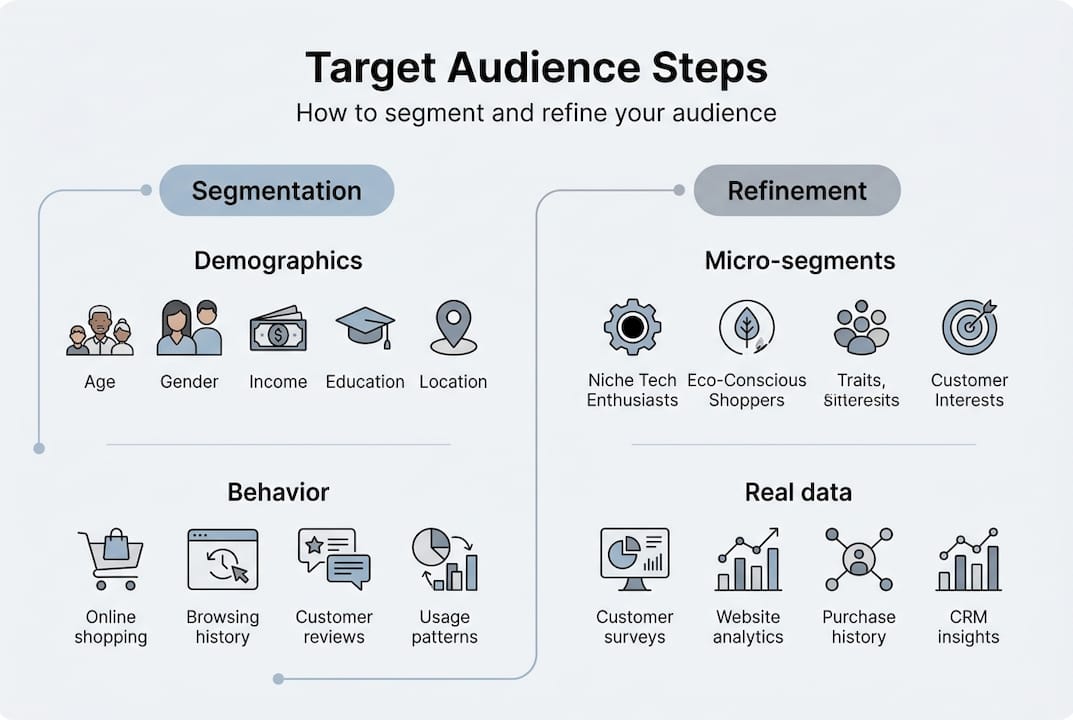
Here's a quick reference for the main segmentation types:
| Segmentation type | What it covers | Example |
|---|---|---|
| Demographic | Age, gender, income, location | Women aged 30 to 45, earning $60K+ |
| Psychographic | Values, lifestyle, motivations | Eco-conscious, health-focused buyers |
| Behavioral | Purchase habits, brand loyalty | Repeat buyers, cart abandoners |
| Geographic | Region, city, climate | Urban professionals in the Northeast |
For deeper work on audience segmentation, consider breaking your audience into micro-segments once you have enough data. This lets you reach digital audiences with hyper-relevant content at each stage of the funnel.
Pro Tip: Don't try to serve every persona equally from day one. Pick your strongest persona and build one campaign around them. Once that converts well, expand to the next.
Common mistakes and special cases: niche vs broad targeting
Even with the right tools and a solid process, there are pitfalls that trip up a lot of SMBs. Knowing them in advance saves you months of frustration.
Common mistakes to avoid:
- Relying only on demographics. Age and gender tell you who someone is, not why they buy. Behavioral and psychographic data fill that gap.
- Skipping behavioral segmentation. Someone who visited your pricing page three times is a very different prospect than someone who read one blog post.
- Building too many personas at once. More than three personas early on dilutes your focus and makes it hard to measure what's actually working.
- Assuming your audience never changes. Markets shift. Run a fresh audience review at least once a year.
- Ignoring negative audiences. Knowing who you're not targeting is just as valuable as knowing who you are.
"Hyper-targeting lowers customer acquisition costs for startups, while broad approaches support scale for established brands."
For startups or businesses with tight budgets, niche targeting is almost always the smarter move. The concept of a "beachhead market" comes from military strategy: capture one small territory first, then expand. In marketing, this means owning a narrow segment before going broad. The benefits of niching down include lower ad costs, stronger word-of-mouth, and faster brand recognition within a specific community.
For established businesses with more budget, a hybrid approach works best. Use broad targeting at the top of your funnel to build awareness, then narrow down to niche audiences for conversion campaigns. This way, you're building reach without wasting conversion budget on cold, unqualified traffic.
Pro Tip: Think about engaging your audience differently at each funnel stage. Top-funnel content can speak to a broad pain point. Bottom-funnel content should speak directly to a specific persona's exact situation.
A smarter way to identify and refine your audience
Here's something most marketing guides won't tell you: the obsession with finding the "perfect" audience before launching is one of the biggest reasons SMBs stall. They spend weeks building elaborate personas, then launch and find reality looks nothing like the spreadsheet.
The smarter path is to start with a good-enough audience profile, launch something small, and let real data reshape your assumptions. Qualitative interviews and analytics build far more robust personas than any amount of desk research alone, because they capture what customers actually say and do, not what you assume they'll say and do.
We've seen SMBs achieve a 175% revenue surge after refining their personas based on real campaign feedback rather than initial assumptions. That kind of growth doesn't come from perfect planning. It comes from fast iteration.
The real edge is in blending broad and niche targeting depending on where someone is in your funnel, and in using analytics to improve marketing decisions continuously. Audience identification is not a one-time project. It's an ongoing practice that gets sharper every time you test, measure, and adjust.
Tools to streamline audience identification and marketing
Putting all of this into practice takes time, but the right tools can cut that time dramatically. That's exactly where Babylovegrowth.ai comes in.
Our organic traffic tool helps you understand which content is pulling in your best-fit visitors, so you can double down on what's working. And with our SEO automation platform, you get AI-driven content and audience insights built into a single workflow. No juggling five different tools. No guessing. Just a clear, automated path from audience research to traffic growth, all optimized for both Google and ChatGPT visibility in 2026.
Frequently asked questions
What is a target audience and why does it matter?
A target audience is the specific group most likely to buy your product or service. Reaching them with relevant messaging makes 77% of consumers more likely to purchase, which directly lifts your ROI.
How do I start identifying my target audience?
Begin by analyzing your current customers, then conduct interviews with your top clients. Customer interviews outperform broad surveys for SMBs because they surface real motivations and language.
Should I focus on a niche or broad audience?
Start niche if you have a limited budget or are a startup, then expand as you grow. Hybrid targeting is more profitable than committing fully to one approach at every funnel stage.
What are the best tools for identifying target audiences?
CRM, Analytics, and Surveys make audience profiling easier and more accurate. Combine all three for the most complete picture of who your buyers actually are.
How do I validate and refine my audience definitions?
Test your marketing with 2 to 3 personas, measure conversion results, and iterate. Iterative refinement with personas consistently leads to better targeting and higher profitability over time.
Recommended
Smart SEO,
Faster Growth!
Most Read Articles
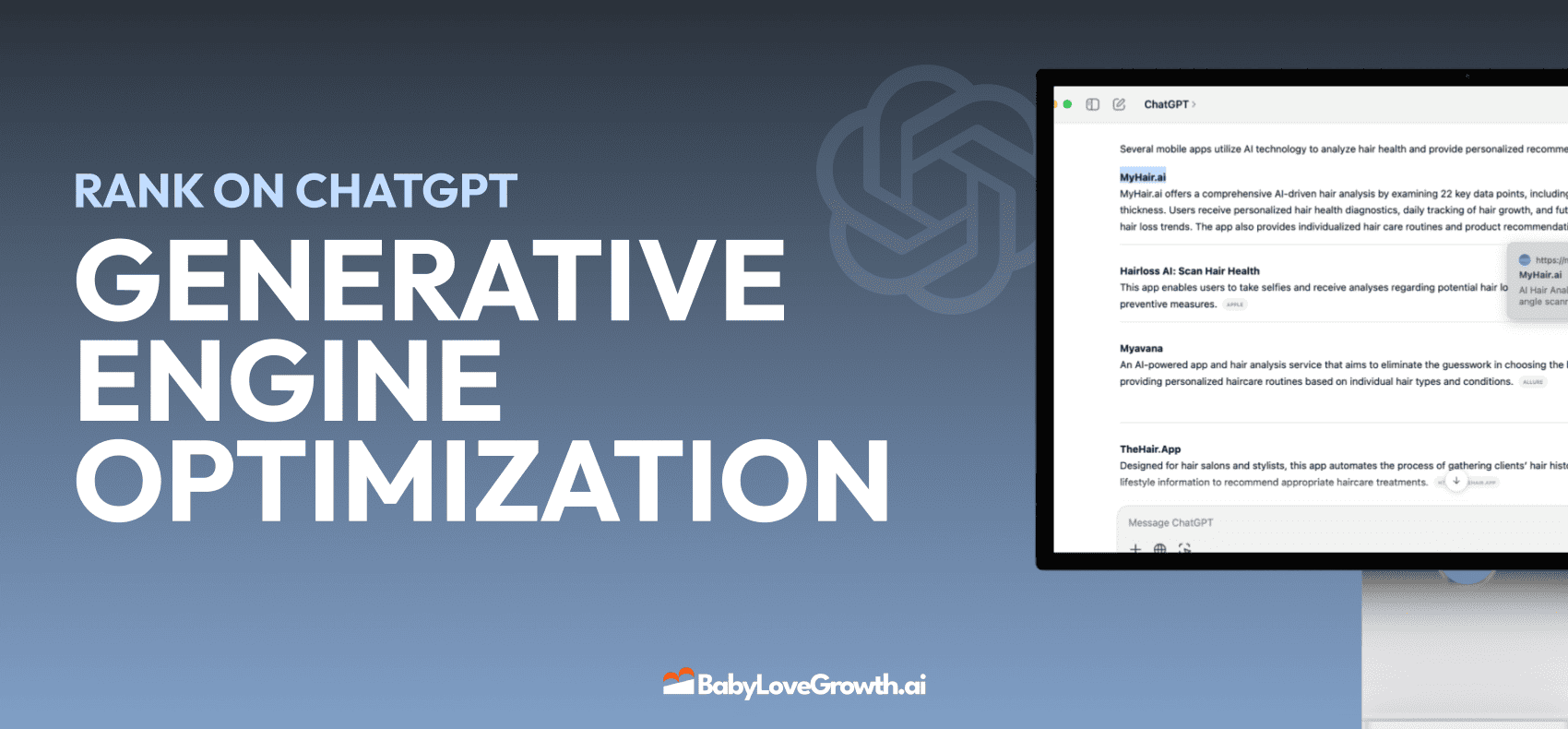
Generative Engine Optimization (GEO)
Learn how Generative Engine Optimization (GEO) helps your content rank in AI search engines like ChatGPT and Google AI. This comprehensive guide explains the differences between SEO and GEO, why it matters for your business, and practical steps to implement GEO strategies for better visibility in AI-generated responses.
DylenJan 18, 2025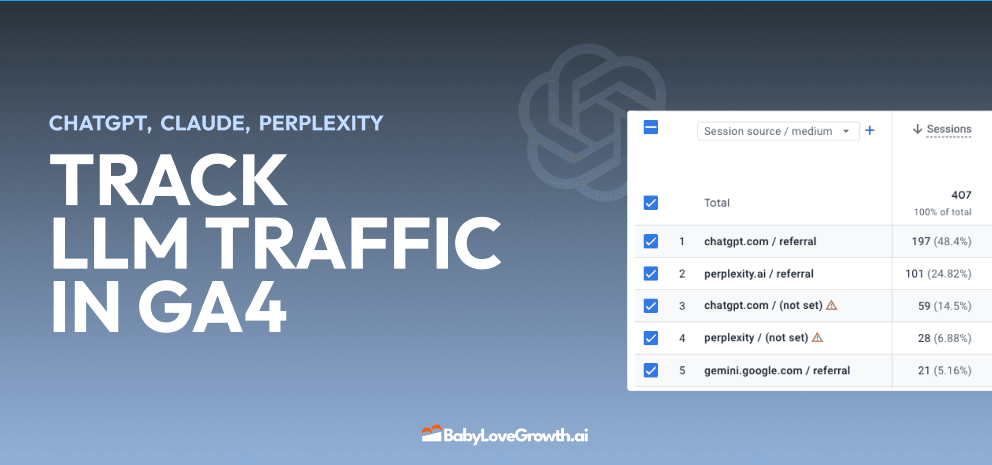
Track LLM Traffic in Google Analytics 4 (GA4)
Learn how to track and analyze traffic from AI sources like ChatGPT, Claude, Perplexity, and Google Gemini in Google Analytics 4. This step-by-step guide shows you how to set up custom filters to monitor AI-driven traffic and make data-driven decisions for your content strategy.
DylenMar 18, 2025
How to Humanize AI Text with Instructions
Learn practical techniques to make AI-generated content sound more natural and human. This guide covers active voice, direct addressing, concise writing, and other proven strategies to transform robotic text into engaging content.
DylenApril 7, 2025
Open AI Revenue and Statistics (2024)
Comprehensive analysis of OpenAI financial performance, user engagement, and market position in 2023. Discover key statistics including $20B valuation, $1B projected revenue, and 100M+ monthly active users.
DylenOctober 03, 2025