How to develop a marketing strategy for organic growth


Table of Contents
- Assess your business and set actionable goals
- Identify your ideal audience and unique value
- Choose and prioritize the right marketing channels
- Create, launch, and automate your campaigns
- Test, measure, and optimize for continuous improvement
- Why structured, automated strategy is the SMB growth multiplier
- Automate your strategy for growth with Babylovegrowth.ai
- Frequently asked questions
Key Takeaways
| Point | Details |
|---|---|
| Start with clear goals | Assess your business position and set goals that you can measure for better results. |
| Prioritize organic channels | SEO, email, and social platforms offer sustainable, high-ROI growth for SMBs. |
| Automate to scale | CRMs and AI tools save time and boost marketing ROI for small teams. |
| Test and optimize | Regular A/B testing and KPI review help focus resources on what truly works. |
| Frameworks boost consistency | Using structured, repeatable processes keeps strategies effective and adaptable. |
Assess your business and set actionable goals
Before you write a single piece of content or run a single campaign, you need an honest picture of where your business stands. This means listing your strengths, your weaknesses, and your assets, including your existing audience, your content library, your team's skills, and your budget. Most SMBs skip this step and jump straight to tactics. That's why most SMBs stall.
A simple way to do this is a quick internal audit:
- Strengths: What do customers consistently praise? What do you do better than competitors?
- Weaknesses: Where do leads drop off? What channels have you tried that didn't work?
- Assets: Do you have an email list, a blog, a social following, or existing partnerships?
- Market position: Are you a premium option, a budget solution, or a niche specialist?
Once you have that clarity, you can set goals that actually mean something. Vague goals like "grow our brand" don't move the needle. SMART goals do. SMART stands for Specific, Measurable, Achievable, Relevant, and Time-bound.
"Increase organic website traffic by 30% within six months by publishing two SEO-optimized blog posts per week."
That's a SMART goal. It tells you exactly what to do, how to measure it, and when to evaluate it.
Next, choose KPIs that match your goals. If your goal is organic traffic, track sessions, keyword rankings, and bounce rate. If your goal is lead generation, track form submissions, email signups, and conversion rate.
Pro Tip: Set clear goals and KPIs before touching any channel. Businesses that do this are far more likely to see measurable results within 90 days.
For budgeting, most SMBs should allocate 8-10% of total revenue to marketing, with the majority going to digital. Use this table as a starting point:
| Business stage | Recommended marketing budget | Digital allocation |
|---|---|---|
| Early stage | 10-12% of revenue | 80%+ |
| Growth stage | 8-10% of revenue | 72% |
| Established | 6-8% of revenue | 65-70% |
Identify your ideal audience and unique value
Once your goals are set, everything else depends on knowing exactly who you're talking to. A message that tries to reach everyone reaches no one. This is where buyer personas come in.
A buyer persona is a semi-fictional profile of your ideal customer. It includes demographics, but more importantly, it captures pain points, motivations, and buying behavior. Here's how to build one:
- Interview real customers. Ask them why they chose you, what problem you solved, and what almost stopped them from buying.
- Analyze your data. Look at your best customers by lifetime value and find patterns in their industry, company size, or behavior.
- Map the journey. Understand how they find you, what they read before buying, and what objections they have.
- Segment your list. Group contacts by behavior or stage so your messaging feels personal, not generic.
Once you know your audience, you need to distill your unique selling proposition (USP). Your USP answers one question: why should someone choose you over every other option? It should be specific, not a vague claim like "great customer service."
A strong USP sounds like: "We help e-commerce brands double their organic traffic in 90 days without paid ads."
- Focus on the outcome, not the feature
- Make it verifiable or at least believable
- Use the language your customers actually use
Pro Tip: Define your buyer personas before writing any copy. Messaging built around a real persona converts at a significantly higher rate than generic messaging.
Personalization starts here. When you know your audience's specific pain points, you can segment your email list, tailor your content topics, and speak directly to what matters most to each group.

Choose and prioritize the right marketing channels
With your audience and goals defined, the next decision is which channels to invest in. Not all channels are equal, and spreading yourself too thin is one of the most common SMB mistakes.
For organic growth, three channels consistently outperform the rest:
| Channel | Average ROI | Time to results | Best for |
|---|---|---|---|
| Email marketing | $36-42 per $1 spent | Immediate | Retention, nurture |
| SEO and content | High, long-term | 3-6 months | Authority, traffic |
| Social media | Moderate | 1-3 months | Engagement, reach |
Email marketing is the most cost-effective channel available to SMBs. Period. It's direct, personal, and measurable. SEO and content marketing build compound authority over time. Every article you publish is an asset that keeps working. Social media is best for engagement and community, not direct conversion.
To maximize organic reach, focus on SEO and email first, then layer in social. Don't try to be everywhere at once. Pick two channels, do them well, and expand once you have traction.
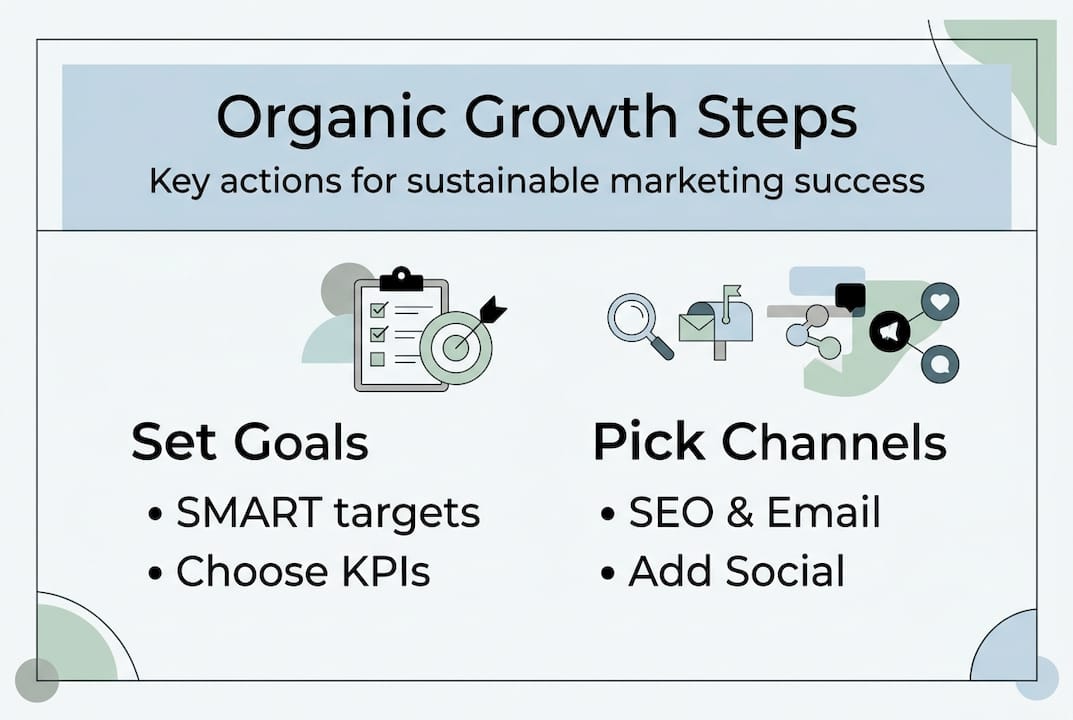
For email and SEO strategies that compound over time, the key is integration. Your blog drives organic traffic, your content captures email signups, and your email nurtures leads back to your site. That loop is how organic SEO for growth actually works at scale.
Pro Tip: Before adding a new channel, ask: "Can I automate at least 40% of the work on this channel?" If not, you'll burn out before you see results. Check SaaS marketing channel strategy examples for automation-first thinking.
- Start with email and SEO
- Use social for amplification, not as your primary channel
- Automate scheduling, sequences, and reporting from day one
Create, launch, and automate your campaigns
Having selected your channels, you can now unify them into campaigns and streamline execution with automation. A campaign isn't just a single email or a blog post. It's a coordinated sequence of messages across channels, all pointing toward one goal.
Here's a simple campaign development process:
- Define the goal. What action do you want the audience to take? Sign up, buy, book a call?
- Build your messaging framework. What's the core promise? What objections will you address?
- Create a content calendar. Map out every piece of content, email, and social post for the campaign.
- Set up automation. Use a CRM or email tool to trigger sequences based on user behavior.
- Test before you launch. Check every link, every subject line, and every CTA before going live.
Automation is where most SMBs leave serious growth on the table. Automate with CRM and AI for personalization and efficiency, and using checklist-based processes can boost ROI by 1.7x. That's not a small gain.
"The businesses that grow fastest aren't the ones working hardest. They're the ones who've automated the repetitive work so they can focus on strategy."
For personalized marketing strategies that scale, automation is non-negotiable. Use AI for brand loyalty by setting up behavioral triggers that send the right message at the right time. An AI content marketing platform can handle content creation, scheduling, and optimization simultaneously.
Pro Tip: Review growth marketing frameworks to find automation sequences that match your sales cycle. Even a simple three-email welcome sequence can increase conversions by 30% or more.
- Automate welcome sequences, abandoned cart emails, and re-engagement campaigns
- Use AI tools to personalize subject lines and content blocks
- Review campaign performance weekly, not monthly
Test, measure, and optimize for continuous improvement
Execution is only as good as your follow-through. The difference between businesses that plateau and businesses that keep growing is a consistent habit of testing and optimizing.
Start with A/B testing. This means running two versions of something, changing only one variable, and measuring which performs better. You can test:
- Email subject lines: Does a question or a statement get more opens?
- Landing page headlines: Does benefit-focused copy outperform feature-focused copy?
- CTAs: Does "Start free trial" outperform "Get started today"?
- Content formats: Do how-to posts drive more traffic than listicles in your niche?
For KPI tracking, build a simple dashboard that shows your most important numbers at a glance. Don't track 20 metrics. Track five that directly connect to your goals.
Organic growth takes time. Reaching page one on Google typically takes 120 to 270 days. That's not a bug. It's a feature. Organic rankings are stable and compound. Paid ads stop the moment you stop paying.
54% of SMBs now use AI for data analysis and content creation. If you're not using AI to surface patterns in your analytics, you're working harder than you need to. Use organic SEO optimization tools to identify which keywords are gaining traction and double down on what's working.
Pro Tip: Check your SMB marketing benchmarks quarterly. Knowing the industry average for open rates, conversion rates, and cost per lead tells you whether your results are strong or if there's room to improve.
- Review A/B test results after at least 500 impressions or 100 opens
- Kill underperforming content quickly; double down on what works
- Use AI to predict which segments are most likely to convert next
Why structured, automated strategy is the SMB growth multiplier
Here's something most marketing guides won't tell you: the strategy itself matters less than the system around it. We've seen businesses with mediocre tactics outperform competitors with brilliant ideas, simply because they had a repeatable process.
Most SMBs "wing it." They try a channel for a few weeks, don't see immediate results, and pivot to something new. That's not a strategy. That's noise. SMBs with a clear plan outperform those without one, yet measuring ROI remains the top challenge for most.
The real problem isn't knowledge. It's process fatigue. When marketing depends on someone remembering to post, write, or follow up, it breaks down the moment that person gets busy. Automation removes the dependency on memory and willpower.
Over-reliance on paid ads is another trap. Paid traffic feels fast, but it creates zero compounding value. Every dollar you invest in organic SEO builds an asset. Every dollar in paid ads disappears the moment you pause the campaign.
Structured, automated frameworks reduce fatigue, enable quick adaptation, and free your team to focus on the work that actually requires human judgment. That's the real multiplier.
Automate your strategy for growth with Babylovegrowth.ai
The steps in this guide work. But executing them manually is slow and exhausting. That's exactly why Babylovegrowth.ai exists.
The platform's SEO automation platform handles content creation, keyword targeting, and publishing on autopilot, so your organic presence grows while you focus on running your business. The organic traffic tool gives you a 30-day personalized content plan built around your specific business goals. And the backlink building software connects you to a backlink exchange ecosystem that builds authority without the manual outreach grind. Start your free trial and let the system do the heavy lifting.
Frequently asked questions
What is the most cost-effective marketing strategy for SMBs?
Email marketing delivers the highest ROI at $36 to $42 for every $1 spent, making it the most cost-effective channel for small and medium businesses by a wide margin.
How long does it take to see organic marketing results?
Organic growth typically takes 120 to 270 days to reach page one on Google, but the results are far more stable and long-lasting than paid advertising.
How much should SMBs budget for their marketing strategy?
Most SMBs allocate 8-10% of revenue to marketing, with roughly 72% of that budget directed toward digital channels for maximum reach and measurability.
How can SMBs automate their marketing without huge budgets?
Affordable CRMs and AI tools handle personalization, content scheduling, and campaign automation at low cost. 54% of SMBs already use AI for analysis and content, proving it's accessible at any budget level.
What's a common mistake to avoid when developing a marketing strategy?
Skipping measurable goals and ignoring data are the biggest pitfalls. SMBs with structured plans consistently outperform those that rely on guesswork, yet measuring ROI remains the top reported challenge.
Recommended
Smart SEO,
Faster Growth!
Most Read Articles
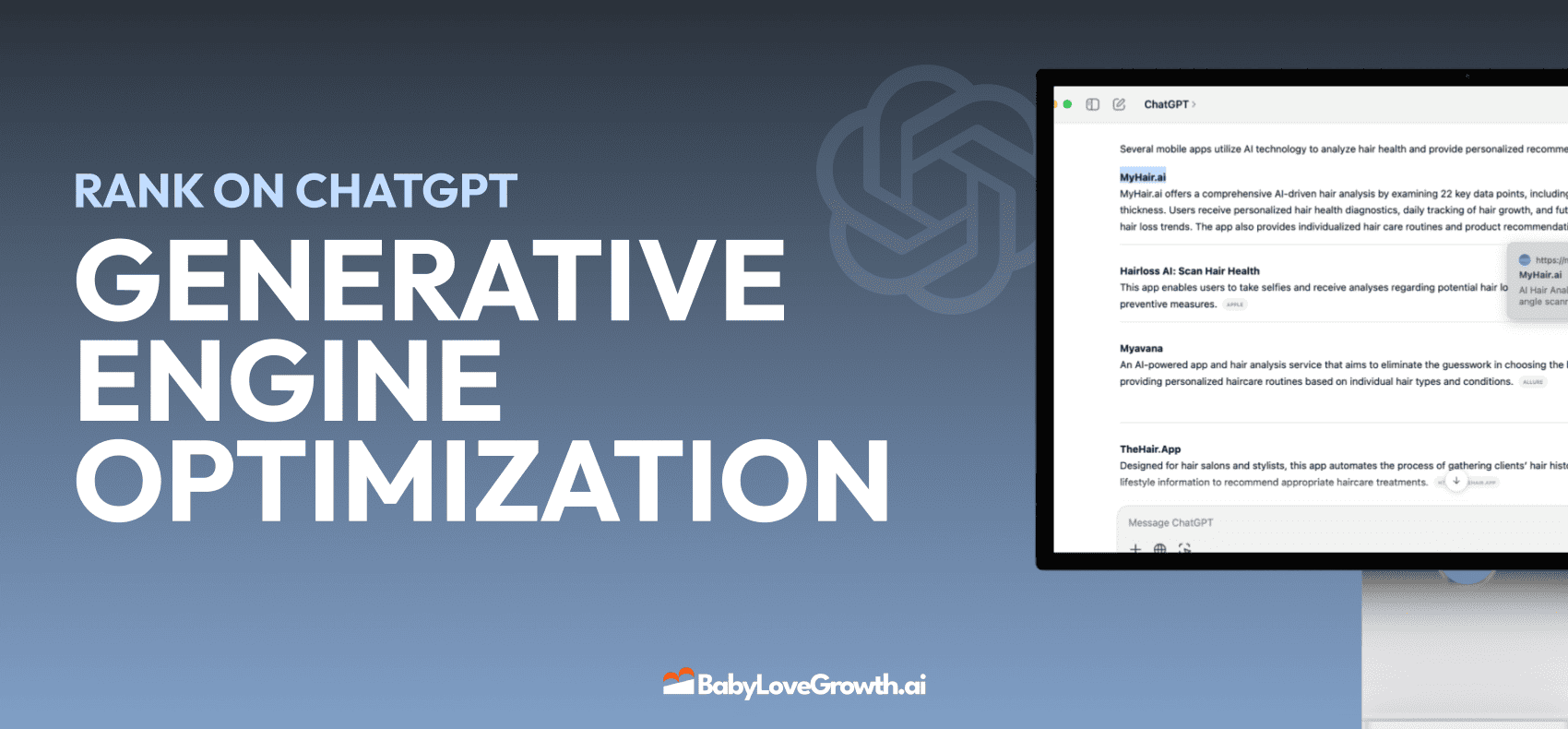
Generative Engine Optimization (GEO)
Learn how Generative Engine Optimization (GEO) helps your content rank in AI search engines like ChatGPT and Google AI. This comprehensive guide explains the differences between SEO and GEO, why it matters for your business, and practical steps to implement GEO strategies for better visibility in AI-generated responses.
DylenJan 18, 2025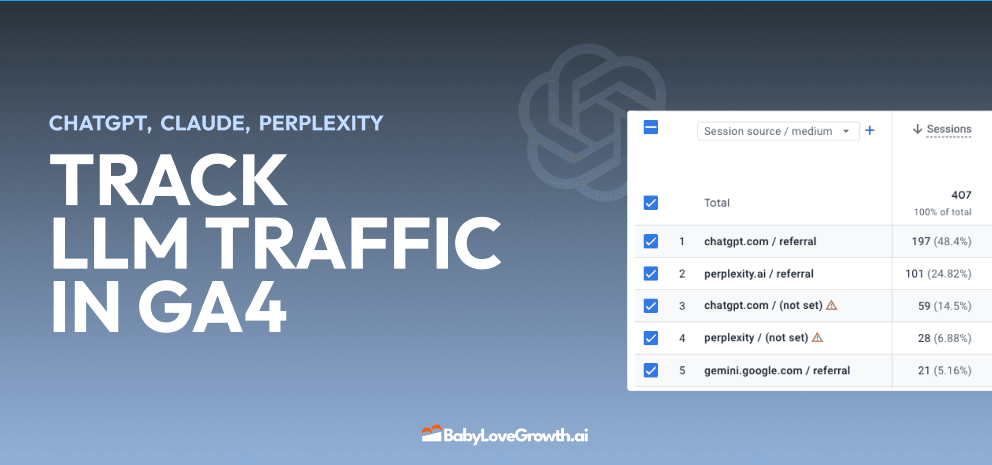
Track LLM Traffic in Google Analytics 4 (GA4)
Learn how to track and analyze traffic from AI sources like ChatGPT, Claude, Perplexity, and Google Gemini in Google Analytics 4. This step-by-step guide shows you how to set up custom filters to monitor AI-driven traffic and make data-driven decisions for your content strategy.
DylenMar 18, 2025
How to Humanize AI Text with Instructions
Learn practical techniques to make AI-generated content sound more natural and human. This guide covers active voice, direct addressing, concise writing, and other proven strategies to transform robotic text into engaging content.
DylenApril 7, 2025
Open AI Revenue and Statistics (2024)
Comprehensive analysis of OpenAI financial performance, user engagement, and market position in 2023. Discover key statistics including $20B valuation, $1B projected revenue, and 100M+ monthly active users.
DylenOctober 03, 2025