How to Create Compelling CTAs for Higher Conversion Rates


Over 90 percent of website visitors ignore standard calls to action and vanish without converting, a figure that startles even experienced American marketers. With every missed interaction, small and medium-sized businesses lose ground to competitors who decode what truly drives user behavior. This guide explains how understanding audience motivation, clarifying action, and leveraging AI insights can help you craft more persuasive calls to action—so you capture attention before it slips away.
Table of Contents
- Step 1: Identify Your Audience's Key Motivators
- Step 2: Define A Clear Desired Action
- Step 3: Craft Engaging And Actionable CTA Text
- Step 4: Design Visually Attention-Grabbing CTA Elements
- Step 5: Test And Optimize CTA Performance
Quick Summary
| Key Takeaway | Explanation |
|---|---|
| 1. Understand Your Audience | Conduct in-depth research to uncover your audience's motivations, emotional triggers, and challenges. |
| 2. Define Clear CTA Actions | Clearly articulate the specific action you want users to take using precise and compelling language. |
| 3. Create Engaging CTA Text | Use strong, action-oriented language that resonates with your audience's desires and aspirations. |
| 4. Design Standout CTA Elements | Ensure your CTA design is visually appealing and distinct to attract user attention effectively. |
| 5. Implement A/B Testing | Regularly test different CTA variations to optimize performance based on data-driven insights. |
Step 1: Identify Your Audience's Key Motivators
Understanding your audience's core motivations is like decoding a complex psychological puzzle. Successful digital marketers recognize that effective calls to action (CTAs) aren't just about flashy design but about deeply connecting with what truly drives people's decision making. Motivational research reveals that audience behaviors stem from multiple complex influences, including emotional triggers, personal values, and social context.
To uncover these critical motivators, you'll want to conduct comprehensive audience research using a multi-dimensional approach. Start by developing detailed audience personas that go beyond basic demographics. Explore their goals, challenges, aspirations, and pain points through surveys, interviews, social media analysis, and customer feedback. Look for patterns in their language, emotional responses, and underlying needs that reveal what genuinely motivates them to take action. This means understanding not just what they want, but why they want it and what psychological barriers might prevent them from converting.
A strategic framework involves segmenting your audience and mapping their specific motivational triggers. Some might be driven by financial savings, others by professional growth, status, or emotional satisfaction. Effective programs identify these factors through primary research and collaborative team brainstorming, allowing you to craft highly targeted CTAs that speak directly to each segment's unique motivational landscape.
Pro tip: Create a motivational matrix that categorizes different audience segments and their primary emotional and rational drivers to develop laser focused CTAs.
Here is a summary of common motivational triggers and how to address them in your CTAs:
| Audience Segment | Key Motivational Trigger | Recommended CTA Approach |
|---|---|---|
| Budget-conscious | Financial savings | Emphasize discounts or free offers |
| Career-driven | Professional advancement | Promote growth and career benefits |
| Status-seekers | Social recognition | Highlight prestige or exclusivity |
| Solution-focused | Overcoming challenges | Stress speed and simplicity |
| Emotionally engaged | Personal connection or values | Create CTAs with emotional language |
Step 2: Define a Clear Desired Action
Effective communication demands absolute clarity about the specific action you want your audience to take. When designing calls to action, ambiguity is your worst enemy. Your CTA needs to be razor sharp, removing any potential confusion about what you want people to do next.
Start by articulating your desired action with surgical precision. Instead of vague language like "learn more" or "check it out," use specific, action oriented verbs that create momentum. For example, replace "Explore our services" with "Get your free marketing assessment" or "Download the conversion blueprint." Each CTA should answer three critical questions: What exactly should the user do? Why should they do it? How easy is it to complete the action? Break down complex actions into simple, digestible steps that reduce cognitive friction and make taking action feel effortless.
Successful campaigns continuously reassess and refine their communication objectives to maintain laser focus on the precise behavioral outcomes. This means regularly analyzing conversion data, gathering user feedback, and iteratively improving your CTA language to ensure it resonates with your audience's motivational triggers. Your goal is to create a CTA that feels less like a command and more like an irresistible invitation.Pro tip: Test multiple CTA variations using A/B testing to discover which specific language and framing generates the highest conversion rates.
Step 3: Craft Engaging and Actionable CTA Text
Effective CTA language requires deep psychological understanding of what motivates your audience to take action. Your text must do more than simply instruct readers what to do it must inspire them to want to do it. Think of your CTA as a bridge between your audience's current state and their desired outcome.The art of crafting compelling CTA text involves strategic word selection that speaks directly to your audience's intrinsic and extrinsic motivations. Use active, powerful verbs that create a sense of immediacy and possibility. Words like "Unlock," "Discover," "Transform," and "Accelerate" signal potential and progress. Motivational theories suggest leveraging language that makes desired actions feel valuable and achievable, which means connecting your CTA to specific benefits and outcomes that matter to your target audience. Instead of generic phrases like "Click Here," craft messages that explain the tangible value such as "Boost Your Conversion Rates in 30 Days" or "Get Your Personalized Growth Strategy."

Remember that emotional resonance matters as much as logical appeal. Your CTA should tap into underlying desires frustrations and aspirations. Speak directly to the problem your audience wants to solve and position your CTA as the key to their solution. Personalize your language match your audience's tone and use social proof or urgency triggers that make taking action feel both exciting and low risk.
Pro tip: Conduct rapid fire A/B testing on your CTA text experimenting with different emotional triggers verb choices and benefit statements to discover what truly motivates your specific audience.
Step 4: Design Visually Attention-Grabbing CTA Elements
Visual design plays a critical role in directing user attention and creating compelling calls to action. Your CTA elements are not just decorative but strategic communication tools that guide user behavior and motivate interaction.
Start by understanding visual hierarchy and contrast. Your CTA should stand out dramatically from surrounding content using strategic color choices that create visual tension. Choose colors that contrast sharply with your page background while remaining consistent with your brand palette. Size matters significantly smaller CTAs get lost while oversized elements feel aggressive. Aim for a Goldilocks zone of visibility that draws the eye without overwhelming the page. Incorporate white space around your CTA to create visual breathing room and ensure it captures immediate attention. Rounded buttons with subtle shadows tend to perform better than flat rectangular designs because they create a sense of depth and encourage clicking.
Psychological principles of design suggest using visual directional cues like arrows subtle animations or strategic placement that naturally draws the user's gaze. Position your CTA where users naturally look first typically the top right or center of the page. Incorporate micro interactions subtle hover effects or gentle pulsing that signal interactivity without feeling intrusive. Remember that every visual element should communicate purpose create excitement and reduce friction in the user's journey toward taking action.
Pro tip: Use heat mapping tools to scientifically analyze where users actually look and click on your page to optimize your CTA placement and design with real user behavior data.
Step 5: Test and Optimize CTA Performance
Continuous testing represents the cornerstone of effective CTA optimization, enabling data driven insights that transform user engagement strategies. Understanding how small variations impact conversion rates requires a systematic and scientific approach to performance analysis.
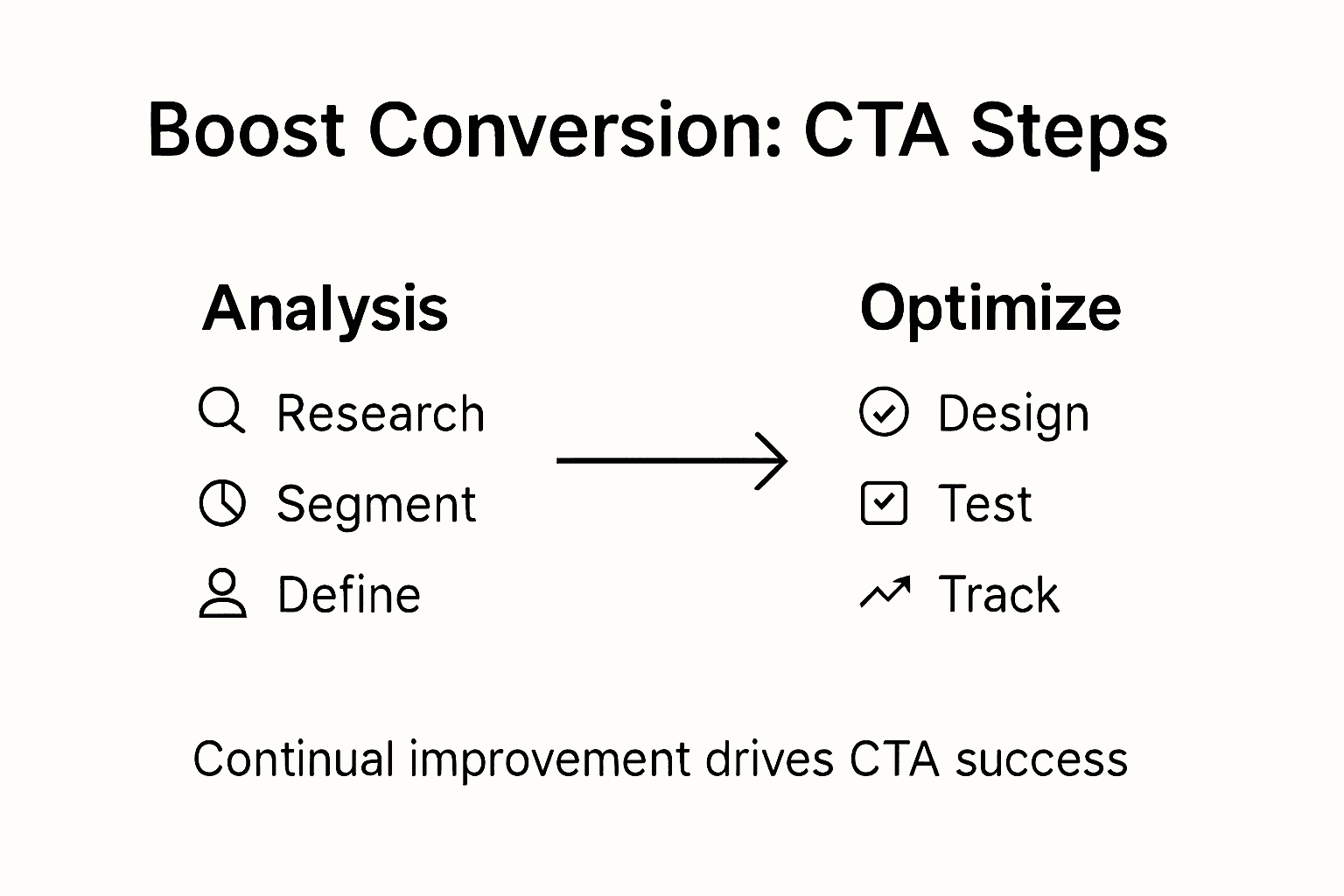
Implement a rigorous A/B testing methodology where you change one variable at a time. This could mean experimenting with button colors, text wording, placement, or size. Track key performance metrics like click through rates, conversion rates, and time spent on page. Statistical significance matters more than gut feelings track each variation for a meaningful sample size typically between 1000 to 5000 user interactions to ensure your results are not just random fluctuations. Focus on quantitative data but also gather qualitative feedback through user surveys and session recordings to understand the deeper psychological triggers behind user behaviors.
Remember that optimization is an ongoing process. What works today might not work tomorrow as user preferences and digital landscapes evolve. Create a testing calendar that schedules regular performance reviews. Develop a hypothesis before each test predict what you believe will improve performance and then validate or challenge that assumption with actual user data. Effective optimization integrates behavioral insights and continuous feedback to refine messaging and design making your CTAs increasingly compelling over time.
Pro tip: Develop a standardized tracking spreadsheet that documents each CTA test variation test duration results and key insights to build a comprehensive optimization knowledge base.
Here is a quick reference to the top CTA testing variables and their potential effects:
| Variable Tested | Impact on Performance | Example Change |
|---|---|---|
| Button Color | Visibility and click likelihood | Blue to orange |
| CTA Text | Clarity and appeal | 'Submit' to 'Get Free Quote' |
| Placement | User noticeability | Sidebar vs. main content |
| Size/Shape | Perceived importance and action | Small rectangle to large round |
Unlock Higher Conversion Rates with AI-Powered SEO Solutions
Creating compelling calls to action is all about understanding your audience's motivations and delivering clear, irresistible messages that drive action. If you found the strategies for crafting focused CTAs and testing their performance insightful, imagine combining these techniques with a powerful AI-driven platform that automates your SEO and content growth. At Babylovegrowth.ai, we simplify organic traffic growth by generating optimized articles and providing personalized 30-day content plans designed to boost your visibility on Google and ChatGPT while supporting your conversion goals.
Take control of your marketing funnel today. Experience how automated, high-quality content aligned with proven CTA strategies can accelerate your business growth without the guesswork. Start your free trial now and see how Babylovegrowth.ai combines SEO expertise with AI to craft the perfect bridge between your audience's needs and your business outcomes.
Frequently Asked Questions
How can I identify my audience's key motivators for effective CTAs?
Understanding your audience's key motivators involves conducting comprehensive research to uncover their emotional triggers, values, and challenges. Create detailed audience personas and utilize surveys or interviews to gather insights, focusing on what drives their decision-making.
What should my desired action be when creating CTAs?
Your desired action should be clearly defined and specific. Instead of using vague phrases, articulate the action with direct verbs, such as "Get your free marketing assessment," to guide users effectively toward conversion.
How can I craft engaging and actionable CTA text?
To create engaging CTA text, use active and encouraging language that resonates emotionally with your audience. For instance, replace generic phrases with benefit-driven statements like "Boost Your Conversion Rates in 30 Days" to inspire action.
What design elements are important for visually compelling CTAs?
Key design elements for effective CTAs include color contrast, size, and visual hierarchy. Ensure your CTA stands out by using contrasting colors and sufficient white space, making it visually appealing and noticeable for users.
How do I test and optimize my CTAs for better performance?
Testing and optimizing CTAs requires A/B testing different variables, such as color, wording, and placement. Regularly analyze performance metrics like click-through rates, and gather user feedback to refine your CTAs continuously, aiming for incremental improvements over time.