How storytelling drives real brand growth in marketing


TL;DR:
- Storytelling significantly enhances marketing persuasion by improving recall and emotional engagement, outperforming mere facts.
- Authentic, credibility-backed stories build trust and long-term brand loyalty, whereas inauthentic narratives risk backlash.
Most marketing teams spend months perfecting their data decks, ROI charts, and product feature lists, then wonder why audiences scroll past their campaigns without a second glance. The uncomfortable truth is that facts alone rarely move people to buy. Narrative processing correlates 0.39 with persuasion compared to just 0.24 for analytical approaches, meaning stories are measurably more persuasive than raw information. This article breaks down the science, the frameworks, and the practical steps that help you turn brand narratives into real conversion and loyalty engines.
Table of Contents
- Why storytelling matters more than facts in marketing
- The science behind storytelling's persuasive power
- Building stories that drive action: Key elements and frameworks
- Tailoring storytelling for channels, audiences, and business goals
- Storytelling isn't a magic bullet: What marketers often miss
- Automate compelling content and storytelling at scale
- Frequently asked questions
Key Takeaways
| Point | Details |
|---|---|
| Stories drive higher persuasion | Blending narrative with facts persuades consumers more than analytics alone. |
| Credibility is crucial | Brand credibility mediates storytelling’s positive impact on purchase intent and loyalty. |
| Tailor stories to channels | Choose written, video, or social storytelling based on your target audience for greatest effect. |
| Audience-first storytelling works | Letting the consumer be the hero using relevant archetypes and meanings yields better results. |
| Avoid inauthentic narratives | Stories that feel forced or fake can harm brand trust and reduce marketing ROI. |
Why storytelling matters more than facts in marketing
Now that we've identified the gap between facts and narrative, let's look at the research that actually quantifies storytelling's advantage, because the numbers are striking.
Most marketers intuitively know that "stories sell," but few understand how significant the gap really is. The narrative vs analytical persuasion gap is not a small rounding error. It's a statistically meaningful difference that compounds across every campaign, every email, and every ad you run. More importantly, the research shows that blending story with facts is even more persuasive than either approach alone, which gives you a concrete formula to work with.
Stories also give information a place to live in memory. A feature list is forgotten within minutes. A well-constructed narrative about a customer solving a painful problem gets recalled days later. That's not a soft benefit. It directly impacts brand recall at the moment of purchase decision.
| Marketing approach | Persuasion correlation | Key strength |
|---|---|---|
| Pure analytical (facts/data) | 0.24 | Credibility, precision |
| Pure narrative (story only) | 0.39 | Emotional engagement, recall |
| Blended (story + facts) | Highest | Persuasion, sharing, ROI |
"Pure stories outperform facts for engagement and memory, but blending narratives with evidence maximizes persuasion and return on investment."
The risk, of course, is that inauthentic storytelling risks backlash and can erode the very trust you're trying to build. Forced narratives, where a brand awkwardly inserts itself into cultural moments or manufactures emotional arcs that don't match reality, can do more damage than a boring fact sheet. Audiences are increasingly skilled at detecting performative storytelling, and they punish it.
Pro Tip: Before publishing any brand story, ask yourself honestly: "Would our best customer recognize this as true about their experience?" If the answer is no, rewrite it.
The good news is that engagement and SEO impact are deeply connected. Stories that resonate organically earn more shares, longer page dwell time, and more natural backlinks, all of which feed your search rankings. Storytelling is not just a creative exercise. It is a business growth mechanism.
The science behind storytelling's persuasive power
We've established why stories matter. Now let's look at how storytelling psychologically influences your audience, because understanding the mechanism helps you apply it more precisely.

There are two distinct psychological pathways through which stories influence consumer behavior, and knowing which one to activate for your goal makes a significant difference. Research into digital storytelling shows that the cognitive narrative pathway is foundational for driving purchase intention, while the emotional pathway is more closely linked to word-of-mouth behavior and long-term loyalty. These are not interchangeable. They serve different stages of the customer journey.
Here's what that looks like in practice:
- Cognitive pathway: The audience processes the story logically, follows the cause and effect structure, relates it to their own situation, and concludes that the product or service is the rational choice. This path drives immediate purchase intent.
- Emotional pathway: The audience feels something during or after the story. They feel understood, inspired, or validated. This emotional resonance drives them to share the story and return to the brand repeatedly.
- Brand equity as amplifier: Established brands with strong reputations get more persuasive mileage out of the same story than newer brands. The story lands harder when the audience already has a positive association.
- Audience relatability: When the story features a character or scenario the audience recognizes from their own life, both pathways activate simultaneously, which is when storytelling reaches peak effectiveness.
| Storytelling pathway | Primary effect | Marketing application |
|---|---|---|
| Cognitive | Purchase intention | Product launch, sales pages, demos |
| Emotional | Word-of-mouth, loyalty | Brand campaigns, community building |
| Combined | Maximum impact | Flagship brand storytelling |
Understanding this dual-pathway model directly shapes how you build content storytelling for growth. A product page needs cognitive narrative. A brand video needs emotional narrative. Mixing up the two, using pure emotional storytelling where a buyer needs logical reassurance, is one of the most common reasons campaigns underperform.
You also need to think carefully about audience-centric content design. The story has to be about the audience's world, not yours. The second you make it about your company's journey rather than your customer's problem and transformation, you lose both pathways at once.
Building stories that drive action: Key elements and frameworks
Now that you know what drives persuasion, here is how to structure stories for real marketing effectiveness, with a step-by-step approach you can use immediately.
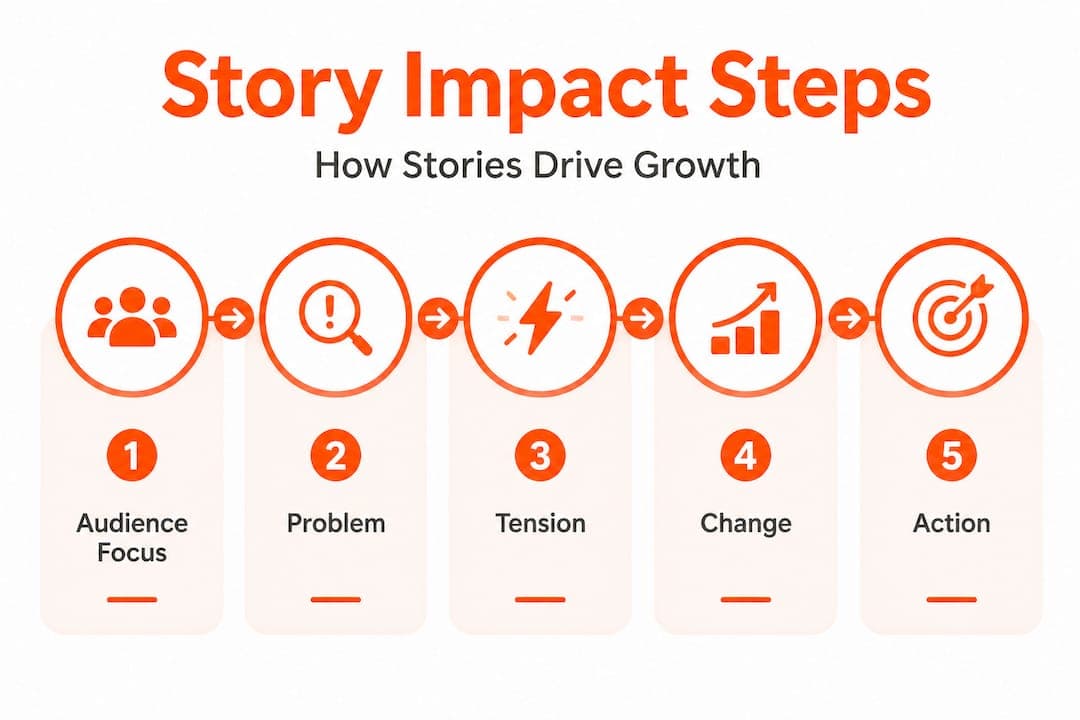
Harvard Business School research identifies four core elements that make marketing stories work. Effective brand storytelling requires resonant meaning, archetypal plots and characters, the customer positioned as the hero, and a blend of emotion with factual grounding. Every element earns its place.
Step-by-step story building guide:
-
Identify the core tension. What is the specific, relatable problem your audience is experiencing right now? Not a generic pain point, but a precise frustration. "I can't figure out why my content isn't ranking" is more powerful than "businesses struggle with SEO."
-
Choose an archetype. The most common effective archetypes in marketing include the Hero's Journey (customer overcomes a challenge), the Underdog (scrappy business beats the odds), and the Transformation (before and after a meaningful change). Pick the one that matches your customer's actual experience.
-
Position your brand as the guide, not the hero. This is the most common mistake in brand storytelling and the one that kills campaigns. Your customer is Luke Skywalker. Your brand is Yoda. The moment you make your company the hero of the story, you lose the audience's identification with the narrative.
-
Build the emotional arc first. Map out how you want the audience to feel at each stage: frustrated at the start, curious in the middle, hopeful and confident at the end. Emotion is the vehicle. Facts are the fuel.
-
Add credibility anchors. Once the emotional arc is set, layer in real data, customer results, and specific product details. These anchors prevent the story from feeling like empty inspiration and give the cognitive pathway something to grab onto.
-
End with a clear next step. Every great marketing story ends with an invitation, not a conclusion. What should the audience do now that they feel and understand what you've shown them?
You can find a wide range of brand storytelling examples that demonstrate these elements in action across different industries, and studying them is one of the fastest ways to accelerate your own story-building skills. Also consider the role of visual storytelling in amplifying these frameworks. Images, video thumbnails, and graphics that reflect the emotional arc of your story create a layered experience that engages multiple senses simultaneously.
Pro Tip: Record a two-minute voice memo describing your customer's problem as if you were telling a friend. Then transcribe it. That raw, unpolished language is almost always more compelling than the polished copy your team writes afterward.
Tailoring storytelling for channels, audiences, and business goals
With story frameworks in hand, let's look at how to apply them across marketing channels and goals, because a story that works on Instagram may fall completely flat in a podcast.
The channel you choose fundamentally changes how the story should be told. Recent analysis of brand storytelling patterns shows that consumer-led narratives outperform brand-hero storytelling in written, social, and video formats. Audio is a notable exception. Podcasts and radio favor fact-heavy, authority-driven content because listeners are often multitasking and need clear, structured information they can follow without visual support.
Here is a practical breakdown of channel-specific storytelling tactics:
- Blog and long-form content: Use a full narrative arc. Open with the tension, develop the transformation, and close with the call to action. Long-form allows you to activate both cognitive and emotional pathways fully.
- Social media: Lead with the most emotionally resonant moment of the story first. You have three seconds to stop the scroll. Start in the middle of the drama, not at the beginning.
- Video: Show, don't tell. Let customer faces, environments, and behavior carry the emotional arc. Narration should fill gaps, not repeat what the viewer can already see.
- Email marketing: Subject lines should reflect the tension or transformation, not the solution. "Why our customers almost gave up on SEO" outperforms "Our new SEO tool is here" every single time.
- Audio and podcast sponsorships: Shift to credibility-first framing. Lead with results, data, and expert opinion. Emotional connection comes second.
Audience segmentation also shapes storytelling strategy in ways most teams underestimate. A Forbes analysis argues that marketing storytelling must shift from message to meaning through audience segmentation, and that credibility consistently outperforms resonance and extensibility when it comes to actual conversion metrics. This means that a story which feels emotionally powerful but lacks specific, credible evidence will underperform a less "moving" story that grounds its claims in real data.
You can find concrete content marketing success stories that demonstrate these channel-specific tactics working in real campaigns. If you're newer to building out a content framework, reviewing content marketing basics first gives you the strategic context that makes channel-specific storytelling decisions much easier to make.
Pro Tip: Run A/B tests where the only variable is narrative structure. Keep the offer, the audience, and the call to action identical. Change only whether you lead with story or lead with facts. The results will surprise you and permanently change how you plan campaigns.
Storytelling isn't a magic bullet: What marketers often miss
Here's the thing nobody in a marketing conference keynote will say out loud: storytelling fails more often than it succeeds, and the reasons are almost always predictable.
The most important finding from recent research is that storytelling marketing increases purchase intention primarily through brand image mediation, and that credibility is the strongest individual effect measured. Not emotional resonance. Not creative originality. Credibility. That should fundamentally reorder your priorities when you build brand stories.
What this means practically is that a story packed with real customer names, specific numbers, and verifiable outcomes will outperform a beautifully produced emotional narrative with vague claims. The creativity earns attention. The credibility earns the sale.
We also see brands make the mistake of treating storytelling as a campaign tactic rather than a brand-level commitment. A single emotional video does not build a storytelling brand. Consistent narrative across every customer touchpoint, every piece of content, every social post over months and years, is what builds the compounding brand equity that makes stories land harder over time.
The other failure mode is deploying stories at the wrong moment in the customer journey. If someone is comparing your product against three competitors on a pricing page, they don't need an origin story. They need a credible, specific narrative about a customer just like them who made the switch and got measurable results. The emotional arc is short. The cognitive anchors are heavy. Context determines everything.
Finally, AI-driven loyalty strategies show us that the future of storytelling is personalization at scale. The brands winning in 2026 are not just telling better stories. They're telling different stories to different audience segments, optimized in real time based on engagement signals. That level of sophistication requires both strong storytelling instincts and smart automation tools working together.
Automate compelling content and storytelling at scale
You're now equipped to craft brand stories that convert. But the real challenge most marketing teams face isn't knowing what to write. It's producing enough high-quality, story-driven content consistently to actually move the SEO and conversion needle.

That's exactly where Babylovegrowth.ai comes in. The platform's SEO automation capabilities allow you to produce a full 30-day content plan built around your brand's narrative, audience segments, and target keywords, all optimized for both Google and ChatGPT rankings. You're not just publishing more content. You're publishing story-rich, credibility-backed content that works harder for longer. Pair that with the platform's backlink building software to amplify reach, and you have a complete system for scaling storytelling-driven growth without burning out your team.
Frequently asked questions
How does storytelling increase purchase intention?
Storytelling increases purchase intention by strengthening brand credibility and positive brand image, which are the two strongest mediating factors between narrative exposure and buying behavior.
Should my marketing focus more on emotion or facts?
Blending both is the most effective approach, but narrative processing outperforms analytical processing for persuasion. For direct conversions, lean toward cognitive, logic-driven storytelling anchored in credible data.
Which channels benefit most from storytelling in marketing?
Written, social, and video channels consistently show the strongest storytelling performance, while audio formats tend to respond better to fact-based, authority-driven content.
Why do some storytelling campaigns backfire?
Inauthentic narratives trigger backlash because audiences quickly detect when a brand's story doesn't match their actual experience, which destroys trust faster than any factual misstep would.