Data-driven marketing: grow smarter with customer insights


TL;DR:
- Data-driven marketing relies on customer data and analytics over intuition for better decision-making.
- Successful strategies involve analyzing diverse data types and maintaining long-term performance tracking.
- Common pitfalls include imbalanced data, poor attribution, and lacking strategic personalization.
Most marketers think they know their customers. They've run the campaigns, watched the numbers tick up, and trusted their instincts when the data got confusing. But that confidence is often misplaced. Data-driven marketing is the practice of using customer data, behavioral analytics, and performance metrics to inform decisions rather than relying on gut instinct or assumptions. In this guide, we break down what data-driven marketing actually means, which data types matter most, how to turn raw numbers into strategy, and how to avoid the traps that derail even well-resourced teams.
Table of Contents
- What is data-driven marketing?
- The types of data that power modern marketing
- From raw data to actionable strategy: How marketers create impact
- Pitfalls and challenges: Avoiding common data-driven marketing mistakes
- Implementing data-driven marketing for organic SEO growth
- Why simply 'using data' isn't enough: Lessons from real marketers
- Unlock your marketing growth with the right data-driven tools
- Frequently asked questions
Key Takeaways
| Point | Details |
|---|---|
| Data beats intuition | Businesses relying on data-driven marketing consistently outperform those led by instinct or assumptions. |
| Different data types matter | Demographics, behavioral analytics, and feedback all contribute unique value for strategy. |
| Workflow transforms results | Effective marketing turns raw data into actionable steps using clear metrics and analysis. |
| Pitfalls are avoidable | Understanding common mistakes like bad attribution or data imbalance helps sidestep failure. |
| Sustained tracking wins | Measuring progress over time, not just at a single point, is key to lasting growth. |
What is data-driven marketing?
Data-driven marketing sits at the opposite end of the spectrum from "spray and pray" tactics. Instead of guessing what your audience wants, you use real signals from real customers to shape every decision you make.
Data-driven marketing is the practice of using customer data, behavioral analytics, and performance metrics to inform marketing decisions rather than relying on intuition or assumptions. That definition sounds simple, but the shift it requires is significant. You stop asking "what feels right?" and start asking "what does the data show?"
The contrast with traditional marketing is sharp. A gut-driven marketer might choose a campaign theme because it worked two years ago. A data-driven marketer looks at current search behavior, customer segments, and conversion paths before committing a single dollar. The evidence behind this approach is compelling. Teams that invest in analytics-driven ROI benefits consistently outperform those relying on experience alone.
| Factor | Traditional marketing | Data-driven marketing |
|---|---|---|
| Decision basis | Intuition, past experience | Customer data, analytics |
| Targeting | Broad demographic groups | Behavioral segments |
| Measurement | Campaign-level impressions | KPIs tied to revenue |
| Iteration speed | Slow, campaign-by-campaign | Continuous, real-time adjustments |
| Personalization | Generic messaging | Context-aware content |
The primary benefits of adopting a data-driven approach include:
- Increased ROI through smarter budget allocation
- Improved targeting by reaching people ready to act
- Measurable outcomes so you know exactly what is working
- Faster iteration because you catch underperformance early
- Reduced waste by cutting spend on channels that do not convert
"The shift to data-driven marketing is not about replacing human creativity. It is about giving that creativity a foundation of evidence so it lands with the right audience at the right moment."
Understanding measuring content marketing ROI becomes far more achievable once you have this evidence-based foundation in place.
The types of data that power modern marketing
With the foundations in place, it is time to explore the kinds of data that fuel modern marketing strategies. Not all data is created equal, and knowing what you are collecting matters as much as how much you collect.
Six core data types power modern marketing programs: demographics, behavioral data, transaction history, website analytics, social engagement, and customer feedback. Each one tells a different part of the customer story, and using them together is where the real insight lives.
| Data type | Common sources | Primary marketing use |
|---|---|---|
| Demographics | CRM, signup forms, third-party lists | Audience segmentation |
| Behavioral data | Google Analytics, heatmaps, session recordings | UX optimization, content relevance |
| Transaction history | eCommerce platforms, POS systems | Retention, upsell, LTV modeling |
| Website analytics | GA4, Search Console, tag managers | SEO, landing page optimization |
| Social engagement | Native platform insights, social listening tools | Brand sentiment, content strategy |
| Customer feedback | Surveys, reviews, NPS scores | Product development, messaging refinement |
Real-world collection looks like this in practice:
- Google Analytics tracks where users land, how long they stay, and where they drop off
- CRM platforms like HubSpot or Salesforce capture transaction history and lifecycle stage
- Post-purchase surveys reveal why customers chose you over a competitor
- Search Console shows which queries bring organic traffic and where click-through rates could improve
- Social listening tools surface mentions, sentiment shifts, and emerging topic interest
Mapping user behavior insights to each of these data streams is what separates teams that collect data from teams that use it.
Pro Tip: Data quality beats data quantity every time. Before running any analysis, audit your sources for completeness, recency, and consistency. A dashboard built on stale or duplicated data will send you in the wrong direction faster than having no data at all. Set a quarterly data hygiene review on your calendar and treat it like a non-negotiable.
From raw data to actionable strategy: How marketers create impact
Knowing which data to collect is only half the battle. The next step is transforming it into genuine marketing advantage. Raw numbers sitting in a spreadsheet do nothing. What turns data into impact is a repeatable process.
Here is how successful marketing teams move from collection to campaign:
- Define your goals and KPIs first. Know what success looks like before you touch the data. Revenue per visitor? Organic keyword rankings? Email conversion rate? Pick top digital marketing KPIs that connect directly to business outcomes.
- Centralize your data sources. Pull all relevant data into one place, whether that is a BI tool, a marketing dashboard, or a connected analytics platform. Fragmented data creates blind spots.
- Analyze for patterns, not just totals. Traffic is up 20%. Great. But which pages drove that? From which channels? At what time of day? Totals tell you what happened. Patterns tell you why.
- Generate insights, not just observations. An insight is actionable. "Blog posts under 1,000 words convert 40% lower than longer-form content" is an insight. "Traffic came from search" is an observation.
- Apply insights to campaign decisions. Adjust content, ad targeting, landing page copy, or channel mix based on what the data actually showed, not what you expected it to show.
- Measure, iterate, and repeat. Schedule a regular performance review. What moved? What did not? Feed those results back into step one.
A review of 53% of firms shows ROI gains from data-driven marketing, but cross-sectional studies limit long-term proof. The real winners are teams that prioritize longitudinal tracking, measuring the same metrics over months and years rather than celebrating one-quarter wins. Using analytics for content marketing is one of the highest-leverage places to apply this discipline.
Pro Tip: Attribution is a known weak point for most marketing teams. Multi-touch attribution models, which credit each touchpoint a customer interacted with before converting, give you a much more accurate picture of which channels truly move the needle. Avoid last-click attribution if you want to understand full channel contribution. Tools that support using analytics for growth often include attribution modeling built in.
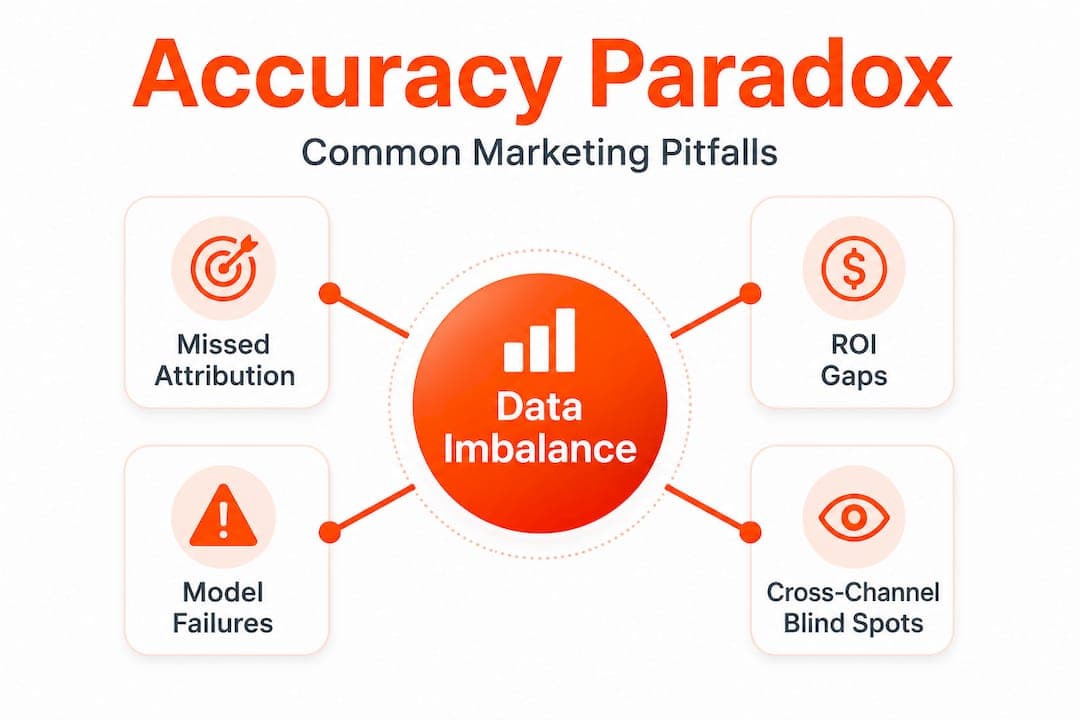
One critical warning from the research: imbalanced data leads to what analysts call the "accuracy paradox," where a model appears to perform well overall but fails completely on the minority segment you care most about. If 95% of your dataset represents one customer type, your model will be wildly overfit and essentially useless for everyone else.
Pitfalls and challenges: Avoiding common data-driven marketing mistakes
Data-driven marketing is powerful, but it is not without its challenges. Understanding these pitfalls is crucial before you invest time and resources into a system that could quietly fail.
The most common reasons data-driven marketing underperforms:
- Imbalanced datasets that create models optimized for majority segments while ignoring high-value niches
- Last-click attribution bias that overvalues the final channel and undervalues top-of-funnel content
- Personalization without strategy, where you have the data to personalize but no plan for how it should change the customer experience
- Privacy regulation blind spots that leave teams scrambling when third-party cookies disappear or compliance rules tighten
- Siloed teams where marketing, sales, and product each have their own data with no shared source of truth
- Vanity metrics masquerading as KPIs, like social followers or page views, that feel good but do not tie to revenue
"The biggest failure mode in data-driven marketing is not bad data. It is treating attribution and privacy as someone else's problem until they become a crisis."
Imbalanced data leads to model failures through the accuracy paradox. Poor attribution misses cross-channel effects. Personalization fails without a strong strategy behind it. And privacy regulations consistently challenge teams that rely heavily on third-party data sources. These are not edge cases. They are the norm for teams that move fast without a solid data governance plan.
Addressing these issues proactively means building a data quality checklist before any campaign launches, establishing attribution model standards across your team, and working with legal counsel to stay ahead of regulations like GDPR and CCPA. For more on navigating these complexities, overcoming marketing challenges in a data-heavy environment requires both process discipline and the right tools.
Implementing data-driven marketing for organic SEO growth
Armed with awareness of both opportunities and risks, you are ready to put data-driven marketing into practice for SEO and organic content growth. This is where theory meets your actual business results.
Here is a sequential plan to get started:
- Define your SEO goals with precision. Do you want to rank for specific commercial keywords? Increase organic traffic to a product page? Grow topical authority in your niche? Each goal requires a different data focus.
- Collect the right data from the start. Use a mix of data types including website analytics, behavioral signals, and customer feedback to understand how your audience searches and what they need once they land.
- Analyze search intent at scale. Pull keyword data from Google Search Console, cluster queries by intent (informational, navigational, transactional), and map each cluster to content that genuinely matches what the user wants.
- Create content informed by user behavior. Look at which existing pages have high traffic but low time-on-page. That signals a mismatch between what users expected and what they found. Fix the mismatch before creating new content.
- Build internal links strategically. Use your analytics to identify high-authority pages and route link equity toward pages you want to rank higher.
- Track performance longitudinally. Set monthly benchmarks for organic rankings, click-through rates, and on-page engagement. Compare quarter over quarter, not just week over week.
- Iterate based on what moves. Kill what does not work. Double down on what does. This sounds obvious, but most teams only do half of it.
Staying ahead of digital marketing trends for SMBs is easier when your SEO strategy is built on data rather than guesswork. You can respond to algorithm updates with evidence instead of panic. Understanding how to effectively reach digital marketing audiences also becomes more precise when you let behavioral data guide content decisions.
Pro Tip: User intent is the single most underused data point in SEO strategy. Before optimizing any page, look at what users actually do after they land. If they bounce immediately, the page is not matching intent. If they scroll deep but do not convert, there may be a CTA or trust gap. Pairing this with measuring brand awareness with AI gives you a complete picture of where your organic strategy is actually landing.
Why simply 'using data' isn't enough: Lessons from real marketers
Here is something most marketing guides will not tell you: having access to data is not a competitive advantage anymore. Every mid-sized company has Google Analytics. Most have a CRM. Plenty have dashboards that no one reads after the first month. Access is table stakes. What separates the teams that grow from the teams that stagnate is the discipline to extract actual business insight from what they collect.
We see this pattern repeatedly. A team implements a full analytics stack, runs reports every week, and still cannot tell you why their organic traffic plateaued six months ago. The data was there. The insight was not.
Research across dozens of firms shows that 53% see ROI gains, but cross-sectional studies limit long-term proof. The implication is critical: most companies measure marketing performance in snapshots, not trajectories. They see a good quarter and assume the strategy is working. They see a bad month and panic-pivot. Neither response is grounded in enough longitudinal data to actually mean something.
The marketers who build durable organic growth are the ones who commit to tracking the same metrics over 12 to 24 months, revisiting their KPI framework every quarter to make sure it still aligns with shifting business goals, and treating each data review as a learning opportunity rather than a scorecard. Understanding long-term marketing ROI is the lens that separates short-term wins from compounding growth.
Pro Tip: Set a recurring calendar block every 90 days to review your core KPIs and ask one question: "Does this metric still reflect what we actually care about?" Goals shift. Competitive landscapes shift. Your metrics should keep pace.
The uncomfortable truth is that data-driven marketing requires more discipline than intuition-based marketing, not less. Gut instinct is fast. Analyzing behavioral cohorts over time is slow. But the slow work is where the lasting competitive edge lives.
Unlock your marketing growth with the right data-driven tools
You have built a strong understanding of what data-driven marketing requires and where it tends to break down. The next step is making sure your tools can keep pace with your strategy.
Automation removes the routine guesswork from SEO and content decisions, giving you more time to act on the insights that actually matter. Babylovegrowth.ai is built specifically for business owners and marketers who want to scale organic growth without building a full in-house SEO department. From AI-generated content optimized for Google and ChatGPT to a built-in backlink exchange ecosystem, the platform turns data-driven strategy into execution on autopilot. Explore the SEO automation platform to see how it can accelerate your organic results. You can also dig into the organic traffic tool and automated backlink software to cover every layer of your growth strategy with precision.
Frequently asked questions
How do I know if my business is ready for data-driven marketing?
If you have access to basic customer, web, or sales data and want to improve decision-making, you are ready. Basic data types like website analytics and customer feedback are enough to start making smarter marketing decisions today.
What's the main difference between data-driven and traditional marketing?
Traditional marketing relies on personal experience or intuition, while data-driven marketing uses customer insights and analytics to guide every decision, from targeting to messaging to budget allocation.
What types of data are most important for SEO growth?
Behavioral data, website analytics, and customer feedback are especially valuable. These data types reveal what users actually want from your content, which is the foundation of any effective organic growth strategy.
How can I avoid common data-driven marketing pitfalls?
Use high-quality, balanced data, select metrics that tie directly to revenue, and stay aware of privacy and attribution challenges. Imbalanced data and poor attribution are the two most common causes of underperforming data-driven programs.
Does being data-driven guarantee better results over time?
No single approach guarantees results, but longitudinal tracking significantly improves your odds. Sustained improvement comes from measuring performance over months and years, not individual campaign snapshots.