Customer feedback drives 20-40% revenue growth in 2026


Most businesses treat customer feedback like a suggestion box — something you glance at occasionally and then forget. That's a costly mistake. Acting on feedback boosts retention rates by 25-35% and revenue by 20-40%, yet most small and medium-sized businesses still treat it as a passive data collection exercise. This guide flips that script. You'll learn how to build a real feedback system that turns raw customer opinions into product improvements, stronger loyalty, and measurable business growth. No vague advice — just practical frameworks you can apply this week.
Table of Contents
- Why customer feedback matters for business growth
- The customer feedback loop: Collection, analysis, and action
- Methods for collecting and interpreting customer feedback
- Common feedback pitfalls and how to avoid them
- Turning customer feedback into actionable business improvements
- What most businesses get wrong about customer feedback
- Ready to turn customer insights into growth?
- Frequently asked questions
Key Takeaways
| Point | Details |
|---|---|
| Feedback fuels growth | Acting on customer feedback directly increases retention and revenue for businesses. |
| Follow the feedback loop | Collecting, analyzing, acting, and communicating builds loyalty and trust. |
| Mix your methods | Combining surveys, reviews, and behavioral data delivers the most actionable insights. |
| Avoid common pitfalls | Don't ignore feedback, rely only on surveys, or act on just the vocal minority. |
| Action is everything | Feedback adds value only when transformed into real improvements users notice. |
Why customer feedback matters for business growth
Feedback isn't just a nice-to-have. It's one of the most direct signals your business receives about what's working and what's quietly driving customers away. The companies that treat it as a strategic asset consistently outperform those that don't.
Consider the numbers. Businesses that act on customer feedback grow revenue 20-40% faster than those that don't. That's not a marginal edge — that's the difference between a business that scales and one that stagnates. And when you dig into the customer experience (CX) side of things, the gap widens further.
"CX maturity leads to faster issue resolution and higher customer satisfaction, with mature organizations resolving issues nearly 50% quicker than their peers."
What does that mean in practice? Customers who get problems solved fast are far more likely to stay, buy again, and refer others. Speed of resolution, driven by feedback systems, becomes a direct competitive advantage.
There's also the trust factor. When 77% of customers say they view brands more favorably after seeing their feedback visibly acted upon, ignoring that signal is leaving loyalty on the table. People want to know their voice matters. When you show them it does, you build the kind of relationship that's hard for competitors to replicate.
Here's what feedback-driven growth actually looks like in practice:
- Revenue acceleration: Businesses using feedback loops identify upsell opportunities and fix churn triggers faster.
- Product-market fit: Regular feedback surfaces which features customers actually use versus which ones you assumed they'd love.
- Faster problem resolution: Structured feedback channels mean issues get flagged before they become crises.
- Competitive intelligence: Customer comments often reveal what competitors are doing right — or wrong.
Understanding analytics in marketing impact is closely tied to how you interpret feedback signals. Feedback isn't just surveys — it's behavioral data, support tickets, social comments, and purchase patterns all speaking at once. The businesses that listen across all those channels grow faster because they're working with a fuller picture.
The customer feedback loop: Collection, analysis, and action
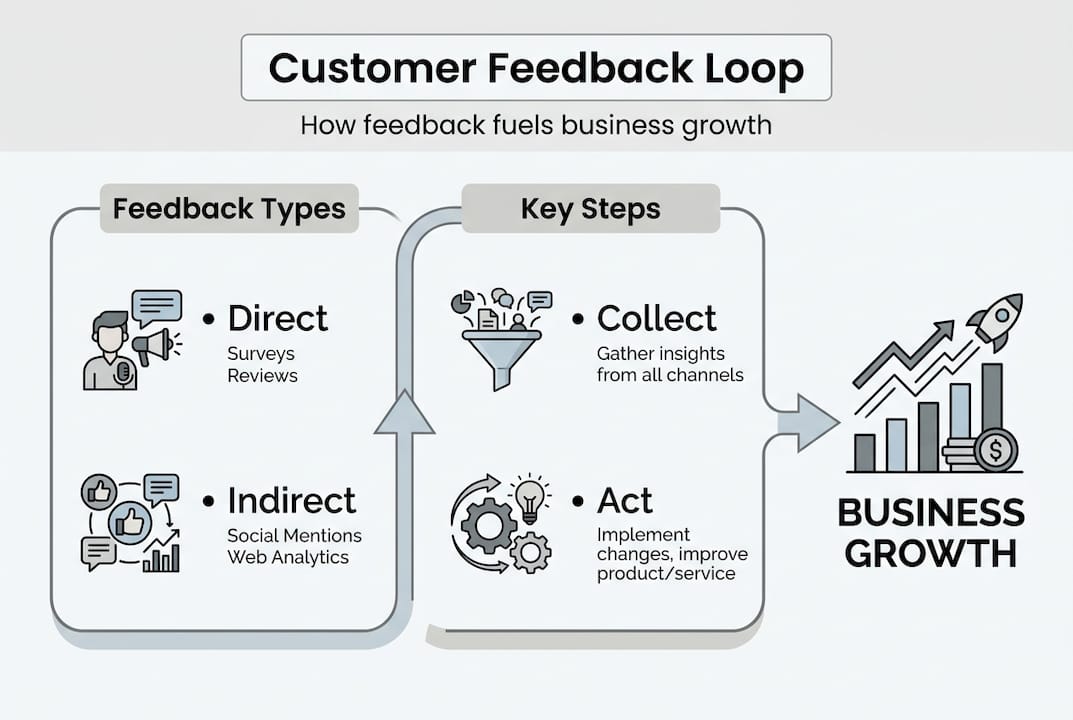
With business growth tied to feedback, understanding the feedback loop is the next crucial step. Customer Feedback Management (CFM) is the systematic process of collecting, analyzing, and acting on what customers tell you — then closing the loop by communicating what changed.
Here's how the loop works in four stages:
- Collect across multiple channels — surveys, reviews, support chats, social media, and in-app prompts.
- Analyze for patterns — look for recurring themes, not just one-off complaints.
- Act on the insights — prioritize by business impact and frequency, not just urgency.
- Close the loop — tell customers what changed because of their input.
That last step is where most businesses drop the ball. A CX pulse survey found that customers who are informed about changes made from their feedback report significantly higher trust and loyalty scores. Silence after feedback feels like dismissal.
| Feedback type | Source examples | Best use case |
|---|---|---|
| Solicited | NPS surveys, post-purchase emails | Measuring satisfaction at key touchpoints |
| Unsolicited | Online reviews, social mentions | Spotting unprompted pain points |
| Behavioral | Click data, churn patterns | Understanding what customers do, not just say |
Pro Tip: Don't wait until you have "enough" feedback to act. If three separate customers mention the same friction point in one week, that's a pattern worth addressing immediately — even before your next quarterly review.
The feedback incorporation process works best when it's built into your regular operations, not treated as a one-time project. Assign ownership. Set review cadences. Make it a habit, not an event.
Methods for collecting and interpreting customer feedback
Once you understand the flow, selecting the right methods is key. Not all feedback channels are created equal, and the best approach combines direct and indirect methods to get a complete picture.
Direct methods involve asking customers explicitly for their input. Indirect methods capture what customers reveal through their actions and public behavior.

| Method | Type | Strengths | Limitations |
|---|---|---|---|
| NPS/CSAT surveys | Direct | Quantifiable, trackable | Can suffer from response bias |
| Focus groups | Direct | Rich qualitative insight | Time-intensive, small sample |
| Online reviews | Indirect | Authentic, unsolicited | Hard to control or prompt |
| Behavioral analytics | Indirect | Shows real usage patterns | Requires interpretation |
| Social listening | Indirect | Real-time, broad reach | Noisy, needs filtering |
A multi-channel approach combining surveys, social listening, and behavioral data consistently yields the most actionable insights. No single channel tells the whole story.
Here's what to watch for when building your method mix:
- The silent majority problem: Research shows most dissatisfied customers say nothing — they just leave. Behavioral data (like drop-off rates or abandoned carts) catches what surveys miss.
- AI-powered interpretation: Tools that analyze free-form comments and social data can surface themes across thousands of responses in minutes, something manual review can't match.
- Push vs. pull balance: Push feedback (you ask for it) captures structured data. Pull feedback (customers volunteer it) captures raw emotion. You need both.
Building multichannel marketing strategies into your feedback collection means you're meeting customers where they already are — not forcing them to a channel that's convenient for you. And using online reviews as a feedback source is often underrated — they're unfiltered, public, and highly credible.
Be aware of common feedback program pitfalls like over-relying on a single channel or collecting data without a plan to act on it. The method is only as good as what you do with the results.
Common feedback pitfalls and how to avoid them
Choosing methods is only half the equation — steering clear of common pitfalls ensures your hard-won feedback delivers true value. The reality is sobering: 30-40% of departments do nothing with the feedback they collect, and survey fatigue and social desirability bias routinely skew results.
Here are the pitfalls that trip up even well-intentioned teams:
- Overfitting to vocal minorities: One angry customer who leaves five reviews doesn't represent your entire customer base. Always cross-reference complaints with behavioral data before making major changes.
- Survey fatigue: Sending too many surveys too often trains customers to ignore them. Keep surveys short (under five questions) and time them to meaningful moments — right after a purchase or support interaction.
- Inaction: Collecting feedback and doing nothing is worse than not collecting it at all. Customers who feel ignored are more likely to churn and leave negative reviews.
- Leading questions: Poorly written survey questions push customers toward the answer you want, not the truth you need.
- Ignoring behavioral signals: What customers do often contradicts what they say. If they say they love a feature but never use it, that's the real signal.
Pro Tip: Pair your survey data with behavioral analytics to understand user behavior more accurately. If your NPS scores are high but churn is rising, something in the experience isn't matching the reported sentiment.
Also, consider the timing of your feedback requests. A survey sent immediately after a frustrating support interaction will capture raw emotion. One sent three days later captures reflection. Both are useful — but for different purposes. Match the timing to the insight you're trying to gather.
And pay attention to feedback fatigue solutions — some experts now recommend shifting from asking for feedback to extracting lessons from observed behavior, which reduces friction and often yields more honest signals.
Turning customer feedback into actionable business improvements
Avoiding pitfalls sets you up for the final — and most rewarding — step: applying feedback to fuel real business change. This is where the loop closes and the ROI becomes visible.
Here's a practical sequence for turning insights into improvements:
- Categorize and score feedback by frequency (how often it's mentioned) and business impact (how much fixing it would affect retention or revenue).
- Identify quick wins — changes that are low effort but high visibility. These build momentum and show customers you're listening.
- Plan high-impact changes with clear owners, timelines, and success metrics. Assign responsibility explicitly — vague ownership kills follow-through.
- Communicate changes back to customers. Informing customers about changes from their feedback strengthens trust and loyalty in measurable ways.
- Track the impact using retention rates, satisfaction scores, and revenue metrics. If a change doesn't move the needle, revisit the underlying feedback.
This process works because it ties feedback directly to decision-making. It's not a separate track — it's baked into how your team operates. A strong product marketing approach uses customer language and pain points to shape messaging, not just internal assumptions.
Look at content marketing success stories and you'll notice a pattern — the brands that resonate most deeply are the ones that clearly understand their customers' real frustrations. That understanding comes from feedback, not guesswork. And using feedback for SEO growth is an underutilized tactic that surfaces the exact language your audience uses to search for solutions.
What most businesses get wrong about customer feedback
Here's the uncomfortable truth: most businesses treat feedback as a task to complete rather than a system to maintain. They run a survey, review the results once, make a few tweaks, and consider the job done. Then nothing changes structurally.
The danger of survey tunnel vision is real — surveys are often stuck in the past and usually disconnected from meaningful action. They capture a moment in time, not the ongoing conversation your customers are having with your brand every day.
The businesses that actually grow from feedback treat it as a continuous strategic input, not a quarterly checkbox. They connect it to product decisions, marketing messaging, and customer success workflows. They assign it to real people with real accountability.
Feedback only pays off when it's tied to decision-making and clear communication back to customers. Building that into your feedback for SEO success strategy means your content, your product, and your customer experience all evolve together — informed by the same signals.
Ready to turn customer insights into growth?
The strategies above give you a clear path from collecting feedback to driving real business results. But executing all of this consistently — especially at scale — is where most teams hit a wall.
BabyloveGrowth.ai helps you build the systems that make feedback-driven growth sustainable. From SEO automation that captures what your customers are searching for, to backlink building software that amplifies your authority, to an organic traffic tool that turns insights into visibility — the platform is built for business owners and marketers who want results, not just reports. Start your free trial and see how automated, AI-driven growth works in practice.
Frequently asked questions
What is the main benefit of collecting customer feedback?
Acting on feedback boosts retention rates by 25-35% and revenue by 20-40%, making it one of the highest-ROI activities a business can invest in.
What is a feedback loop in business?
A feedback loop is a structured process of collecting customer input, analyzing it for patterns, acting on the insights, and informing customers about what changed as a result.
How can small businesses get honest customer feedback?
Mixing direct surveys with indirect behavioral data and targeted follow-up questions gives small businesses a more complete and honest picture of what customers actually experience.
What are common mistakes in handling customer feedback?
Ignoring feedback entirely, acting only on the loudest complaints, and creating survey fatigue through excessive or poorly timed requests are the most common and costly mistakes businesses make.
Recommended
Smart SEO,
Faster Growth!
Most Read Articles
Generative Engine Optimization (GEO)
Learn how Generative Engine Optimization (GEO) helps your content rank in AI search engines like ChatGPT and Google AI. This comprehensive guide explains the differences between SEO and GEO, why it matters for your business, and practical steps to implement GEO strategies for better visibility in AI-generated responses.
DylenJan 18, 2025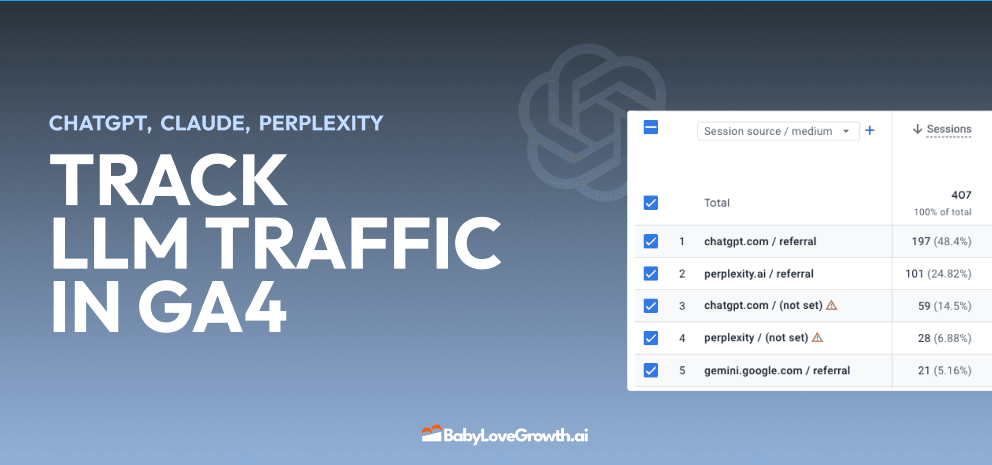
Track LLM Traffic in Google Analytics 4 (GA4)
Learn how to track and analyze traffic from AI sources like ChatGPT, Claude, Perplexity, and Google Gemini in Google Analytics 4. This step-by-step guide shows you how to set up custom filters to monitor AI-driven traffic and make data-driven decisions for your content strategy.
DylenMar 18, 2025
How to Humanize AI Text with Instructions
Learn practical techniques to make AI-generated content sound more natural and human. This guide covers active voice, direct addressing, concise writing, and other proven strategies to transform robotic text into engaging content.
DylenApril 7, 2025
Open AI Revenue and Statistics (2024)
Comprehensive analysis of OpenAI financial performance, user engagement, and market position in 2023. Discover key statistics including $20B valuation, $1B projected revenue, and 100M+ monthly active users.
DylenOctober 03, 2025