Content gap analysis: Boost SEO visibility and traffic fast


TL;DR:
- Most web pages attract no significant organic traffic due to poor strategic focus.
- Content gap analysis identifies what users actively search for but is missing from your site.
- Using AI-powered tools improves gap detection accuracy and accelerates content optimization efforts.
Ninety-seven percent of web pages get zero organic traffic. That number should stop every marketing manager cold. If nearly all published content vanishes into the search void, volume alone is clearly not the answer. Content gap analysis is the strategic process of identifying what your audience actively searches for and what your site currently fails to address, whether that's a missing topic, the wrong format, or content that no longer matches search intent. Master this framework and you'll stop guessing and start building content that earns real visibility and real conversions.
Table of Contents
- Why most content fails to deliver results
- What is content gap analysis? Key concepts and definitions
- How to conduct a content gap analysis: Step-by-step framework
- Content gap analysis tools: AI vs. traditional platforms
- Real-world results: Measured gains from closing content gaps
- Why closing the gap beats chasing volume: An expert perspective
- Ready to close your content gaps? Next steps for strategic growth
- Frequently asked questions
Key Takeaways
| Point | Details |
|---|---|
| Content gaps hinder results | Missing or under-optimized content often explains low search traffic and engagement. |
| Gap analysis boosts SEO | Systematically closing content gaps brings 30-45% more organic traffic and better rankings. |
| AI tools outperform legacy platforms | AI-driven analysis is 25% more precise and can 5x conversion rates over traditional methods. |
| Actionable, ongoing process | Gap analysis works best when performed regularly and tied to business goals. |
Why most content fails to deliver results
The brutal truth is that most content strategies are built on assumptions rather than data. Teams publish steadily, distribute across channels, and then wonder why organic traffic stays flat. The problem is rarely effort. It's direction.
Consider the scale of the problem. Research confirms that 97% of pages attract no meaningful search traffic whatsoever. These pages aren't penalized or broken. They're simply invisible because they fail to match what real users actually search for. That's a systemic failure of strategy, not execution.
The most common mistakes behind content failure include:
- Publishing without keyword or intent research, creating content only the author cares about
- Ignoring what competitors rank for, leaving entire topic clusters uncontested
- Never refreshing old content, so pages that once ranked slowly decay in relevance
- Misaligning format and intent, such as writing blog posts when users want comparison tables or video walkthroughs
- Treating SEO as a one-time task rather than a living, iterative process
A content gap isn't always a missing keyword. It can be a missing format, a topic your competitors own but you don't, outdated statistics a reader can't trust, or a user question you've never directly answered. These nuances matter enormously when you're trying to earn both traditional search rankings and citations in AI-driven engines like ChatGPT and Perplexity.
"Content without strategic intent isn't marketing. It's noise."
The importance of content audits is often underestimated here. Audits reveal what exists and what's underperforming, but they can't tell you what's missing. That's where deeper gap analysis becomes essential. Think of an audit as reading your current chapter and gap analysis as planning the chapters you haven't written yet.
What is content gap analysis? Key concepts and definitions
Content gap analysis is the structured process of comparing what your target audience searches for against what your website currently provides. The delta between those two sets is your gap. Close the gap and you earn rankings, organic traffic, and relevance with buyers who are actively in-market.
The direct benefits for marketing managers are concrete and measurable. Studies show that closing gaps can yield a 30 to 45% organic traffic boost within six to twelve months. That's not a minor improvement in a core metric. That's the difference between a content program that justifies its budget and one that struggles to prove ROI.
Here's a simplified process overview you can adapt immediately:
- Audit your existing content to understand what topics, formats, and intents you currently address
- Benchmark your top competitors to map the topics and keywords they rank for that you don't
- Map search intent for each gap you discover, matching content type to user need
- Prioritize by opportunity, focusing first on high-traffic gaps where you have topical authority or can build it quickly
- Execute and track, monitoring ranking improvements and organic sessions at the keyword and page level
Traditional tools like Semrush or Ahrefs have long offered keyword gap functions. But AI-powered platforms are pulling ahead fast. Benchmarks show AI-driven tools like Promptwatch achieve 87% precision vs. 62% for legacy SEO platforms in real-world gap detection. That accuracy gap directly affects which opportunities you find and which you miss entirely.
| Feature | Legacy SEO tools | AI-powered platforms |
|---|---|---|
| Keyword gap detection | Strong | Very strong |
| Intent alignment accuracy | Moderate (62%) | High (87%) |
| Format gap identification | Limited | Advanced |
| AI search citation opportunities | Not available | Core feature |
| Content refresh recommendations | Basic | Automated and prioritized |
| Speed of analysis | Hours | Minutes |
Pro Tip: Refreshing existing content with current statistics and schema markup can boost your AI search citations by 3.2x to 3.8x compared to untouched pages. Don't just create new content. Update what you already own. This is one of the highest-ROI moves in AI content optimization today.
How to conduct a content gap analysis: Step-by-step framework
Now that you know what content gap analysis is, here's exactly how you can put it into practice as a marketing manager with real deliverables and deadlines.
Step 1: Build your content inventory. Pull a complete list of every page on your site using a crawl tool or your CMS. Tag each piece by topic cluster, format, targeted keyword, and current organic ranking. This inventory becomes your baseline.

Step 2: Identify your top five to eight competitors. These should be brands your customers compare you to, not just domain authority leaders. Analyze which keywords and topics they rank for in the top ten results that you don't appear in at all.
Step 3: Map intent against your gaps. For every gap you find, determine the user's search intent. Is it informational (research phase), navigational (looking for a brand), commercial (comparison shopping), or transactional (ready to buy)? The format of your content must match the intent precisely.
Step 4: Score and prioritize your gaps. Not every gap is worth filling immediately. Use a scoring model that factors in monthly search volume, keyword difficulty, your existing topical authority, and estimated conversion value. A gap with 2,000 monthly searches and low difficulty in a category you already cover is almost always higher priority than a 10,000-search gap where you have no authority at all.
| Stage | Action | Output |
|---|---|---|
| Inventory | Crawl and catalog all pages | Baseline content map |
| Competitor analysis | Identify keyword and topic gaps | Gap opportunity list |
| Intent mapping | Align content type to user need | Prioritized intent matrix |
| Scoring | Weight by traffic, difficulty, and value | Content roadmap |
| Execution | Create or refresh content | New or updated pages |
| Tracking | Measure ranking and traffic changes | Performance report |
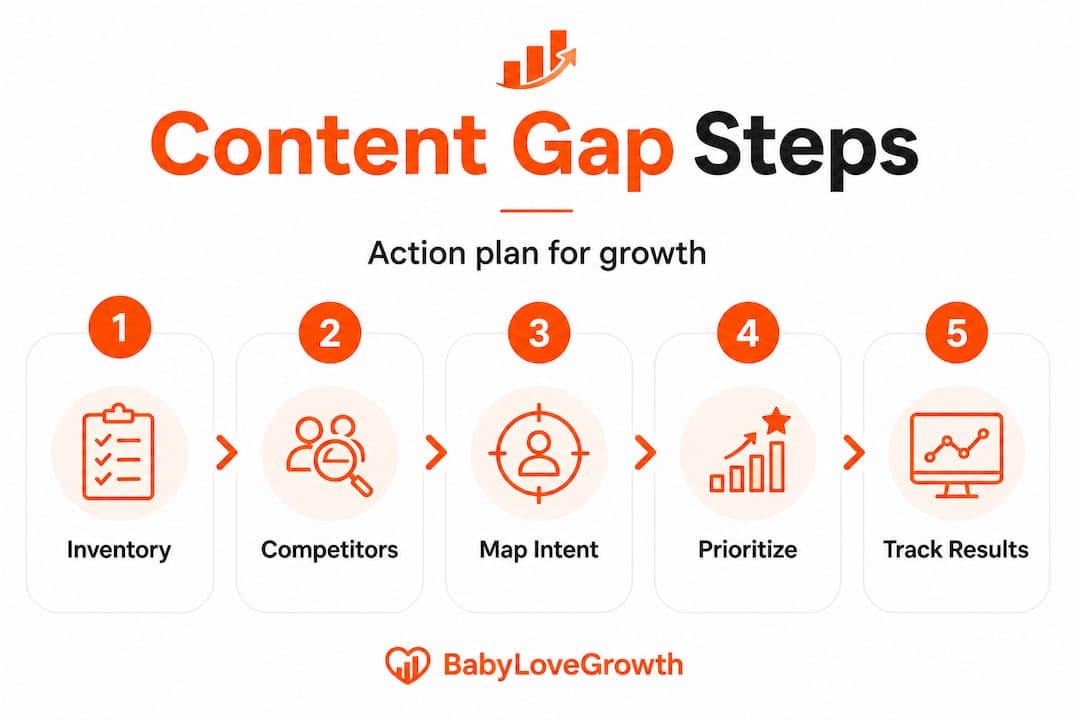
Execution without measurement is guessing at scale. Track ranking positions, organic sessions, and on-page engagement metrics weekly for the first 90 days after publishing gap content. AI tools speed up this analysis dramatically, cutting research time by up to 60%, which frees your team to focus on strategy and creative execution instead of manual data collection.
Closing these gaps can consistently yield a 30 to 45% lift in organic traffic, but only when execution is disciplined and tracked. Revisiting content audit strategies regularly ensures your inventory stays current as your site grows.
Pro Tip: When AI tools surface a gap in a topic where data is scarce, add proprietary statistics, original research, or structured schema markup to your new content. Pages with verifiable data and schema are significantly more likely to be cited in AI-generated answers across platforms like Perplexity and Claude.
Content gap analysis tools: AI vs. traditional platforms
With a step-by-step framework in hand, the next decision is which tools to trust with your analysis. The gap between legacy SEO platforms and modern AI-powered solutions is widening faster than most teams realize.
Legacy tools like Semrush, Ahrefs, and Moz excel at surfacing keyword-level gaps. They're reliable, well-documented, and have large data sets. But they have significant blind spots. They struggle to identify format gaps, they don't capture intent misalignment well, and they have no visibility into AI search citation opportunities, which are increasingly where high-converting traffic originates.
AI-powered gap analysis platforms address all three of those weaknesses. In head-to-head testing, Promptwatch achieved 87% precision compared to Semrush's 62%, a 25-point accuracy advantage that compounds across every recommendation in your content roadmap. Fewer false positives mean less wasted content budget.
Key advantages of AI-powered platforms include:
- Real-time trend detection, catching emerging search patterns before competitors do
- Multiformat gap identification, spotting when you need a comparison table, FAQ section, or structured list rather than another long-form article
- AI search optimization, identifying what content formats get cited in ChatGPT, Claude, and Perplexity answers
- Intent scoring at scale, automatically categorizing hundreds of gaps by user need type
- Citation opportunity mapping, flagging where adding statistics to existing content will increase AI engine mentions
"Adding verifiable statistics to content increases AI visibility by 30 to 41%. This isn't an abstract SEO benefit. It translates directly to being the source an AI assistant recommends."
Both tool categories have a role. Use traditional platforms for broad keyword data and domain comparisons. Use AI-powered solutions for intent mapping, format gap detection, and optimizing for the AI search layer that now influences millions of purchase decisions. Combining both into a unified workflow supports truly scalable content with AI at the level growing brands need.
Real-world results: Measured gains from closing content gaps
Understanding the potential gains from gap analysis is one thing. Seeing what leading teams actually achieve when they apply the methodology consistently is what builds conviction.
The results are not marginal. They're structural:
- Brands that systematically close content gaps see 30% to 45% more organic traffic within six to twelve months of a focused execution sprint
- AI-referred visitors, those arriving via ChatGPT, Claude, or Perplexity recommendations, convert at 14.2% compared to 2.8% for standard organic search visitors, a five times higher conversion rate that changes your content's revenue attribution entirely
- Content refreshed in direct response to gap analysis earns three to four times more citations from both traditional and AI search engines compared to static, untouched pages
- Teams that combine intent mapping, citation optimization, and technical schema upgrades see compounding returns, where each improvement reinforces the others
The conversion gap between AI-referred and organic visitors deserves special attention. If your content-driven SEO growth strategy doesn't include optimization for AI engines, you're leaving high-converting traffic on the table. Getting cited in an AI answer means your brand is the recommended solution, not just one result in a list of ten.
From a practical standpoint, the highest-performing gap closure campaigns share three characteristics. First, they prioritize commercial and transactional intent gaps before informational ones when budget is limited. Second, they pair new content with structured data markup from day one. Third, they treat refreshing as equal in value to creating, which is a mindset shift most teams haven't made yet.
When you pair consistent gap closure with conversion rate optimization best practices, the ROI case becomes undeniable. More relevant traffic converting at higher rates is a fundamentally different business outcome than more traffic that bounces.
Why closing the gap beats chasing volume: An expert perspective
Here's a perspective most content strategy guides won't give you: the obsession with publishing volume is one of the most expensive mistakes a growing brand can make.
More articles, more keywords, more output does not equal more results. Without strategic gap closure, you're producing content that competes with itself, dilutes topical authority, and spreads your team thin across topics that may never rank. We've seen brands with 3,000-page content libraries pulling less organic traffic than competitors with 400 pages that directly address real audience gaps.
The counterintuitive truth is that the best-performing content programs we observe are not the most prolific. They're the most precise. Every publishing decision is informed by gap data. Every refresh is triggered by a signal, a ranking drop, a competitor moving in, a new format emerging in search results. Nothing gets published just to fill a calendar.
Real transformation in content performance comes from three moves most teams undervalue: updating what already exists with current data and richer structure, repackaging existing content into the formats that users actually want at each intent stage, and expanding topic clusters strategically based on measured gaps rather than editorial instinct.
A future-proof content strategy is not built on a single quarterly gap analysis. It's built on treating gap analysis as a continuous operational habit. Monthly or quarterly reviews catch trend shifts, new competitor content, and format changes in search results before they erode your hard-won rankings. Automation for SEO makes this continuous cycle feasible even for lean marketing teams, turning what used to be a manual, resource-intensive process into a systematic growth engine.
The brands winning in organic search in 2026 are not the ones publishing the most. They're the ones closing gaps with discipline, speed, and precision.
Ready to close your content gaps? Next steps for strategic growth
If you've recognized gaps in your current content strategy, the good news is that closing them is a highly structured, measurable process when you have the right platform behind you.
Babylovegrowth.ai is built specifically for marketing managers and strategy consultants who need to move from gap identification to execution without losing weeks in manual research. The platform's AI-powered tools automate keyword discovery, intent mapping, content planning, and structured data markup across your entire site. You get daily SEO articles, 30-day content roadmaps, automatic schema markup, and backlink building coordinated around the gaps your competitors don't know you've found. Whether you're optimizing for Google or earning citations in ChatGPT and Perplexity, Babylovegrowth.ai gives your team the infrastructure to turn gap analysis into consistent, compounding organic growth.
Frequently asked questions
What's the main difference between content audit and content gap analysis?
A content audit reviews your existing assets for quality, performance, and relevance, while content gap analysis focuses on what's missing entirely to fully meet your audience's needs and SEO opportunities.
How often should I perform content gap analysis for best results?
Most experts recommend a thorough gap review every quarter, since search trends and competitor content strategies shift fast enough to create new opportunities and threats within that window.
Which KPIs prove content gap analysis effectiveness?
Track organic traffic growth, keyword ranking improvements, new citation counts, and conversion rate changes after filling specific gaps. Research confirms 30 to 45% traffic lifts are achievable, with AI-referred visitors converting at 14.2% compared to 2.8% for standard organic traffic.
Does AI really improve content gap analysis?
Yes, significantly. Benchmarks show AI-powered tools achieve 87% detection precision versus 62% for legacy SEO platforms, which means fewer missed opportunities and fewer wasted content investments in your roadmap.