Content cluster strategy: boost SEO with proven steps 2026


Your website publishes dozens of blog posts, yet organic traffic remains flat. Search engines struggle to understand your expertise because content sits in silos without clear topical relationships. A content cluster strategy solves this by organizing related articles around core topics, signaling authority to search engines and improving user navigation. This guide walks you through research, execution, and measurement to transform scattered content into powerful SEO clusters that drive sustainable organic growth in 2026.
Table of Contents
- Understanding Content Cluster Strategy Basics
- Preparing Your Content Cluster Plan: Research And Tools
- Executing Your Content Cluster Strategy Step By Step
- Measuring And Optimizing Your Content Cluster Performance
- Enhance Your Content Cluster Strategy With BabyLoveGrowth Tools
Key takeaways
| Point | Details |
|---|---|
| Semantic grouping boosts rankings | Content clusters organize related topics around pillar pages to demonstrate topical authority and improve search visibility. |
| Intent-based keyword mapping matters | Group keywords by user intent during research to create relevant pillar and cluster content that matches searcher needs. |
| Strategic internal linking drives results | Connect cluster articles to pillar pages and between each other to enhance crawlability and distribute page authority. |
| Performance tracking enables optimization | Monitor organic traffic, rankings, and engagement metrics to identify underperforming content and refine your cluster strategy. |
Understanding content cluster strategy basics
A content cluster consists of a comprehensive pillar page covering a broad topic, surrounded by multiple cluster articles addressing specific subtopics, all connected through strategic internal links. This architecture helps search engines recognize your site as an authoritative resource on the subject. Unlike isolated blog posts competing independently, content clusters signal thematic relevance and improve crawlability by creating clear pathways between related content.
Pillar pages serve as the foundation, typically targeting high-volume, competitive keywords with comprehensive guides spanning 3,000 to 5,000 words. Cluster articles dive deeper into specific angles, answering long-tail queries and addressing particular user intents. For example, a pillar page about email marketing might link to cluster articles covering subject line optimization, segmentation strategies, and automation workflows.
Content clusters outperform isolated pages because they create topical depth that search algorithms reward. When you publish ten interconnected articles about a subject, you demonstrate expertise far more convincingly than a single post. This structure also improves user experience by guiding visitors to related information naturally, increasing time on site and reducing bounce rates.
Common cluster types include:
- Topic clusters organized around broad subjects like content marketing or SEO
- Product clusters focusing on features, use cases, and comparisons
- Solution clusters addressing specific problems and their remedies
- Geographic clusters targeting location-based searches
Mapping clusters to search intent ensures your content meets user needs at different journey stages. Informational intent suits educational cluster articles, while commercial and transactional intent align with product-focused pillar pages. A robust content strategy platform helps visualize these relationships and plan content that fills gaps in your topical coverage.
Preparing your content cluster plan: research and tools
Effective cluster strategies begin with comprehensive keyword research that identifies both broad topics and specific subtopic opportunities. Start by brainstorming core themes relevant to your business, then use keyword tools to discover related search terms, questions, and long-tail variations. Focus on topics where you can create at least eight to twelve supporting articles, ensuring sufficient depth to establish authority.
Keyword clustering groups terms by intent, revealing natural content groupings that inform your cluster structure. For instance, searches for "content marketing strategy," "content marketing plan," and "content marketing framework" share informational intent and belong in the same cluster. Conversely, "content marketing tools" and "best content marketing software" indicate commercial intent, suggesting a separate cluster focused on solutions and comparisons.
Specialized tools streamline the clustering process by automatically grouping keywords based on semantic similarity and search engine results page overlap. These platforms analyze which keywords trigger similar results, indicating Google views them as related queries. This data-driven approach eliminates guesswork and uncovers content opportunities you might miss through manual analysis.
| Tool Type | Purpose | Key Benefit |
|---|---|---|
| Keyword clustering tool | Groups related keywords automatically | Saves hours of manual sorting and reveals semantic relationships |
| Keyword research platform | Discovers long-tail variations and questions | Expands cluster content ideas beyond obvious terms |
| Content strategy platform | Maps clusters and tracks coverage | Visualizes topical gaps and prevents content overlap |
| SEO audit tool | Identifies existing content to repurpose | Leverages current assets rather than starting from scratch |
Pro Tip: Prioritize clusters where you already have three to five existing articles. Retrofitting current content into clusters delivers faster results than building from scratch, and you can identify gaps to fill strategically.
When organizing your research, create a spreadsheet mapping each keyword to its cluster, search volume, difficulty score, and intended content type. This becomes your content calendar foundation. A keyword clustering tool automates much of this work, but manual review ensures thematic coherence and catches outliers that don't fit your cluster logic.
Don't chase high-volume keywords if they don't align with user intent relevant to your business. A cluster targeting 50 highly relevant long-tail queries often outperforms one chasing a single competitive head term. Use a keyword research tool to balance volume with relevance, and remember that intent alignment drives conversions more effectively than raw traffic numbers.
Executing your content cluster strategy step by step
Building effective content clusters requires systematic execution across four critical phases. Each step builds on the previous one, creating a cohesive structure that search engines and users can navigate easily.
-
Develop your pillar content first. Create a comprehensive resource covering your core topic broadly, targeting your primary keyword with high search volume. Aim for 3,000 to 5,000 words that provide genuine value without fluff. Structure the pillar page with clear sections that preview subtopics you'll explore in cluster articles. Include a table of contents linking to those sections, which later becomes your internal linking roadmap. Focus on answering the fundamental questions someone new to the topic would ask.
-
Write supporting cluster articles targeting specific subtopics and long-tail keywords. Each piece should dive deeper into one aspect introduced in the pillar page, typically ranging from 1,500 to 2,500 words. Maintain consistent formatting, tone, and depth across cluster content to create a cohesive user experience. Address specific user intents like how-to queries, comparisons, or problem-solving scenarios. Every cluster article must provide unique value rather than rehashing pillar content.
-
Implement strategic internal linking between clusters and pillars. Link from the pillar page to each cluster article using descriptive anchor text that includes target keywords naturally. Within cluster articles, link back to the pillar page and to related cluster pieces when contextually relevant. Avoid over-optimization by varying anchor text and linking only where it genuinely helps readers discover related information. Aim for three to five internal links per article.
-
Optimize metadata and on-page elements for search engines. Craft unique title tags and meta descriptions for each page that include target keywords naturally. Use header tags to structure content logically, with H2s for main sections and H3s for subsections. Add schema markup to help search engines understand content relationships, particularly for FAQ sections and how-to guides. Optimize images with descriptive alt text and compress files for faster loading.
Pro Tip: Use content marketing automation tools to streamline cluster creation and maintain consistency across dozens of articles. Automation handles repetitive tasks like internal linking suggestions, metadata generation, and content formatting, freeing you to focus on strategy and quality.
Consistency matters more than perfection when launching clusters. Publish your pillar page and initial cluster articles together, then add supporting content systematically over subsequent weeks. This approach builds momentum while allowing you to refine your strategy based on early performance data.
Measuring and optimizing your content cluster performance
Tracking the right metrics reveals whether your cluster strategy delivers results or needs adjustment. Focus on organic search traffic to cluster pages as your primary success indicator, comparing performance before and after implementing the cluster structure. Monitor keyword rankings for both pillar and cluster pages, watching for improvements in positions and the number of keywords each page ranks for. Increased rankings for related terms signal that search engines recognize your topical authority.
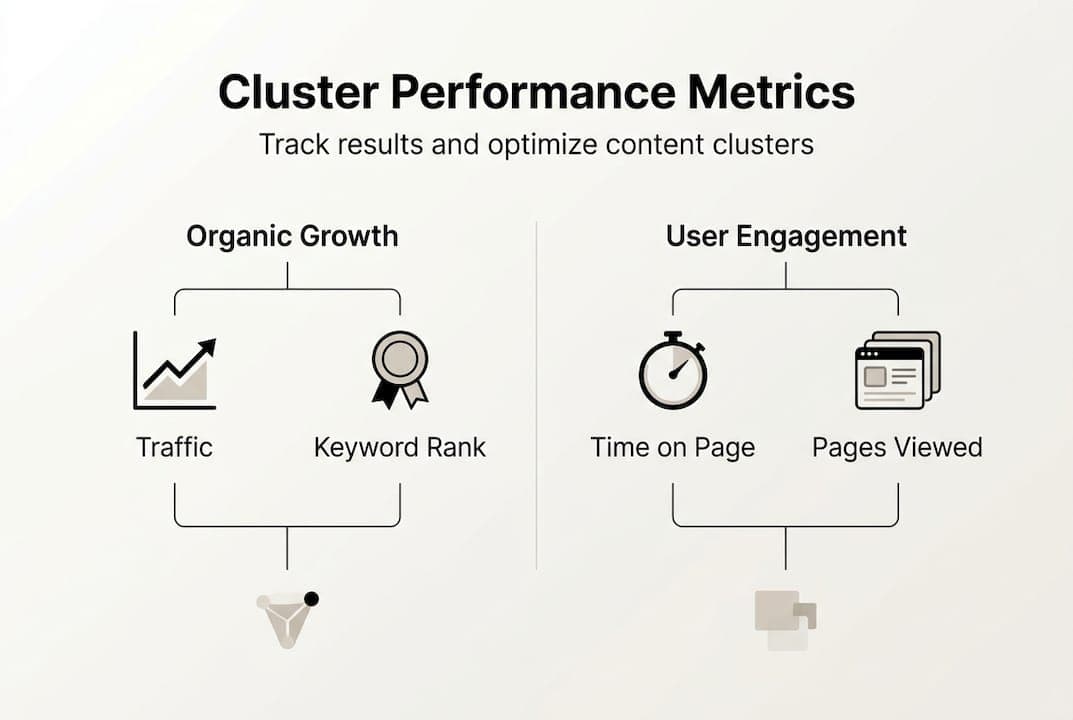
Engagement metrics provide insight into user experience within your clusters. Track average time on page, pages per session, and bounce rate for cluster content. Higher engagement suggests your internal linking effectively guides visitors through related topics. Conversely, high bounce rates on cluster articles may indicate weak connections to the pillar page or content that doesn't match search intent.
Audit your internal linking structure quarterly to identify broken links, orphaned pages, or weak connections between cluster content. Use crawling tools to visualize your link architecture and spot pages that need better integration into clusters. Regular audits maintain cluster effectiveness as you add new content and update existing pages. An AI SEO audit can automatically flag linking issues and suggest improvements based on your cluster structure.
| Approach | Manual Optimization | Automated Optimization |
|---|---|---|
| Time Investment | High, requires ongoing manual review | Low, tools monitor continuously |
| Scalability | Limited to small clusters | Handles hundreds of pages easily |
| Accuracy | Prone to human oversight | Consistent, data-driven recommendations |
| Cost | Staff time and opportunity cost | Tool subscription fees |
Refresh underperforming cluster content by updating statistics, adding new sections addressing emerging subtopics, and improving internal linking. Content decay affects older articles, so plan to revisit cluster pages annually with fresh data and examples. Check website crawlability to ensure search engines can access and index all cluster pages efficiently.
Watch for these red flags indicating cluster problems:
- Pillar page ranks well but cluster articles remain invisible in search results
- High bounce rates on cluster pages despite strong rankings
- Cluster articles compete with each other for the same keywords
- Internal links lead to 404 errors or redirect chains
- New cluster content doesn't improve overall topic rankings
Address issues promptly by reoptimizing content, fixing technical problems, or restructuring clusters that don't align with user intent. Sometimes splitting a broad cluster into two focused ones or merging thin cluster articles into comprehensive guides solves performance problems. Data-driven iteration separates successful cluster strategies from those that stagnate after launch.
Enhance your content cluster strategy with BabyLoveGrowth tools
Implementing content clusters at scale requires tools that automate research, planning, and optimization. BabyLoveGrowth offers AI-powered solutions designed specifically for digital marketers building authority through strategic content.
Our keyword clustering tool automatically groups thousands of keywords by semantic similarity and search intent, revealing natural cluster opportunities you'd miss manually. The keyword discovery platform uncovers long-tail variations and questions your competitors haven't targeted, expanding your clusters with high-value, low-competition content ideas. Regular AI SEO audits monitor your cluster performance, flagging technical issues and suggesting optimization improvements that keep your content competitive. These integrated tools help you scale from a few experimental clusters to comprehensive topical coverage that dominates your niche.
FAQ
What is a content cluster strategy and why is it important?
A content cluster strategy organizes related content around comprehensive pillar pages, with supporting articles addressing specific subtopics all interconnected through strategic internal links. This structure helps search engines understand your topical expertise and improves rankings by demonstrating depth of coverage. Clusters also enhance user experience by guiding visitors to related information naturally, increasing engagement and time on site. For digital marketers, clusters provide a systematic framework for content planning that prevents gaps and duplication while building sustainable organic traffic.
How do I identify the right keywords for my content clusters?
Start with broad topics relevant to your business, then use keyword research tools to discover related terms, questions, and long-tail variations. Prioritize keywords based on search intent rather than volume alone, grouping terms that indicate similar user needs. A keyword clustering tool automates this process by analyzing which keywords trigger similar search results, revealing natural content groupings. Focus on clusters where you can create at least eight to twelve articles, ensuring sufficient depth to establish authority on the topic.
What are common mistakes to avoid when building content clusters?
The most critical mistake is weak or missing internal links between pillar and cluster pages, which prevents search engines from understanding content relationships. Avoid clustering unrelated topics just to hit a target number of articles; thematic relevance matters more than cluster size. Don't let cluster content become outdated, as stale information undermines your authority and rankings. Finally, resist the temptation to over-optimize anchor text or force keywords unnaturally into links, which can trigger spam filters and hurt user experience.
How can I measure the success of my content cluster strategy?
Track organic search traffic to cluster pages before and after implementation, looking for sustained growth over three to six months. Monitor keyword rankings for both pillar and cluster content, watching for improvements in positions and the number of terms each page ranks for. Analyze engagement metrics like time on page, pages per session, and bounce rate to assess whether internal linking effectively guides users through your clusters. Use SEO audit tools to evaluate internal linking health, crawlability, and technical issues that might limit cluster performance. Regular measurement enables data-driven optimization that compounds results over time.