Content automation for SEO success in 2026: A guide


Most marketers believe that scaling content production automatically boosts SEO rankings. However, AI tools treat each prompt as a new opportunity without awareness of internal overlap, often creating competing pages that split authority rather than consolidate it. This guide reveals how to harness content automation strategically to amplify your SEO results without diluting your ranking power, helping you avoid the common pitfalls that undermine automated content strategies.
Table of Contents
- Understanding AI Content Automation And Its SEO Impact
- The Problem Of AI Content Cannibalization And Intent Replication
- How Structural Awareness Prevents Intent Overlap In Automated Content
- Best Practices To Leverage Content Automation For SEO Growth
- Explore BabyLoveGrowth AI Tools For Optimized Content Automation
Key takeaways
| Point | Details |
|---|---|
| Content automation boosts efficiency but requires structural intent management | AI-driven workflows scale content production rapidly yet demand clear intent allocation to prevent authority fragmentation. |
| AI content cannibalization arises from overlapping intents in automated workflows | Multiple AI-generated pages unintentionally targeting the same search intent split SEO authority and reduce ranking potential. |
| Effective automation consolidates authority rather than splits it | Strategic content mapping ensures each published page serves a unique intent, building cumulative SEO strength. |
| Structural awareness in publishing systems prevents SEO pitfalls | Adding intent allocation layers to automation workflows avoids duplicate content issues and maintains stable organic traffic. |
Understanding AI content automation and its SEO impact
Content automation uses AI content marketing platforms to generate, schedule, and publish articles at scale without constant manual input. These systems leverage natural language models to produce blog posts, social media updates, and landing pages based on keyword inputs and content briefs. For digital marketers, this represents a massive efficiency gain, allowing teams to cover hundreds of topics monthly while maintaining consistent brand voice and messaging standards.
The benefits are clear. Automation delivers:
- Scalability to cover extensive keyword lists and content gaps quickly
- Consistency in publishing frequency and content quality standards
- Resource efficiency by reducing manual writing and editing time
- Data-driven topic selection based on search volume and competitive analysis
Yet content marketing automation introduces a critical challenge most teams overlook. Without system awareness, automation treats every keyword as an isolated opportunity, generating multiple pieces that unknowingly compete for the same search intent. This creates internal competition where your own pages fight each other in search results rather than dominating different ranking opportunities.
SEO performance depends on how well your content architecture aligns with search intent distribution. When automation lacks structural oversight, it produces content that appears diverse on the surface but collapses into redundant intent clusters. Search engines then struggle to determine which page deserves ranking priority, often rotating pages in and out of results or selecting none for top positions. Understanding AI's role in SEO strategy means recognizing that intent management is the critical layer separating successful automation from counterproductive content proliferation.
The problem of AI content cannibalization and intent replication
AI content cannibalization issues occur when multiple AI-generated pages unintentionally target the same search intent, fragmenting your site's authority across competing URLs instead of concentrating ranking signals on one authoritative resource. This happens because AI writing tools generate content based on individual prompts without cross-referencing existing content or understanding your site's broader intent architecture. Each new article appears unique in wording and structure, yet serves the same underlying search need as three other pages already published.
Intent replication manifests in subtle ways. You might publish separate articles on "best email marketing tools," "top email automation platforms," and "leading email software solutions." While the phrasing differs, search engines recognize these as variations of identical commercial intent. Instead of ranking one strong page highly, your authority splits three ways, and none achieves the visibility a single consolidated page would command.
Most publishing systems track keyword usage but ignore intent overlap, allowing cannibalization to grow invisibly until traffic plateaus despite increasing content volume.
Recognize these warning signs:
- New content publishes regularly but organic traffic remains flat or declines
- Multiple pages rank intermittently for the same queries, with no clear winner
- Search Console shows impression sharing across similar URLs for identical keywords
- Individual page authority scores decrease as total published pages increase
- Backlinks distribute across competing pages rather than consolidating on primary targets
The root cause lies in how automated publishing platforms operate. They excel at text generation but lack the strategic layer that maps content to distinct intent spaces. Without this oversight, automation becomes a volume game that works against SEO fundamentals. Each new piece dilutes rather than strengthens your domain authority in target topic areas.

How structural awareness prevents intent overlap in automated content
Most AI publishing pipelines miss one critical layer: Structural awareness. This means mapping content roles and search intents before any writing begins, creating a blueprint that ensures each published piece occupies a unique strategic position in your content ecosystem. Rather than letting AI tools generate content reactively based on keyword lists, structural awareness allocates specific intent territories to each planned article, preventing overlap at the architectural level.
Implement structural intent allocation with this framework:
- Audit existing content to identify current intent coverage and gaps using keyword clustering analysis
- Map target keywords into distinct intent clusters: informational, commercial, transactional, and navigational
- Assign one primary URL to each intent cluster, designating it as the authority page
- Create supporting content that links to authority pages rather than competing with them
- Configure automation workflows to check intent assignments before generating new content
- Schedule quarterly reviews to consolidate or redirect pages showing overlap signals
This approach transforms automation from a content generation tool into a strategic content marketing automation system. Instead of asking "What content can we create?" you ask "What intent positions need filling?" The shift seems subtle but produces dramatically different results. Authority consolidates around fewer, stronger pages rather than dispersing across numerous weak competitors.
Pro Tip: Audit your current content pipeline by grouping published URLs by primary keyword, then manually reviewing whether each group serves genuinely different intents or merely rephrases the same need. This reveals hidden overlap your automation tools have been creating invisibly.
The difference between writing text and allocating strategic intent defines successful automation. Text generation scales infinitely, but intent spaces are finite and must be deliberately claimed. Understanding structural SEO awareness means recognizing that your content architecture matters more than individual article quality when automation reaches scale.
Best practices to leverage content automation for SEO growth
Optimizing AI content automation requires balancing scale with strategic control. The following comparison shows how manual and automated workflows differ in managing SEO intent:
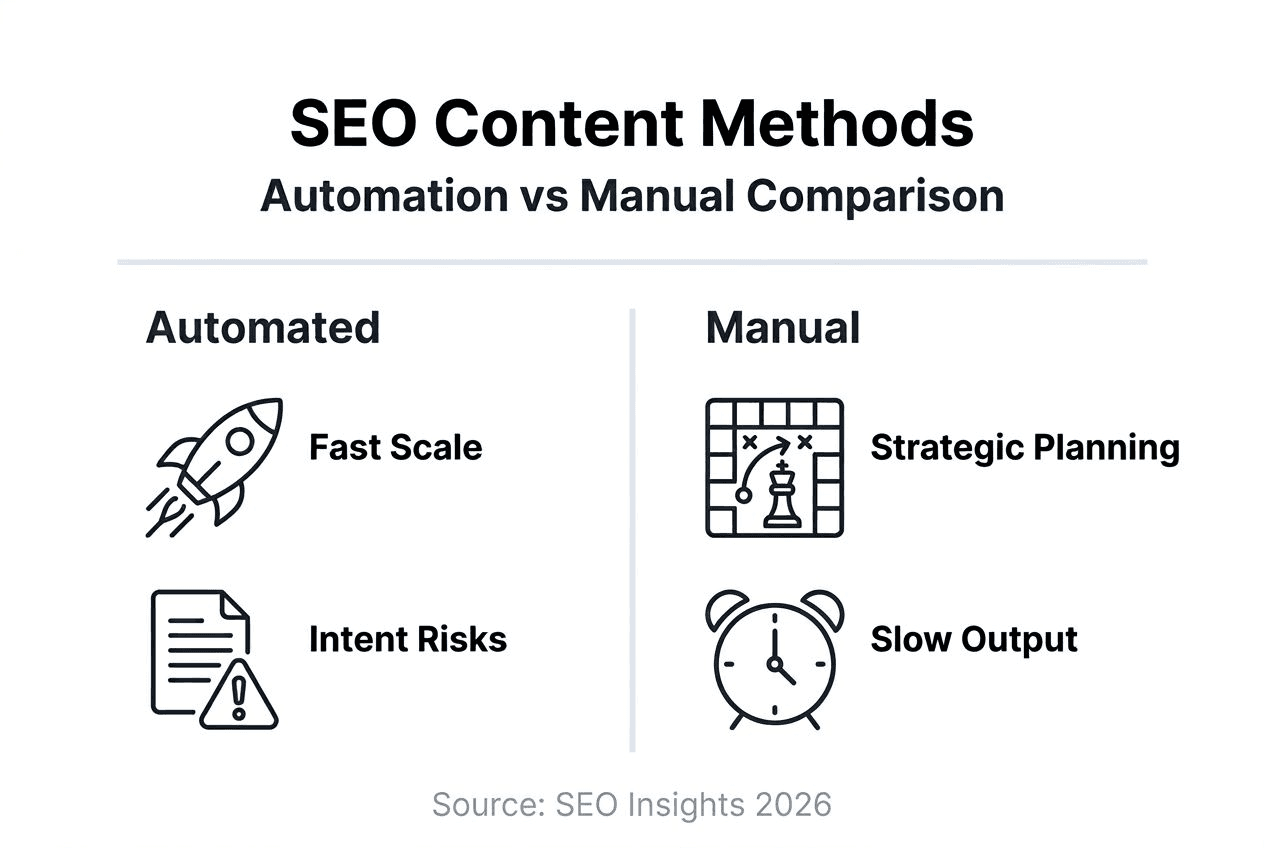
| Aspect | Manual Content Workflow | Automated Content Workflow |
|---|---|---|
| Intent Control | High precision but limited scale | Requires structural systems to maintain precision at scale |
| Publishing Speed | 2-5 articles weekly | 20-50+ articles weekly with proper tools |
| Keyword Coverage | Deep focus on priority terms | Broad coverage including long-tail opportunities |
| Cannibalization Risk | Low due to human oversight | High without intent mapping systems |
| Resource Investment | High labor cost per article | High upfront system design, low ongoing cost |
Apply these best practices to maximize automation benefits:
- Use keyword discovery platforms to identify genuine content gaps rather than generating variations on covered topics
- Implement keyword clustering tools to group related terms into single intent territories before writing begins
- Leverage keyword research tools to prioritize opportunities based on search volume, competition, and intent clarity
- Schedule monthly SEO audits specifically targeting cannibalization signals like multiple pages ranking for identical queries
- Configure automation rules that prevent new content creation when existing pages already serve the target intent
- Integrate crawlability assessments to ensure automated content maintains technical SEO standards as volume scales
Pro Tip: Run quarterly content gap analysis that compares your intent coverage against competitor content strategies. This reveals new opportunities while highlighting areas where your automation has created redundant coverage that should be consolidated.
The goal is making automation work for strategic advantage rather than just volume. When structured properly, AI-driven content systems become force multipliers that expand your organic footprint systematically without the authority fragmentation that plagues most scaled content operations. Success comes from treating automation as a strategic deployment system rather than just a writing assistant.
Explore BabyLoveGrowth AI tools for optimized content automation
Ready to implement strategic content automation without the cannibalization risks? BabyLoveGrowth offers specialized platforms that help you discover and organize keywords with intent awareness built in. Our keyword discovery platform identifies genuine content opportunities by analyzing search intent patterns, ensuring each new piece fills a unique strategic position rather than competing with existing content.
The keyword clustering tool groups related terms into consolidated intent territories, showing you exactly which keywords belong on the same page versus which require separate content. Combined with our AI SEO audit tool, you get continuous monitoring for overlap signals and crawlability issues that emerge as automation scales. These systems work together to maintain the structural awareness your content automation needs for sustained SEO growth, turning volume into authority rather than fragmentation.
FAQ
What is AI content cannibalization and why does it matter?
AI content cannibalization occurs when multiple AI-generated pages target the same search intent, splitting SEO authority across competing URLs instead of consolidating it on one strong page. This matters because search engines struggle to determine which page deserves ranking priority, often rotating pages in results or ranking none highly. The result is flat or declining organic traffic despite increasing content volume.
How can I identify if my website suffers from AI content cannibalization?
Look for multiple pages ranking intermittently for identical queries without a clear dominant URL. Check Search Console for impression sharing across similar pages targeting the same keywords. Use SEO audit tools to detect overlapping keyword intent patterns where different URLs serve the same underlying search need despite varied phrasing.
What steps can I take to prevent intent overlap in my automated content?
Implement content mapping before publishing to define unique intent territories for each planned article. Use keyword clustering tools to group related terms that belong on single pages rather than across multiple URLs. Add structural awareness layers to your automation workflows that check for existing intent coverage before generating new content, preventing duplication at the system level.
Can content automation improve organic traffic despite these risks?
Yes, content automation dramatically increases organic traffic when paired with proper intent management systems. Automation enables faster keyword coverage, consistent publishing frequency, and systematic content gap filling that manual workflows cannot match at scale. The key is adding structural oversight that ensures volume builds authority rather than fragments it across competing pages.