Backlink Analysis: Boosting SEO Strategy and Rankings


Over 80 percent of American websites see significant search ranking changes after adjusting their backlink strategies. For SEO professionals, understanding why links matter goes beyond satisfying an algorithm. A strong backlink analysis shapes more credible link portfolios and leaves less room for penalties or missed opportunities. This guide helps you cut through confusion, highlighting what separates high-impact American backlinks from risky, low-value links so your campaigns move competitors aside and gain real organic traction.
Table of Contents
- What Is Backlink Analysis And Why It Matters
- Types Of Backlinks And Their SEO Impact
- Essential Tools For Backlink Analysis
- Evaluating Link Quality And Relevance
- Common Pitfalls In Backlink Strategies
Key Takeaways
| Point | Details |
|---|---|
| Importance of Backlink Analysis | Backlink analysis offers insights into a website's authority and helps in developing effective SEO strategies. It evaluates the quality, quantity, and relevance of external links. |
| Types of Backlinks | Diferent types of backlinks, such as editorial and natural backlinks, have varying impacts on SEO performance. Focus on acquiring high-quality, contextual links. |
| Tools for Backlink Analysis | Utilize sophisticated software, like Ahrefs and SEMrush, to comprehensively evaluate your link profile and discover opportunities for improvement. |
| Avoiding Common Pitfalls | Avoid quantity-driven link building and over-optimization of anchor text. Instead, prioritize organic links from credible sources and periodically audit your link profile. |
What Is Backlink Analysis and Why It Matters
Backlink analysis represents a strategic digital marketing technique for understanding and evaluating the network of external links pointing to a website. At its core, this process involves systematically examining the quantity, quality, and relevance of links from other websites that connect back to your digital platform. Backlink analysis provides critical insights into a website's search engine authority, helping SEO professionals develop more effective optimization strategies.
The fundamental purpose of backlink analysis goes beyond simple link counting. Professionals use this technique to assess the domain authority, understand competitive link profiles, and identify potential opportunities for improving search engine rankings. By carefully examining factors like link source credibility, anchor text diversity, and overall link portfolio composition, marketers can develop nuanced strategies to enhance organic visibility. Strategic backlink building techniques become more precise and targeted when supported by comprehensive analytical research.
Understanding backlink analysis requires recognizing its multifaceted nature. SEO experts evaluate several key metrics during their assessments, including link origin domains, total referring domains, anchor text distribution, and link relevance. These metrics help determine not just the quantity of backlinks, but their qualitative impact on search engine performance. Websites with diverse, high-quality backlink profiles typically achieve stronger search rankings compared to those with limited or low-quality external links.
Pro tip: Start your backlink analysis by auditing your current link profile and identifying your top 10 highest-quality referring domains to understand your existing link strength and potential improvement areas.
Types of Backlinks and Their SEO Impact
Backlinks are not created equal, with distinct types offering varying levels of value and impact on search engine optimization. Editorial backlinks represent the gold standard in link building, emerging from high-quality content that naturally attracts references from authoritative websites. Sophisticated link acquisition strategies recognize that not all external links carry the same weight in search rankings.
The spectrum of backlink types includes several critical categories that SEO professionals must understand. Natural backlinks occur when other websites voluntarily link to your content because of its inherent value, while manual backlinks are deliberately obtained through outreach and relationship building. Guest posting, industry citations, and resource page links represent strategic methods for generating high-quality external references that signal credibility to search engines.
Some backlink types carry more significant SEO potential than others. Contextual links embedded within relevant content typically provide more ranking power compared to sidebar or footer links. Niche-specific backlinks from industry-related websites demonstrate topical authority and relevance, which search algorithms increasingly prioritize. Authoritative domains linking to your content can dramatically improve domain credibility, with links from educational (.edu), government (.gov), and established industry websites offering the most substantial ranking benefits.

Here's a comparison of common backlink types and their typical SEO value:
| Backlink Type | How It's Acquired | Typical SEO Impact |
|---|---|---|
| Editorial Backlink | Earned via high-value content | Very strong ranking boost |
| Natural Backlink | Unprompted references from others | High authority signal |
| Manual Backlink | Outreach or relationship building | Moderate ranking effect |
| Guest Post Link | Published article contributions | Strong if context matches |
Pro tip: Prioritize acquiring contextual backlinks from websites with high domain authority that are directly relevant to your industry and content focus.
Essential Tools for Backlink Analysis
Backlink analysis requires sophisticated software that can comprehensively map and evaluate external link networks. Advanced backlink discovery platforms have revolutionized how SEO professionals track and assess link profiles, offering unprecedented insights into digital connectivity and search engine performance. Premium tools like Ahrefs, SEMrush, and Moz provide nuanced metrics that go far beyond simple link counting.
The landscape of backlink analysis tools encompasses several critical categories, each designed to address specific analytical needs. Free tools such as Google Search Console offer basic link tracking, while enterprise-level platforms deliver comprehensive link auditing capabilities. Key features to evaluate include database size, real-time link discovery, toxic link detection, and competitor benchmarking. These tools help professionals understand link quality, assess domain authority, and identify potential opportunities for strategic link building.
Professional SEO practitioners typically leverage multiple tools to create a comprehensive link analysis strategy. Some platforms specialize in specific aspects of backlink research, such as anchor text analysis, referring domain evaluation, or competitive link profile comparison. Most sophisticated tools now integrate machine learning algorithms that can predict link value, detect potential link spam, and provide actionable recommendations for improving overall link portfolio performance.
Pro tip: Combine at least two different backlink analysis tools to cross-validate link data and gain a more comprehensive understanding of your website's link profile.
Evaluating Link Quality and Relevance
Link quality assessment involves a multifaceted approach that goes far beyond simple numerical metrics. Advanced link quality metrics demonstrate that modern link evaluation requires a comprehensive understanding of multiple interconnected factors. Domain authority, content relevance, and contextual alignment represent the primary pillars of effective link quality assessment.
Professional SEO strategists evaluate links through several critical lenses. Topical relevance emerges as a paramount consideration, where links must originate from websites sharing similar subject matter or industry context. Relevance signals include content theme alignment, audience overlap, and thematic proximity. Additional key metrics encompass domain age, website credibility, organic traffic volume, and the linking page's specific PageRank or authority score.
The most sophisticated link evaluation approaches integrate quantitative and qualitative assessments. Technical metrics like domain rating, trust flow, and citation flow provide numerical insights, while qualitative factors such as editorial standards, content depth, and user engagement contribute nuanced understanding. Search engines increasingly prioritize links that demonstrate genuine editorial recommendation and authentic contextual value over manipulative or low-quality link acquisition strategies.
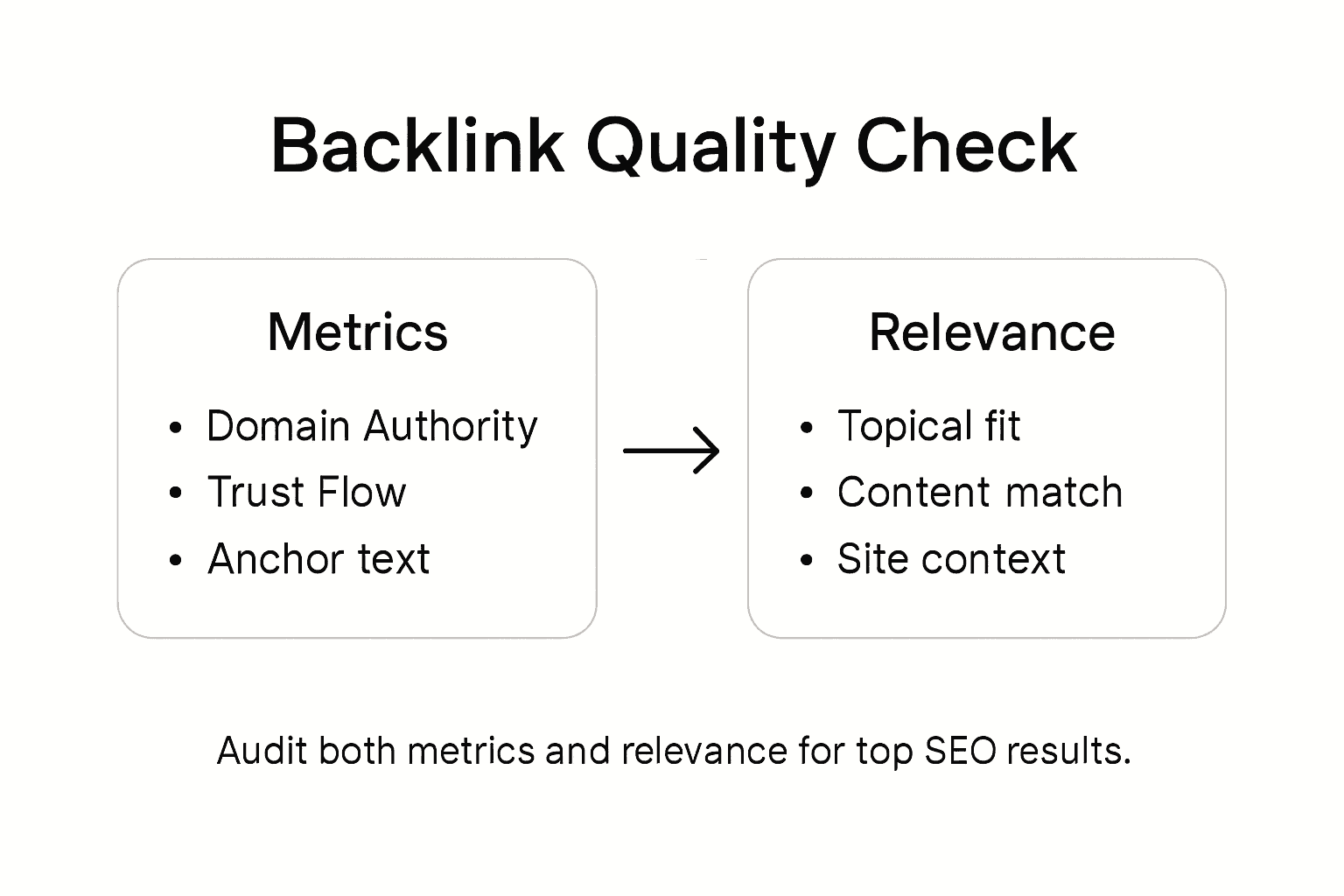
This summary outlines important link quality metrics and what they indicate:
| Metric | What It Measures | Why It Matters |
|---|---|---|
| Domain Authority | Overall site trust | Predicts potential search impact |
| Page Relevance | Topical alignment | Ensures contextual value |
| Anchor Diversity | Variation in anchor texts | Reduces penalty risk, boosts trust |
| Link Placement | Position within content | Contextual links pass more value |
Pro tip: Implement a rigorous three-tier link evaluation framework that considers technical metrics, content relevance, and editorial quality to accurately assess backlink potential.
Common Pitfalls in Backlink Strategies
Backlink strategies are fraught with potential missteps that can dramatically undermine SEO performance. Dangerous link building mistakes continue to plague digital marketers who prioritize quantity over strategic quality. Quantity-driven approaches represent the most prevalent error, where professionals accumulate links without considering their inherent value, relevance, or potential search engine penalties.
Some of the most critical backlink strategy failures emerge from fundamental misunderstandings about link acquisition. Over-optimization of anchor text remains a significant risk, where marketers repeatedly use identical keyword-rich phrases that trigger search engine spam filters. Additional common pitfalls include pursuing links from irrelevant domains, engaging in link exchange networks, and creating low-quality content solely designed to generate backlinks. These tactics not only fail to improve rankings but can actively harm a website's search engine credibility.
Professional SEO practitioners must adopt a sophisticated, holistic approach to link building. This means developing a nuanced strategy that emphasizes organic link acquisition through high-quality content, genuine industry relationships, and creating genuinely valuable resources that naturally attract external references. Successful link strategies require continuous monitoring, periodic link profile audits, and a commitment to maintaining a diverse, contextually relevant link ecosystem that aligns with search engine quality guidelines.
Pro tip: Conduct a comprehensive link profile audit every quarter to identify and disavow toxic or low-quality backlinks that could negatively impact your search engine rankings.
Unlock the Power of Backlink Analysis with AI-Driven SEO Solutions
Backlink analysis is essential for mastering your website’s search authority and boosting rankings while avoiding costly mistakes like over-optimization or irrelevant link building. If you want to transform complex backlink data into actionable strategies that increase your organic traffic and domain credibility, it is time to explore automated tools designed for precise link quality assessment and strategic backlink acquisition.
Discover how Babylovegrowth.ai can simplify your backlink management by providing AI-powered backlink building, domain authority tracking, and contextual link insights. Our platform offers everything you need to elevate your SEO strategy including automated content planning, daily SEO articles, and advanced link building software that targets high-quality, relevant backlinks. Start gaining stronger search rankings today by harnessing the power of intelligent backlink analysis and scalable SEO automation.
Frequently Asked Questions
What is backlink analysis and why is it important for SEO?
Backlink analysis involves evaluating the external links pointing to a website to understand its authority and performance in search engines. It helps identify strengths and weaknesses in a website's link profile, allowing for more effective SEO strategies.
How can I start my backlink analysis?
Begin by auditing your current link profile. Identify your top 10 highest-quality referring domains to understand your existing link strength and areas for potential improvement.
What are the different types of backlinks and how do they impact SEO?
Backlinks vary in quality and impact. Editorial backlinks are highly valuable as they come from high-quality content. Natural backlinks are earned organically, while manual backlinks are obtained through outreach. Contextual links typically carry more ranking power compared to sidebar or footer links.
What tools can I use for backlink analysis?
Sophisticated tools like Ahrefs, SEMrush, and Moz are widely used for comprehensive backlink analysis. These tools offer features such as real-time link discovery, toxic link detection, and competitor benchmarking to help evaluate link quality and performance.