How to master AI-powered keyword discovery for SEO


TL;DR:
- Traditional keyword tools often miss searcher intent, affecting rankings in 2026.
- AI-driven SEO requires structured inputs, human validation, and focus on semantic relevance.
- Hybrid human-AI workflows deliver better ROI and more accurate, intent-driven keyword discoveries.
Traditional keyword tools tell you what people search. They rarely tell you why. Volume metrics and broad match data leave huge gaps in search intent, and in 2026, those gaps cost you rankings. Traditional volume tools are increasingly insufficient for intent-driven SEO, which is exactly why AI-powered keyword discovery has moved from novelty to necessity. In this guide, you'll learn how to prepare your workflow, execute a structured AI-driven process, avoid costly pitfalls, and measure real results so your SEO strategy stays ahead of the curve.
Table of Contents
- Preparing for AI-powered keyword discovery
- Step-by-step AI-powered keyword discovery process
- Troubleshooting and pitfalls in AI keyword discovery
- Expected results and measuring AI SEO success
- Why hybrid human-AI keyword workflows are the future of SEO
- Accelerate your SEO with AI-powered keyword tools
- Frequently asked questions
Key Takeaways
| Point | Details |
|---|---|
| Hybrid workflow wins | Combining human validation with AI-powered keyword discovery yields more accurate and actionable SEO outcomes. |
| Semantic intent matters | AI tools help uncover intent-driven and long-tail phrases missed by volume-based tools. |
| Measure and verify | Always validate AI-discovered keywords against SERPs and customer data to ensure effectiveness. |
| Avoid metric hallucination | Do not rely solely on AI-generated numbers without expert review—watch for semantic confusion. |
| Accelerate SEO with AI | Deploy specialized AI keyword tools to speed up research, clustering, and content strategy for organic growth. |
Preparing for AI-powered keyword discovery
Before you run a single AI prompt, you need the right conceptual foundation and toolset. Three terms matter most here: semantic relevance (how closely keywords align with a topic's meaning, not just its wording), clustering (grouping keywords by shared intent or topic), and intent modeling (predicting what a searcher actually wants to accomplish). Without clarity on these, you'll feed AI vague inputs and get vague outputs.
Understanding keyword research importance is the first step before layering AI on top of your existing process. AI doesn't replace strategy. It amplifies it.
Tools you'll need to get started:
- An AI language model with strong reasoning capability (GPT-4o, Claude 3.5, or similar)
- A keyword data source for volume validation (Google Search Console, Ahrefs, or Semrush)
- A clustering platform or spreadsheet to organize outputs
- Access to real SERP data and, ideally, customer interview transcripts or support tickets
- A CMS or content planning tool to map keywords to pages
AI excels at modeling customer journeys and long-tail discovery, which is something no legacy tool can do at scale. But it needs structured inputs to perform well.
| Preparation step | Tool or resource | Purpose |
|---|---|---|
| Define target personas | CRM data, interviews | Align AI prompts with real buyer language |
| Pull seed keywords | Google Search Console | Ground AI outputs in actual search data |
| Set intent categories | Custom taxonomy | Filter AI clusters by funnel stage |
| Validate with SERPs | Manual review | Confirm topical accuracy before scaling |
The role of AI in content strategy has expanded rapidly, but every strong workflow still starts with human-defined goals. Decide what pages you need to rank, what audience segments you're targeting, and what conversions matter before asking AI to generate anything.

Pro Tip: Feed AI your actual customer support tickets or sales call transcripts as context. You'll get keyword suggestions that match how real buyers describe their problems, not how your product team does.
Step-by-step AI-powered keyword discovery process
With your preparation complete, follow this structured blueprint to maximize results.
- Define your semantic core. Start with 5 to 10 seed topics tied to specific buyer stages. For each topic, write a prompt asking the AI to generate 20 to 30 long-tail variations based on informational, navigational, and transactional intent.
- Model the buyer journey. Prompt AI to map keyword clusters to awareness, consideration, and decision stages. This surfaces intent signals that volume tools miss entirely.
- Cluster by topic and intent. Group AI outputs into semantic clusters. Each cluster should represent one clear topic and one dominant intent type. Tools like spreadsheets with color coding work fine here.
- Validate against SERPs. For each cluster, manually review the top 5 search results. Does the content format match what Google rewards? Are competitors ranking with articles, product pages, or tools? Adjust your clusters accordingly.
- Cross-check with customer data. Pull language from reviews, support tickets, or interview notes. If a keyword appears in your AI cluster and in real customer language, it's a strong signal.
- Prioritize by opportunity gap. Sort your validated clusters by estimated difficulty versus your current domain authority. Target clusters where you have a realistic shot at page one within 90 days.
| Approach | Speed | Accuracy | Strategic depth | Cost |
|---|---|---|---|---|
| Pure AI | Very fast | Medium | Low | Low |
| Pure manual | Slow | High | High | High |
| Hybrid AI + human | Fast | High | High | Medium |
The AI keyword discovery workflow works best when humans define the intent categories and AI handles the volume generation. Think of it as AI doing the heavy lifting and you doing the quality control.
For teams scaling this process, an AI content workflow that integrates keyword clustering directly into content briefs can cut research time significantly.
Pro Tip: When prompting AI for keyword clusters, include a negative instruction. Tell it to exclude keywords that are purely informational if you need transactional intent. Specificity in prompts directly improves output quality.
Troubleshooting and pitfalls in AI keyword discovery
Running AI at scale creates a specific category of errors that traditional SEO tools don't produce. The most dangerous is metric hallucination, where an AI confidently assigns search volume or competition scores that are simply fabricated. This happens because most large language models don't have live data access unless specifically integrated with a real-time data source.
Warning signs of hallucinated metrics:
- Volume figures that don't appear in any paid keyword tool
- Keywords with suspiciously round numbers (exactly 1,000 or 10,000 monthly searches)
- Long-tail phrases with zero SERP results when you search manually
- Topically accurate clusters that rank for completely different intents in practice
AI tools can over-rely on keyword density and hallucinate relevance without human checks, which makes SERP validation at every stage essential rather than optional.
The second major risk is semantic confusion. AI may cluster keywords together that sound related but serve very different intents. For example, "content strategy template" (a tool-seeker) and "content strategy examples" (a research-seeker) look similar but need different page formats to rank.
"The difference between semantic similarity and topical authority is something humans recognize instantly and AI frequently misses. Your job is to audit every cluster for intent coherence before it touches a content brief."
Expert shortcuts for advanced teams:
- Use RAG (Retrieval-Augmented Generation) to feed AI your existing top-ranking content as context, so keyword suggestions align with your established topical authority
- Apply chunking when processing large keyword lists: break inputs into groups of 50 or fewer for more precise clustering
- Structure AI outputs with schema-ready labels so you can directly map keywords to structured data types (FAQ, HowTo, Product) from the start
Exploring SEO automation tools that integrate validation steps natively can reduce the manual QA burden significantly. Pairing automation with strong AI content creation practices keeps quality high even at volume.
Pro Tip: Always run your final keyword list through a real SERP check before assigning it to a content brief. A five-minute manual check per cluster saves hours of rework later.
Expected results and measuring AI SEO success
AI-powered keyword discovery delivers measurable gains when the workflow is properly executed. Here's what realistic performance looks like.
Key metrics to track:
- Organic traffic lift: Measure week-over-week and month-over-month changes for pages built from AI-discovered clusters
- Long-tail ranking depth: Track how many new long-tail keywords enter the top 50, top 20, and top 10 over 30, 60, and 90-day windows
- Semantic authority score: Use tools like Surfer SEO or Clearscope to monitor topical coverage scores for your target clusters
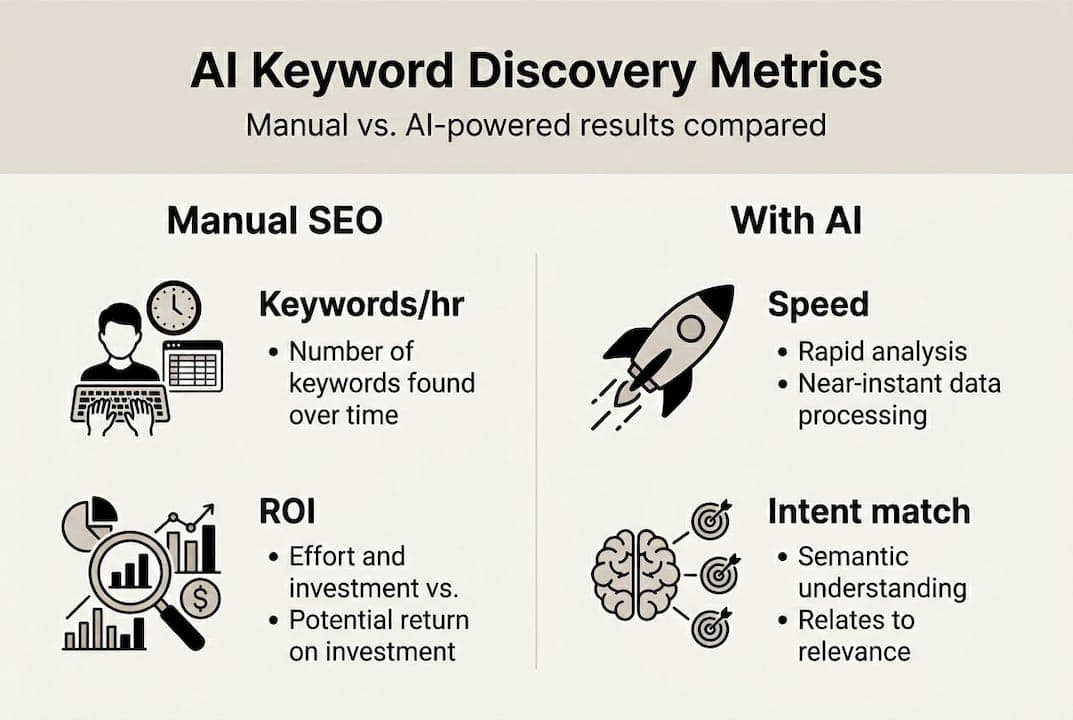
- Discovery speed: Measure how many net-new keyword opportunities your team identifies per hour compared to manual methods
- Content-to-ranking conversion rate: What percentage of AI-informed pages rank on page one within 90 days?
AI can deliver faster discovery and deeper intent-driven results when properly validated, but benchmarks depend heavily on your domain authority and content execution quality.
| Metric | Manual baseline | AI-powered result | Improvement |
|---|---|---|---|
| Keywords discovered per hour | 20 to 30 | 150 to 300 | 5x to 10x |
| Long-tail coverage | Narrow | Broad | Significant |
| Time to first ranking | 60 to 90 days | 45 to 60 days | 25% faster |
| Content brief creation time | 2 to 4 hours | 30 to 60 minutes | 75% reduction |
For teams tracking AI productivity gains across their SEO programs, keyword discovery is consistently one of the highest-leverage areas for automation. Scalable SEO automation becomes viable only when keyword inputs are both high quality and high volume. AI-powered discovery makes both possible simultaneously.
Interpret your results through two lenses. AI will show you patterns in the data. Humans will tell you whether those patterns actually match buyer behavior. Use both.
Why hybrid human-AI keyword workflows are the future of SEO
Here's the part most guides skip: AI is genuinely impressive at scale, and it will still get your SEO strategy wrong if left unsupervised. Not because it's bad technology. Because it lacks brand context, customer intuition, and the judgment to recognize when a semantically correct keyword is strategically wrong for your business.
We've seen teams use AI to generate thousands of keyword clusters, publish content at speed, and then watch rankings stagnate because the clusters never matched actual buyer language. The tool wasn't the failure. The missing human layer was.
Hybrid approaches outclass pure AI for ROI and semantic relevance in SEO, and this isn't a defense of slow, manual processes. It's a case for building AI workflows where humans own the strategy layer and AI owns the execution layer. That division of labor is what separates teams that get compounding organic growth from teams that produce content volume with no ranking impact.
The real competitive edge in 2026 isn't using AI. It's knowing where to override it and why. Investing in AI-driven SEO user experience improvements reinforces this point: the brands winning search are those treating AI as a skilled assistant, not an autonomous strategist.
Accelerate your SEO with AI-powered keyword tools
You now have a complete framework for implementing AI-powered keyword discovery, from setup through measurement. The next step is putting the right tools behind the process.
Babylovegrowth.ai gives SEO professionals and marketing teams an AI keyword discovery platform built for strategic depth, not just volume. Use the integrated keyword research tool to surface intent-driven opportunities your competitors haven't found yet, and apply the keyword clustering tool to organize outputs into content-ready topic clusters automatically. From daily SEO articles to 30-day content plans, Babylovegrowth.ai handles the execution so your team can focus on strategy.
Frequently asked questions
How does AI-powered keyword discovery improve SEO over traditional methods?
AI-powered keyword discovery surfaces intent-driven, long-tail, and semantically relevant terms that legacy volume tools consistently miss. It models buyer journeys at scale, identifying opportunities that manual research would take weeks to find.
What are the risks of relying solely on AI for keyword research?
Pure AI can hallucinate relevance and metric data without human oversight, leading to semantic confusion and keyword clusters that don't match actual search behavior or buyer intent.
How do you validate AI-generated keyword clusters for SEO effectiveness?
Cross-check every cluster against live SERPs and real customer language from reviews or support data, confirming that semantic and topical accuracy holds up before the cluster informs a content brief.
Which metrics should be tracked to measure AI SEO success?
Focus on organic traffic lift, long-tail ranking depth, semantic authority scores, and discovery speed per hour. AI delivers faster discovery and stronger intent alignment when validation steps are built into the workflow.