Search Engine Ranking: What Drives Online Visibility


Most American businesses rely on search engines to reach their audience, yet only a small fraction ever make it to the coveted first page of results. The way a website ranks in search results can determine its visibility, trust, and success in the crowded digital world. Understanding search engine ranking reveals why some sites attract thousands of visitors while others remain unseen and outlines practical strategies for standing out in any competitive online space.
Table of Contents
- Defining Search Engine Ranking And Its Purpose
- How Search Engines Determine Ranking Positions
- Major Factors That Influence Rankings
- Effective Strategies To Improve Rankings
- Common Misconceptions And Mistakes In Seo
Key Takeaways
| Point | Details |
|---|---|
| Search Engine Ranking is Essential | It determines a website's visibility and ability to attract online traffic, significantly impacting user accessibility to information. |
| Content Quality is Crucial | High-quality, original, and comprehensive content leads to improved search positioning and sustained organic traffic. |
| Ongoing Optimization is Necessary | Websites must continually adapt to evolving search algorithms and prioritize both technical performance and user experience. |
| Avoid Common SEO Misconceptions | Many strategies, such as keyword stuffing or focusing solely on quantity over quality, can hinder a website's visibility and effectiveness. |
Defining Search Engine Ranking and Its Purpose
Search Engine Ranking fundamentally determines how websites appear in search results, representing their visibility and potential to attract online traffic. It's a critical metric that decides which web pages users see first when searching for specific information.
At its core, search engine ranking operates through complex algorithmic processes that evaluate websites across multiple dimensions. Search engines like Google analyze factors such as content relevance, website authority, user experience, loading speed, and the quality of backlinks to determine a page's position on search results pages. These intricate calculations happen instantaneously, presenting users with the most appropriate and valuable content for their specific query.
Understanding search engine ranking involves recognizing its primary purpose: connecting users with the most pertinent information efficiently. Websites that effectively optimize their content, provide genuine value, and meet technical performance standards are more likely to achieve higher rankings. This means businesses and content creators must focus not just on keywords, but on creating comprehensive, high-quality content that genuinely addresses user needs and provides meaningful insights.
The ranking process isn't static - it's a dynamic system that continuously evolves. Search engines regularly update their algorithms to improve result quality, reward excellent content, and penalize manipulative tactics. Successful online visibility requires ongoing adaptation, strategic content development, and a deep understanding of how search technologies evaluate and prioritize digital information.
How Search Engines Determine Ranking Positions
Search engine ranking algorithms are intricate systems designed to evaluate and prioritize web content based on multiple sophisticated criteria. These complex computational processes analyze websites through a multidimensional lens, assessing everything from content quality to technical performance.
Google's ranking systems strategically consider factors such as keyword relevance, content comprehensiveness, website authority, and user engagement metrics. Websites are essentially scored across various performance dimensions, with each element contributing to their overall search result positioning. Key ranking signals include:
- Content originality and depth
- Website loading speed
- Mobile responsiveness
- Quality and quantity of backlinks
- User interaction signals (time spent on page, bounce rates)
- Technical website infrastructure
- Content freshness and update frequency
The algorithmic evaluation is dynamic and continuously evolving. Search engines regularly refine their ranking mechanisms to combat manipulative tactics and reward high-quality, user-focused content. This means websites must consistently adapt their strategies, focusing not just on technical optimization but on genuinely providing valuable, relevant information that meets user intent.
Successful search ranking requires a holistic approach that balances technical performance with meaningful content creation. Websites must develop comprehensive strategies that address both algorithmic requirements and user experience, understanding that search engines fundamentally aim to connect users with the most relevant, high-quality information available.
Major Factors That Influence Rankings
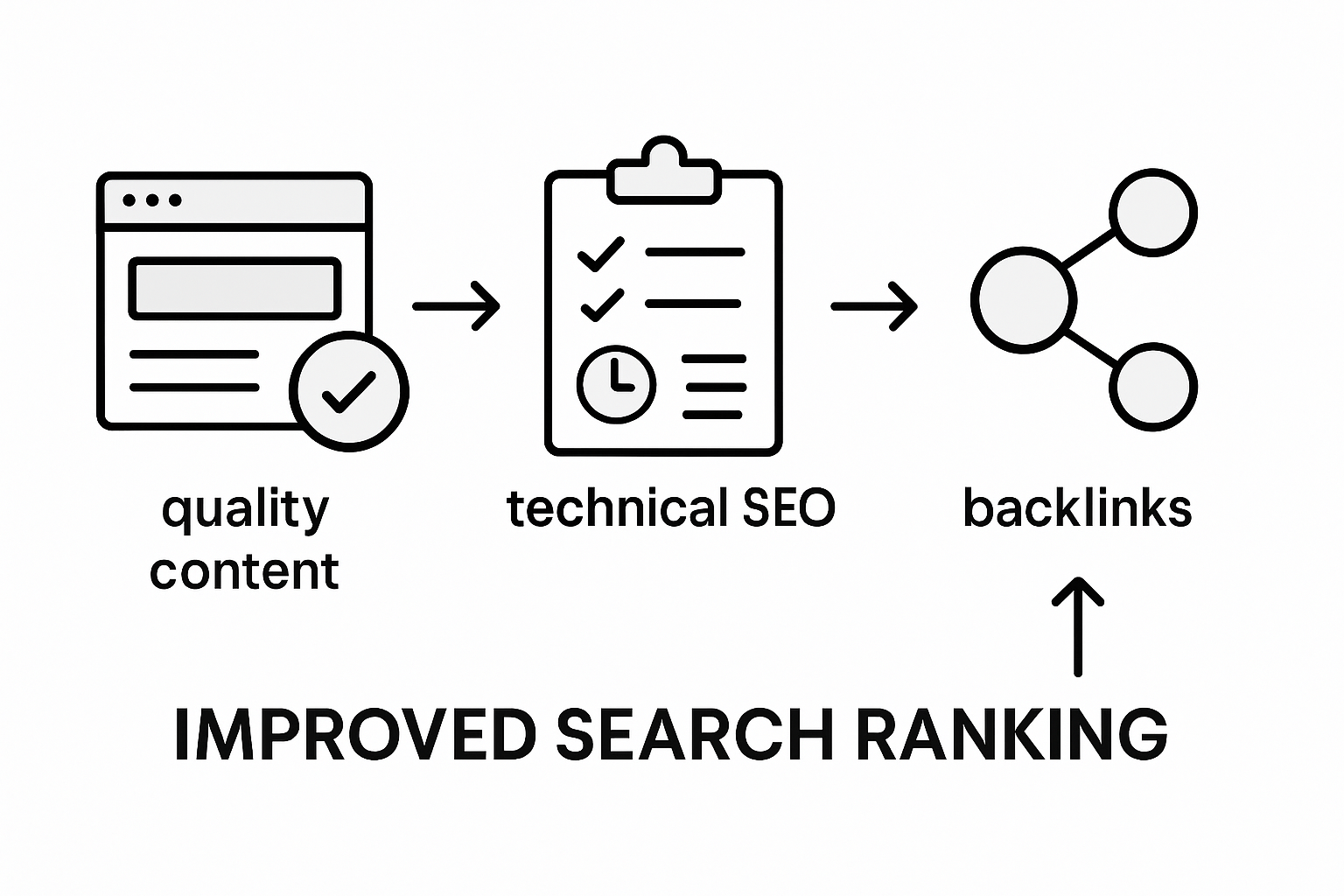
Content Quality stands as the foundational cornerstone of search engine rankings, representing the most critical factor that determines a website's visibility and success in digital landscapes. Websites that consistently produce comprehensive, original, and valuable content are more likely to achieve higher search positioning and attract sustained organic traffic.
The ranking process involves multiple interconnected elements that search engines meticulously evaluate. Key ranking factors include:
- Keyword Relevance
- Strategic keyword integration
- Semantic keyword coverage
- Natural language context
- Technical Performance
- Website loading speed
- Mobile responsiveness
- Secure HTTPS protocols
- User Experience Signals
- Click-through rates
- Time spent on page
- Low bounce rates
- Content Characteristics
- Depth and comprehensiveness
- Originality and uniqueness
- Regular content updates
Backlink profiles represent another crucial ranking determinant, with search engines interpreting high-quality external links as endorsements of a website's credibility and authority. Websites that attract natural, relevant backlinks from reputable sources typically enjoy improved search visibility and higher domain authority.

Understanding these ranking factors requires recognizing their dynamic nature. Search engines continuously refine their algorithms, meaning successful digital strategies demand ongoing adaptation, continuous learning, and a holistic approach to content creation and technical optimization. Websites must proactively develop strategies that simultaneously address technical requirements, user experience, and genuine value creation.
Effective Strategies to Improve Rankings
Search Engine Optimization (SEO) demands a multifaceted approach that combines technical precision with high-quality content creation. Successful ranking strategies require websites to implement a comprehensive set of techniques that address both algorithmic requirements and user experience expectations.
Websites can significantly enhance their search positioning by optimizing meta descriptions and title tags with strategic keyword integration. Key optimization strategies include:
- Content Optimization
- Develop comprehensive, original content
- Target long-tail and semantic keywords
- Maintain consistent content quality and relevance
- Technical SEO Improvements
- Enhance website loading speed
- Implement mobile-responsive design
- Ensure secure HTTPS protocols
- Backlink Development
- Create link-worthy, high-quality content
- Engage in ethical link-building practices
- Build relationships with industry authorities
- User Experience Enhancements
- Improve site navigation
- Reduce bounce rates
- Optimize internal linking structure
Building a robust backlink profile remains crucial for establishing website authority. Search engines interpret high-quality external links as endorsements, significantly influencing a site's credibility and potential search rankings. Websites must focus on attracting natural, relevant backlinks from reputable sources through consistently valuable content creation.
Successful ranking strategies require continuous adaptation and proactive optimization. Digital marketers and website owners must stay informed about evolving search engine algorithms, continuously refine their approaches, and maintain a holistic perspective that balances technical requirements with genuine user value. The most effective SEO strategies are those that prioritize creating meaningful, user-focused content while maintaining technical excellence.
Common Misconceptions and Mistakes in SEO
Search Engine Optimization (SEO) is often misunderstood, with many digital marketers and website owners falling prey to outdated or ineffective strategies. These misconceptions can significantly hinder a website's potential to achieve meaningful online visibility and organic growth.
Many professionals mistakenly believe that search engine optimization follows simple, static rules, but the reality is far more nuanced. Common SEO myths and mistakes include:
- Keyword Stuffing Misconceptions
- Believing more keywords mean better rankings
- Ignoring natural language and readability
- Overemphasizing exact-match keywords
- Content Quality Errors
- Prioritizing quantity over meaningful content
- Creating shallow, repetitive articles
- Neglecting user intent and value
- Technical SEO Misunderstandings
- Overlooking mobile responsiveness
- Ignoring page loading speeds
- Neglecting structured data implementation
- Link Building Fallacies
- Pursuing quantity over link quality
- Engaging in manipulative link schemes
- Failing to develop genuine industry relationships
Quick fixes and shortcuts rarely produce sustainable SEO results. Search engines continuously evolve their algorithms to prioritize user experience, meaningful content, and genuine website authority. Websites that focus on creating valuable, user-centric content while maintaining technical excellence are more likely to achieve and maintain strong search rankings.
Successful SEO requires a holistic approach that balances technical optimization, content quality, and authentic user engagement. Digital marketers must move beyond simplistic strategies and embrace a comprehensive understanding of how search technologies evaluate and rank online content. The most effective SEO strategies are those that prioritize genuine value, user experience, and continuous learning.
Unlock Your Website's True Potential with AI-Powered SEO
Understanding what drives search engine ranking is the first step toward improving your online visibility. This article highlights key challenges like balancing content quality, technical performance, and backlink authority — areas where manual effort can quickly become overwhelming. If you are striving to create original, comprehensive content while navigating ever-changing algorithms, you need a solution that adapts with you and scales effortlessly.

Transform your SEO strategy today with Babylovegrowth.ai, an all-in-one AI-powered platform designed to simplify organic traffic growth. Our system provides automated high-quality articles optimized specifically for Google and ChatGPT, backed by a 30-day personalized content plan and a robust backlinks exchange ecosystem. Explore how our SEO marketing strategy can help you consistently outrank competitors through proven optimization techniques. Don’t wait to boost your search rankings—start your free trial now and experience SEO on autopilot with Babylovegrowth.ai.
Frequently Asked Questions
What factors influence search engine ranking?
Key factors influencing search engine ranking include content quality, keyword relevance, technical performance, user experience signals, and backlink profiles. High-quality, original content and an optimized website contribute significantly to higher rankings.
How can I improve my website's search engine ranking?
To improve your website's search engine ranking, focus on creating comprehensive, valuable content, optimizing technical aspects like loading speed and mobile responsiveness, and building quality backlinks from reputable sources.
What is the role of keywords in search engine ranking?
Keywords play a crucial role in search engine ranking as they help search engines understand the content relevance. Strategic integration of keywords, including long-tail and semantic variations, increases the chances of ranking higher for relevant searches.
Why is content quality so important for SEO?
Content quality is essential for SEO because search engines prioritize valuable and informative content that meets user intent. High-quality content not only boosts rankings but also enhances user engagement and reduces bounce rates.
Recommended
- What is Search Engine Visibility & How to Improve
- Understanding the Importance of Website Visibility
- Understanding Website Visibility Techniques for Success
- Essential Search Visibility Metrics for Online Growth
- 7 Key Digital Marketing Trends 2025 for Malaysian Buyers - Projector Display
- Understanding the Importance of Customer Communication – My WordPress
Smart SEO,
Faster Growth!
Most Read Articles
Generative Engine Optimization (GEO)
Learn how Generative Engine Optimization (GEO) helps your content rank in AI search engines like ChatGPT and Google AI. This comprehensive guide explains the differences between SEO and GEO, why it matters for your business, and practical steps to implement GEO strategies for better visibility in AI-generated responses.
DylenJan 18, 2025
Track LLM Traffic in Google Analytics 4 (GA4)
Learn how to track and analyze traffic from AI sources like ChatGPT, Claude, Perplexity, and Google Gemini in Google Analytics 4. This step-by-step guide shows you how to set up custom filters to monitor AI-driven traffic and make data-driven decisions for your content strategy.
DylenMar 18, 2025
How to Humanize AI Text with Instructions
Learn practical techniques to make AI-generated content sound more natural and human. This guide covers active voice, direct addressing, concise writing, and other proven strategies to transform robotic text into engaging content.
DylenApril 7, 2025
Open AI Revenue and Statistics (2024)
Comprehensive analysis of OpenAI financial performance, user engagement, and market position in 2023. Discover key statistics including $20B valuation, $1B projected revenue, and 100M+ monthly active users.
DylenOctober 03, 2025