Scalable content explained: boost visibility with AI strategies


TL;DR:
- Scalable content focuses on systems that produce high-quality, relevant content efficiently without increasing resources proportionally.
- Implementing strategic frameworks, content matrices, workflows, AI tools, and feedback loops is essential for sustainable growth.
- AI accelerates content creation but requires governance, grounding, gating, and guidance to maintain quality and brand trust.
Most digital marketers assume that publishing more content automatically leads to better search rankings. It feels logical on the surface: more pages indexed, more keywords covered, more chances to rank. But that assumption is one of the most expensive mistakes you can make with your content budget. Scalable content refers to content creation systems and strategies that enable businesses to produce, distribute, and optimize high-quality content at increased volume and efficiency without proportional increases in resources, focusing on relevance, strategic alignment, and long-term impact rather than mere quantity. This article breaks down exactly what that means and how it changes the way you should think about organic growth.
Table of Contents
- What is scalable content?
- The building blocks of scalable content systems
- The role of AI in scaling content without losing quality
- Pitfalls and edge cases when scaling content
- A smarter pathway: our perspective on scaling content for real organic impact
- Scale your content success with powerful AI tools
- Frequently asked questions
Key Takeaways
| Point | Details |
|---|---|
| Scalable content defined | It means producing high-quality, relevant content efficiently by using smart systems—not just more volume. |
| AI is a force-multiplier | Automation and agentic workflows help scale output, but need guardrails to keep quality and brand consistency. |
| Strategic frameworks matter | Frameworks, content matrices, and feedback loops convert plans into sustainable, scalable results. |
| Beware common pitfalls | Overproduction and generic AI content can dilute authority and harm engagement if not carefully managed. |
| Use the right tools | Pairing strategy with advanced AI tools is the best recipe for organic visibility and ongoing growth. |
What is scalable content?
Scalable content is not about flooding your blog with articles. It is about building systems that let you produce relevant, high-quality content consistently, without burning out your team or blowing up your budget every time you need to grow output. The distinction matters enormously for digital marketers who are under pressure to show compounding organic traffic gains quarter over quarter.
Think of it this way: a non-scalable content approach typically looks like this. You identify a topic, assign it to a writer, wait for a draft, edit it, publish it, and move to the next one. Each new piece requires the same energy and resources as the last. There is no leverage. When you need to double output, you double costs. When the writer leaves, the whole system stalls.
A scalable approach looks completely different. You build templates, style guides, keyword clusters, and production workflows that allow any competent contributor, or an AI-assisted tool, to produce on-brand, strategically aligned content faster and with more consistency. The system produces the output, not individual heroics.
As scaled content experts define it, scalable content creation focuses on efficiency and long-term value, not raw publishing velocity. That is a critical mindset shift.
Here is a side-by-side comparison that illustrates the difference clearly:
| Dimension | Non-scalable content | Scalable content |
|---|---|---|
| Production model | Ad hoc, writer-dependent | Systemized, template-driven |
| Quality consistency | Variable | Standardized via frameworks |
| Cost trajectory | Linear with volume | Decreasing cost per piece |
| Strategic alignment | Inconsistent | Mapped to goals and personas |
| Long-term organic impact | Unpredictable | Compounds over time |
"Scalable content refers to content creation systems and strategies that enable businesses to produce, distribute, and optimize high-quality content at increased volume and efficiency without proportional increases in resources, focusing on relevance and strategic alignment." — Search Engine Land
One real-world example worth examining: an e-commerce brand selling outdoor gear that publishes 20 product description articles per week without a framework will quickly find those pages underperforming. They look similar, they target near-identical keywords, and Google treats them as thin content. A brand using a scalable model, with differentiated templates per product category, internal linking logic, and audience-specific tone guidelines, will produce the same 20 articles per week but with far stronger individual page authority and cluster coherence.
When you apply AI content marketing principles to this kind of systemized approach, you create a repeatable engine that compounds in value. Every well-placed, strategically aligned article strengthens the ones around it, building topical authority that search engines reward over time. That is precisely why content marketing automation has become such a central investment for competitive brands in 2026.

The building blocks of scalable content systems
Having covered what scalable content is, let's explore the core components required to implement it successfully. Understanding the definition is step one. Actually building a scalable content system requires putting five distinct mechanics in place, and most brands underinvest in at least three of them.
The first is strategic frameworks. Before you produce a single piece of content, you need crystal-clear goals. Are you targeting top-of-funnel awareness? Converting warm leads? Supporting existing customers with technical knowledge? Every content decision should map back to a measurable outcome, whether that is organic impressions, time on page, or conversion rate by landing page.
The second building block is content matrices. A content matrix maps your buyer personas to your funnel stages, and then assigns content types and topics to each intersection. For example, a persona like "growth-focused marketing director" at the consideration stage might need comparison articles, ROI calculators, and case studies, not broad explainer posts. Without this mapping, your content feels scattershot even when it is technically well-written.
Here is a simplified content matrix example:
| Persona | Funnel stage | Content type | Example topic |
|---|---|---|---|
| Marketing director | Awareness | Blog post | What is topical authority? |
| Marketing director | Consideration | Case study | How Brand X tripled organic traffic |
| Marketing director | Decision | Comparison article | Best AI SEO tools for 2026 |
| Business owner | Awareness | Short explainer | Why organic traffic compounds |
| Business owner | Decision | Product demo | Live walkthrough of keyword discovery |
The third component is repeatable processes. From ideation to promotion, every step should be documented. Who selects topics? Who assigns keywords? Who reviews drafts for E-E-A-T signals (experience, expertise, authoritativeness, and trustworthiness)? Without a documented content creation workflow, your process breaks down the moment a team member leaves or your volume requirements change.
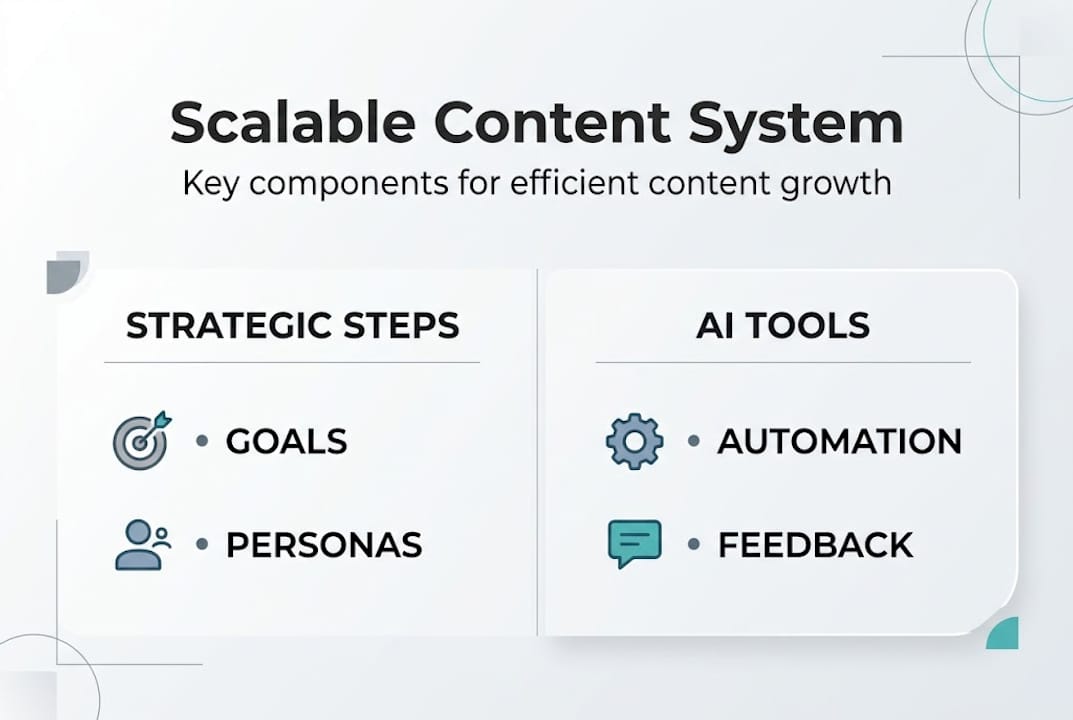
The fourth building block is AI tools. AI content marketing tools now handle research acceleration, keyword clustering, draft generation, and optimization checks in a fraction of the time human-only teams require. According to scaled content mechanics, the key mechanics include AI tools for consistency and acceleration alongside feedback loops and audience-specific frameworks.
The fifth is feedback loops. Your content system should get smarter over time. That means tracking what performs, feeding data back into your topic selection and keyword targeting, and regularly revisiting your personas and funnel maps as market conditions shift.
Pro Tip: Build a monthly content performance review into your workflow. Track organic traffic, engagement rate, and conversion attribution per content cluster. Use that data to prune underperformers and double down on what is building authority fastest.
The role of AI in scaling content without losing quality
With foundational systems set, the next frontier is leveraging AI to scale efficiently without sacrificing quality or brand trust. AI is no longer a novelty in content production. For serious digital marketing teams, it is a core infrastructure tool.
Here is how modern AI accelerates scalable content production without the common quality pitfalls:
-
Automated research and outlines. AI tools can analyze top-ranking content for any target keyword, extract key subtopics, identify semantic gaps, and produce a structured outline in minutes. What used to take a senior writer two hours now takes under ten minutes.
-
On-brand draft generation. Using carefully constructed prompts and brand voice templates, AI can generate first drafts that match your tone, style, and technical depth. The key is investing time upfront in the templates. A poorly designed prompt produces generic output. A well-designed one produces content that requires minimal editing.
-
Agentic workflows for lifecycle management. The newest frontier in AI-driven content creation is agentic orchestration, where AI systems manage multi-step content workflows autonomously. This includes brief creation, draft production, internal link insertion, meta description writing, and publishing queue management, all without constant human intervention.
-
The 4G model for quality control. One of the most important frameworks for avoiding what industry practitioners call "AI slop" (generic, low-value automated output) is the 4G model: governance, grounding, gating, and guidance.
According to expert analysis on agentic content scaling, AI leverages must avoid this quality dilution through explicit governance structures, factual grounding in reliable sources, gating mechanisms that filter output before publishing, and clear guidance embedded in every prompt and template.
"Scaling content in the agentic era requires automation for research, outlines, drafts, and optimization, maintaining brand voice via prompts and templates, while avoiding 'AI slop' through governance, grounding, gating, and guidance." — Fast Company
What does this look like in practice? Governance means defining who has final approval rights over AI-generated content. Grounding means requiring AI to cite sources or work from factual briefs rather than generating unsupported claims. Gating means no content goes live without passing a checklist review, even if that review is partly automated. Guidance means your prompts are detailed and opinionated, not vague instructions that leave the AI guessing.
When you use automated content for SEO within this kind of structured framework, the efficiency gains are substantial without the quality trade-offs that have given AI content a bad reputation in some circles.
Pitfalls and edge cases when scaling content
While scaling with AI unlocks huge potential, it also exposes your strategy to key pitfalls if you are not careful and selective about how you implement it.
The most common mistakes brands make when attempting to scale content include:
-
Audience fatigue from over-publishing. When you push out too much content too fast, your audience stops engaging. Worse, Google may interpret a sudden flood of low-differentiation pages as spam behavior. Steady, purposeful growth almost always outperforms volume bursts.
-
AI hallucinations diluting authority. AI models can confidently produce incorrect statistics, fabricated citations, or outdated information. Without a human review layer, these errors erode your credibility with both readers and search engines. This is especially damaging in technical or regulated niches.
-
Weak E-E-A-T signals tanking rankings. Google's quality evaluator guidelines place heavy weight on experience, expertise, authoritativeness, and trustworthiness. AI-only content, stripped of first-hand experience and genuine expert perspective, often fails these signals. The result is content that looks polished but ranks poorly.
-
Programmatic SEO that ignores context. Copying a competitor's programmatic SEO approach without understanding their unique brand equity or audience context is a shortcut that backfires. Scaled content edge cases consistently show that over-optimizing volume leads to audience fatigue and oversaturation, while generic output risks hallucinations and authority loss.
-
Loss of brand differentiation. When every piece of content reads the same because it came from the same AI template with no human editorial layer, your brand becomes indistinguishable from competitors. Differentiation is a ranking factor in the eyes of your audience, even if it is not a direct algorithmic signal.
Strong AI-driven brand strategies account for these risks upfront. The brands succeeding with scalable content are not the ones publishing the most. They are the ones maintaining consistent quality, genuine expertise signals, and audience relevance even as they grow output. You can study content marketing examples from leading brands to see how differentiation is preserved at scale.
Pro Tip: Audit a random sample of 10 to 15 recent AI-assisted content pieces every month. Check for factual accuracy, brand voice consistency, and E-E-A-T signals. This quarterly quality gate will catch systemic problems before they compound into a traffic or penalty issue.
A smarter pathway: our perspective on scaling content for real organic impact
Most guides on scalable content focus almost entirely on output mechanics: how to produce more, faster, and cheaper. What they miss is the compounding power of strategic content clusters mapped tightly to user journeys.
Here is what our experience tells us: true scale comes from disciplined topical authority building, not sheer volume. When your content system covers a topic cluster completely, from foundational explainers to advanced tactical guides to comparison and decision-stage assets, you create a network of mutually reinforcing pages that search engines read as genuine expertise. That network compounds over time. A single well-placed cluster can outperform dozens of isolated articles targeting similar keywords.
AI is a powerful enabler of this approach, but it is not the strategy itself. The strategy requires human judgment about which clusters to prioritize, which long-tail queries signal genuine buying intent, and how to sequence content for maximum compounding effect.
As topical authority research consistently shows, scalable content enhances organic visibility by building topical authority, capturing long-tail queries, and compounding via clusters, repurposing, and AI efficiency, but it demands strategic planning over raw output to avoid dilution.
What that means practically: before you scale, map your clusters. Before you automate, design your governance. An AI-powered content workflow built on a strong strategic foundation will always outperform a high-volume approach built on assumptions.
Scale your content success with powerful AI tools
With a clear understanding of what scalable content requires and where it can go wrong, the logical next step is putting the right tools in place to execute your strategy efficiently.

Babylovegrowth.ai is built specifically for digital marketing professionals and business owners who need to move from content strategy to measurable organic growth without hiring a full in-house production team. The platform's keyword discovery platform helps you identify the exact long-tail queries your audience is searching across Google and AI-driven search engines like ChatGPT and Perplexity. Pair that with the AI SEO audit tool to continuously monitor your technical health and content quality signals. These tools transform scalable content from a concept into a practical, compounding growth system for your brand.
Frequently asked questions
How is scalable content different from just publishing more articles?
Scalable content prioritizes strategic frameworks and efficiency over quantity, focusing on long-term organic impact through systems, not volume. Publishing more without strategy typically dilutes quality and wastes budget.
Can AI create scalable content without human involvement?
AI can automate research, drafts, and optimization, but human oversight is essential for ensuring quality, brand alignment, context accuracy, and E-E-A-T signals that AI alone cannot reliably produce.
What are signs that my content strategy isn't scalable?
Key warning signs include content burnout on your team, inconsistent quality across pieces, declining audience engagement, and plateaued search visibility despite continued publishing. These patterns indicate a process problem, not a talent problem.
How can I maintain brand voice when scaling content with AI?
Use carefully designed prompts and brand templates to encode your voice into every AI interaction, and always include a human editorial review before publishing to catch tone drift and factual errors.
Recommended
Smart SEO,
Faster Growth!
Most Read Articles
Generative Engine Optimization (GEO)
Learn how Generative Engine Optimization (GEO) helps your content rank in AI search engines like ChatGPT and Google AI. This comprehensive guide explains the differences between SEO and GEO, why it matters for your business, and practical steps to implement GEO strategies for better visibility in AI-generated responses.
DylenJan 18, 2025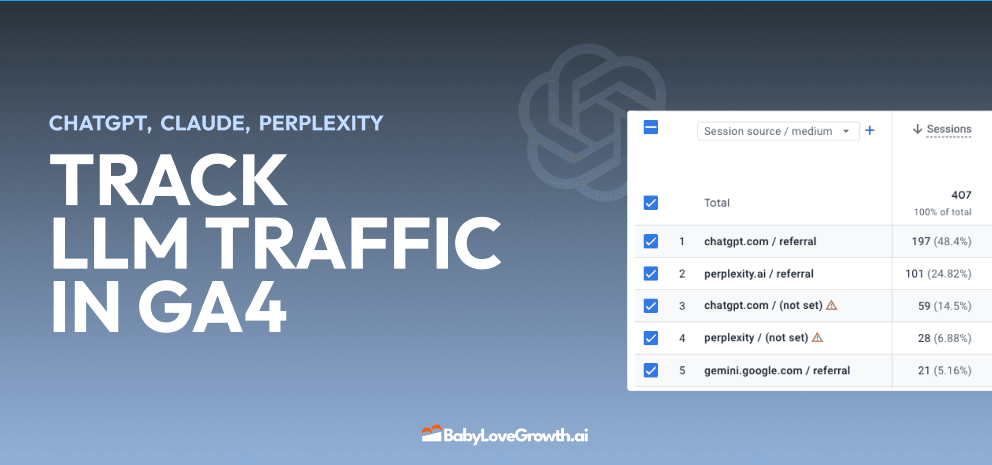
Track LLM Traffic in Google Analytics 4 (GA4)
Learn how to track and analyze traffic from AI sources like ChatGPT, Claude, Perplexity, and Google Gemini in Google Analytics 4. This step-by-step guide shows you how to set up custom filters to monitor AI-driven traffic and make data-driven decisions for your content strategy.
DylenMar 18, 2025
How to Humanize AI Text with Instructions
Learn practical techniques to make AI-generated content sound more natural and human. This guide covers active voice, direct addressing, concise writing, and other proven strategies to transform robotic text into engaging content.
DylenApril 7, 2025
Moz DA vs Ahrefs DR: Which Metric Should You Actually Use?
Moz Domain Authority and Ahrefs Domain Rating look similar but measure very different things. Learn what each score actually tells you, when to use each one, and what to track instead for real SEO results in 2026.
DylenApr 23, 2026
Open AI Revenue and Statistics (2024)
Comprehensive analysis of OpenAI financial performance, user engagement, and market position in 2023. Discover key statistics including $20B valuation, $1B projected revenue, and 100M+ monthly active users.
DylenOctober 03, 2025
"Search Google or Type a URL": What It Means & What to Do
Learn what "Search Google or type a URL" actually means, how your browser decides whether to search or navigate, and what to do if your address bar starts behaving unexpectedly. Includes browser settings guides for Chrome, Firefox, Edge, and Safari.
DylenApr 21, 2026