Relationship Marketing: Strategies for Customer Loyalty


TL;DR:
- Relationship marketing focuses on building long-term customer loyalty rather than short-term sales.
- Effective strategies include personalized engagement, loyalty programs, and trust-building efforts.
- AI and omnichannel tactics enhance personalization and retention, but trust and genuine value are essential.
Most marketing budgets chase new customers. That's the default assumption: growth means acquisition. But relationship marketing flips that logic entirely, focusing instead on the customers you already have and turning them into long-term advocates who spend more, refer others, and stick around. This article breaks down what relationship marketing actually is, the core strategies that drive it, a proven framework for tracking customer progression, and the modern tactics (including AI and omnichannel) that separate brands who retain customers from those who constantly start over.
Table of Contents
- What is relationship marketing? Definition and key principles
- Core strategies and mechanisms of relationship marketing
- Frameworks, measurement, and progression: The Relationship Ladder
- Innovative tactics and challenges: AI, omnichannel, and common pitfalls
- A fresh perspective: Relationship marketing is about trust—here's what most brands miss
- Take your relationship marketing to the next level
- Frequently asked questions
Key Takeaways
| Point | Details |
|---|---|
| Relationship marketing delivers lasting value | Building long-term customer relationships leads to higher profits, loyalty, and lifetime value. |
| Practical strategies optimize retention | Loyalty programs, CRM systems, and personalization drive measurable increases in customer retention and ROI. |
| Frameworks enable targeted engagement | Using progression frameworks like the Relationship Ladder helps track, measure, and deepen customer bonds. |
| Innovative tactics boost results | AI-powered personalization and omnichannel strategies radically enhance engagement and loyalty. |
| Avoid one-size-fits-all approaches | Generic or over-promotional efforts undermine relationship marketing—tailor your approach for maximum impact. |
What is relationship marketing? Definition and key principles
At its core, relationship marketing basics describe a long-term strategy focused on building, maintaining, and enhancing customer relationships to boost retention, loyalty, and lifetime value. That's the direct contrast to transactional marketing, which treats every sale as a finish line rather than a starting point.
Transactional marketing is built around single interactions. You run a promotion, a customer buys, the cycle ends. Relationship marketing treats that first purchase as the beginning of an ongoing conversation. The goal shifts from "how do we close this deal?" to "how do we make this customer's experience so valuable that they never consider leaving?"
Three core mechanics drive this approach:
- Continuous engagement: Regular touchpoints that add value between purchases, not just during them.
- Personalization: Treating customers as individuals with specific needs, not as a segment of one million.
- Value beyond discounts: Building emotional connection and trust, not just transactional incentives.
Here's a quick comparison to make this concrete:
| Dimension | Transactional marketing | Relationship marketing |
|---|---|---|
| Goal | Single sale | Long-term loyalty |
| Focus | Product/price | Customer experience |
| Communication | One-way, campaign-driven | Two-way, ongoing |
| Success metric | Revenue per campaign | Customer lifetime value |
| Customer view | Anonymous buyer | Known individual |
The empirical case for relationship marketing is strong. Businesses that invest in customer retention strategies consistently outperform those focused purely on acquisition, because retaining a customer costs significantly less than acquiring a new one and generates compounding returns over time.
"Relationship marketing is not a tactic. It's a fundamental shift in how you define success with customers."
For business owners and marketers, the practical implication is clear: if your marketing strategy resets to zero after every sale, you're leaving most of your revenue potential on the table.
Core strategies and mechanisms of relationship marketing
With the definitions set, let's explore how relationship marketing is applied through specific strategies and data-backed mechanisms.
Methodologies in relationship marketing include loyalty programs, lifecycle marketing, personalized communication, feedback loops, referral programs, and CRM systems. Each one serves a different function in the broader goal of keeping customers engaged and moving them toward deeper commitment.

The numbers behind these strategies are hard to ignore. A 5% retention increase can boost profits by 25 to 95 percent. Loyal customers spend 67 percent more than new ones. Loyalty programs specifically generate 12 to 18 percent revenue uplift and deliver 3 to 10x ROI. These aren't marginal gains.
Here's how the main programs compare on impact:
| Strategy | Revenue uplift | ROI range |
|---|---|---|
| Loyalty programs | 12-18% | 3-10x |
| Personalized email | 6-10% | 4-8x |
| Referral programs | 5-15% | 5-12x |
| Feedback-driven CX | 4-8% | 2-6x |
To implement these effectively, follow this sequence:
- Map your customer lifecycle. Identify the key moments where customers engage, go quiet, or churn.
- Choose a CRM system that tracks individual behavior and enables segmentation.
- Launch a loyalty program tied to meaningful rewards, not just points accumulation.
- Build feedback loops through surveys, reviews, and direct outreach after key interactions.
- Activate referral programs once customers reach a high-satisfaction threshold.
- Personalize communication at every stage using behavioral data, not just demographics.
Pro Tip: Generic loyalty programs fail because they reward purchase frequency without recognizing individual value. Focus on omnichannel engagement to make every touchpoint feel intentional, and use AI content for loyalty to scale personalization without losing the human feel.
The most effective relationship marketers treat their CRM not as a database but as a living record of each customer's evolving relationship with the brand.
Frameworks, measurement, and progression: The Relationship Ladder
Now that you know the main strategies, let's map out how relationship marketing progresses through tangible stages and measurable outcomes.
The Relationship Ladder framework defines four stages of customer progression: Stranger, Acquaintance, Friend, and Partner. Each stage represents a deeper level of trust, engagement, and mutual value. The framework gives marketers a structured way to think about where each customer is and what it takes to move them forward.
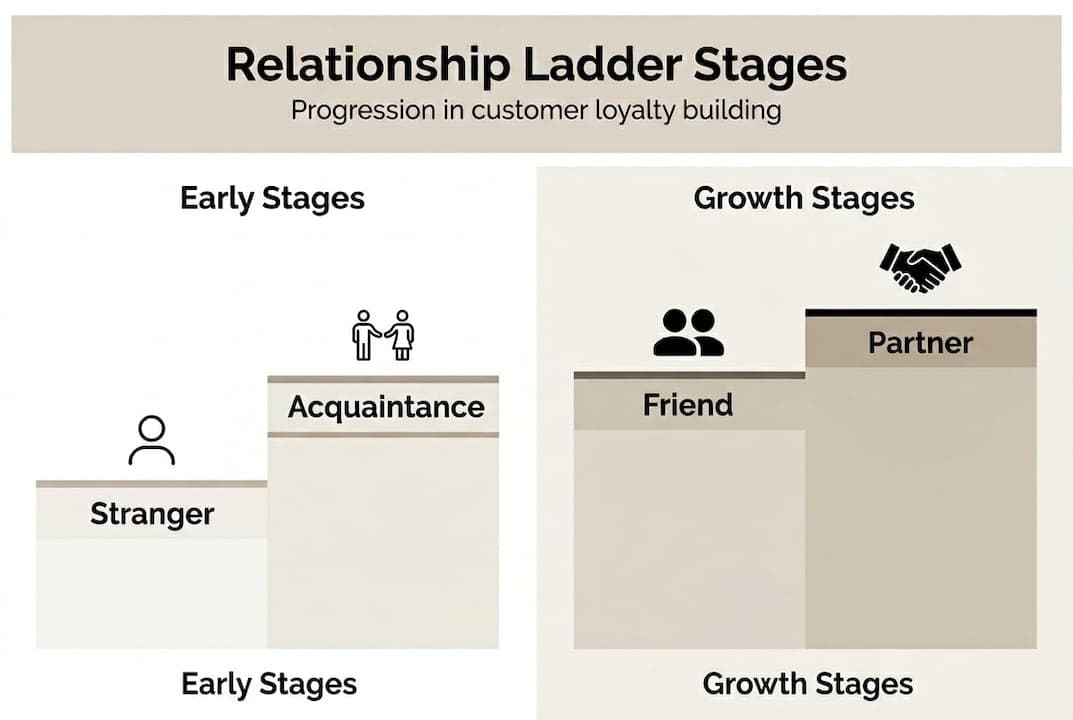
Here's how the stages break down with measurable indicators:
| Stage | Relationship depth | Key metrics |
|---|---|---|
| Stranger | No awareness | Impressions, reach |
| Acquaintance | First interaction | First purchase, email open rate |
| Friend | Repeat engagement | Purchase frequency, NPS score |
| Partner | Deep loyalty | Referrals, lifetime value, advocacy |
To move customers from Stranger to Partner, follow this progression:
- Attract strangers with content and visibility that addresses their real problems.
- Convert acquaintances through a frictionless first experience that exceeds expectations.
- Deepen friendships with personalized follow-up, exclusive access, and consistent value delivery.
- Earn partnership by actively involving customers in product feedback, community, and co-creation.
One critical insight here: performance metrics must serve long-term relationships, not replace them. It's easy to optimize for open rates or click-through rates while the actual relationship stagnates. Metrics are signals, not destinations.
Using personalized marketing at each ladder stage makes the progression feel natural to the customer rather than mechanical. When a customer moves from Friend to Partner, they shouldn't feel pushed. They should feel recognized.
The Relationship Ladder is especially useful for teams that struggle with prioritization. When you know where a customer sits on the ladder, you know exactly what kind of communication, offer, or experience will move them forward.
Innovative tactics and challenges: AI, omnichannel, and common pitfalls
Understanding progression is key, but adopting innovative tactics and avoiding mistakes is what sets leaders apart.
AI and omnichannel strategies are reshaping relationship marketing at scale. AI enables dynamic personalization, predictive churn modeling, and automated segmentation that would take human teams weeks to execute manually. Omnichannel approaches, where customers experience consistent, connected engagement across every channel, can drive up to an 89 percent boost in retention.RFM segmentation (Recency, Frequency, Monetary value) is one of the most practical tools for re-engagement. It lets you identify which customers are slipping away before they're gone, and target them with the right message at the right moment.
Key innovative tactics worth implementing:
- Predictive AI personalization: Serve content and offers based on predicted next behavior, not just past behavior.
- Behavioral trigger campaigns: Automate messages when customers hit specific milestones or show disengagement signals.
- Cross-channel consistency: Ensure your email, social, SMS, and in-app messaging tell the same story.
- Community building: Create spaces where loyal customers connect with each other, not just with your brand.
Pro Tip: Before scaling any AI-driven campaign, test it on a small segment first. AI-driven brand loyalty tools are powerful, but poorly calibrated automation can feel impersonal and do more damage than good.
That said, there are real pitfalls to watch for. One-size-fits-all approaches are the most common failure mode. When every customer gets the same message regardless of their stage, fatigue sets in fast. Over-promotion is the second trap: bombarding customers with offers trains them to wait for discounts rather than value the relationship itself.
Also worth noting: relationship marketing is not suited for every product category. Low-involvement, one-off purchases rarely justify the investment in deep relationship infrastructure. Know your context before committing resources.
For brands ready to go deeper, omnichannel retention strategies and building a brand with AI offer proven paths to scaling what works.
A fresh perspective: Relationship marketing is about trust—here's what most brands miss
Here's the uncomfortable truth most marketing teams avoid: you can implement every strategy in this article and still fail at relationship marketing. Why? Because the strategies are tools. Trust is the foundation. And trust cannot be automated.
We see brands invest in sophisticated CRM stacks and loyalty programs, then wonder why retention doesn't improve. The answer is usually that they've mistaken activity for engagement. Sending more emails is not the same as saying something worth reading. Triggering a birthday discount is not the same as making a customer feel known.
The brands that genuinely win at relationship marketing do three things consistently: they deliver value before asking for anything, they listen actively and act on what they hear, and they're honest when they fall short. That last one is rare and powerful.
A practical lesson we've learned: build trust before you scale technology. Get the human elements right first. Know what your customers actually care about. Then use automation to deliver that at scale, not to replace the thinking behind it.
Your product marketing strategy should reflect this same principle: lead with genuine value, and the relationship will follow.
Take your relationship marketing to the next level
Relationship marketing works best when your brand stays consistently visible and relevant to customers over time. That's exactly where content and SEO become force multipliers.
At Babylovegrowth.ai, we help businesses build the kind of sustained organic presence that keeps customers engaged long after the first sale. Our SEO automation platform generates high-quality, AI-optimized content on autopilot, so your brand keeps showing up where your customers are searching. Pair that with our backlink exchange benefits ecosystem, and you have a compounding visibility engine that supports every stage of the Relationship Ladder. If you're serious about retention and long-term growth, let's build it together.
Frequently asked questions
What makes relationship marketing different from transactional marketing?
Relationship marketing builds long-term loyalty and lifetime value, while transactional marketing focuses on closing single, immediate sales. The mindset, metrics, and tactics are fundamentally different.
Which industries benefit most from relationship marketing?
Industries with repeat and high-involvement purchases, such as retail, SaaS, finance, and healthcare, benefit most. Low-involvement purchases rarely justify the investment in deep relationship infrastructure.
How can small businesses implement relationship marketing cost-effectively?
Small businesses can start with personalized communication, feedback surveys, and basic loyalty programs and CRM tools without large budgets. Consistency matters more than scale at the early stage.
What are the main pitfalls to avoid in relationship marketing?
Avoid one-size-fits-all approaches and excessive promotion, both of which cause customer fatigue and erode the trust you're trying to build.
Can AI really improve relationship marketing results?
Yes. AI enables dynamic personalization and segmentation at scale, leading to measurably higher engagement and retention rates when implemented thoughtfully.