Overcoming Digital Marketing Challenges: Proven Strategies for 2026


TL;DR:
- Measuring ROI remains the top challenge for marketers due to its complexity and impact on budget decisions.
- Small businesses should diversify early into owned channels like email and SMS to reduce customer acquisition costs.
- Focusing on a few well-managed channels and balancing short-term tactics with brand building leads to sustainable growth.
Measuring ROI is now the top marketer challenge, cited by 33% of marketing professionals in 2026. That single figure tells a bigger story: even with more tools, more data, and more channels than ever before, most small to medium businesses still struggle to connect what they spend to what they earn. This guide cuts through that confusion. You will find practical, evidence-backed strategies for measuring ROI, surviving trend fatigue, generating quality leads, and picking the right channels without burning your budget. If you run a growing business or manage a marketing team, these solutions are built for your reality.
Table of Contents
- Decoding digital marketing's biggest challenges
- Why ROI measurement and 'performance plateaus' matter
- Navigating rapid trends and evolving platforms
- Scaling lead generation and bridging sales-marketing gaps
- Practical solutions: Cost-effective channels and growth tips
- What most guides miss about digital marketing's toughest challenges
- Enhance your digital marketing with scalable tools
- Frequently asked questions
Key Takeaways
| Point | Details |
|---|---|
| Measure ROI first | Focusing on key ROI metrics helps prioritize marketing strategies that deliver results. |
| Invest in owned channels | Owned channels like email and SEO offer higher ROI and sustainable growth compared to paid-only strategies. |
| Keep up with trends | Monitoring digital trends and platform shifts is essential, but consistency and evergreen tactics win long term. |
| Align sales and marketing | Shared KPIs and regular feedback create a smoother, more productive sales-marketing relationship. |
| Balance automation with human touch | Overusing AI can hinder brand loyalty—blending automation and personalization works best. |
Decoding digital marketing's biggest challenges
Digital marketing in 2026 is not harder because the tools are worse. It is harder because there are too many of them, and most small to medium businesses lack the bandwidth to use them well. The result is a persistent gap between effort and outcome that leaves teams frustrated and executives skeptical.
According to current digital marketing statistics, the top struggles marketers report are:
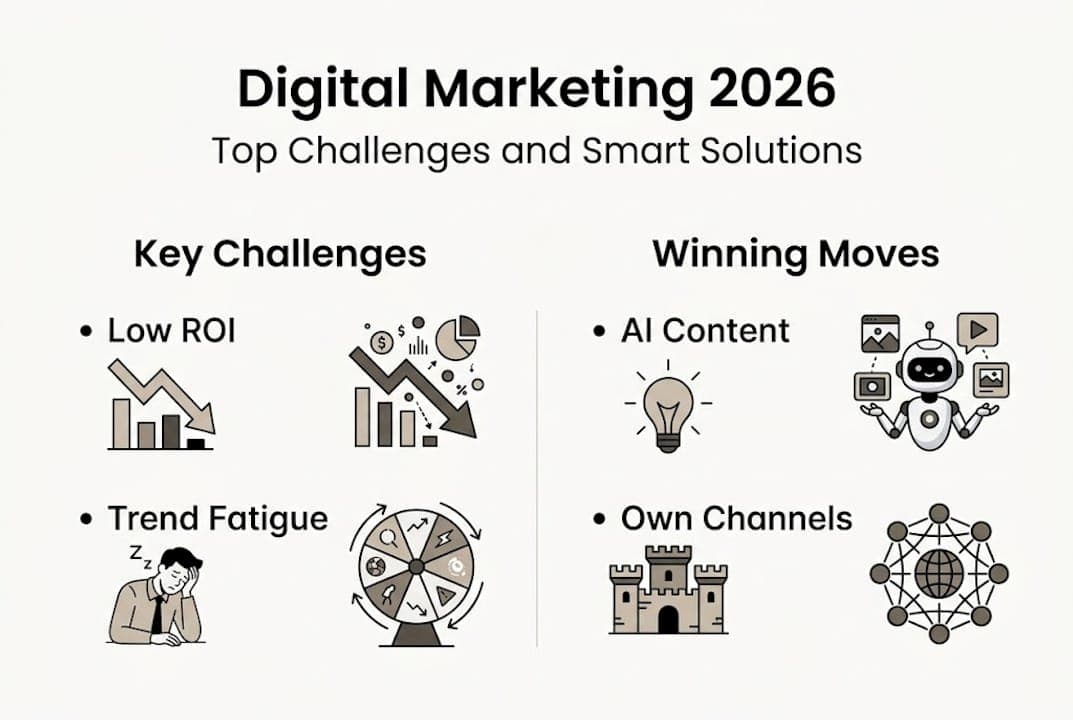
- Measuring ROI (33%) — the single biggest pain point across business sizes
- Keeping up with trends (29.8%) — platform changes, algorithm updates, and new tools
- Generating quality leads (29.6%) — volume is easy, conversion is not
- Aligning sales and marketing (27.6%) — disconnected teams mean lost revenue
- Managing tight budgets — doing more with less remains a daily reality
These challenges do not exist in isolation. When you cannot measure ROI, you cannot justify budget. When you cannot justify budget, you cannot invest in the channels that actually work. It becomes a loop.
| Challenge | Frequency cited | Business impact |
|---|---|---|
| Measuring ROI | 33% | High — affects budget decisions |
| Keeping up with trends | 29.8% | Medium — leads to reactive strategy |
| Generating leads | 29.6% | High — directly hits revenue |
| Sales-marketing alignment | 27.6% | High — causes pipeline leakage |
| Budget constraints | Ongoing | High — limits channel diversity |
Measuring ROI tops the list because it is both technically complex and politically charged. Executives want proof. Marketers want flexibility. That tension rarely resolves itself without a deliberate system. Staying current on the latest marketing trends helps you understand which metrics actually matter for your business model.
Why do these problems persist? Largely because most small to medium businesses adopt tactics before building infrastructure. They run paid ads before they understand their cost per lead. They chase social media trends before they have a consistent content calendar. Fixing the foundation is always less exciting than launching a campaign, but it is the only path to sustainable results.
Now that we understand digital marketing's key struggles, let's look closely at the issue of ROI measurement and performance plateau.
Why ROI measurement and 'performance plateaus' matter
ROI (return on investment) in marketing means one thing: did the money you spent generate more value than it cost? Simple in theory, complicated in practice. CAC, or Customer Acquisition Cost, is the metric that connects ROI to real business performance. It tells you exactly what you paid to win each new customer, and when it keeps rising, something is broken.
Many mid-market SMEs hit a performance plateau precisely because they over-rely on paid digital channels like Google Ads and Meta. When ad costs rise and audiences saturate, CAC climbs fast, and owned channels like email and SMS sit underused.
This plateau is not just about rising costs. It is about diminishing returns. You spend more, reach the same people, and convert fewer of them. The businesses that escape this trap are the ones that diversify early.
| Channel type | Average CAC | Scalability |
|---|---|---|
| Google Ads (paid) | High and rising | Limited by budget |
| Meta Ads (paid) | Medium to high | Audience saturation risk |
| Email marketing (owned) | Low | High, minimal incremental cost |
| SEO/organic (owned) | Low over time | High, compounds with content |
| SMS marketing (owned) | Very low per send | High for retention |
Businesses that shift 20 to 30 percent of their paid budget into owned channels consistently see CAC fall within two to three quarters. That is not a coincidence. Email and SMS allow you to speak directly to people who already know you, at a fraction of the acquisition cost. Explore how cost-effective email marketing can anchor your owned channel strategy.

Pro Tip: Track your CPL (Cost Per Lead) and conversion rate weekly, not monthly. Monthly reporting masks early warning signs. If CPL rises two weeks in a row, your campaign needs attention now, not at the next strategy meeting.
The businesses that thrive are the ones treating owned channels as revenue assets, not just support tools. One regional e-commerce brand shifted from 80% paid to a balanced 50/50 paid and owned split, and their CAC dropped by 34% in six months. The math works. The challenge is committing to the transition.
With a clearer grasp on ROI and channel effectiveness, it's time to tackle trends and technology that complicate success.
Navigating rapid trends and evolving platforms
Trend fatigue is real. Keeping up with trends ranks as a concern for 29.8% of marketers, and that figure understates the daily exhaustion of chasing algorithm changes, new platforms, and shifting consumer behaviors.
The pressure to stay current creates a dangerous pattern: teams abandon strategies that are working because something newer looks shinier. This is one of the biggest digital marketing challenges that rarely gets named directly.
Here are the most disruptive platform shifts every small to medium business should know:
- Zero-click SEO — search engines answer queries directly, reducing organic click-through rates
- Privacy regulation changes — third-party cookie deprecation forces consent-based targeting
- Social algorithm unpredictability — reach becomes less reliable without paid amplification
- AI-generated content saturation — standing out now requires originality, not just volume
- Gen Alpha's expectations — this next consumer wave is algorithmically native and filters inauthenticity immediately
To avoid trend-driven burnout, use this three-step approach:
- Audit quarterly, not weekly. Review new platforms and tactics every 90 days. Do not pivot your strategy every time a new article appears about what is working.
- Anchor to evergreen fundamentals. Consistent branding, clear messaging, and educational content never go out of style. Understanding AI's impact on marketing helps you identify which trends are structural shifts versus noise.
- Test small before scaling. Allocate 10% of your budget to new channel experiments. Only scale what shows clear CPL improvement within 60 days.
Pro Tip: The best defense against trend fatigue is a documented content strategy. When you know your content pillars and audience personas, every new trend becomes easier to evaluate: does it serve your audience, or does it just look interesting?
For building a durable presence that does not depend on any single platform, AI brand-building tips offer a practical framework for consistency at scale.
Now let's address generating leads and aligning sales and marketing for improved performance.
Scaling lead generation and bridging sales-marketing gaps
Generating quality leads troubles 29.6% of marketers, while sales-marketing alignment challenges 27.6%. These two problems are almost always connected. When marketing and sales define "good lead" differently, the entire pipeline suffers.
Effective lead generation strategies for small to medium businesses in 2026 include:
- SEO-driven content — target high-intent search queries with detailed guides and comparison pages
- Referral programs — existing customers convert at 3 to 5 times the rate of cold leads
- Webinars and live events — high-engagement formats that attract motivated buyers
- Gated resources — checklists, templates, and tools that trade value for contact information
- Community building — LinkedIn groups and niche forums generate warm leads organically
For lead generation content strategies, the key is matching content format to buyer intent. Awareness-stage prospects need educational articles. Decision-stage prospects need case studies and demos.
The sales-marketing alignment fix comes down to three structural changes:
- Shared KPIs — both teams measure revenue, not just MQLs (Marketing Qualified Leads) or SQLs (Sales Qualified Leads) in isolation
- Bi-weekly feedback loops — sales tells marketing which leads actually closed and why
- Lead scoring automation — AI tools grade leads by behavior so sales spends time on the right prospects
Pro Tip: If your sales team ignores 40% or more of marketing's leads, that is a definition problem, not a volume problem. Run a joint session to agree on what a qualified lead looks like before you generate more of them.
Building AI for brand loyalty into your nurture sequences keeps prospects warm without adding manual workload. For long-term pipeline health, organic growth planning ensures your lead sources compound over time instead of resetting every quarter.
Finally, let's look at how to apply these strategies with cost-effective channels and practical measurement tools for sustainable growth.
Practical solutions: Cost-effective channels and growth tips
Budget constraints force smart choices. The good news is that the most cost-effective marketing research consistently points to the same channels: SEO and email marketing deliver the highest ROI at scale, with email averaging $42 return per $1 spent.
High-ROI channels and tactics for small to medium businesses:
- Organic SEO — slow to start, but compounds over 12 to 24 months into a reliable traffic source
- Email marketing — low cost per send, high conversion rate for warm audiences
- Content repurposing — one blog post becomes a video script, social posts, an email series, and a podcast outline
- Niche targeting — narrow your focus to a specific audience segment and dominate it before expanding
- Retargeting campaigns — reach people who already visited your site at a fraction of cold-acquisition cost
For businesses ready to maximize brand visibility with AI SEO, the combination of automated content production and strategic keyword targeting removes the bottleneck that slows most teams down.
Before committing budget to any channel, assess it against three questions: What is the expected CPL? What is the historical conversion rate for this channel? How long before we break even? If you cannot answer all three, the channel is not ready for serious investment.
Pro Tip: Run a 60/30/10 budget split. Sixty percent on your proven best channel, thirty percent on a secondary channel showing growth, and ten percent on experiments. This protects revenue while creating room to discover what works next.
With these solutions in hand, here's a fresh perspective on why traditional advice sometimes fails and what actually works.
What most guides miss about digital marketing's toughest challenges
Most guides tell you to diversify your channels and automate everything. That advice sounds smart. For resource-constrained small to medium businesses, it can be a trap.
Channel diversity only works when you have the team to manage each channel properly. Spreading thin across five platforms means doing all of them poorly. The businesses that consistently outperform are often the ones doing two or three things exceptionally well, not ten things adequately.
The AI vs. human touch tension is becoming the defining challenge of 2026. Automation is powerful. But when every email sounds like it was generated by the same model, your brand voice disappears. Consent-based personalization and genuine human interaction are now differentiators, not just compliance checkboxes.
There is also a structural tension between short-term tactics and long-term brand building that most playbooks gloss over. Quick wins matter for cash flow. But brands built entirely on performance marketing crumble the moment ad costs rise. The businesses that thrive invest in brand signals consistently, even when the ROI is not immediately obvious. Building an effective brand strategy with AI helps you do both without sacrificing one for the other.
Enhance your digital marketing with scalable tools
If this article gave you a clearer map of the challenges ahead, the next step is putting the right tools behind your strategy. Babylovegrowth.ai is built for exactly this: helping small to medium businesses grow organic traffic without burning budget on channels that plateau.
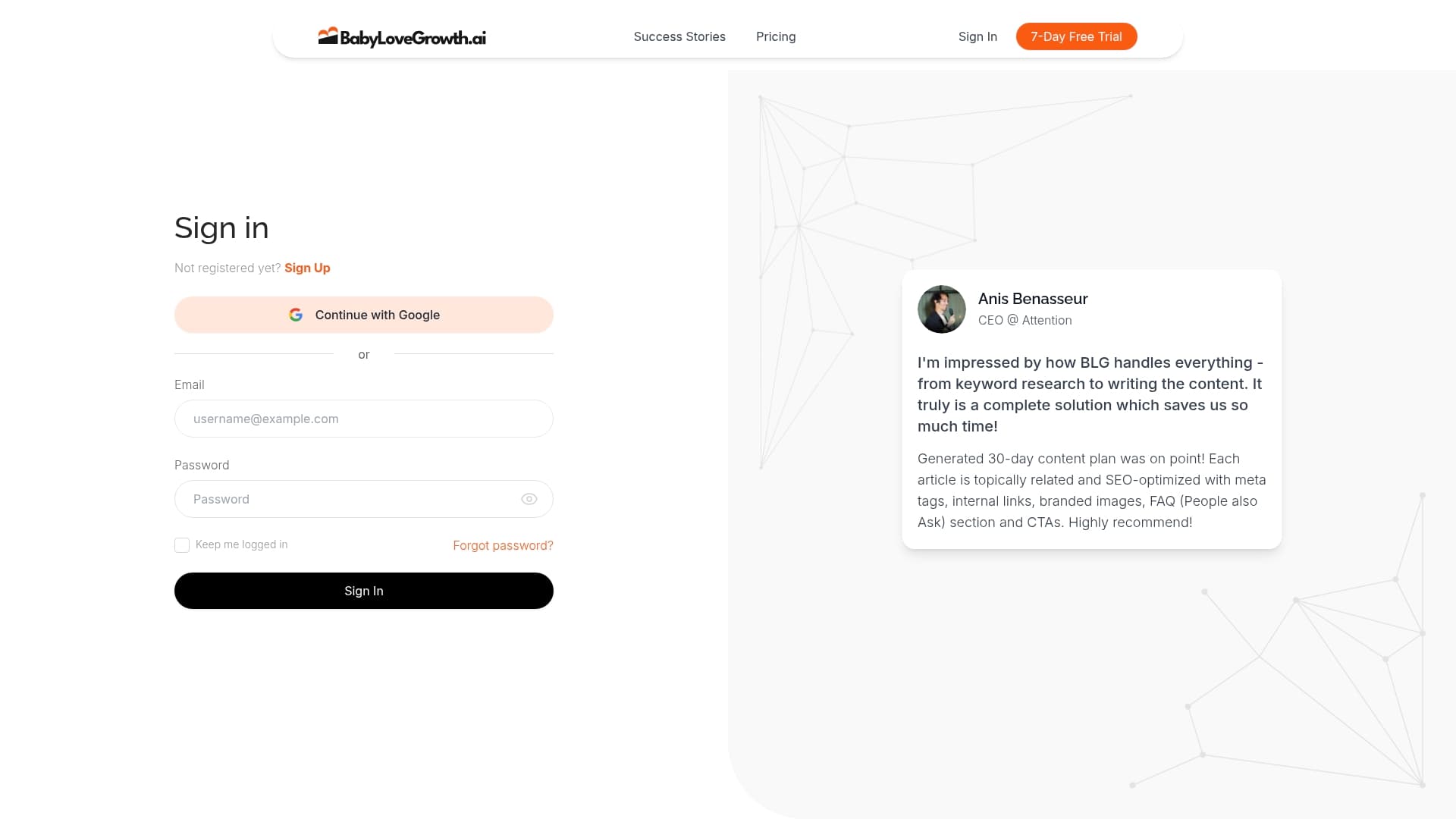
The Organic Traffic Tool gives you a personalized 30-day content plan optimized for both Google and ChatGPT rankings. The Automated Publishing Platform removes the content production bottleneck so you can scale without hiring. And the Backlink Exchange builds domain authority through a curated network, boosting your visibility without expensive outreach campaigns. Try it free and see what consistent, compounding organic growth actually looks like.
Frequently asked questions
What is the most common digital marketing challenge in 2026?
Measuring ROI tops the list as the number one challenge, cited by 33% of marketers, surpassing even trend fatigue and lead generation concerns.
How can small businesses avoid the 'performance plateau'?
Reduce dependence on paid ads and shift budget toward owned channels like email and SMS, which carry lower CAC and compound over time. Mid-market SMEs that make this shift consistently lower their acquisition costs within two to three quarters.
What are cost-effective channels for digital marketing?
SEO and email marketing lead for ROI, with email averaging $42 return for every $1 spent, making them the most reliable budget-efficient options for small to medium businesses.
What are best practices for aligning sales and marketing teams?
Establish shared KPIs tied to revenue, run bi-weekly feedback sessions between teams, and use AI-powered lead scoring to ensure sales focuses on the prospects most likely to close. Generating leads and alignment improve together when teams share a common definition of success.
What risks come with overusing AI in digital marketing?
Overreliance on AI can erode brand voice and reduce the human connection that drives loyalty. AI overreliance risks are especially acute when automation replaces genuine audience interaction rather than supporting it.