How to optimize SEO automation for maximum traffic gains


TL;DR:
- Automating repetitive SEO tasks improves site impressions and reduces critical issues significantly.
- Human oversight remains essential for content quality, strategy, and E-E-A-T signals to prevent penalties.
- Ongoing review and iterative adjustments are vital for sustainable, scalable SEO automation success.
Manual SEO at scale is brutal. Between crawling hundreds of pages, auditing broken links, tracking keyword positions, and trying to publish consistent content, even the sharpest marketing teams hit a wall fast. The good news? Automated fixes improved impressions by 56.4% across nearly 39,000 sites while cutting critical issues by 85%. That kind of lift is not luck. It comes from building a disciplined automation framework that knows exactly what to hand off to machines and what to keep human. This guide walks you through that framework, step by step, so you can squeeze more organic traffic out of every hour your team invests.
Table of Contents
- What to automate (and what not to)
- Choosing and integrating automation tools
- Automating content ideation, optimization, and quality control
- Monitoring, measuring, and continuously improving automated SEO
- Why smart automation beats 'set it and forget it'
- Take the next step: Smarter SEO automation tools
- Frequently asked questions
Key Takeaways
| Point | Details |
|---|---|
| Automate the right tasks | Routine technical and reporting jobs are best automated, but content and strategy require human input. |
| Integrate and adapt tools | Use tools that sync with your workflows to continually improve and scale your processes. |
| Balance automation with quality | Automate for speed but always review for E-E-A-T, creativity, and user intent. |
| Monitor and iterate regularly | Set up feedback loops and refine automation based on real results, not assumptions. |
What to automate (and what not to)
Not every SEO task deserves a robot. The teams that win at automation are the ones who draw a sharp line between work that scales through software and work that requires genuine human judgment. Getting this wrong is costly. AI-driven SEO automation thrives in repetitive, data-heavy environments, but it falls apart where nuance and creativity are required.
Here is a clear breakdown of where to deploy automation versus where to keep a human in the loop:
| Task type | Automate | Keep human |
|---|---|---|
| Technical site audits | Yes | Review findings |
| Keyword data aggregation | Yes | Strategy decisions |
| Rank tracking and alerts | Yes | Interpretation |
| Reporting and dashboards | Yes | Insight extraction |
| Meta tag generation | Yes | Quality review |
| Content strategy | No | Always human |
| E-E-A-T signals | No | Always human |
| Creative angles and tone | No | Always human |
| Link building outreach | Partial | Relationship management |
Common mistakes teams make when over-automating include:
- Publishing AI-generated content without editorial review
- Setting crawl schedules so aggressive they eat crawl budget
- Automating internal link insertion without anchor text logic
- Running keyword stuffing scripts that trigger spam filters
- Using bulk redirect tools without checking destination quality
Pro Tip: Map your team's weekly SEO hours by task. Any task consuming more than two hours per week with a repeatable pattern is your first automation candidate.
"Over-automation risks thin, spammy content and Google penalties for scaled abuse. Always keep a human in the loop for strategy, creative judgment, and E-E-A-T."
The smartest angle here is that automation in SEO is not about replacing your strategists. It is about freeing them from the tedious, low-leverage work so they can focus on the decisions that actually move the needle. Teams that treat automation as a replacement for thinking tend to produce sites full of technically correct but completely forgettable content.
Choosing and integrating automation tools
With a clear picture of what to automate, the next challenge is selecting the right technologies and wiring them into your actual workflow. Tool selection is where most teams overthink things. You do not need every platform. You need the right combination that covers your biggest bottlenecks without creating integration nightmares.
Here is a practical overview of the core tool categories:
| Tool category | What it handles | Examples |
|---|---|---|
| Technical audit | Crawling, issue detection | Screaming Frog, Sitebulb |
| Monitoring and alerts | Uptime, ranking changes | Google Search Console, SEMrush |
| AI content tools | Drafts, optimization scoring | Surfer SEO, Jasper |
| Reporting | Dashboards, automated sends | Looker Studio, AgencyAnalytics |
| All-in-one platforms | End-to-end SEO workflows | Babylovegrowth.ai |
To set up continuous technical SEO monitoring, follow this checklist:
- Connect your site to Google Search Console and configure crawl error alerts.
- Schedule automated crawls weekly using your audit tool of choice, checking for broken links, redirect chains, and missing tags.
- Set up automated SEO audits to track Core Web Vitals changes after every major site update.
- Configure rank tracking alerts for your top 20 keywords so you catch drops before traffic does.
- Integrate your SEO audit software with a reporting dashboard so findings flow automatically into your weekly review.
- Review alert thresholds quarterly and tighten or loosen them based on false positive rates.
Pro Tip: Start with conservative alert thresholds. If your team gets flooded with notifications in the first week, they will start ignoring them. Fewer, higher-quality alerts beat a noisy inbox every time.
Proactive monitoring is where you see the biggest payoff. Continuous technical SEO monitoring catches problems like broken links, page speed regressions, and Core Web Vitals failures before they dent your rankings. Pairing this with the right top SEO automation tools creates a feedback loop that gets sharper over time.

Automating content ideation, optimization, and quality control
Once your tooling is in place, content is the next high-impact opportunity. This is also where the stakes are highest because content quality is directly tied to your domain authority and user trust.
AI excels at the structured, repeatable parts of content work. Here is what you can safely hand off to automation:
- Topic ideation based on keyword gaps and competitor analysis
- Content brief generation with target keywords and structure
- Optimization scoring against top-ranking pages
- Readability checks and sentence length analysis
- Internal link suggestions based on semantic relevance
- Meta description drafts for bulk page updates
Where you must keep a human involved:
- Final editorial review before publishing
- Adding first-hand experience, data, and original insights
- Adjusting tone for your specific audience
- Fact-checking all statistics and claims
- Ensuring E-E-A-T signals like author credentials and sourcing
The payoff from this hybrid approach is significant. AI drafts cut production time by 30% and can halve time-to-publish according to Harvard Business Review research. But those gains only hold when human editing catches what AI misses.
Using tools for AI in content strategy gives you smarter topic clusters and better keyword coverage at scale. Pair that with AI content optimization tools that score your drafts against live search results, and you get content that is built to rank from the first draft. A well-structured AI-powered content workflow can cut research time by up to 60%.
Pro Tip: Run every AI-generated draft through a checklist before publishing. Ask: Does this add a perspective no one else has published? Does it include a real example or original data? If the answer is no to both, it is thin content waiting to get penalized.
Also, use AI for topic ideation and optimization scoring, but never skip the human editing step for E-E-A-T and personalization. Generic AI output is the fastest route to a quality penalty.
Monitoring, measuring, and continuously improving automated SEO
With execution optimized, the final layer is making sure your automation keeps delivering results and does not quietly drift off course. This requires a feedback loop, not a one-time setup.
Start by building a performance dashboard that pulls together:
- Connect Google Search Console and GA4 to a centralized dashboard like Looker Studio.
- Set up automated reporting for weekly traffic, clicks, impressions, and average position changes.
- Configure automated alerts for traffic drops exceeding 10% week-over-week.
- Add a technical health score widget that updates after every automated crawl.
- Schedule monthly reviews using your SEO audit checklist to evaluate automation scope and retire outdated rules.
The alerts you set matter as much as the dashboards themselves. Prioritize notifications for:
- Critical crawl errors and 4xx spikes
- Core Web Vitals failures on high-traffic pages
- New ranking opportunities entering the top 20
- Sudden drops in indexed page count
- Changes in backlink profile quality
"Automating your reporting saves 75% of manual compilation time, freeing your team to focus on interpreting data and acting on insights rather than assembling spreadsheets."
Use the free AI SEO audit tool to get a baseline health check before you build your dashboards. It surfaces priority issues so your monitoring system focuses on what actually matters rather than tracking hundreds of low-impact signals.
The teams that sustain long-term SEO growth treat their automation setup like a product. They review it regularly, prune what is no longer relevant, and add new rules as the search landscape evolves. Automation that is never updated becomes a liability.
Why smart automation beats 'set it and forget it'
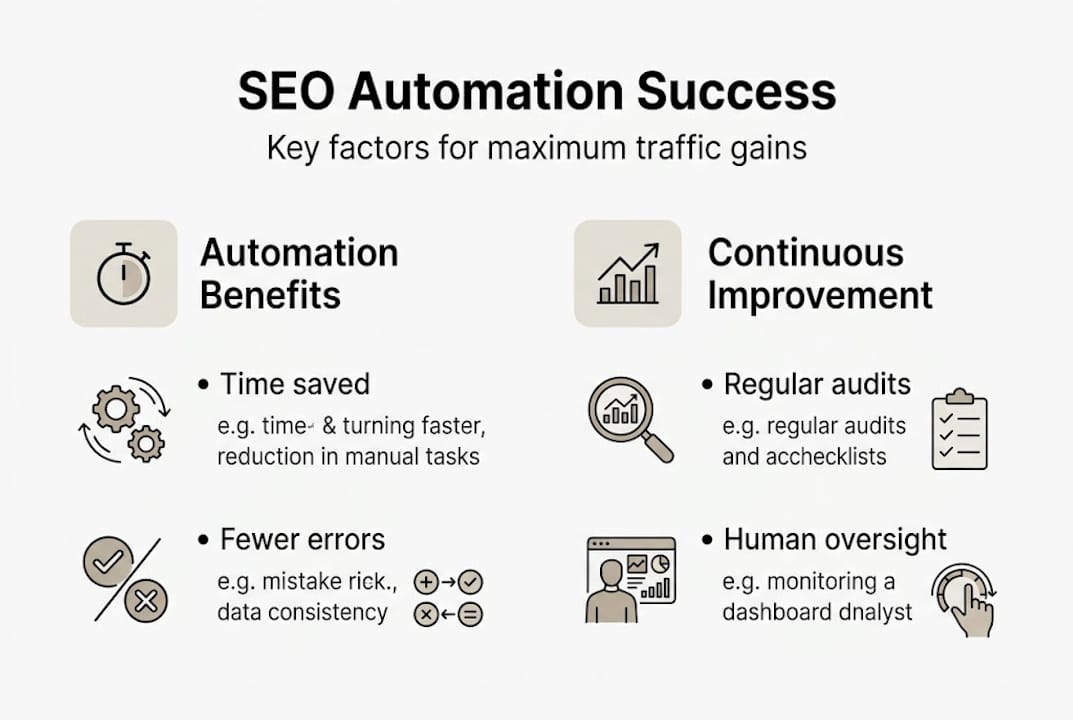
Here is the uncomfortable truth most SEO guides will not tell you. The teams that automate everything and walk away are the ones who eventually panic when rankings collapse with no obvious explanation.
We have seen it happen. One client scaled to over 20,000 programmatic pages using full automation. Crawl budget waste and thin pages eroded their domain signals over six months. The pages existed. They just were not earning anything. The fix required removing thousands of low-quality URLs and rebuilding with a quality-first approach.
The lesson is not that automation fails. It is that automation without human checkpoints scales your mistakes just as fast as it scales your wins. The strongest scaling SEO with automation strategies we see include quarterly reviews where a human asks the hard question: is what we automated still producing value?
Smart automation is iterative, not static. It is a lever that amplifies your team's judgment. And that judgment has to stay sharp.
Take the next step: Smarter SEO automation tools
Building the automation framework described in this guide takes focused tools that actually talk to each other. At Babylovegrowth.ai, every feature is designed to replace a manual bottleneck with an intelligent, scalable process.

Start with the Keyword Discovery Platform to surface high-opportunity topics your competitors are missing, then use Backlink Building Software to grow your domain authority without the manual outreach grind. Round out your stack with Technical SEO Tools that monitor your site health automatically and alert you before issues affect rankings. Together, these tools turn a reactive SEO process into a compounding growth engine.
Frequently asked questions
Which SEO tasks should never be fully automated?
Tasks requiring creative strategy, E-E-A-T signals, and user intent prioritization should always have a human involved. Over-automation risks thin content and Google penalties when these signals are missing.
How does AI improve the SEO automation process?
AI accelerates content ideation, technical checks, and reporting, cutting overall workflow time by 30% while improving optimization accuracy. AI drafts halve time-to-publish when paired with human editorial review.
What is the biggest risk with SEO automation?
Over-automating can lead to thin or spammy content and domain quality penalties if not balanced with human oversight. Crawl budget waste and thin pages are the most common symptoms of full automation without quality controls.
What are the essential tools for SEO automation?
Look for audit, monitoring, content optimization, and reporting solutions that integrate with your existing workflow. Automated crawls and alerts for broken links, page speed, and Core Web Vitals are the non-negotiable starting point.
Recommended
Smart SEO,
Faster Growth!
Most Read Articles
Generative Engine Optimization (GEO)
Learn how Generative Engine Optimization (GEO) helps your content rank in AI search engines like ChatGPT and Google AI. This comprehensive guide explains the differences between SEO and GEO, why it matters for your business, and practical steps to implement GEO strategies for better visibility in AI-generated responses.
DylenJan 18, 2025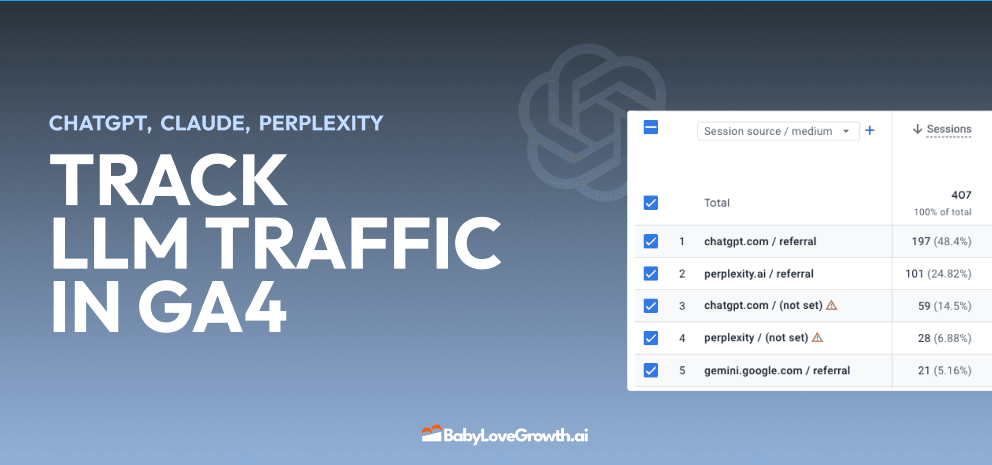
Track LLM Traffic in Google Analytics 4 (GA4)
Learn how to track and analyze traffic from AI sources like ChatGPT, Claude, Perplexity, and Google Gemini in Google Analytics 4. This step-by-step guide shows you how to set up custom filters to monitor AI-driven traffic and make data-driven decisions for your content strategy.
DylenMar 18, 2025
How to Humanize AI Text with Instructions
Learn practical techniques to make AI-generated content sound more natural and human. This guide covers active voice, direct addressing, concise writing, and other proven strategies to transform robotic text into engaging content.
DylenApril 7, 2025
Open AI Revenue and Statistics (2024)
Comprehensive analysis of OpenAI financial performance, user engagement, and market position in 2023. Discover key statistics including $20B valuation, $1B projected revenue, and 100M+ monthly active users.
DylenOctober 03, 2025