Multi-Channel Funnels Boost Sales 20-25% with AI Content


Most business owners think of the sales funnel as a straight line from stranger to customer. Reality? Buyers loop back, skip stages, and enter at unexpected points. Understanding this complexity is the first step to optimizing your funnel with AI-driven organic traffic strategies that actually convert.
Table of Contents
- Understanding The Sales Funnel: Key Stages And Customer Behaviors
- Integrating Organic Traffic And Content At Each Funnel Stage
- Optimizing Sales Funnel With AI-Driven Content
- Automation And Funnel Efficiency
- Common Misconceptions About Sales Funnels
- Comparison Of Funnel Optimization Strategies
- Performance Metrics And Funnel Success
- Optimize Your Sales Funnel With AI-Powered Automation Tools
- FAQ
Key Takeaways
| Point | Details |
|---|---|
| Sales funnels are dynamic | Multiple stages require tailored strategies, not linear approaches. |
| Organic traffic dominates | Over 53% of website visitors come from organic search, feeding your entire funnel. |
| AI reduces marketing labor | Automation cuts content creation effort by 40% while maintaining conversion rates. |
| Multi-channel wins | Integrating SEO, content, and social media improves conversions by 20-25%. |
| Metrics drive improvement | Track engagement and drop-off rates to identify and fix funnel bottlenecks. |
Understanding the Sales Funnel: Key Stages and Customer Behaviors
The traditional sales funnel breaks down into four critical stages that map to your customer's journey. Each stage represents different mindsets and requires specific marketing approaches.
Top of Funnel (TOFU) is the Awareness stage. Potential customers just discovered they have a problem. They're researching symptoms, not solutions. Your job here is education, not selling.
Middle of Funnel (MOFU) covers Interest and consideration. Buyers now understand their problem and actively compare solutions. They want detailed comparisons, case studies, and proof your approach works.
Bottom of Funnel (BOFU) includes Decision and Action stages. Prospects are ready to choose. They need pricing details, demos, free trials, and clear calls to action that remove final purchase barriers.
Mapping these stages lets you deliver the right message at the right time. A customer researching "what is marketing automation" needs different content than someone searching "best marketing automation software pricing." Understanding this distinction is what separates effective funnels from broken ones.
- TOFU attracts with educational blog posts and awareness content
- MOFU nurtures with comparison guides and detailed resources
- BOFU converts with product pages and strong CTAs
- Each stage requires metrics tracking to identify weak points
Integrating Organic Traffic and Content at Each Funnel Stage
Organic search drives over 53% of all website traffic, making it your funnel's primary fuel source. Yet most businesses treat organic visitors the same regardless of where they enter.
Your top funnel needs awareness content optimized for informational queries. Think "how to" guides, problem identification articles, and educational resources. These pieces attract strangers who don't know you exist yet.
Middle funnel content targets comparison and consideration searches. Visitors here know possible solutions and want details. Product comparisons, detailed tutorials, and case studies perform best. This is where organic SEO strategies really shine by targeting long-tail buyer intent keywords.
Bottom funnel content focuses on conversion. Product pages, pricing information, and demo signup forms answer final questions. Pages optimized for "buy" and "pricing" keywords capture ready buyers.
Tailored content improves conversion rates by over 35% compared to generic approaches. When you match content to funnel stage, visitors find exactly what they need. No friction, no confusion, just smooth progression toward purchase.
- Educational content builds awareness and trust
- Comparative content helps evaluation and consideration
- Conversion content removes final purchase barriers
- Stage-specific optimization maximizes organic traffic value
Matching content type to funnel stage is the single biggest lever for improving organic conversion rates.
Optimizing Sales Funnel with AI-Driven Content
AI transforms how businesses create and distribute funnel content. Instead of manually writing articles for every stage, AI tools generate personalized content at scale tailored to specific buyer intents.

AI analyzes search intent, identifies content gaps, and produces articles optimized for each funnel stage. Top funnel gets educational explainers. Middle funnel receives detailed comparisons. Bottom funnel gets conversion-focused landing pages. All generated faster than manual creation.
Beyond creation, AI handles backlink planning and content refresh scheduling. It identifies which pieces need updates, suggests internal linking opportunities, and maintains content relevance over time. This sustained approach keeps organic traffic flowing consistently.
The real power comes from combining AI efficiency with human strategy. Use AI content strategies for brand loyalty to generate drafts, then refine with brand voice and specific examples. Follow an automated content generation guide that balances automation with quality control.
- AI produces personalized content for each funnel stage rapidly
- Automation cuts content creation labor costs by approximately 40%
- Backlink planning and updates sustain organic growth long term
- Human oversight ensures brand voice and strategic alignment remain strong
Pro Tip: Start with AI-generated outlines and data, then add your unique customer insights and examples. This hybrid approach delivers speed without losing authenticity.
Automation and Funnel Efficiency
Marketing automation streamlines repetitive funnel management tasks that consume hours weekly. Email sequences, content distribution, lead scoring, and follow-up triggers all run without manual intervention.
Automation lowers marketing labor approximately 40% while maintaining or improving conversion rates by targeting funnel-specific pain points with tailored messages. SMBs gain enterprise-level capabilities without enterprise budgets.
But over-automation creates problems. Completely automated communication feels robotic and impersonal. Buyers notice when messages lack human touch. Balance is essential.
Focus automation on content delivery, lead qualification, and initial outreach. Reserve human interaction for consultations, objection handling, and relationship building. This split maximizes efficiency while preserving the personal connection that closes deals.
Use funnel stage data to trigger automated messages appropriately. When someone downloads a TOFU guide, send educational follow-ups. When they view pricing three times, trigger a sales team notification. Context-aware automation feels helpful, not intrusive.
Integrate content engagement strategies that blend automated content with opportunities for human interaction. Monitor which marketing automation impact metrics indicate readiness for personal outreach.
- Automation handles repetitive tasks like email sequences and lead scoring
- Too much automation makes communication feel impersonal and generic
- Automate content delivery, use human follow-up for personalization and closing
- Funnel data triggers appropriate automated messages at optimal times
Automation should feel like a helpful assistant, not a spam bot. Use it to enhance human relationships, not replace them.
Pro Tip: Set automation rules based on engagement signals like page views, time on site, and content downloads. Let buyer behavior determine when human outreach happens.
Common Misconceptions about Sales Funnels
The biggest myth? Sales funnels are linear. Buyers rarely move smoothly from awareness to purchase. They research, leave, return weeks later, skip stages entirely, or enter at the bottom after a referral.
Another false belief: all traffic is sales-ready. Reality is most organic visitors are browsing, researching, or comparing. Only a small percentage is ready to buy immediately. Treating everyone like a hot lead wastes resources and annoys prospects.
Many assume AI content automation guarantees success. Wrong. AI accelerates content production but doesn't replace strategy. You still need audience research, keyword planning, and conversion optimization. AI is a tool, not a magic solution.
Some believe more content always equals better results. Quality and relevance matter more than quantity. Ten highly targeted articles outperform fifty generic ones. Focus beats volume.
Understanding these misconceptions helps SMBs set realistic expectations and optimize funnels effectively. Recognition of non-linear buyer journeys informs better content mapping and nurture sequences.
- Sales funnels involve looping behaviors, not strict linear progression
- Most visitors need nurturing, not immediate sales pitches
- AI accelerates efficiency but requires strategic direction to succeed
- Targeted quality content beats high-volume generic content every time
Comparison of Funnel Optimization Strategies
Multi-channel funnels see conversion rate improvements of 20-25% over single-channel funnels. Integrating organic search, social media, and email creates multiple touchpoints that reinforce your message and build trust faster.Single-channel approaches limit reach and risk. If your only funnel entry is paid ads, budget cuts kill traffic overnight. Organic-focused funnels provide sustainable, cost-effective growth but take longer to build momentum.
Content marketing funnels complement paid advertising but organic approaches win for long-term ROI. Paid ads work for immediate results. Organic content compounds value over time as digital content trends show sustainable growth patterns.
AI content automation versus manual creation presents a speed-versus-personalization tradeoff. AI generates content 10x faster but requires human refinement for brand voice. Manual creation offers deeper personalization but can't match AI's scale.
| Strategy | Pros | Cons |
|---|---|---|
| Multi-channel funnel | 20-25% higher conversions, diverse traffic sources | More complex to manage and optimize |
| Single-channel funnel | Simple to track, focused optimization | High risk if channel fails, limited reach |
| AI automation | 40% labor reduction, rapid scaling | Needs human oversight for quality |
| Manual content | Deep personalization, brand voice control | Slow production, can't scale easily |
| Organic focus | Sustainable growth, low ongoing cost | Takes 3-6 months to see results |
| Paid ads focus | Immediate traffic and results | Expensive, stops when budget runs out |
The winning combination? Multi-channel funnel benefits paired with AI-assisted organic content. This approach delivers scale, sustainability, and superior conversion rates.
Performance Metrics and Funnel Success
Conversion rate alone doesn't tell the full story. You need multiple metrics to identify bottlenecks and optimize effectively.
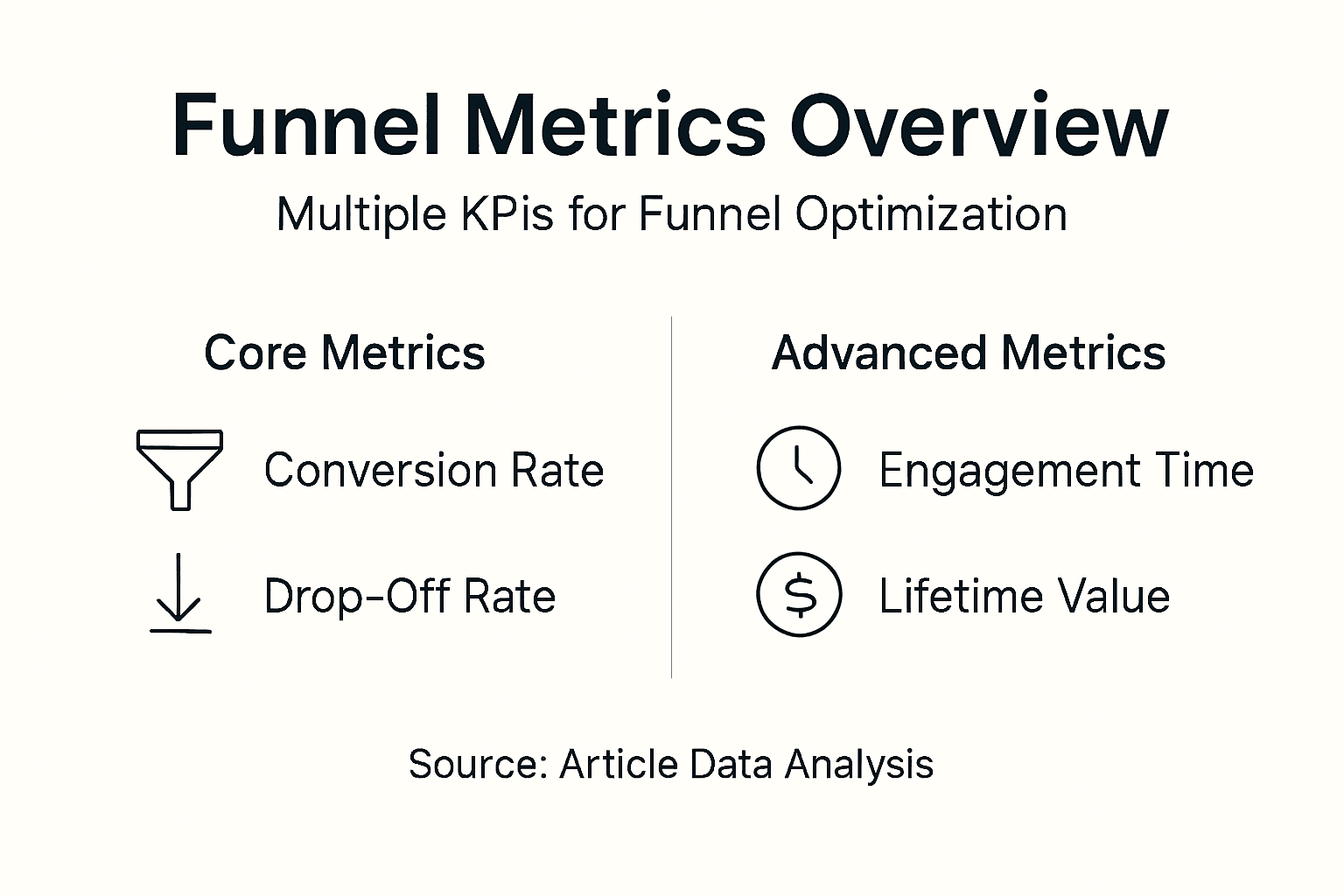
Engagement time reveals content quality. Visitors spending 3+ minutes on TOFU content are genuinely interested. Short times indicate poor targeting or weak content that needs improvement.
Funnel drop-off rates show where you lose prospects. If 80% leave after viewing pricing, your price communication or value proposition needs work. If most abandon during signup, your form is too complex.
Customer lifetime value (CLV) measures long-term funnel effectiveness. Acquiring cheap leads that churn immediately is worse than slower acquisition of loyal customers. Track CLV alongside acquisition cost for true ROI.
Source attribution identifies which channels and content pieces drive best results. Maybe organic blog traffic converts 3x better than social. Double down on what works, fix or eliminate what doesn't.
Regular data review enables iterative improvements. Check metrics weekly, run A/B tests on weak points, and adjust content strategy based on real performance. This continuous optimization compounds gains over time.
Use organic SEO strategy principles to track which keywords and content types drive qualified traffic through each funnel stage.
- Engagement time indicates content quality and audience targeting accuracy
- Drop-off rates reveal specific bottlenecks requiring immediate attention
- Customer lifetime value shows true funnel profitability beyond initial conversion
- Source attribution guides resource allocation to highest-performing channels
Optimize Your Sales Funnel with AI-Powered Automation Tools
Ready to implement everything you've learned? AI-driven automation transforms funnel theory into practical results. Instead of manually creating content for each stage, automated systems generate optimized articles aligned with buyer intent at every funnel level.
The right SEO automation platform handles content creation, backlink building, and performance tracking in one place. You save 40% of marketing labor while organic traffic and conversions increase. Follow proven automated content generation guide approaches and leverage AI content strategies for brand loyalty to build sustainable growth systems. Explore solutions designed specifically for SMBs seeking efficient, scalable funnel optimization without agency costs or complexity.
FAQ
What are the stages of a sales funnel?
The four main stages are Awareness (TOFU), Interest (MOFU), Decision, and Action (BOFU). Each represents a different phase in the customer journey from problem discovery to purchase. Marketing content and tactics must align with the specific mindset and needs at each stage.
How does organic traffic impact sales funnel performance?
Organic search accounts for over 53% of website traffic, making it the primary entry point for most funnels. Properly targeting organic visitors with stage-appropriate content significantly boosts conversion rates. Sustainable organic growth provides cost-effective, long-term funnel fuel compared to paid alternatives.
What are the benefits of using AI in sales funnel optimization?
AI reduces manual content creation labor by approximately 40% while maintaining or improving lead conversion rates. It enables rapid production of personalized, scalable content matched to buyer intent at each funnel stage. AI also handles backlink planning and content updates to sustain organic traffic growth over time.
What common mistakes should I avoid in sales funnel management?
Avoid treating the funnel as strictly linear since buyers often loop back or skip stages entirely. Segment content by funnel stage to prevent irrelevant messaging that confuses or annoys prospects. Balance automation with humanized follow-up to maintain the personal touch that builds trust and closes deals.
Recommended
Smart SEO,
Faster Growth!
Most Read Articles
Generative Engine Optimization (GEO)
Learn how Generative Engine Optimization (GEO) helps your content rank in AI search engines like ChatGPT and Google AI. This comprehensive guide explains the differences between SEO and GEO, why it matters for your business, and practical steps to implement GEO strategies for better visibility in AI-generated responses.
DylenJan 18, 2025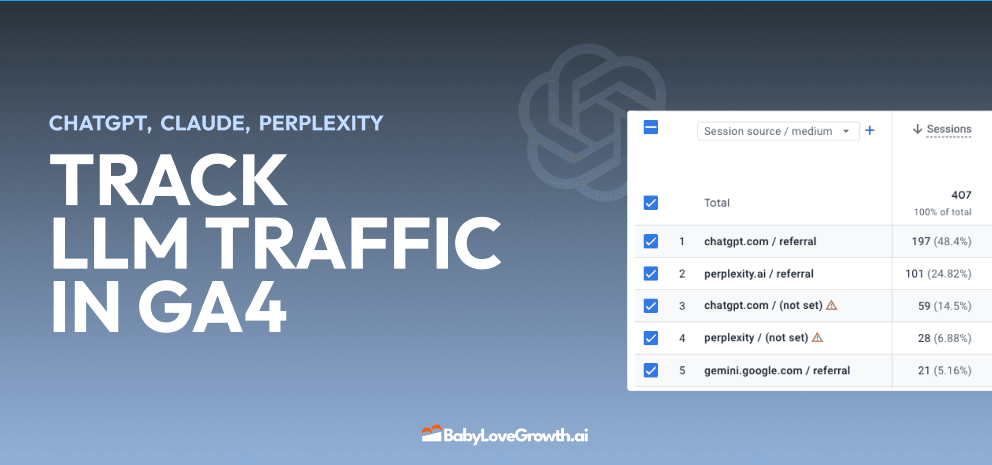
Track LLM Traffic in Google Analytics 4 (GA4)
Learn how to track and analyze traffic from AI sources like ChatGPT, Claude, Perplexity, and Google Gemini in Google Analytics 4. This step-by-step guide shows you how to set up custom filters to monitor AI-driven traffic and make data-driven decisions for your content strategy.
DylenMar 18, 2025
How to Humanize AI Text with Instructions
Learn practical techniques to make AI-generated content sound more natural and human. This guide covers active voice, direct addressing, concise writing, and other proven strategies to transform robotic text into engaging content.
DylenApril 7, 2025
Open AI Revenue and Statistics (2024)
Comprehensive analysis of OpenAI financial performance, user engagement, and market position in 2023. Discover key statistics including $20B valuation, $1B projected revenue, and 100M+ monthly active users.
DylenOctober 03, 2025